How to Identify a Yellow Flower
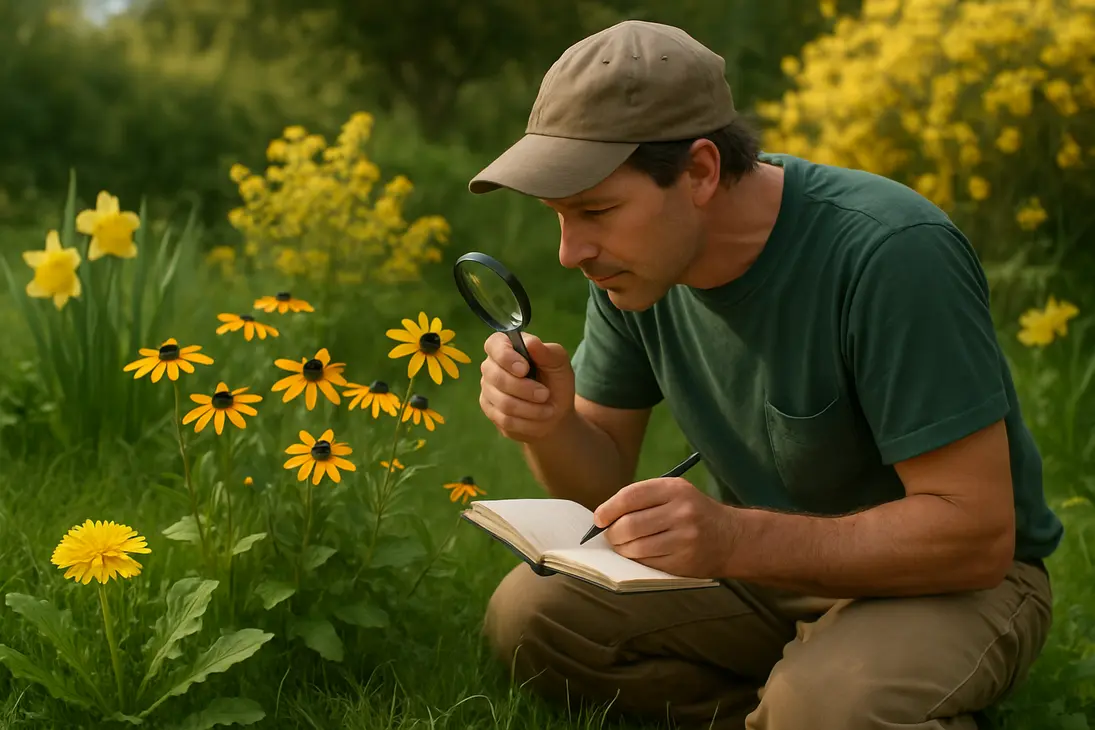
Yellow flower identification is easiest when you look beyond color. Many unrelated plants have yellow blooms, including dandelions, buttercups, daffodils, coreopsis, evening primrose, goldenrod, St. John’s wort, roses, forsythia, witch hazel, and yellow irises.
A reliable identification combines flower shape, leaves, stem, plant size, habitat, season, and location. A close-up of the blossom helps, but the whole plant usually gives the best answer.
Yellow Flower Identification Guide
Start With the Most Visible Clues
Begin with the obvious features before relying on an app or image search. Color narrows the field, but many yellow flowers look alike from a distance.
Stand back and note the whole plant. Is it a low lawn plant, tall meadow flower, shrub, vine, or garden bulb? Then look closely at the bloom’s shape, size, petal pattern, and whether flowers are single or clustered.
Flower shape and arrangement
Flower shape is one of the fastest ways to narrow the possibilities.
| Flower appearance | What to look for | Common examples |
|---|---|---|
| Daisy-like | Flat center with ray-like petals | Sunflower, coreopsis, black-eyed Susan, dandelion |
| Cup-shaped | Rounded open cup or bowl | Buttercup, tulip, California poppy |
| Trumpet-shaped | Tube flaring at the end | Daffodil, yellow trumpet vine, some lilies |
| Pea-like | Banner and wing-shaped petals | Scotch broom, wild peas, lupines |
| Star-shaped | Evenly spread star-like petals | Yellow star grass, some sedums |
| Clustered tiny flowers | Many small flowers grouped together | Goldenrod, yarrow, mustards |
Arrangement matters too. A single yellow head on a leafless stalk suggests different plants than many small flowers on branching stems. A spike, flat-topped cluster, drooping spray, or woody branch all point in different directions.
Number of petals or ray florets
Counting petals can help, but do not rely on it alone. Daisy-like flowers are often composite heads made of many tiny florets, and cultivated varieties may have extra petals.
Useful patterns include:
- Four petals in a cross shape: often mustard family plants.
- Five petals: possible buttercup, cinquefoil, St. John’s wort, or evening primrose.
- Six petal-like segments: common in bulbs and monocots such as daffodils, tulips, and lilies.
- Many narrow rays: possible dandelion, hawkweed, or other aster-family plants.
Petal count is most useful when paired with leaves, stems, and habitat.
Flower size and height of the plant
Estimate both flower width and plant height. A coin-sized yellow flower in a lawn is very different from a palm-sized bloom on a tall stalk.
Notice whether the stem is leafless, leafy, woody, branching, or vining. Also note whether the plant grows alone, in clumps, as a colony, or as a mat.
For example, dandelions usually have a single yellow head on a hollow, leafless stalk above toothed basal leaves. Black-eyed Susan has yellow rays around a dark cone on upright leafy stems. Goldenrod produces many tiny yellow flowers in branching clusters.
Single bloom vs. clusters
Check whether flowers appear alone or grouped. Single or nearly single blooms are common in daffodils, tulips, dandelions, evening primrose, poppies, and daylilies. Clustered blooms may suggest goldenrod, forsythia, yarrow, mustard family weeds, sedum, lantana, alyssum, or some shrubs and trees.
Also note whether flowers open all at once or in sequence. Daylilies may carry several buds, but each flower lasts only about a day. Goldenrod opens many tiny flowers along sprays.
Check the Leaves, Stem, and Growth Habit
Flowers attract attention, but leaves and stems are often more dependable for identification. If you ask for help online or use an identification app, include clear photos of leaves, stems, and the whole plant, not just the blossom.
Leaf shape, edges, and arrangement
Look at several leaves because lower, upper, young, and mature leaves may differ.
Record:
- Shape: round, oval, lance-shaped, heart-shaped, fern-like, grass-like, lobed, or divided
- Edges: smooth, toothed, wavy, spiny, or deeply cut
- Arrangement: opposite, alternate, whorled, or all from the base
- Surface: glossy, dull, hairy, waxy, rough, or bluish-green
- Attachment: stalked, clasping the stem, or forming a rosette
Dandelions have deeply toothed basal leaves and no true leaves on the flower stalk. Yellow wood sorrel has clover-like leaves and small five-petaled yellow flowers. Black-eyed Susan usually has rough, hairy leaves on upright stems.
Smooth, hairy, thorny, or milky stems
Stem texture is another strong clue. Observe carefully and avoid breaking the stem unless you know the plant is safe to handle.
Check whether the stem is smooth or hairy, hollow or solid, round or square, green or woody, thorny or prickly, milky when broken, and climbing, trailing, or upright.
Milky sap occurs in dandelions and some spurges, but that does not make them the same plant. Square stems may suggest the mint family. Thorny stems can point toward roses, barberry, or other woody shrubs.
Upright plant, vine, shrub, groundcover, or tree
Growth habit narrows the search dramatically. A woody shrub with yellow flowers will not be a dandelion, and a climbing vine will not be a daffodil.
Forsythia is a woody shrub with bright yellow flowers along bare or nearly bare branches in early spring. Yellow trumpet vine climbs and produces tubular flowers. Creeping Jenny is a low groundcover with rounded leaves and yellow flowers. Tulip poplar is a tree with yellow-green, tulip-shaped flowers.
Weed-like vs. cultivated garden plant
A weed is simply a plant growing where it is not wanted. A dandelion in a lawn may be unwanted, while the same plant may be tolerated in a pollinator-friendly garden.
Clues that a yellow flower may be a volunteer or weed include fast growth, spreading patches, many seeds, runners or taproots, growth in cracks or disturbed soil, and appearance without planting.
Cultivated plants are more likely in beds, rows, containers, or mulched areas, but garden plants can self-seed too. Calendula, coreopsis, black-eyed Susan, poppies, and sunflowers may all appear as volunteers.
Use Location, Season, and Habitat to Narrow the Match
A yellow flower photo can lead to different answers depending on where and when it was taken. Habitat, climate, and bloom season are essential clues.
Garden bed, lawn, roadside, meadow, wetland, or woodland
Consider the growing site:
- Lawn: dandelion, yellow wood sorrel, hawkweed, lesser celandine in some regions
- Garden bed: marigold, calendula, coreopsis, daylily, daffodil, rudbeckia
- Roadside or disturbed soil: wild mustard, evening primrose, mullein, broom, ragwort
- Meadow or prairie: goldenrod, black-eyed Susan, sunflower relatives
- Wetland or ditch: yellow iris, marsh marigold, some loosestrifes
- Woodland edge: celandine poppy, trout lily, yellow violet, spicebush in bloom
Moisture level is especially helpful. A yellow flower with sword-like leaves in wet soil could be yellow flag iris, which is invasive in many areas.
Spring, summer, or fall bloom time
Bloom time eliminates many possibilities.
| Bloom time | Yellow flowers often seen |
|---|---|
| Early spring | Daffodil, forsythia, winter aconite, lesser celandine, marsh marigold |
| Late spring | Buttercups, yellow iris, columbine, tulips, broom |
| Summer | Coreopsis, black-eyed Susan, sunflowers, daylilies, evening primrose, St. John’s wort |
| Late summer to fall | Goldenrod, sneezeweed, some sunflowers, yellow mums, late rudbeckias |
Climate affects timing, but season is still a strong clue when combined with plant form and habitat.
Native wildflower, garden ornamental, or invasive weed
A yellow flower may be native, cultivated, naturalized, or invasive depending on your region. Goldenrods are valuable native wildflowers in many parts of North America, though some spread vigorously in gardens. Yellow flag iris is attractive but invasive in many wetlands. Scotch broom has bright yellow pea-like flowers and is invasive in several regions. Lesser celandine can look cheerful in spring but is invasive in many places.
Before planting, moving, or encouraging an unknown yellow flower, check whether it is recommended for your area. Local extension offices, native plant societies, and regional invasive plant lists are often more reliable than general image searches.
Regional growing range
An identification suggestion is useful only if the plant grows where you are. If an app suggests a tropical shrub for a cold-climate roadside plant, be skeptical.
When asking for identification, include your country, state/province, or general region; whether the plant is wild, planted, or in a container; sun and soil conditions; and nearby habitat such as lawn, woods, water, or roadside. You do not need to share your exact address.
Compare Common Yellow Flower Types
Instead of memorizing hundreds of plants, sort the flower into a broad group first. Then compare leaves, height, habitat, and bloom time.
Daisy-like yellow flowers
Many daisy-like yellow flowers belong to the aster family. The “flower” is often a composite head made of many florets.
Common examples include:
- Dandelion: Low rosette, toothed leaves, hollow stalk, milky sap, single yellow head.
- Black-eyed Susan: Yellow rays around a dark cone, rough leaves, upright stems.
- Coreopsis: Often narrow or finely divided leaves, yellow daisy-like blooms.
- Sunflower: Large heads, rough leaves, tall stems, prominent central disk.
- Golden ragwort or groundsel relatives: Smaller yellow heads, often clustered.
A dark central cone suggests rudbeckia or a related plant. A flat yellow head without a dark center may point toward dandelion, hawkweed, or similar lawn and meadow plants.
Cup-shaped or buttercup-like yellow flowers
Cup-shaped yellow flowers include buttercups, poppies, tulips, and woodland wildflowers.
Look for petal texture, leaf shape, plant height, habitat, and whether the plant grows from bulbs, tubers, or fibrous roots. Buttercups often have shiny petals and divided leaves. Winter aconite blooms very early with a yellow cup surrounded by green bracts. California poppy has silky cups and finely divided blue-green foliage. Yellow tulips are larger bulb plants, usually in planted areas.
Trumpet-shaped yellow flowers
Trumpet-shaped flowers have a tube that flares outward. They are common in bulbs, vines, and some shrubs.
Examples include:
- Daffodil: Six outer petal-like segments and a central trumpet or cup.
- Yellow daylily: Funnel-shaped blooms, strap-like leaves, many buds.
- Yellow trumpet vine: Woody climbing vine with tubular flower clusters.
- Some lilies: Upright stems, showy blooms, alternate or whorled leaves.
Daffodils are recognizable by the central corona surrounded by six tepals. Daylilies form clumps of arching leaves and branching flower stalks. Trumpet vines climb and become woody.
Clustered yellow flowers
Clustered yellow flowers may look like plumes, sprays, domes, or flat-topped heads.
Common possibilities include:
- Goldenrod: Tall stems with branching clusters, usually late summer to fall.
- Yarrow: Flat-topped clusters with ferny foliage.
- Mustard family plants: Small four-petaled flowers in loose clusters.
- Sedum: Succulent leaves with starry yellow clusters.
- Lantana: Rounded clusters of small tubular flowers in warm climates.
Photograph both the whole cluster and one small flower close up. The individual flower structure is often the key.
Yellow flowering shrubs and trees
For woody plants, focus on leaves, bark, branching pattern, and bloom timing.
Common examples include:
- Forsythia: Bright yellow flowers on bare stems in early spring.
- Witch hazel: Strap-like yellow petals, often blooming in late fall, winter, or very early spring.
- Yellow roses: Thorny shrubs or climbers with compound leaves.
- Mahonia/Oregon grape: Evergreen holly-like leaves and yellow flower clusters.
- Golden chain tree: Hanging yellow pea-like flowers; parts are poisonous.
- Tulip poplar: Tall tree with yellow-green, tulip-shaped flowers.
Include photos of leaves, bark, the whole plant, and any fruit or seed pods.
Take Better Photos for Accurate Identification
One close-up often produces conflicting answers. A useful photo set shows the flower, leaves, stem, whole plant, and habitat.
Photograph the whole plant
Start with the entire plant, including the base if possible. This shows height, branching, growth habit, and whether the plant is alone or part of a patch.
A whole-plant photo helps distinguish rosettes from upright plants, shrubs from perennials, vines from groundcovers, and bulbs from seeded annuals.
Take close-ups of the flower, leaves, and stem
Take focused photos of:
- Flower front
- Flower side view
- Buds
- Back of the flower head
- Upper and lower leaves
- Leaf attachment
- Stem texture
- Thorns, hairs, sap, seed pods, or fruit
The side view can reveal a trumpet, spur, bracts, sepals, or how the flower attaches to the stem.
Include scale and growing location
Scale prevents confusion. Use a coin, ruler, garden label, pencil, or your hand if the plant is safe to touch.
Also include a wider photo of the setting: lawn, sidewalk crack, vegetable bed, woodland edge, ditch, meadow, or container. Habitat helps rule out unlikely matches.
Use plant ID apps, websites, or local extension services
Plant ID apps are helpful starting points, not final answers. They may miss regional range, growth stage, toxicity, hybrids, or subtle leaf differences.
For better results, upload several photos, compare suggestions with leaves and stems, check whether the plant grows in your region, search the scientific name, and confirm with a local expert if the plant may be toxic, invasive, edible, or hard to remove.
Local extension services, master gardener programs, native plant groups, and botanical gardens are often better for regional weeds, natives, and invasives.
Confirm with scientific names when possible
Common names can be vague. “Yellow daisy,” “buttercup,” “wild sunflower,” and “golden flower” may refer to many plants.
Scientific names are more precise. “Black-eyed Susan” often refers to Rudbeckia hirta, but related species and cultivars can look similar. “Goldenrod” includes many Solidago species. “Buttercup” may refer to various Ranunculus species.
Confirm the scientific name before eating, planting, spraying, removing, or recommending the plant.
Watch for Toxic or Easily Confused Yellow Flowers
Do not assume a yellow flower is safe because it is attractive or common. Some are toxic to people, pets, or livestock; others irritate skin or spread aggressively.
Yellow flowers that may be poisonous
Risk depends on the plant, plant part, amount eaten, and who or what ate it. Use caution with:
- Daffodil: Bulbs are toxic and may be mistaken for onions.
- Yellow oleander: Highly toxic.
- Oleander with yellow cultivars or related yellow forms: All parts of oleander are poisonous.
- Buttercups: Many fresh Ranunculus species can irritate the mouth and digestive tract.
- Yellow flag iris: Can irritate skin, is toxic if eaten, and is invasive in many wet areas.
- Golden chain tree: Seeds and other parts are poisonous.
- St. John’s wort: Can affect livestock and may interact with medications if used medicinally.
If children, pets, or livestock may access an unknown plant, identify it before leaving it in place. If ingestion is suspected, contact a veterinarian, poison control center, or medical professional.
Lookalikes that are commonly mistaken for each other
Common yellow-flower mix-ups include:
- Dandelion vs. cat’s ear/hawkweed: Dandelions have hollow, leafless stalks and basal rosettes; cat’s ear and hawkweed often have branched or hairy stems.
- Goldenrod vs. ragweed: Goldenrod has showy yellow clusters; ragweed has less noticeable greenish flowers and is a major pollen source.
- Buttercup vs. lesser celandine: Both can have shiny yellow spring flowers; lesser celandine often forms dense mats with rounded or heart-shaped leaves.
- Daffodil bulbs vs. edible bulbs: Daffodil bulbs can resemble onions to beginners but are toxic.
- Yellow iris vs. daylily: Iris flowers have distinct falls and standards; daylilies are funnel-shaped and grow from clumping foliage.
Leaves, stems, habitat, and bloom time usually reveal the difference.
When not to touch, eat, or remove a plant without confirmation
Pause before handling an unknown yellow flower if it has irritating sap, grows in a wetland or protected area, may spread by fragments or rhizomes, could be toxic to pets or children, resembles a toxic plant, or is on public land or someone else’s property.
For suspected invasive plants, confirm the species and local control method before pulling, mowing, digging, or composting.
Conclusion
Yellow flower identification works best when you combine clues instead of relying on color alone. Start with flower shape, petal pattern, size, and whether blooms are single or clustered. Then check leaves, stems, sap, thorns, and growth habit. Add context: where it grows, when it blooms, whether it appears planted or wild, and what plants are common in your region.
If you need help, provide clear photos of the whole plant, flower, leaves, stem, scale, and habitat. Whenever possible, confirm the scientific name, especially before eating, removing, planting, or allowing pets and livestock near the plant.
FAQ
What is the easiest way to identify a yellow flower?
Sort it into a broad type first: daisy-like, cup-shaped, trumpet-shaped, clustered, shrub, vine, or tree. Then compare leaves, stem, height, bloom season, and habitat. Color alone is rarely enough.
Can I identify a yellow flower from a picture?
Sometimes, especially if the plant is common and the photo is clear. For better accuracy, use several photos: whole plant, flower front and side, leaves, stem, and growing location. Check app suggestions against regional range and plant details.
What details should I include when asking someone to identify a flower?
Include your general location, season, habitat, plant height, flower size, leaf photos, stem photos, and whether it is wild or planted. Mention milky sap, thorns, hairy stems, fragrance, seed pods, or spreading growth.
How can I tell if a yellow flower is a weed or a garden plant?
A weed is a plant growing where it is not wanted. Clues include rapid spreading, growth in lawns or disturbed soil, many seedlings, taproots, runners, or appearance where you did not plant it. However, some “weeds” are useful native or pollinator plants, and some ornamentals can become invasive. Identify the plant before deciding whether to keep or remove it.
You Might Also Like