Can Non-Carnivorous Plants Adapt Carnivorous Traits?
Non-carnivorous plants can adapt in impressive ways, but they do not usually “turn into” carnivorous plants the way gardeners might imagine. A tomato, fern, oak seedling, pepper plant, or houseplant will not start digesting insects during its lifetime because the soil is poor or pests are present.
What can happen over evolutionary time is more subtle. Some non-carnivorous plants already have traits that resemble early steps toward carnivory: sticky hairs, cupped leaves, water-holding structures, or limited nutrient absorption through leaves. In certain habitats, if those traits help a plant gain nutrients and reproduce better, natural selection may gradually favor more specialized versions.
So the short answer is: non-carnivorous plants adaptation can include traits that look “pre-carnivorous,” but true carnivory requires a specific combination of trapping, digestion, nutrient absorption, and ecological benefit.
What Adaptation Means for Non-Carnivorous Plants
Plant adaptation means a plant population changes over generations in ways that help it survive and reproduce. It does not mean an individual plant consciously changes strategy. A basil plant stressed by poor soil may grow smaller leaves or fewer flowers, but it will not evolve a Venus flytrap-style trap in one season.
Most non-carnivorous plants adapt through ordinary plant structures and life strategies, including:
- Roots that grow deeper, wider, thicker, or more finely branched.
- Leaves that become waxy, hairy, narrow, succulent, deciduous, or shade-tolerant.
- Growth habits such as climbing, creeping, forming rosettes, going dormant, or growing rapidly after rain.
- Reproductive strategies such as wind-dispersed seeds, fleshy fruits, bulbs, or long-lived seed banks.
- Stress tolerance for drought, cold, heat, salt, flooding, pests, grazing, or low fertility.
For gardeners, plant success is usually about matching the plant to the site. Carnivory is only one possible adaptation, and it is highly specialized.
Why Carnivorous Traits Evolve in Some Plants
Carnivorous plants are specialists. Their traps, pitchers, sticky leaves, or suction bladders help them survive where many common plants struggle to obtain enough mineral nutrients from the soil.
These habitats are often wet, acidic, sandy, or otherwise poor in available nitrogen and phosphorus. The plant still makes sugars through photosynthesis, but prey supplies nutrients that roots cannot easily obtain.
Nutrient-poor soils and reduced root function
Many carnivorous plants grow where soil contains little available nitrogen or phosphorus. This does not always mean there is no organic matter. Bogs may contain partially decomposed plant material, but nutrients can be locked up or released slowly.
In these conditions, roots may not supply enough nutrients. Some carnivorous plants have relatively simple or reduced root systems compared with non-carnivorous plants in fertile ground. Their roots may mainly anchor the plant and absorb water, while leaves take on more of the nutrient-gathering role.
That trade-off makes sense only in certain environments. In a rich garden bed, a plant with strong roots and broad photosynthetic leaves usually has the advantage.
Wet bogs, acidic soils, and harsh growing conditions
Classic carnivorous plant habitats include peat bogs, acidic wetlands, seeps, wet sandy soils, nutrient-poor savannas, rocky or seasonally wet habitats, and low-nutrient aquatic environments.
These places can be difficult for ordinary plants. Wet soils may have low oxygen around roots. Acidic conditions can slow decomposition and affect nutrient availability. Sandy soils often hold few nutrients.
Carnivorous plants solve part of this problem by getting nutrients from insects and other small organisms. Sundews trap tiny insects on sticky leaves. Pitcher plants collect prey in fluid-filled pitchers. Venus flytraps snap shut on suitable prey. Bladderworts use tiny suction traps.
The shared theme is not that these plants “prefer meat.” It is that animal prey can supply nutrients the soil does not.
Why insects become a nutrient supplement, not an energy source
A common misconception is that carnivorous plants eat insects the way animals eat food. They do not.
Carnivorous plants still rely on photosynthesis for energy. Sunlight, carbon dioxide, and water allow them to produce sugars. Insects provide mostly mineral nutrients, especially nitrogen and phosphorus.
| Plant need | Main source in carnivorous plants |
|---|---|
| Energy/sugars | Photosynthesis |
| Carbon for growth | Carbon dioxide from air |
| Water | Roots or surrounding water |
| Nitrogen and phosphorus | Soil plus captured prey |
| Trace minerals | Soil/water plus prey |
This is why a Venus flytrap kept in darkness will not survive just because it catches insects. It needs light. Likewise, feeding insects to a normal houseplant will not fix low light, overwatering, compacted soil, or root disease.
Possible “Pre-Carnivorous” Traits in Non-Carnivorous Plants
Some plants have features that trap insects or collect organic matter without being fully carnivorous. These are sometimes called “protocarnivorous” or “sub-carnivorous” traits, although scientists do not always draw the boundary in the same place.
To be considered truly carnivorous, a plant generally needs more than accidental insect capture. It should gain a measurable benefit from prey through digestion and nutrient absorption.
Sticky or glandular leaves that trap insects accidentally
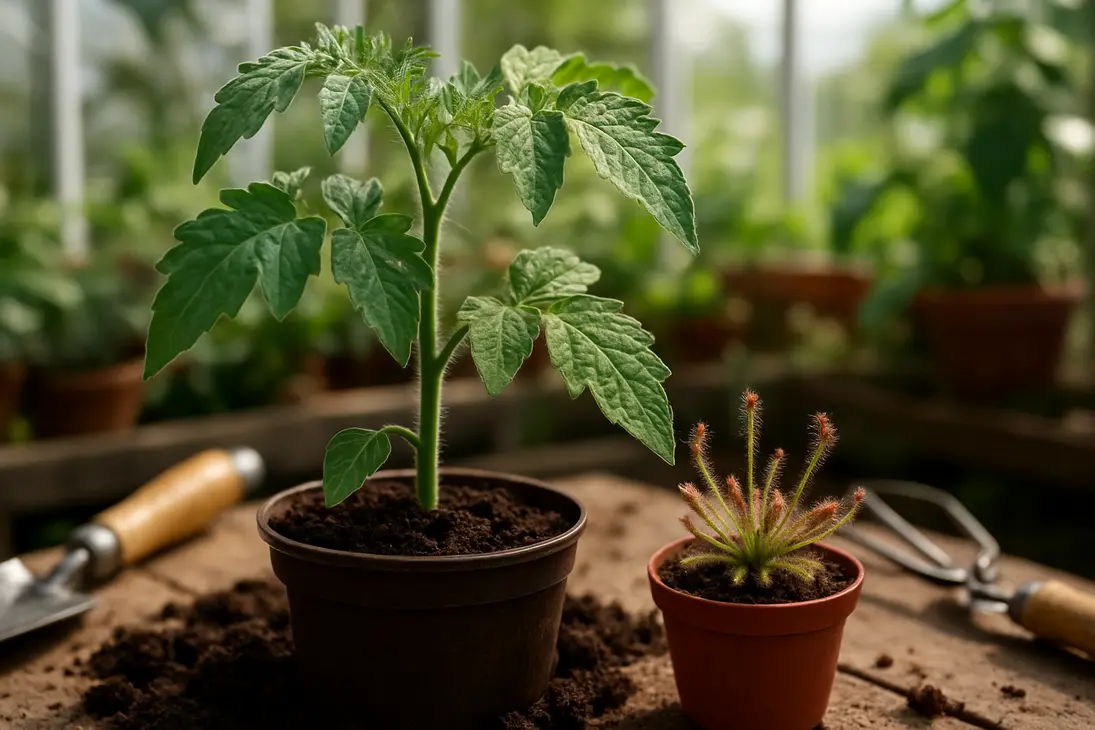
Many non-carnivorous plants have sticky or glandular hairs. Gardeners may see this on tomatoes, petunias, tobacco relatives, geraniums, and some herbs. These sticky surfaces may deter pests, reduce feeding damage, or trap small insects incidentally.
But a sticky plant is not automatically carnivorous.
A tomato leaf can catch gnats or aphids, but the tomato is not considered carnivorous because it lacks a specialized system for digesting prey and absorbing nutrients the way a sundew does. The sticky hairs are mainly protective, not nutritional.
If your pepper or tomato plant has insects stuck to its leaves, it is not “adapting to eat bugs.” It is more likely showing normal leaf texture, pest pressure, spray residue, or honeydew from insects such as aphids or whiteflies.
Leaf shapes that collect water, debris, or small organisms
Some non-carnivorous plants have leaf arrangements that collect rainwater, leaf litter, pollen, dust, dead insects, or small organisms. Cupped leaves, rosettes, overlapping leaf bases, and tank-like structures can all create small reservoirs of organic material.
Bromeliads are a familiar example. Many form central cups that hold water and debris. Microbes and small animals may live in those tanks, and nutrients released from decomposing material may become available to the plant. Most bromeliads are not considered truly carnivorous, but they show how leaves can participate in nutrient capture without becoming strict traps.
Foliar nutrient absorption from organic matter
Leaves are not just solar panels. In some plants, leaves can absorb small amounts of dissolved nutrients through their surfaces, especially when nutrients are in solution. This is why foliar feeding can sometimes green up deficient plants quickly, though it does not replace healthy soil and roots.
In nature, nutrients on leaves may come from rainwater, dust, pollen, decomposing particles, bird droppings, insect waste, microbes, or dead insects caught in hairs or leaf axils.
A plant that absorbs a little nitrogen from material on its leaves is not necessarily carnivorous. The key question is whether it has evolved a reliable prey-capture and nutrient-use system that improves growth or reproduction.
Still, foliar absorption helps explain how carnivory could evolve gradually. A plant does not need to jump from “ordinary leaf” to “complex trap” in one step.
Partnerships with microbes, fungi, or animals for nutrient access
Plants rarely act alone. Non-carnivorous plants often rely on partnerships to obtain nutrients:
- Mycorrhizal fungi help roots access phosphorus and water.
- Nitrogen-fixing bacteria partner with legumes and some other plants.
- Leaf-surface microbes may help break down organic residues.
- Animals may bring nutrients through droppings, nesting material, or movement of organic matter.
This creates a gray area. A plant can benefit from animal-derived nutrients without being a true carnivore. For gardeners, soil life, compost, mulch, and habitat diversity are usually much more relevant to non-carnivorous plant health than insects as “food.”
How Non-Carnivorous Plants Survive Without Eating Insects
Most plants do perfectly well without capturing prey because they have other ways to meet their needs. Their survival depends on light, water, carbon dioxide, roots, soil organisms, and a good match between plant and environment.
Carnivorous plants are fascinating, but they are not a superior version of plant life. A sunflower, sedge, maple, cactus, lavender, lettuce, or native grass has its own survival strategy.
Photosynthesis remains the main source of energy
All green plants, including carnivorous ones, depend on photosynthesis. Non-carnivorous plants use sunlight to make sugars, then use those sugars to build leaves, stems, roots, flowers, seeds, storage organs, and defensive compounds.
This is why light is often the first thing to check when a plant is weak. A plant that is not getting enough light cannot make enough energy, no matter how much fertilizer or compost is added. Conversely, a shade-adapted plant in harsh afternoon sun may scorch because its leaves are not built for that exposure.
In gardens and homes, many problems blamed on “poor feeding” are actually light or watering problems.
Roots, mycorrhizae, and soil nutrient uptake
Roots are the main nutrient-gathering organs for non-carnivorous plants. They absorb water and dissolved minerals from the soil, and many work with fungi and bacteria to improve access to nutrients.
Healthy soil supports this process by providing pore space, organic matter, gradual nutrient release, good drainage, suitable pH, and protection from compaction or waterlogging. Mycorrhizal fungi are especially important for many plants because they extend beyond the root surface and help access phosphorus and moisture.
For gardeners, improving root conditions is usually more useful than unusual feeding tricks. If a plant is struggling, check:
- Is the soil staying too wet or too dry?
- Are roots cramped in a container?
- Is the potting mix old, compacted, or hydrophobic?
- Is the plant adapted to the soil pH?
- Has fertilizer built up as salts?
- Is mulch helping or smothering the crown?
Drought, shade, salt, pest, and poor-soil adaptations
Non-carnivorous plants have evolved many strategies that are just as remarkable as carnivory.
Drought-adapted plants may have thick succulent leaves, waxy coatings, small leaves, deep roots, silver hairs, or the ability to go dormant. Cacti reduce leaves to spines and store water in stems. Many Mediterranean herbs, such as rosemary and lavender, prefer lean, well-drained soils and can suffer in rich, wet beds.
Shade-adapted plants often have broader, thinner leaves that capture limited light efficiently. Salt-tolerant plants may exclude salt at the roots, store it in older tissues, or excrete it through specialized glands. Pest-resistant plants may produce bitter compounds, tough leaves, hairs, latex, resins, thorns, or growth patterns that help them recover after damage.
Poor-soil plants may grow slowly, conserve nutrients in long-lived leaves, form strong fungal partnerships, or time growth to brief periods when nutrients are available. Carnivory is only one branch of plant survival.
Native plants and local environmental resilience
Native plants are often good examples of successful non-carnivorous adaptation. A locally native plant has evolved within the climate, soils, seasonal patterns, insects, and ecological relationships of its region. That does not mean every native plant will thrive in every yard, but the right native plant in the right site can be resilient with less intervention.
A dry prairie plant may handle lean soil and summer drought better than a moisture-loving ornamental. A woodland native may grow well under deciduous trees where turfgrass struggles. A wetland-edge plant may tolerate seasonal flooding that would rot many garden perennials.
This kind of adaptation is more useful to most gardeners than thinking about carnivory. If a plant is well matched to its site, it does not need to “eat insects” to survive.
Why Most Non-Carnivorous Plants Do Not Become Carnivorous
Carnivory sounds like an advantage, but it comes with costs. A plant benefits from carnivorous traits only if the nutrients gained from prey outweigh the energy, space, and structural costs of making traps and digestive systems.
In fertile soil, carnivory would usually be unnecessary or even disadvantageous. A plant that can get nitrogen and phosphorus through roots does not need to sacrifice leaf area or energy to catch insects.
Carnivorous structures can reduce photosynthetic area
Leaves are valuable because they capture light. When a leaf becomes a trap, pitcher, sticky surface, or snap mechanism, it may lose some efficiency as a normal photosynthetic leaf.
Pitcher leaves may still photosynthesize, but their form is shaped for prey capture. Venus flytrap leaves combine photosynthesis with trapping, but the trap is a specialized investment. Sundews cover leaves with sticky glands, which require resources to build and maintain.
For a plant in nutrient-rich soil and strong competition, broad efficient leaves may be the better strategy. Growing fast and shading competitors can matter more than catching an occasional insect.
Digestive enzymes and traps require energy
True carnivory is not just passive insect death. Many carnivorous plants produce sticky secretions, trap fluids, attractants, digestive enzymes, or responsive movements. Some maintain specialized surfaces that absorb released nutrients.
These features require energy and nutrients. They also carry risks:
- Traps may catch too little prey to pay for themselves.
- Digestive tissues may be damaged or infected.
- Trap leaves may be shorter-lived.
- Energy used for traps cannot be used for roots, flowers, seeds, or ordinary leaves.
- Insects may be more valuable as pollinators than as prey if traps are poorly placed or timed.
Carnivorous plants often manage this balance carefully. Many separate flowers from traps physically or seasonally to reduce the chance of trapping pollinators.
Carnivory is useful only in specific habitats
Carnivory works best where three conditions overlap:
- Soil nutrients are limited, especially nitrogen or phosphorus.
- Light is available, because photosynthesis still powers the plant.
- Prey is available often enough to provide a nutrient benefit.
A dark forest floor with poor soil is not automatically ideal for carnivory because low light limits photosynthesis. A rich vegetable bed is not ideal because roots can get nutrients more cheaply. A dry desert may have insects, but maintaining sticky traps or water-filled pitchers may be too costly for many plants.
This is why carnivorous plants are common in some bogs, seeps, and wet sandy habitats but not everywhere. They are not simply plants that “learned to eat bugs.”
Adaptation is gradual, not an individual plant “deciding” to change
A normal plant cannot become carnivorous during its lifetime. Individual plants can respond to stress by changing growth patterns: producing smaller leaves, growing deeper roots, dropping leaves, flowering early, or entering dormancy. These are plastic responses, not the evolution of a new feeding system.
Evolution happens across generations. If a population contains variation—such as slightly stickier leaves or slightly better foliar nutrient absorption—and those individuals produce more offspring in a nutrient-poor habitat, those traits may become more common.
A simplified pathway might look like this:
| Stage | Possible trait | Benefit |
|---|---|---|
| Ordinary non-carnivorous plant | Glandular or hairy leaves | Pest defense |
| Incidental insect capture | Small insects stick to leaves | Organic residue near leaf |
| Better nutrient absorption | Leaves absorb dissolved nutrients | Slight growth benefit |
| More specialized trapping | Leaf shape or secretions improve prey capture | More reliable nutrient gain |
| True carnivory | Digestion and absorption are integrated | Prey nutrients improve survival and reproduction |
Real evolutionary paths vary, but this shows why carnivory is plausible over evolutionary time and unrealistic as a short-term response in a garden plant.
Conclusion
Non-carnivorous plants adapt constantly, but usually through roots, leaves, timing, partnerships, defenses, and stress tolerance—not by becoming carnivorous. Sticky leaves, cupped growth, foliar absorption, and microbial relationships can resemble early steps toward carnivory, yet they do not automatically make a plant carnivorous.
True carnivory evolves only when the trade-off makes sense: the plant must live where soil nutrients are scarce, light is sufficient, prey is available, and specialized traps or digestive systems provide more benefit than cost.
For gardeners, the practical takeaway is simple. If a normal plant is struggling, it does not need insects as food. It needs the right light, water, soil, root space, nutrients, and environmental match.
FAQ
Do carnivorous plants still photosynthesize?
Yes. Carnivorous plants still photosynthesize and depend on sunlight for energy. Insects provide mineral nutrients, especially nitrogen and phosphorus, but they do not replace light. A carnivorous plant kept in poor light will decline even if it catches prey.
Can a normal plant become carnivorous during its lifetime?
No. A non-carnivorous plant cannot become truly carnivorous during its own lifetime. It may respond to stress by changing growth, flowering, root development, or leaf size, but carnivory requires inherited structural and physiological traits that evolve over many generations.
What nutrients do carnivorous plants get from insects?
Carnivorous plants mainly gain nitrogen and phosphorus from insects and other small prey. They may also obtain potassium, sulfur, and trace minerals in smaller amounts. The plant still gets its carbon from carbon dioxide through photosynthesis.
Are sticky non-carnivorous plants considered carnivorous?
Not usually. Many non-carnivorous plants have sticky or glandular leaves that trap insects accidentally or help defend against pests. To be considered truly carnivorous, a plant must do more than catch insects; it must digest or otherwise break down prey, absorb nutrients, and gain a clear benefit from that nutrient source.
You Might Also Like