How to Prepare NPK Fertilizer Without Precipitation
Clear NPK fertilizer depends on two things: compatible salts and a concentration they can tolerate. Cloudiness, sediment, grit, or crystals usually mean a salt exceeded its solubility limit or ions reacted to form an insoluble compound.
This matters for containers, fertigation, hydroponics, nurseries, and foliar-type applications. A formula can look correct on paper but fail in the bucket if calcium, phosphate, sulfate, micronutrients, pH, temperature, or hard water are ignored.
Start With the Target NPK Ratio and Chemical Sources
Before weighing ingredients, decide your target N-P-K analysis and whether you are making a concentrated stock solution or a ready-to-use working solution. A weak working solution may stay clear even when the same ingredients would precipitate in a strong stock tank.
Convert NPK percentages into actual nutrient amounts
Fertilizer labels do not express all NPK numbers as elemental nutrients:
- N = elemental nitrogen
- P = expressed as phosphate, P₂O₅
- K = expressed as potash, K₂O
A 10-10-10 fertilizer contains 10% N, 10% P₂O₅, and 10% K₂O—not 10% elemental phosphorus and potassium.
Useful conversions:
| Conversion | Approximate factor |
|---|---|
| P to P₂O₅ | multiply by 2.29 |
| P₂O₅ to P | multiply by 0.44 |
| K to K₂O | multiply by 1.20 |
| K₂O to K | multiply by 0.83 |
For liquids, decide the actual concentration in water, not only the ratio. A 3-1-2 fertilizer can be mild or excessive depending on grams per liter.
Match common soluble sources to N, P, and K
Choose fertilizer salts for nutrient content and compatibility.
| Fertilizer source | Supplies | Key compatibility note |
|---|---|---|
| Calcium nitrate | N, calcium | Keep away from concentrated phosphates and sulfates |
| Potassium nitrate | N, K | Generally compatible |
| Urea | N | Very soluble; supplies no P, K, or calcium |
| MAP | N, P | Avoid concentrated calcium mixes |
| MKP | P, K | Incompatible with calcium in stock |
| Potassium sulfate | K, sulfur | Can precipitate with calcium |
| Magnesium sulfate | magnesium, sulfur | Keep separate from calcium in strong stocks |
| Potassium chloride | K | Avoid for chloride-sensitive plants |
For a simple clear calcium-free NPK fertilizer, potassium nitrate plus monopotassium phosphate is often a practical starting point. If calcium is required, use a separate stock solution.
Check whether secondary nutrients or micronutrients are included
Plants may also need calcium, magnesium, sulfur, iron, manganese, zinc, copper, boron, molybdenum, and other trace elements. These increase precipitation risk.
Common problems include calcium reacting with phosphate or sulfate, iron and other metals precipitating at high pH, magnesium contributing to deposits, and tiny micronutrient doses being overapplied. If using a micronutrient mix, check whether it is chelated and whether the label gives a suitable pH range.
Why Precipitation Happens in NPK Fertilizer Solutions
Precipitation does not mean fertilizer is stronger. It means nutrients have formed solids or crystals that may be less available and can clog sprayers, filters, and drip emitters.
Low solubility at high concentration
Every fertilizer salt has a solubility limit. Below that limit it dissolves; above it, some remains undissolved or reappears as crystals after cooling or evaporation.
Concentrated stocks are most vulnerable. A recipe that dissolves in 10 liters may fail in 1 liter. Warning signs include crystals on the bottom, deposits at the waterline, grit after sitting overnight, or sediment after cooling.
If oversaturation is the only issue, adding more water is usually the simplest correction.
Incompatible ions, especially calcium with phosphate or sulfate
Some ions form low-solubility compounds when they meet. The classic incompatibilities are:
- Calcium + phosphate → calcium phosphate precipitate
- Calcium + sulfate → calcium sulfate, or gypsum
- Calcium + carbonate or bicarbonate → calcium carbonate scale
- Iron or other metals + phosphate → insoluble metal phosphates under some conditions
This is why calcium nitrate and monopotassium phosphate are commonly kept in separate stock tanks. Each may dissolve perfectly alone, yet turn cloudy when combined at high concentration. At low working strength, after dilution in irrigation water, the same nutrients may coexist well enough for immediate use.
pH shifts that cause micronutrients to fall out
Iron, manganese, copper, and zinc are more likely to precipitate or become unavailable when the solution becomes too alkaline.
A solution can look clear at first and then turn cloudy after pH adjustment if a strong base is added too fast. Local high-pH zones can precipitate metals before the container is evenly mixed.
To reduce risk:
- Dissolve main salts first.
- Add micronutrients at recommended rates.
- Adjust pH slowly with stirring.
- Avoid large pH swings.
- Do not pour concentrated acid or alkali onto undissolved fertilizer.
Temperature and water-quality effects
Cold water slows dissolution and may hold less fertilizer in solution. A batch mixed warm can crystallize later in a cold shed.
Water quality also matters. Hard water contains calcium, magnesium, bicarbonates, and carbonates that can react with phosphate, sulfate, and micronutrients. High-alkalinity water can push pH upward and destabilize metals.
For sensitive formulas, use clean low-mineral water when practical, such as rainwater, reverse osmosis water, distilled water for small batches, or suitable low-mineral tap water.
Compatible Mixing Strategies for Clear NPK Fertilizer
Treat fertilizer preparation as a sequence, not a dump-and-stir task. Good order cannot overcome incompatible chemistry, but it prevents many avoidable failures.
Use clean, low-mineral water when possible
Start with water in the container before adding fertilizer. Do not pour water onto a pile of dry salts in a small volume and expect even dissolution.
Use room-temperature water when possible. Very hot water is usually unnecessary and can create handling risks; very cold water slows dissolving.
Dissolve each ingredient separately before combining
Dissolve one salt completely before adding the next. If unsure about compatibility, dissolve each ingredient separately and combine small samples in a jar test.
A simple calcium-free mixing order is:
- Add most of the final water volume.
- Dissolve the nitrogen source, such as potassium nitrate or urea.
- Dissolve any separate potassium source.
- Dissolve the phosphate source, such as monopotassium phosphate.
- Add compatible magnesium sulfate or micronutrients if needed.
- Top up to final volume.
- Check clarity and pH.
Do not add new ingredients while granules remain on the bottom. Undissolved piles create concentrated zones where precipitation is more likely.
Add phosphates and sulfates carefully
Phosphates and sulfates are useful, but they are frequent precipitation partners. Be cautious if the formula includes calcium nitrate, calcium chloride, gypsum, hard water, micronutrient metals, or alkaline pH adjusters.
If phosphate or sulfate causes cloudiness, do not assume it will fix itself. Fine haze may later become visible sediment.
Keep calcium-containing ingredients in a separate stock solution
Calcium is the ingredient most likely to require a two-part system. If the formula needs calcium nitrate, keep it in an A stock and keep phosphates and sulfates in a B stock.
| Stock solution | Usually contains | Usually avoids |
|---|---|---|
| A stock | Calcium nitrate, sometimes chelated iron | Phosphates and sulfates |
| B stock | Phosphates, sulfates, potassium nitrate, magnesium sulfate, most micronutrients | Calcium salts |
The two concentrates are not mixed together. Each is diluted into irrigation water, where ion concentrations are much lower.
Use A/B stock tanks for concentrated formulas
For concentrated fertilizer, assume A/B separation may be needed. This is standard in many hydroponic and fertigation systems because it prevents calcium from meeting concentrated phosphate or sulfate.
The key rule is: concentrated calcium stock should not meet concentrated phosphate or sulfate stock.
For home use, this may be as simple as two labeled bottles:
- Bottle A: calcium nitrate solution
- Bottle B: phosphate/sulfate/potassium/magnesium solution
When feeding, add Bottle A to the full watering volume and stir. Then add Bottle B and stir again. Never pour A and B directly into each other.
Adjust pH only after the salts are fully dissolved
Adjust pH near the end. If you adjust first, later salts may shift it again and increase precipitation risk.
Use a calibrated pH meter or reliable test method when pH matters. Add pH adjuster gradually with stirring. Strong acids and bases can damage skin, eyes, surfaces, and plants, so use proper protection and avoid unknown chemicals.
For soil-grown plants, exact pH adjustment of every batch is often less important than avoiding excess salts. For hydroponics, pH control is much more important.
Practical Preparation, Testing, and Troubleshooting
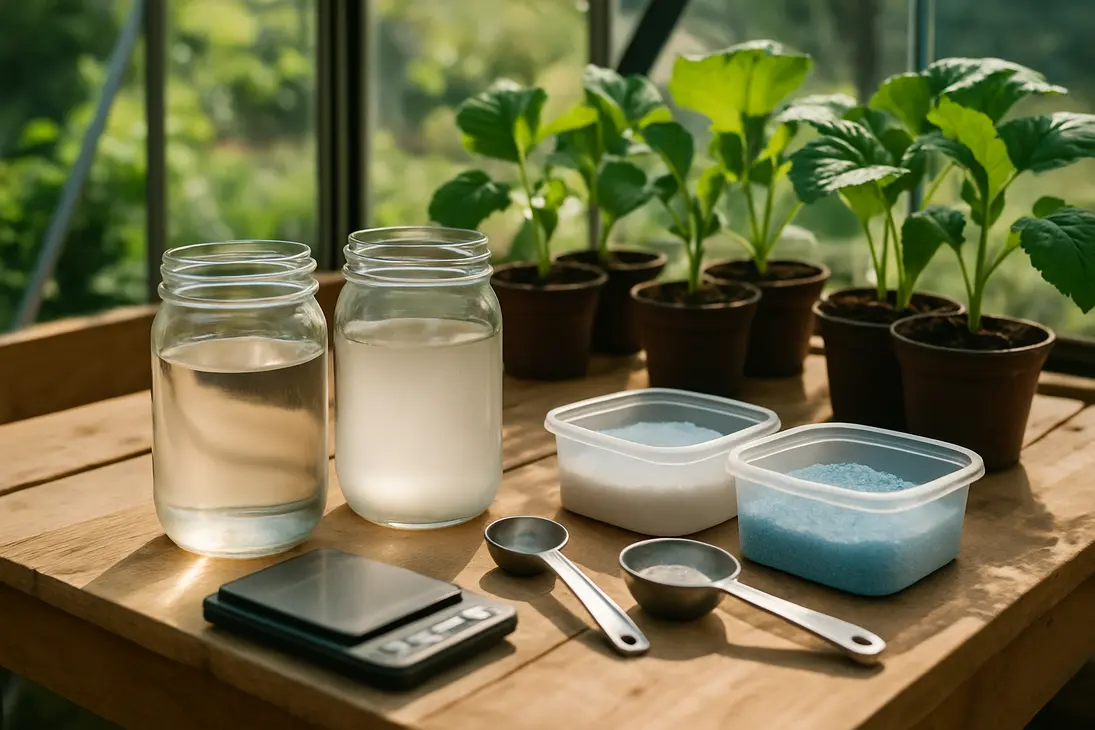
A jar test can save a full stock tank. It helps identify whether the problem is the recipe, water, concentration, or order of addition.
Make a jar test before preparing a full batch
Before making a large batch, prepare a small version at the same concentration and with the same water.
- Label a clean jar with the recipe and date.
- Add the scaled-down water volume.
- Add ingredients in the planned order.
- Stir until each dissolves before adding the next.
- Let it sit several hours, preferably overnight.
- Check for haze, crystals, films, or sediment.
- If useful, compare tap water with low-mineral water.
If the jar test fails, do not scale up. Change one variable at a time: dilute more, use different water, separate calcium, change mixing order, or choose a different nutrient source.
Filter or remake solutions that form sediment
If sediment is only undissolved fertilizer from poor mixing, stirring and dilution may help. If it is a true precipitate, filtering removes solids but does not restore the original nutrient balance. Some nutrients are now trapped in the residue.
Filtering may be acceptable for a noncritical ornamental feed, but it is risky for hydroponics or precision fertigation. In those cases, remake the solution correctly.
Never pour gritty fertilizer into drip lines or fine sprayers.
Dilute if crystals appear from oversaturation
Crystals in an otherwise compatible solution usually indicate oversaturation or cooling. Add water gradually, stir, and see whether the crystals redissolve.
If they dissolve and the batch stays clear, the formula was probably too concentrated. If dilution does not help, suspect chemical incompatibility.
Record weights, water volume, order of addition, pH, and final clarity
Good notes prevent repeated mistakes. Record fertilizer chemicals and grade, ingredient weights, water volume, water source, order of addition, water temperature, pH before and after adjustment, and clarity after 1 hour and 24 hours.
Small differences matter. Distilled water may stay clear while hard tap water clouds the same formula. A warm batch may crystallize after a cold night.
Safe Use: Avoiding Over-Fertilization and Plant Damage
A clear solution is not automatically safe. It may be compatible but still too strong.
Many plant problems come from applying fertilizer too often or too concentrated, especially in containers where salts accumulate quickly.
Start with a diluted working solution
When using a homemade NPK solution for the first time, start weaker than expected and test it on a small group of plants.
Be cautious with seedlings, transplants, drought-stressed plants, small pots, orchids, succulents, salt-sensitive plants, and plants already in fertilized potting mix.
Do not assume more fertilizer means better growth. Extra salts can injure roots, upset nutrient balance, and build up in the growing medium.
Watch for fertilizer burn symptoms
Fertilizer burn can resemble drought, disease, or heat stress. Symptoms soon after feeding often point to excess salts.
| Symptom | Possible meaning |
|---|---|
| Brown tips or margins | Salt stress or root injury |
| Wilting in moist soil | Damaged roots |
| Yellowing or scorched patches | Nutrient imbalance or burn |
| White crust on soil | Salt accumulation |
| Sudden decline after repeated feeding | Over-fertilization likely |
Containers are most vulnerable, but lawns, raised beds, and garden beds can also be damaged by repeated high applications.
Flush the growing medium if too much fertilizer was applied
If you overapply liquid fertilizer, stop fertilizing.
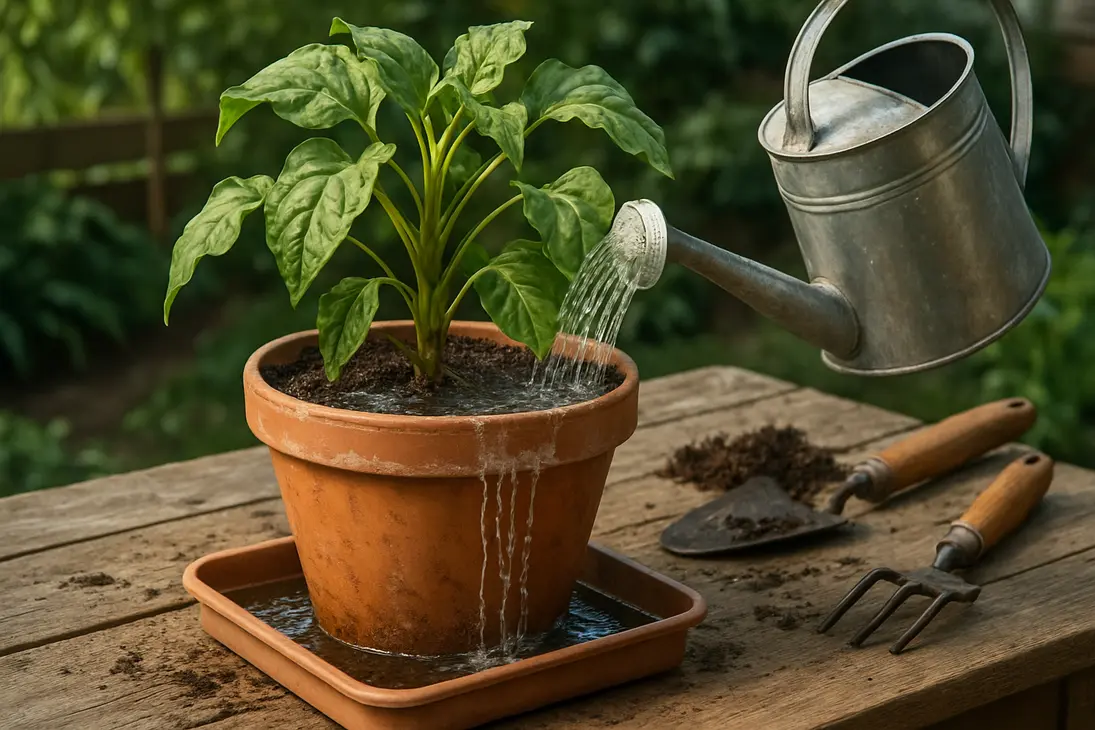
For containers with drainage holes, water thoroughly with plain water until it drains freely, repeat if salts are severe, empty saucers, and wait for recovery before feeding again.
For garden beds, water deeply if drainage is adequate, but avoid waterlogging. Remove visible granular fertilizer before watering if possible.
Damaged leaves may not recover, but healthy new growth means the plant is improving.
Avoid experimenting with unsuitable household substitutes
Baby formula, instant coffee, leftover drinks, and random kitchen powders are not reliable NPK fertilizer sources. They may contain sugars, fats, sodium, preservatives, or residues that encourage mold, attract pests, or damage roots.
Compost, worm castings, and organic fertilizers can be useful, but they are not the same as a clear soluble NPK solution. For precipitation-free liquid fertilizer, use known soluble fertilizer-grade ingredients with labeled analyses.
Conclusion
Successful NPK fertilizer preparation starts with the target analysis, but the ingredients must also be soluble, compatible, properly diluted, and mixed in a sensible order.
Most precipitation problems come from too much salt in too little water, calcium meeting phosphate or sulfate in concentrated form, pH changes that destabilize micronutrients, or mineral-rich water interfering with the formula. When calcium is needed with phosphates or sulfates, A/B stock solutions are usually the practical answer.
Make a jar test, keep notes, and begin with a diluted working solution. A clear, gentle fertilizer is more useful than a strong batch that clouds, clogs equipment, or burns roots.
FAQ
Can I mix all NPK fertilizer chemicals in one container?
Sometimes. Compatible salts at modest working concentration may mix in one container. Calcium-free combinations using potassium nitrate and monopotassium phosphate often work when properly diluted.
If the formula contains calcium nitrate plus phosphate or sulfate, do not mix them in a concentrated container. Use separate A/B stocks and dilute them into the final watering volume.
Which ingredients are most likely to cause precipitation?
Calcium salts are the most common problem when mixed with phosphates or sulfates, including calcium nitrate with monopotassium phosphate, monoammonium phosphate, potassium sulfate, or magnesium sulfate in concentrated solution.
Iron, manganese, zinc, and copper can also precipitate, especially at high pH or when not properly chelated.
Why did my NPK solution turn cloudy after mixing?
Cloudiness usually means the solution is too concentrated, incompatible ions reacted, or pH and water quality caused nutrients to fall out.
Check for hard water, calcium mixed with phosphate or sulfate, early pH adjustment, or an overly strong stock solution. A jar test with low-mineral water can help identify the cause.
How can I fix plants damaged by too much fertilizer?
Stop fertilizing. For potted plants, flush thoroughly with plain water and let the pot drain well. Empty saucers. For garden beds, water deeply if drainage is good and remove visible excess fertilizer.
Do not add more products to “balance” the mistake. Give the plant time. Burned leaves may remain damaged, but healthy new growth is a good sign.
You Might Also Like