How Do Trees Grow from Rock?
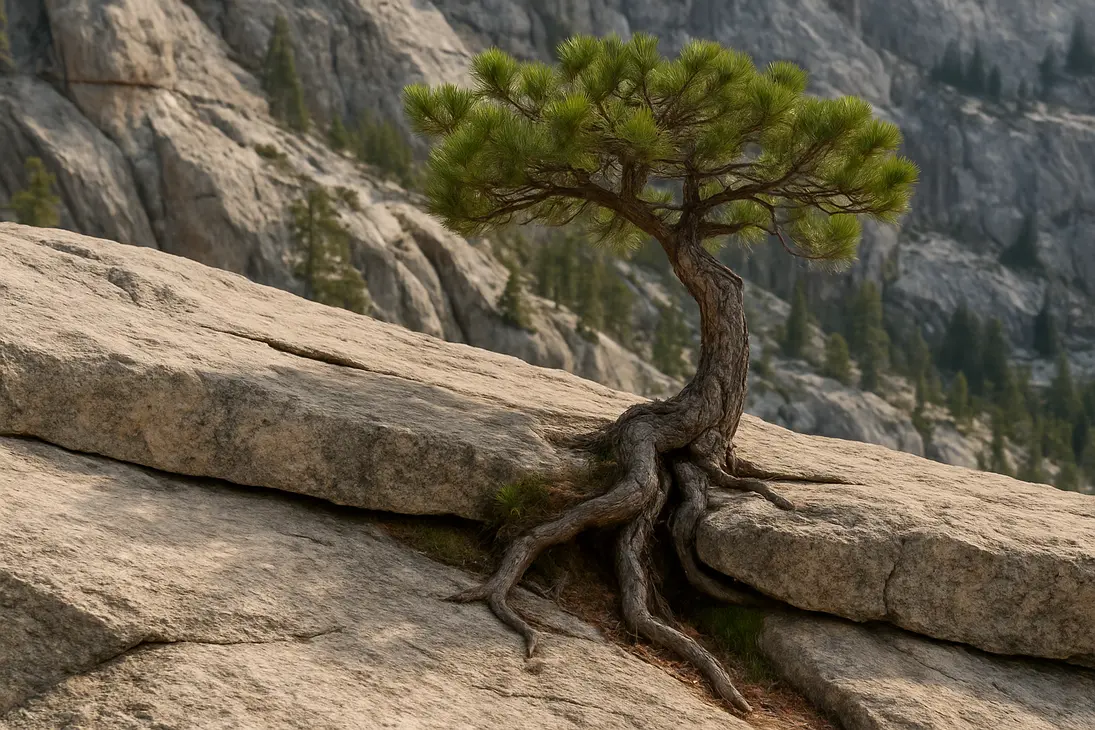
A tree growing from rock looks almost impossible: a pine clinging to a cliff, a fig sprouting from an old wall, or a juniper rooted into a mountain ledge. It can seem as if the tree is living on stone alone.
In reality, trees do not grow from solid rock the way they grow from soil. They survive because rock is rarely smooth, sealed, or lifeless. Cracks, seams, ledges, moss, leaf litter, windblown dust, bird droppings, and trapped moisture can create just enough of a foothold for a seedling. Over time, roots explore those openings, anchor the tree, and may widen the fractures that gave the tree its start.
What It Means When a Tree Is “Growing from Rock”
When people describe a tree growing from rock, they usually mean one of three things:
- The tree is rooted in a crack or crevice in exposed rock.
- The tree is growing on a ledge with a thin layer of soil or decomposed organic matter.
- The tree’s visible roots run over rock, while feeding roots reach soil nearby or behind it.
That distinction matters. A tree still needs water, oxygen, minerals, and support. Bare, uncracked stone provides almost none of that. But a small pocket of gritty soil in a rock seam can be enough for a hardy seedling to begin life.
Rock cracks, ledges, and hidden soil pockets
Natural rock surfaces collect material over time, including:
- Dust and sand blown by wind
- Decaying leaves, needles, moss, and lichens
- Fine particles from weathered rock
- Animal droppings
- Seeds carried by birds, mammals, water, or wind
To us, this material may look insignificant. To a seed, it can be a nursery. A few centimeters of gritty organic matter can hold moisture after rain. If the seedling sends roots into a deeper crack before the pocket dries, it has a chance.
Rock ledges are especially good at forming tiny planting beds. Water slows in depressions and leaves sediment behind. Mosses and lichens trap more particles, gradually creating a harsh but usable version of soil.
Many “rock-grown” trees are also connected to soil that is not visible. A root may disappear into a crevice and reach a deeper pocket, a slope above the cliff, or soil beneath a boulder.
Lithophytes vs. ordinary trees in rocky places
Plants that grow on or among rocks are often called lithophytes. Some true lithophytes are specially adapted to live on rock surfaces or in very thin mineral material. Mosses, lichens, ferns, orchids, and succulents often fit this pattern.
Most trees are not true rock specialists in that strict sense. A pine on a cliff or a birch in a crevice still needs a root zone, water, and nutrients. It is simply using whatever small opportunity the rock provides.
| Situation | What is really happening |
|---|---|
| Tree appears to grow from bare rock | Roots are likely in a crack, seam, or hidden soil pocket |
| Tree roots wrap over a boulder | Feeding roots probably reach soil around or beneath the rock |
| Tree grows from an old stone wall | Mortar gaps, dust, and organic matter act like soil |
| Bonsai tree grows over rock | Roots are trained toward a soil container or pocket |
| Tree on a cliff ledge | A shallow mat of mineral soil and organic debris supports it |
How Tree Roots Survive in Stone
A tree survives in rock by taking advantage of weakness. Roots do not drill through solid granite like tools, but they are excellent at finding openings, following moisture, and enlarging existing cracks over time.
The process is slow and uncertain. A seed must arrive in the right place, germinate during favorable moisture, and grow roots quickly enough to survive drought, heat, frost, or wind.
How seeds reach rocky places
Seeds reach rock crevices in several ways.
Wind carries light seeds into cracks. Pines, birches, maples, willows, and many other trees produce seeds that can lodge in seams where larger seeds would not settle.
Birds and mammals move seeds onto cliffs, walls, and boulders. Birds perch on rocky outcrops and deposit seeds in droppings. Squirrels and other animals may cache nuts or fruits near rocks.
Water washes seeds, silt, and leaf litter into crevices after rain. In steep landscapes, runoff can create small planting sites along cracks and ledges.
Gravity helps too. Seeds falling from trees above cliffs or slopes may land on lower shelves with a thin layer of gritty material.
Most seedlings in these places die. They dry out, wash away, freeze, are eaten, or fail to anchor. The dramatic tree we notice is usually the rare survivor.
Why roots follow cracks and fractures
Roots grow where conditions are favorable: moisture, oxygen, space, and nutrients. A crack in rock offers these more often than the surrounding stone.
Cracks collect rainwater and dew. They stay cooler and wetter than exposed surfaces and hold fine particles and organic matter. For a young root, that is an invitation.
Roots grow from their tips. The tender tip explores small spaces, while older root sections thicken behind it. If a root enters a fracture and keeps growing, it can become wedged. As it thickens year after year, it presses against the sides of the crack.
This does not mean roots shatter healthy stone overnight. Rock usually has existing weaknesses: joints, bedding planes, freeze-thaw cracks, weathered seams, or gaps between stones. Roots exploit and widen those weaknesses; they rarely create large fractures in flawless rock from nothing.
Moisture, minerals, fungi, and weathering
Rocky sites are low in fertility compared with deep garden soil, but they are not nutrient-free. Minerals weather from rock surfaces. Leaves, needles, insects, moss, and lichens decompose in crevices. Water carries dissolved nutrients into the root zone.
Many trees also form mycorrhizal relationships with fungi. The fungi connect with roots and help gather water and nutrients from a larger area. In return, the tree provides sugars made through photosynthesis. This partnership is especially useful in poor, rocky soils.
Weathering gradually creates more growing space. Rock breaks down through freeze-thaw cycles, heating and cooling, chemical reactions, water movement, lichens, mosses, microbes, and roots.
A tree growing from rock does not “eat” the rock, but it benefits from the mineral particles and moisture-holding pockets that weathering creates.
Types of Trees That Grow from Rocks
Not every tree can handle life in a crack or ledge. Species that succeed tend to be drought-tolerant, wind-tolerant, adaptable to poor soils, and capable of strong anchoring. Many are pioneer species: woody plants that colonize exposed, disturbed, or nutrient-poor sites.
Pines, junipers, and other conifers
Conifers are among the most familiar trees on rocky cliffs and mountain slopes. Pines and junipers often appear to grow straight out of stone.
Pines can suit rocky, sandy, acidic, or nutrient-poor conditions, depending on the species. Their needles reduce water loss compared with broad leaves, and many tolerate sun and wind. In rocky landscapes, pines often develop long roots that follow cracks into deeper seams.
Junipers are especially tough in dry, rocky sites. Many tolerate drought, poor soil, heat, and wind. Their compact foliage and rugged root systems make them common on cliffs, desert slopes, and thin-soil hillsides.
Other conifers, including spruces, firs, cedars, cypresses, and hemlocks, may also grow in rocky environments where climate and moisture suit them. Species matters: a conifer adapted to cool, moist mountains may fail on a hot, exposed garden rock.
Figs, birches, maples, and hardy broadleaf trees
Broadleaf trees can also establish in rock crevices, walls, and ledges.
Figs are famous for colonizing stone walls, ruins, and rock faces in warm climates. Birds spread their seeds, and their roots explore cracks effectively. In old masonry, figs can cause serious structural problems as roots thicken.
Birches are pioneer trees with tiny, windborne seeds. They often colonize open, rocky, or thin-soil areas in cool climates. Their seedlings need moisture early on, but some birches cope well with lean conditions once established.
Maples germinate in surprising places because their winged seeds travel easily and lodge in crevices. Some maples tolerate rocky soils better than others. A seedling in a wall or foundation gap may look charming, but it should usually be removed before roots enlarge.
Other hardy broadleaf trees may include oaks, hawthorns, serviceberries, aspens, willows near seepage areas, and certain desert or scrubland trees. The best candidates vary by region.
Bonsai and root-over-rock tree styles
The image of a tree growing from rock is also common in bonsai. In root-over-rock bonsai, a young tree is trained so its roots clasp a stone before entering soil below. The effect suggests age, struggle, and survival.
This differs from a wild tree in a natural crevice. In bonsai, the grower provides controlled soil, watering, pruning, and root training. The rock is part of the design, but the tree still depends on a managed root zone.
Common choices include ficus, juniper, pine, maple, elm, and other species with flexible young roots. Ficus is often forgiving for beginners in warm indoor conditions, while conifers and maples usually need outdoor seasonal care.
Why Trees in Rocky Places Look So Unusual
Trees in rocky places often look older, smaller, and more dramatic than trees in deep soil. Their trunks twist, roots grip exposed stone, crowns lean away from wind, and branches may be sparse or compact. These forms are responses to stress.
Limited soil and nutrients
A tree in deep, fertile soil can expand a broad root system and produce steady growth. A tree in a rock crack has much less room. Its root zone may be narrow, shallow, dry, and low in organic matter.
Limited soil slows growth. Leaves or needles may be smaller. Annual shoots may be short. The tree may produce fewer branches or shed branches during drought to reduce water demand.
Poor fertility can reduce vigor, but fertilizer is not always the answer. A tree adapted to lean conditions may respond to heavy feeding with soft, weak growth that is more vulnerable to drought, pests, or winter damage. Proper species choice and water management usually matter more.
Drought, heat, frost, and wind exposure
Rocky sites are exposed. They heat quickly in sun and cool quickly at night. A south-facing rock face can be much hotter than nearby soil, while a mountain ledge may face severe cold and drying wind.
Drought is often the biggest challenge. Thin soil pockets dry fast, and water runs off smooth rock instead of soaking in. Even after rain, a seedling may face dry conditions within days.
Wind increases moisture loss, bends young stems, and damages branches. Over time, trees in windy places may develop one-sided crowns or dense, low growth. Frost can also disturb roots when water trapped in cracks freezes and expands.
Slow growth, twisted shapes, and anchoring risks
The sculptural shape of a cliff tree is often the result of slow growth and repeated damage. Wind, drought, snow, rock movement, or browsing may kill buds and branches, forcing growth in new directions.
Exposed roots are common because soil washes away or because roots grow over the surface before entering cracks. These roots can look powerful, but they may also signal vulnerability. A tree rooted in a shallow pocket can topple during storms if its crown becomes large and heavy.
In nature, this is part of the landscape. In gardens, near paths, patios, walls, or houses, anchoring deserves careful thought.
Can You Grow a Tree on or Near Rocks at Home?
Yes, you can create the look of a tree growing from rock at home, but a tree cannot thrive on bare stone without soil, water, and suitable species selection. The goal is to create a rocky planting pocket or root-over-rock effect that gives the tree enough root space while preserving the natural appearance of stone.
Many failures come from choosing a species that wants deep, moist soil, or from underestimating how quickly rocky pockets dry out. In this kind of design, horticulture has to come before aesthetics.
Choose trees adapted to rocky or dry conditions
Start with species that suit your climate and site. A tree that naturally tolerates thin soil, drought, wind, or rocky slopes will perform better than one chosen only for appearance.
Good candidates often include:
- Junipers
- Dwarf or slow-growing pines
- Some native oaks, depending on region
- Serviceberry
- Hawthorn
- Certain maples for cooler, moister rocky sites
- Olive or fig in suitable warm climates
- Desert-adapted trees such as mesquite or palo verde where appropriate
For small gardens, choose naturally compact trees or large shrubs trained as small trees. A full-sized forest tree in a rock pocket may look good for a few years, then become stressed, unstable, or too large.
Before planting, ask:
- Is the species hardy in my winter climate?
- Does it tolerate drought once established?
- How large will it become?
- Will roots threaten walls, paving, drains, or foundations?
- Can I water it during establishment?
- Is there enough soil volume for long-term survival?
Native or regionally adapted species are often the safest choice.
Create small planting pockets without smothering the rock
To make a tree look natural among rocks, avoid burying the entire feature under soil. Instead, create a planting pocket that is functional but visually restrained.
A practical approach:
- Choose a stable location. Do not plant into loose rocks that may shift or collapse.
- Provide enough root volume. Even a small tree needs more than a decorative scoop of soil. If the pocket is shallow, connect it to deeper soil.
- Use a gritty, well-drained mix. Combine mineral soil, coarse sand or grit, and compost in moderation.
- Set the root flare correctly. The point where the trunk widens into roots should not be buried.
- Water deeply during establishment. Rocky pockets dry quickly.
- Mulch lightly. Use gravel, small stone, or thin organic mulch, but keep it away from the trunk.
- Monitor stability. Stake only if needed, and remove supports once the tree stands securely.
If you want roots to grow over a rock, start with a young plant. Arrange flexible roots over the stone, cover them temporarily with soil or moss to prevent drying, and let them thicken gradually.
Common mistakes to avoid
The rock-grown look rewards patience. Avoid these common mistakes:
- Planting on bare stone with no real root zone.
- Choosing a thirsty species that needs deep, moist soil.
- Using too little soil for the tree’s mature size.
- Letting the planting pocket dry out during establishment.
- Overfertilizing, which can encourage weak growth.
- Planting too close to masonry or foundations.
- Ignoring mature size.
- Starting with weak or dried-out nursery stock.
For the most natural effect, think like a rocky hillside: lean soil, excellent drainage, careful species choice, and enough hidden root space to keep the tree alive.
Conclusion
A tree growing from rock is not living on stone alone. It is surviving because a seed found a small opportunity: a crack, ledge, gritty soil pocket, moisture, and time.
Roots follow fractures because cracks hold water, oxygen, and organic matter. As roots thicken, they can widen existing openings and contribute to the slow breakdown of rock. The harsh conditions explain the unusual shapes we admire: twisted trunks, exposed roots, compact crowns, and slow, weathered growth.
At home, you can create a similar look, but the same rules apply. Choose a tree adapted to rocky conditions, provide a real planting pocket, water carefully while it establishes, and respect the mature size and strength of the roots. The beauty of a rock-grown tree comes from resilience, not neglect.
FAQ
Can a tree grow directly from solid rock?
Not directly from smooth, unbroken solid rock. A tree needs water, oxygen, nutrients, and room for roots. When a tree appears to grow from solid rock, it is usually rooted in a crack, crevice, ledge, weathered seam, or hidden soil pocket.
What is a tree growing on rock called?
Plants that grow on or among rocks are often called lithophytes. However, many trees seen growing from rocks are not specialized lithophytes in a strict botanical sense. They are usually ordinary trees established where soil, organic matter, and moisture have collected.
In bonsai, the style where roots grow over a stone is commonly called root-over-rock.
Why do tree roots crack rocks?
Tree roots usually widen cracks that already exist. Roots grow into fractures because those spaces hold moisture and fine material. As roots thicken, they press against the sides of the crack. Over time, this pressure, combined with freeze-thaw cycles, water movement, chemical weathering, and microbial activity, can help break rock apart.
Roots are powerful, but they do not typically split flawless solid stone by themselves. They take advantage of weakness.
Are trees growing from rocks harmful to cliffs, walls, or foundations?
In natural cliffs, trees are part of the weathering process. They may loosen rocks or widen cracks, but they can also help bind loose material.
Around buildings, walls, patios, drains, and foundations, the risk is greater. Roots growing into existing cracks, old mortar, drainage gaps, or foundation defects can make damage worse as they enlarge. Seedlings in masonry should usually be removed while small. For intentional planting near structures, choose small, suitable species and leave enough distance for mature roots and trunk growth.
You Might Also Like