Why Avocado Trees Are Grafted Onto Different Varieties
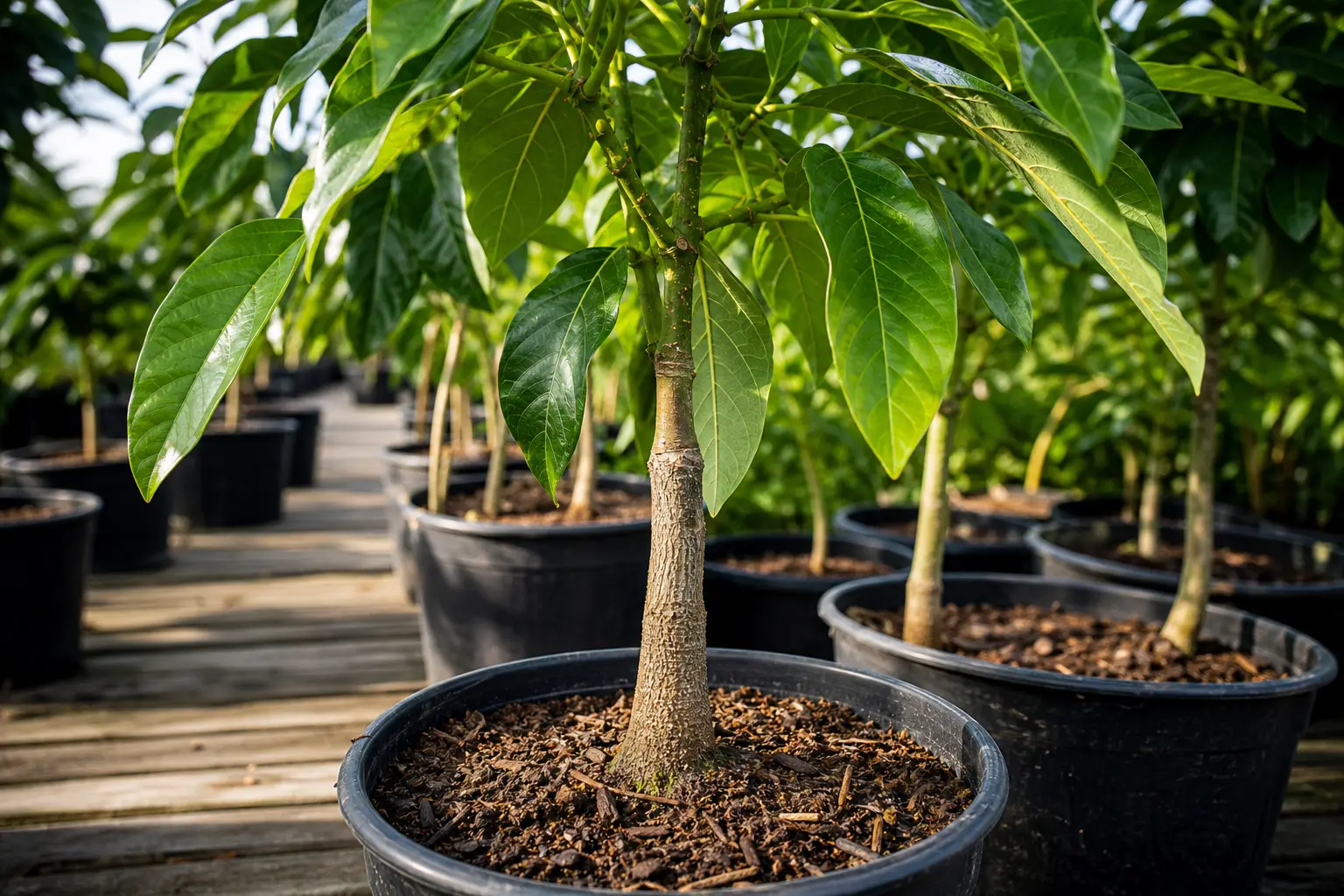
Avocados are grafted because growers want to combine two useful traits in one tree: dependable fruit from a named variety and a root system suited to the growing site.
For example, a tree sold as ‘Hass’ should produce Hass-type fruit: pebbly dark skin when ripe, rich flesh, and the familiar flavor shoppers expect. But the roots may come from a different avocado selection chosen for better performance in the local soil, climate, or disease conditions.
This is why avocados are grafted onto different varieties. The top of the tree determines the fruit; the bottom can be selected for resilience and consistency.
What Grafting Does in an Avocado Tree
Grafting is a form of vegetative propagation. A short piece of stem from a known fruiting avocado tree is joined to the rooted lower portion of another avocado plant. If the tissues heal together successfully, the two pieces grow as one tree.
The join is called the graft union. It is usually visible near the lower trunk of a nursery tree as a slight bend, swelling, or change in bark texture.
A grafted avocado has two genetically different parts:
- The scion, which becomes the upper trunk, branches, leaves, flowers, and fruiting canopy.
- The rootstock, which forms the roots and usually the lowest part of the trunk.
The rootstock and scion must be compatible. In commercial avocado production, both are avocado types, though they may be different cultivars, selections, or genetic backgrounds.
The scion determines the avocado variety
The scion is the part that determines the named avocado variety you buy.
If a nursery grafts a Hass scion onto a suitable rootstock, the branches above the graft union are Hass. The fruit produced on those branches should have Hass characteristics, provided the tree is healthy and correctly identified.
This matters because avocado varieties differ in more than skin color. They can vary in:
- Fruit size and shape
- Skin texture and thickness
- Oil content and flavor
- Season of maturity
- Bearing habits
- Flowering type
- Cold sensitivity
A grower who plants a Hass, Fuerte, Reed, or Pinkerton tree usually wants the predictable fruit traits associated with that cultivar. Grafting preserves those traits far more reliably than planting a pit.
The rootstock provides the roots and lower trunk
The rootstock is the foundation of the tree. It takes up water and nutrients, anchors the tree, and influences how the tree responds to stresses below ground.
Rootstock choice can affect:
- Tolerance of certain soil-borne diseases
- Performance in heavy, wet, saline, or alkaline soils
- Vigor and canopy growth
- Adaptation to local temperatures
- Overall uniformity in an orchard
Rootstocks do not turn Hass fruit into another avocado variety. A Hass scion still produces Hass fruit. However, the rootstock can influence how vigorously the tree grows and how well it copes with its environment, which may indirectly affect crop size and tree health.
It is also important to distinguish rootstock from a “magic fix.” A more tolerant rootstock may help under difficult conditions, but it cannot make an avocado thrive in permanently waterlogged soil, severe frost, or a climate that is fundamentally unsuitable for the species.
The Main Reasons Avocado Trees Are Grafted
Grafting lets nurseries and growers pair a proven fruiting cultivar with roots selected for practical growing conditions. That combination is especially valuable for a long-lived fruit tree, where a poor choice can take years to become obvious.
To reproduce a proven variety true to type
The central reason why avocados are grafted is to reproduce desirable varieties faithfully.
A scion is a vegetative piece of the parent tree. It carries the same genetic identity as that parent. A properly grafted Hass scion therefore produces Hass-type fruit rather than an unpredictable new seedling type.
This allows growers to preserve varieties valued for eating quality, harvest timing, storage behavior, productivity, or market demand. It also gives home gardeners a clearer idea of what they are planting.
A named avocado variety is not simply “an avocado grown from a Hass fruit.” It is a clone maintained through grafting or another vegetative propagation method.
To produce fruit sooner than seed-grown trees
A grafted avocado tree is made with scion wood from a tree that has already reached reproductive maturity. While the grafted tree still needs time to establish roots and build a canopy, it generally reaches fruiting age sooner than a seedling.
For a home gardener, a grafted tree may begin to bear within a few years after planting under warm, favorable conditions. A seed-grown avocado commonly takes much longer and may take many years before flowering, if it flowers at all in the available climate.
This difference is meaningful when space is limited. A gardener with room for only one avocado tree is usually better served by a grafted cultivar than by waiting years to discover what a seedling will become.
To improve tolerance of soil, disease, or climate stresses
Avocado roots are sensitive. They need oxygen in the root zone and can decline quickly in compacted or poorly drained ground. Certain rootstocks are chosen because they perform better than others under specific stresses.
Depending on the rootstock and local conditions, growers may seek improved performance where there is:
- Pressure from root diseases, especially in poorly drained ground
- Salty irrigation water or naturally saline soil
- Heavy clay or marginal drainage
- High-pH soil that makes nutrient uptake difficult
- Cool conditions or other regional climate stresses
The wording matters here: rootstocks are selected for relative tolerance, not immunity. A disease-tolerant rootstock can still struggle if irrigation is excessive, drainage is poor, or the tree is planted too deeply.
For home growers, good site preparation remains more important than the rootstock label alone. Plant on a mound or raised area where drainage is questionable, keep mulch away from the trunk, and avoid frequent shallow watering that leaves soil constantly wet.
To create more uniform orchard trees and crops
Commercial orchards depend on consistency. When trees are grafted with the same scion cultivar onto chosen rootstocks, growers can expect more uniform growth, flowering, fruit maturity, and harvest characteristics than they would from a field of seedlings.
Uniformity helps with practical decisions such as:
- Tree spacing and pruning systems
- Irrigation planning
- Harvest scheduling
- Packing and marketing fruit
- Estimating crop timing and labor needs
No orchard is perfectly uniform. Soil depth, irrigation coverage, wind exposure, and tree health still create variation. But grafted stock reduces the large genetic differences that would occur if every tree were grown from seed.
Why Seed-Grown Avocados Are Not Reliable Replacements
An avocado pit can certainly grow into a tree. It can be a satisfying houseplant or garden experiment, especially in a warm climate. What it cannot reliably do is reproduce the avocado variety that produced the fruit.
That distinction explains why a seed from a good supermarket avocado is not a dependable substitute for buying a grafted tree.
Seedlings vary genetically
Avocado trees grown from seed are sexually reproduced plants. The seed contains a new genetic combination, influenced by both the tree that bore the fruit and the pollen source that fertilized the flower.
Even if the fruit was a Hass avocado, the seedling is not a Hass clone. It is a new individual with unknown traits.
In avocado-growing areas, pollination may involve nearby avocado trees of different types. In other settings, the parentage is simply unknown. Either way, the seed does not preserve the named cultivar in the way a grafted scion does.
This is why gardeners sometimes hear, “You can grow an avocado from a pit, but it probably will not be like the fruit you ate.” That is accurate.
Fruit quality, yield, and tree size can be unpredictable
A seedling may eventually produce excellent fruit. It may also produce fruit that is fibrous, watery, small, late-maturing, or less flavorful than expected. Its crop size and consistency are unknown, too.
Tree growth can also be unpredictable. Seedlings often become large, vigorous trees—an issue in small gardens, patios, and protected growing spaces.
A grafted tree is not automatically compact, but it gives the gardener a more predictable starting point. You know the intended fruit type and can research the usual growth habit of that cultivar before committing to its location.
If you are growing a pit for enjoyment, unpredictability is part of the project. If you want dependable fruit in a limited space, it is a disadvantage.
Seed-grown trees often take longer to bear fruit
A seedling must pass through a juvenile phase before it can flower and fruit. That can take a long time, particularly where summers are cool, winter light is low, or the tree is confined to a container.
A grafted tree is not instantly productive, but the mature scion shortens the wait. It also removes much of the uncertainty over whether the eventual fruit will be worthwhile.
This is a frequent source of disappointment with indoor avocado plants. A tree can look healthy for years and still not fruit. Growing foliage from a pit is much easier than producing a mature, well-pollinated avocado crop.
Why a Hass Scion May Be Grafted Onto Another Avocado Variety
A Hass avocado tree does not need Hass roots to produce Hass fruit. In fact, growers often graft Hass scions onto rootstocks selected for the conditions where the orchard will be planted.
That is not a compromise in fruit identity. It is the point of grafting.
Preserving the desired Hass fruit characteristics
Hass is grown for a recognizable set of fruit qualities, including its rich texture, relatively thick pebbly skin, and darkening skin as it ripens. To preserve those traits, nurseries take scion wood from known Hass trees.
Every branch above the graft union carries the Hass scion’s genetic identity. The roots below may come from another avocado selection, but they do not rewrite the scion’s variety.
Occasionally, shoots may emerge from below the graft union. These are rootstock suckers, not Hass growth. They should usually be removed promptly because they can outgrow and compete with the scion. If left alone, they may eventually produce fruit unlike the Hass fruit expected from the upper canopy.
Selecting rootstocks for specific site conditions
Rootstock selection is a site-matching decision. A nursery or orchard manager may choose one rootstock for relatively light, well-drained soil and another where disease pressure, salinity, or poor soil structure is a concern.
For home gardeners, the exact rootstock is not always listed on a retail label. If it matters for your site, ask the nursery:
- What rootstock is used?
- Is it selected for local soil or disease conditions?
- Is the tree intended for in-ground planting, containers, or protected growing?
- What mature size and cold tolerance should you realistically expect?
A local nursery that grows trees for the regional climate can often be more helpful than a generic label. Still, no rootstock choice can compensate for planting an avocado in dense, wet ground without improving drainage.
Matching rootstock choice to disease pressure and soil drainage
Root disease and poor drainage are closely connected in avocados. Saturated soil excludes air, weakens roots, and creates conditions in which root problems become much more damaging.
Where root disease is known to be common, growers may use rootstocks with better tolerance. But the cultural practices remain essential:
- Choose a planting site that drains freely.
- Avoid burying the graft union or planting the tree too deeply.
- Use mulch to moderate soil moisture, but keep it a few inches away from the trunk.
- Water deeply enough to wet the root zone, then allow the soil to begin drying rather than keeping it constantly soggy.
- Prevent irrigation water from pooling around the trunk.
In a home landscape, correcting drainage before planting is often more effective than trying to rescue a declining avocado later.
What Grafting Does—and Does Not—Guarantee for Home Growers
A grafted avocado is a more predictable fruit tree, not a promise of effortless harvests. It gives you a known cultivar on a selected root system, but avocado fruiting still depends on the growing environment and management.
A grafted tree is more predictable, not maintenance-free
A healthy graft union does not protect a tree from poor planting, drought stress, heat damage, frost, nutrient problems, pests, or root rot.
Grafted trees also need the same basic care as any avocado:
- Full sun in climates where avocados can grow outdoors
- Well-drained soil
- Careful irrigation, especially during establishment
- Protection from damaging cold
- Enough room for the cultivar’s eventual canopy
- Pruning only when needed to manage size, access, or damaged growth
Do not cover the graft union with soil or mulch. If the scion roots above the graft, the tree may lose some of the intended benefits of its rootstock.
Pollination, climate, tree age, and care still affect fruiting
Avocados have unusual flower behavior, often described as Type A or Type B flowering. A compatible flowering partner can improve pollination in some situations, but it does not guarantee a crop. Bees, weather during bloom, cultivar timing, and local conditions all matter.
A single avocado tree can sometimes set fruit, especially where other avocado trees are nearby. But a tree may flower heavily and still shed most flowers or young fruit. This is normal to a degree.
Climate is equally important. Avocados need enough warmth and a sufficiently long growing season to develop fruit properly. A tree kept indoors, grown in a cool greenhouse, or exposed to regular frost may survive yet fail to crop reliably.
Growing an avocado plant is different from producing reliable fruit
Growing an avocado from a pit is an enjoyable project. It teaches propagation, rooting, and tree care. But it is not the same goal as growing a productive fruit tree.
For reliable home harvests, start with a grafted tree appropriate to your climate, plant it in freely draining soil, and give it time. If your winters are too cold for outdoor avocados, a potted tree may be attractive, but fruiting remains uncertain because light, canopy size, pollination, and winter conditions are harder to manage.
Conclusion
Avocados are grafted to combine a dependable fruiting variety with a rootstock chosen for useful growing traits. The scion determines whether the tree produces Hass, Fuerte, Reed, or another named avocado. The rootstock provides the roots and can improve the tree’s ability to handle particular soil, disease, or climate challenges.
A grafted tree is therefore more predictable than a seedling, both in fruit quality and in the time it may take to begin bearing. It is not maintenance-free, but for gardeners who want recognizable fruit rather than a long-term experiment, it is usually the sensible choice.
FAQ
Are all Hass avocado trees grafted?
Commercially sold Hass trees are generally propagated by grafting or another vegetative method because a true Hass tree must be genetically the same cultivar as the original Hass selection.
A seed taken from a Hass avocado can grow into an avocado tree, but it is a seedling—not a true Hass tree. Its fruit and growth habit may differ substantially from the parent fruit.
Can you grow a Hass avocado tree from a pit?
You can grow an avocado tree from a Hass pit, but you cannot reliably grow a true Hass tree from that seed. The seedling has a new genetic combination and may produce very different fruit, if it fruits at all.
To grow a genuine Hass cultivar, buy a grafted tree with Hass scion wood above the graft union.
How long does a grafted avocado tree take to produce fruit?
Under suitable warm conditions, a grafted avocado may begin producing fruit within a few years after planting. The exact timing depends on the cultivar, tree size at purchase, climate, pollination, planting conditions, and care.
Seed-grown trees often take substantially longer, commonly many years, and their fruit quality remains uncertain.
Can one avocado variety be grafted onto another avocado tree?
Yes. A scion from one avocado variety can be grafted onto the rootstock or established framework of another compatible avocado tree. For example, Hass scion wood can be grafted onto a different avocado rootstock.
The fruit produced by the grafted branch will reflect the scion variety. Any shoots growing from below the graft union belong to the rootstock and should be removed if the goal is to maintain the scion cultivar.
You Might Also Like