How Much Mulch Should You Use When Planting a New Tree?
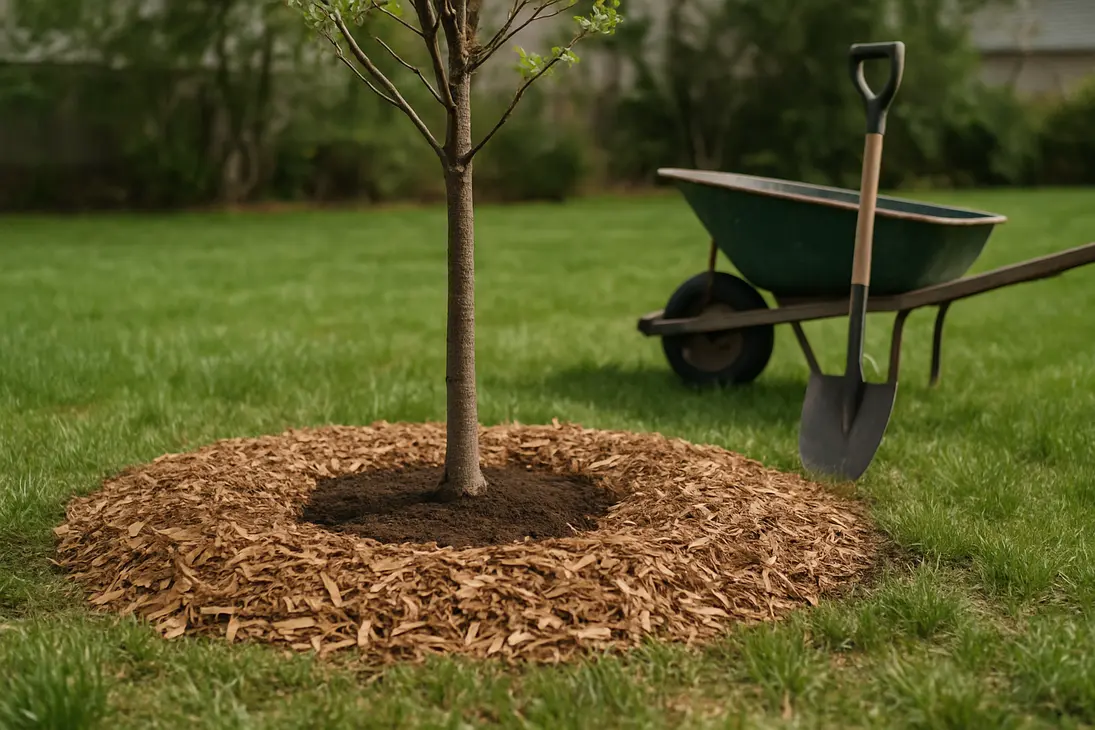
For most new trees, use 2 to 4 inches of organic mulch in a wide, flat ring over the root zone, with mulch kept several inches away from the trunk. A typical young landscape tree usually needs a mulch ring about 4 to 8 feet wide, depending on tree size and space.
The goal is not to bury the tree or fill the planting hole with rich material. Mulch belongs on the soil surface, where it conserves moisture, reduces competition, and protects the young root system while the tree establishes.
Why Mulch Matters for Newly Planted Trees
A newly planted tree has a limited root system. Many fine absorbing roots are lost, cut, confined, or disturbed during nursery production, digging, shipping, and planting. Even when the canopy looks healthy, the tree may struggle to take up enough water during its first few seasons.
Mulch helps by:
- Conserving moisture. It slows evaporation so the root ball and nearby soil stay moist longer.
- Moderating soil temperature. It buffers surface roots from heat and cold swings.
- Reducing grass and weed competition. Turfgrass competes strongly with young trees for water and nutrients.
- Protecting soil structure. Mulch reduces crusting, erosion, and compaction around the tree.
- Improving soil over time. Organic mulch gradually breaks down and supports soil life.
Mulch also creates a visible no-mow zone. That helps prevent mower and string-trimmer damage, which can wound young bark and permanently weaken a tree.
The Right Amount of Mulch for a New Tree
The right mulch application is wide but not deep. Most problems come from piling mulch too high, not from spreading it too far.
Use this basic standard:
- Depth: 2 to 4 inches after settling
- Shape: flat ring or donut
- Width: several feet from the trunk in all directions, if possible
- Trunk clearance: mulch must not touch the bark
Recommended Mulch Depth
Use the mulch texture to choose the depth:
| Mulch texture | Recommended depth | Notes |
|---|---|---|
| Fine shredded bark or composted mulch | 2 inches | Can mat or hold too much moisture if deep. |
| Medium bark or mixed wood mulch | 2 to 3 inches | Good general choice. |
| Coarse wood chips | 3 to 4 inches | Allows better air movement and settles well. |
| Shredded leaves | 2 to 3 inches | Avoid thick layers of whole leaves. |
Measure after spreading, not by how full the bag or wheelbarrow looked. Mulch settles after rain. Avoid going beyond 4 inches because deep mulch can reduce oxygen movement, hold excess moisture, encourage roots to grow into the mulch layer, and shelter rodents in some areas.
How Wide the Mulch Ring Should Be
A new tree benefits more from a wider mulch ring than from a deeper one. If space allows, mulch at least a 3-foot radius from the trunk, creating a ring about 6 feet across. Larger container or balled-and-burlapped trees benefit from a 4-foot radius or more.
Practical guide:
| Tree size at planting | Good mulch ring size | Approx. mulch at 3-inch depth |
|---|---|---|
| Small sapling or whip | 3 to 4 feet wide | 1 to 2 cubic feet |
| Typical young container tree | 5 to 6 feet wide | 4 to 7 cubic feet |
| Larger container or B&B tree | 6 to 8 feet wide | 7 to 13 cubic feet |
If planting in lawn, remove or smother the grass first. Mulch laid over thick turf may look neat, but grass often grows through it and keeps competing with the tree.
As the tree grows, expand the ring when practical. Even a 6- to 8-foot-wide grass-free area during the first few years can help establishment.
When to Use Less Mulch
Use the lower end of the range—about 2 inches—when the site already stays moist or has poor air movement. Be cautious with:
- Heavy clay soil
- Low or poorly drained sites
- Fine mulch that packs tightly
- Cool, wet climates
- Irrigated beds that stay moist
- Sites with vole or rodent activity
Mulch cannot fix poor drainage, and too much can make wet conditions worse. In hot, dry, or sandy sites, 3 to 4 inches of coarse organic mulch may help, but it does not replace deep watering.
How to Apply Mulch After Planting a Tree
The correct order is: plant, backfill, water, then mulch.
Do not mix mulch into the planting hole. Woody material belongs on top of the soil, not in the backfill, where it can interfere with root-to-soil contact and water movement.
A good sequence:
- Set the tree at the proper depth. The root flare should be at or slightly above surrounding soil level.
- Backfill with native soil. Break up large clods, but avoid creating a pocket of heavily amended soil.
- Water thoroughly. Soak the root ball and surrounding backfill.
- Spread mulch on the surface. Make a wide ring and keep the trunk clear.
- Water lightly if needed. This settles the mulch and reduces blowing.
Keep Mulch Away From the Trunk
Leave a clear gap of about 3 to 6 inches around the trunk of a young tree. Larger trees need even more space.
Bark is not meant to stay constantly damp. Mulch piled against the trunk can trap moisture, hide the root flare, encourage decay, and create pest problems. After mulching, you should still see the base of the trunk widening naturally into the soil. If it looks like a pole coming out of a mound, pull mulch back.
Shape the Mulch Ring Like a Donut, Not a Volcano
The ideal mulch ring is a donut: open in the center, broad and shallow over the root zone. The wrong shape is a mulch volcano, with material piled high against the trunk.
A proper mulch ring should be:
- Flat or gently tapered
- Open around the trunk
- No deeper than 2 to 4 inches
- Widest over the root zone
- Free of thick clumps near the bark
If a tree already has a mulch volcano, pull mulch away until the root flare is visible. If roots are circling in the mulch or the flare is buried under soil, correction may require more careful work.
Water Before and After Mulching
Water before mulching because dry root balls can be hard to rewet, especially in container-grown trees. If you mulch over a dry root ball and only sprinkle the surface, the root zone may remain dry.
After planting, soak the root ball and surrounding soil slowly. Then mulch. A light watering afterward can settle the mulch, but it should not replace the deep watering.
During the first growing season, check moisture by pulling back mulch and feeling the soil a few inches down. Water deeply when soil is dry at root depth; wait if it is wet and sticky.
Best Mulch Materials for Tree Planting
The best mulch for new trees is usually an organic, woody material that decomposes slowly while allowing air and water movement. Simple wood chips are often excellent.
Good Organic Mulch Options
| Mulch material | Best use | Watch for |
|---|---|---|
| Arborist wood chips | Excellent general tree mulch | Keep on the surface only. |
| Shredded bark | Neat ornamental beds | Fine grades can mat. |
| Bark nuggets | Long-lasting appearance | May wash or float on slopes. |
| Shredded leaves | Seasonal mulch | Whole leaves can mat. |
| Pine needles | Dry sites and acid-tolerant trees | Can move in wind or runoff. |
| Partially composted wood mulch | Balanced appearance and soil benefit | Avoid sour-smelling material. |
Fresh wood chips are often suitable as surface mulch. The concern that they “steal nitrogen” mainly applies when high-carbon material is mixed into soil. On the surface, chips break down slowly at the soil interface.
Mulches to Avoid Around New Trees
Avoid or use caution with:
- Rubber mulch. It does not improve soil and can heat the planting area.
- Plastic sheeting. It restricts air and water movement.
- Landscape fabric under mulch. It may clog, interfere with soil improvement, and complicate root growth.
- Thick fresh grass clippings. They mat, heat, smell, and can become slimy.
- Fresh manure. It may be too salty or biologically active for new roots and trunks.
- Sawdust or very fine wood waste. It compacts easily when applied thickly.
- Unknown construction wood chips. They may contain treated lumber, paint, or debris.
- Stone or gravel in hot sites. Rock can reflect heat and does not improve soil.
Dyed mulch is mainly a quality issue. If using it, choose a reputable product made from clean wood. When unsure, use undyed bark or wood chips.
Should You Use Compost as Mulch?
Compost can help, but it is finer and breaks down faster than wood mulch. A thick compost layer may crust, wash, or grow weeds more readily than coarse mulch.
A better method is to apply ½ to 1 inch of finished compost as a topdressing, then cover it with 2 to 3 inches of wood chips or bark. Keep both materials away from the trunk. Use only finished compost that smells earthy, not sour, rotten, or ammonia-like.
When to Mulch and How to Maintain It
You can mulch a new tree immediately after planting in most seasons, provided the soil is watered first and the mulch is applied correctly.
Check the ring once or twice a year. Mulch breaks down, shifts, and mixes with leaves or soil. Maintain a 2- to 4-inch layer without letting it build into a mound.
Mulching in Spring and Fall
Spring is a good time to inspect and refresh mulch. Pull material away from the trunk, loosen compacted areas, and add only enough mulch to restore the correct depth. Do not automatically add a new layer each year without checking what is already there.
Fall is also useful, especially where winters are cold or autumn winds are dry. Fall mulch helps conserve moisture and moderate soil temperature as the tree enters dormancy. Shredded leaves can be added, but keep the trunk clear.
If the ring is already 4 inches deep, do not add more. Rake it level instead.
Winter Mulching for Young Trees
Winter mulch can reduce freeze-thaw swings and conserve moisture, especially for fall-planted or shallow-rooted young trees. In cold climates, refresh mulch after the soil has cooled but before harsh winter weather settles in.
The same rules apply:
- Keep mulch away from the trunk.
- Do not cover the root flare.
- Avoid deep, fluffy mounds that shelter rodents.
- Check the trunk area in late winter or early spring.
Where voles are common, keep the trunk gap especially clear so rodents cannot feed unseen on young bark.
Common Mulching Mistakes to Fix
Mistake: Mulch piled against the trunk
Pull it back until the root flare is visible and bark can dry.
Mistake: Mulch too deep
Remove excess until the layer is back to 2 to 4 inches.
Mistake: Mulch ring too narrow
Expand the ring instead of deepening it. A 5- or 6-foot ring helps far more than a small decorative circle.
Mistake: Mixing mulch into the planting hole
If recently planted, correct the backfill if practical. Otherwise, avoid further disturbance and focus on surface mulch and watering.
Mistake: Assuming mulch replaces watering
Mulch reduces evaporation, but new trees still need consistent moisture.
Mistake: Adding mulch every year without checking depth
Measure first. Mulch accumulation is common in maintained landscapes.
Conclusion
The best tree planting mulch is simple: use organic material such as wood chips, bark, shredded leaves, or pine needles; spread it 2 to 4 inches deep; make the ring wide rather than tall; and keep it off the trunk. For many new trees, a mulch ring about 6 feet across is a practical target.
Applied as a donut instead of a volcano, mulch conserves moisture, reduces competition, buffers soil temperature, protects young bark from equipment, and improves the soil surface over time.
FAQ
How many bags of mulch do I need for one new tree?
Most bagged mulch is sold in 2-cubic-foot bags, though sizes vary.
| Mulch ring diameter | Depth | Mulch volume | 2-cu-ft bags |
|---|---|---|---|
| 4 feet wide | 2 inches | About 2 cu ft | 1 |
| 4 feet wide | 3 inches | About 3 cu ft | 2 |
| 6 feet wide | 2 inches | About 5 cu ft | 3 |
| 6 feet wide | 3 inches | About 7 cu ft | 4 |
| 8 feet wide | 3 inches | About 13 cu ft | 7 |
For a typical newly planted landscape tree, plan on 3 to 4 bags for a good 6-foot-wide ring at moderate depth.
Can too much mulch hurt a newly planted tree?
Yes. Too much mulch can keep the trunk wet, reduce oxygen movement, encourage shallow roots in the mulch layer, hide root flare problems, and shelter rodents.
Stay within 2 to 4 inches, and use less on wet, heavy, or poorly drained soils. If the layer is too deep, remove excess.
Should mulch touch the tree trunk?
No. Keep mulch 3 to 6 inches away from the trunk. The root flare should remain visible. Mulch touching bark can trap moisture and contribute to decay, pest issues, and root problems.
The correct shape is a donut: open in the center and broad over the surrounding soil.
Is it better to mulch before or after watering a new tree?
Water first, then mulch. After planting and backfilling, thoroughly soak the root ball and surrounding soil. Then apply mulch over the moist soil surface. A light watering afterward can settle the mulch, but the main deep watering should happen before mulch goes down.
You Might Also Like