What Happens When You Grow Different Bonsai Seeds in the Same Pot?
Growing different bonsai seeds in the same pot will not usually stop them from germinating, but it can cause problems soon afterward. Seeds can share a tray briefly if they need similar moisture, temperature, and dormancy conditions. Once roots and shoots develop, though, seedlings compete for space and rarely grow at the same rate.
A seedling also will not emerge looking like a finished bonsai. It is simply a young tree. Bonsai form develops later through years of cultivation, pruning, wiring, root management, and container choices.
Can Different Bonsai Seed Types Share One Pot?
Yes, different species can be sown in one pot temporarily, but it is rarely the best long-term arrangement. What matters is whether they need the same conditions and can be separated before their roots tangle.
Two deciduous species with similar germination needs may be manageable in a wide seed tray. Mixing a species that needs cold, moist stratification with one that needs warmth is much less practical. One may remain dormant while the other is already growing.
Treat a shared pot as temporary starting space, not as a permanent bonsai pot.
When a Shared Seed-Starting Pot Can Work
A mixed seed-starting pot can work when:
- Seeds have similar dormancy and stratification requirements.
- They germinate at roughly the same temperatures.
- They prefer similar moisture levels.
- You can identify seedlings after they sprout.
- The container is wide enough to space them apart.
- You plan to transplant them while young.
This can be useful when you have only a few seeds of each species. Keep each group separated and labeled rather than scattering all seeds together. Do not sow densely, since crowded roots are difficult to separate without damage.
Why Different Species Often Need Separate Containers
Separate containers give you control over each species’ needs. Seeds sold as “bonsai seeds” can come from very different trees, including conifers, maples, elms, ficus, and pines. Their pre-treatment, watering, temperature, and seasonal requirements may differ greatly.
Keeping them apart lets you:
- Chill only seeds that need cold stratification.
- Keep warm-germinating species warm.
- Adjust watering and light separately.
- Track germination more easily.
- Repot fast-growing seedlings without disturbing slower ones.
Separate pots also reduce confusion when only some seeds sprout. A beginner may otherwise struggle to tell whether unsprouted seeds are dormant, dead, or simply slow.
The Main Problems With Growing Multiple Seedlings Together
The main risk is that one or two vigorous seedlings gradually take most of the light, water, and root space. By the time this is obvious above the soil, roots may already be intertwined.
A shallow bonsai-style pot is especially unsuitable for developing seedlings. Young trees need room to establish roots and build strength. Restricting them too early usually slows growth without creating an attractive bonsai.
Different Germination and Care Requirements
Seeds do not all germinate on the same schedule. Some sprout within weeks in warm, evenly moist conditions. Others need months of cold stratification. Some tolerate consistently moist mix, while others are more likely to rot if soil stays wet.
The gardener often ends up caring for the whole pot according to the first seedlings that emerge, even though slower seeds may need different conditions.
| Growing factor | Why mixed species can be difficult |
|---|---|
| Water | One species may prefer drying slightly between watering, while another needs steadier moisture. |
| Light | One seedling may need strong outdoor sun, while another can scorch in the same location. |
| Temperature | Temperate trees need seasonal changes and winter dormancy; tropical trees generally do not tolerate frost. |
| Feeding | Fast growers may use nutrients quickly, while young or slow seedlings can be stressed by excess fertilizer. |
| Timing | One species may be ready for repotting while another is too young to disturb. |
A seed kit containing several “bonsai” species should not be treated as though every packet follows one set of instructions.
Root Entanglement and Limited Growing Space
Seedlings produce roots soon after germination. In a crowded pot, roots weave around and through one another. Removing one seedling later can tear feeder roots from several plants.
Some root disturbance is normal during transplanting, but severe tearing can set back small or weak seedlings. A vigorous species may also fill much of the pot with roots, taking water and nutrients before slower seedlings establish. Its leaves can shade the rest.
Do not try to solve overcrowding by repeatedly trimming young roots in place. Early root pruning is a bonsai technique for an appropriate stage of development, not a substitute for adequate growing space.
Uneven Growth Does Not Create a Bonsai Shape
Crowded seedlings may become thin, stretched, or uneven. This does not create the aged proportions associated with bonsai; it usually means they are competing for light and resources.
A crowded seedling may develop:
- A long, weak stem reaching for light.
- Sparse lower foliage.
- One-sided growth from shading.
- Poorly distributed roots.
- A thin trunk caused by low vigor.
Bonsai training aims for intentional structure: trunk movement, taper, branch placement, a balanced root base, and a canopy suited to the tree. Crowding produces accidental irregularity rather than controlled character.
Why a Seedling Does Not Automatically Look Like a Bonsai
A newly germinated tree has not developed a trunk, branches, surface roots, or compact canopy. It is normal for it to look like an ordinary seedling for years. Even species commonly used for bonsai must first grow enough to tolerate training.
A packet labeled “bonsai seeds” does not contain naturally miniature trees. The seed determines the tree species and its genetic traits. The gardener creates the bonsai presentation over time.
Bonsai Is a Growing and Training Method, Not a Seed Type
“Bonsai” describes the art of growing and training trees in containers to create a mature-looking miniature composition. It is not a botanical category.
A maple seed grows into a maple, and a pine seed grows into a pine. Whether either becomes bonsai depends on cultivation decisions, including:
- Developing a suitable trunk and root base.
- Pruning branches to create structure.
- Wiring flexible branches where appropriate.
- Using containers suited to the tree’s stage of development.
- Repotting to maintain a healthy root system.
Young bonsai are often grown in larger nursery containers, garden beds, or training boxes before they enter shallow display pots. Early goals are vigor and trunk development, not immediate miniaturization.
When Pruning, Wiring, and Root Work Begin
Do not rush to prune or wire tiny seedlings simply because they came from a bonsai seed packet. A seedling needs leaves and roots to make energy and establish itself. Removing too much growth too early can weaken it.
The general sequence is:
- Germinate and establish the seedling.
- Grow it strongly in an appropriately sized container.
- Make gentle structural decisions once the stem is stronger and the plant is healthy.
- Do major root work during the species’ suitable repotting period.
- Refine branches and foliage gradually as the tree matures.
Light wiring can sometimes add movement to a flexible young trunk, but monitor it closely. Thin bark marks easily, and wire can bite in quickly during active growth.
When and How to Separate Bonsai Seedlings
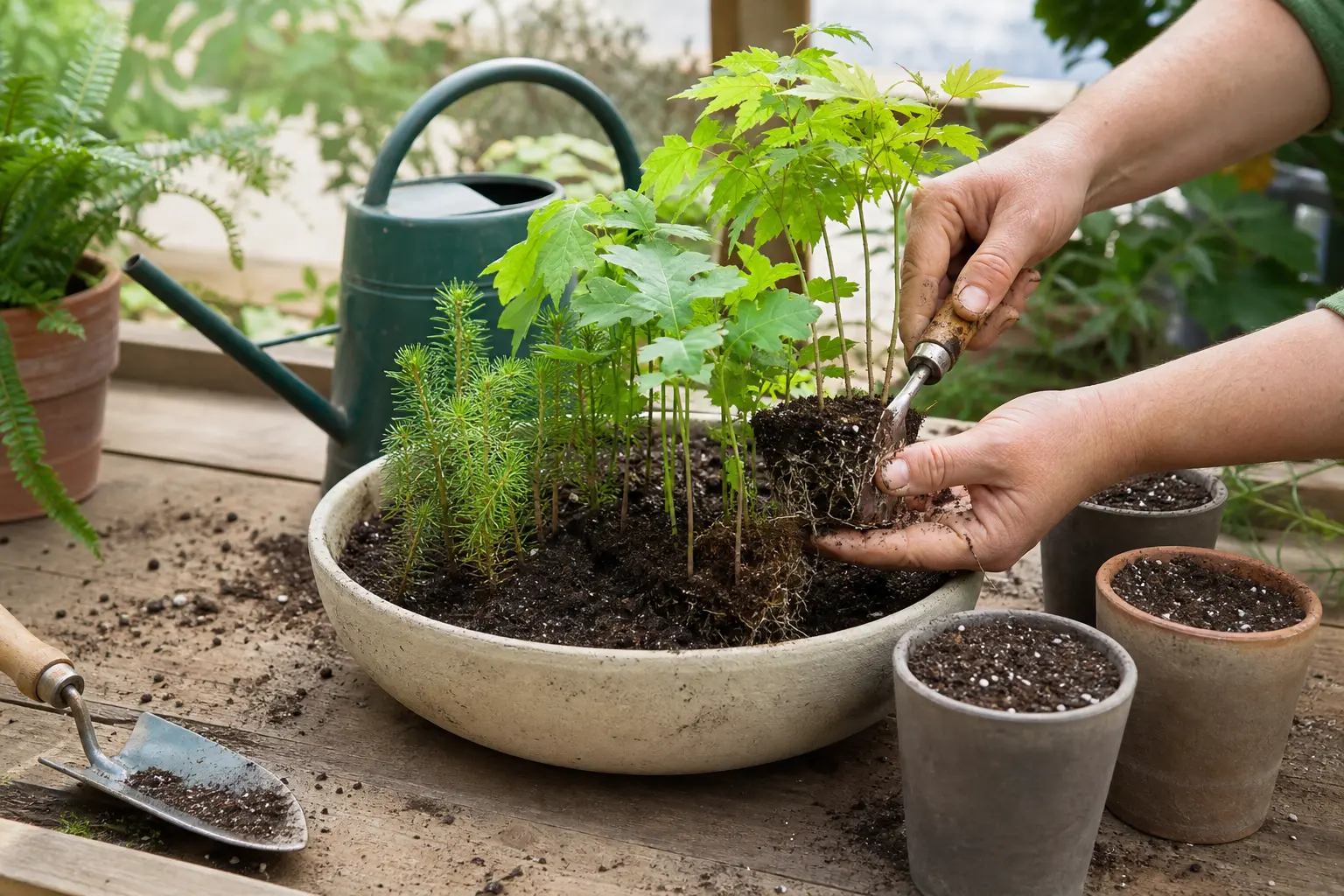
If several seedlings emerge in one pot, separate them once they are sturdy enough to handle but before their roots become heavily interwoven. Timing varies by species and planting density.
As a general rule, wait until each seedling has developed its first set or two of true leaves and is growing steadily. Do not pull apart seedlings immediately after emergence, when stems and roots are especially fragile.
The Best Time to Transplant Seedlings
Transplant on a mild day when seedlings are not drought-stressed. Separate them earlier if you notice:
- Crowded stems.
- One seedling shading the others.
- Roots emerging from drainage holes.
- Dense roots causing water to run through quickly.
- Seedlings stretching away from each other.
- One species growing much faster than the rest.
If tiny seedlings are tightly packed, it may be safer to sacrifice the weakest ones than risk damaging every plant. Two healthy seedlings are often better than ten severely disturbed ones.
How to Reduce Transplant Shock
Prepare new containers before lifting seedlings. Work calmly and do not let roots dry out.
- Water the shared pot lightly beforehand. The mix should be moist, not muddy.
- Lift the entire root area with a small tool. A spoon or narrow dibber works well.
- Ease soil apart gently. Preserve as much of each root system as possible.
- Hold seedlings by a leaf rather than the stem.
- Plant each at the same depth as before.
- Water enough to settle the mix around the roots.
- Protect them briefly from harsh sun and drying wind.
Avoid fertilizer immediately after transplanting unless species-specific guidance supports it. Disturbed roots need stable moisture, suitable light, and time to recover.
Choosing Individual Pots and Growing Medium
Use individual pots with drainage holes. They do not need to be decorative bonsai pots yet. Nursery pots, seedling cells, or small training pots are practical because they provide more moisture retention and root space than shallow ceramic containers.
Choose a pot that fits the root system without dramatically oversizing it. Very large pots can stay wet too long, especially indoors.
Use a clean, free-draining medium suited to young trees. Seed-starting mix is useful for germination, but seedlings often benefit from a slightly more open mix after transplanting. Avoid compacted garden soil, which drains poorly in containers.
Starting Different Bonsai Seeds Successfully
The simplest approach is to treat each species as its own small project. Use separate pots or labeled tray sections, and check each packet’s needs before planting.
This requires a little more organization at first but avoids many later problems. You will know which seeds were chilled, when they were sown, and what conditions they received.
Check Each Species’ Stratification, Temperature, and Light Needs
Before sowing, identify the actual tree species on each packet. Check whether it needs:
- Cold stratification: cool, moist conditions that break dormancy in many temperate seeds.
- Scarification: nicking, sanding, or soaking hard seed coats.
- Warmth: consistently warm germination conditions.
- Light or darkness: seed depth can affect germination.
- Seasonal outdoor conditions: some temperate species benefit from natural seasonal cycles.
Do not assume all seeds in a bonsai kit need the same treatment. If packets do not identify the species or provide reliable instructions, consider using seeds with better labeling.
Label Every Seed Group
Mark each pot or tray section with:
- Species name, if known.
- Date planted.
- Number of seeds sown.
- Any pre-treatment used.
- Expected germination window.
Waterproof labels are better than relying on memory. A notebook or phone note can also help track results and identify patterns, such as one species staying too wet or germinating much later.
Use Separate Pots When Requirements Differ
Use separate pots whenever species differ in dormancy, temperature, watering, or light needs. This is especially important when mixing tropical and temperate trees.
To save space, place separate small pots in one tray rather than sowing everything in one large pot. You get the convenience of one growing area without forcing every plant into identical conditions.
Conclusion
Different bonsai seeds can share one pot briefly, especially during germination, but it is rarely the easiest or healthiest long-term method. Different species often need different temperatures, watering schedules, light levels, and seasonal treatment. As seedlings grow, competition and tangled roots make separation harder.
For better survival and easier future bonsai training, sow each species separately whenever possible. If you have already planted several seed types together, let healthy seedlings establish, then separate them before the container becomes crowded.
Most importantly, do not judge a young seedling by whether it resembles a bonsai yet. It is supposed to look like a young tree. Bonsai character comes later through patient growth and intentional training.
FAQ
Can I plant different bonsai seeds in the same pot?
Yes, but only as a temporary seed-starting arrangement. Different species may need different germination conditions, and roots can quickly compete and tangle. Separate pots are safer when seed types have different stratification, warmth, moisture, or light needs.
Should I separate bonsai seedlings after they sprout?
Usually, yes. Wait until seedlings have developed true leaves and are growing steadily, then transplant them into individual containers before roots become heavily intertwined. Handle them gently and avoid pulling them apart by their stems.
Will planting several seeds together make a bonsai forest?
Not automatically. A bonsai forest is a designed composition of compatible trees, usually the same species or closely matched material, with deliberate spacing, height variation, root management, and visual balance. Randomly crowded seedlings are more likely to compete than form a convincing forest.
Why does my bonsai seedling look like a normal tree?
Because it is a normal young tree. “Bonsai” is not a seed type or naturally miniature plant. A seedling needs years of healthy growth before pruning, wiring, root work, and container cultivation can create the appearance of a mature tree in miniature.
You Might Also Like