Why Some Succulents Tolerate Drought While Haworthias, Gasterias, and Aeoniums Prefer Gentler Light
“Succulent” describes a plant that stores water, not a plant that automatically thrives in blazing sun. This is the key to understanding succulent drought tolerance and light needs.
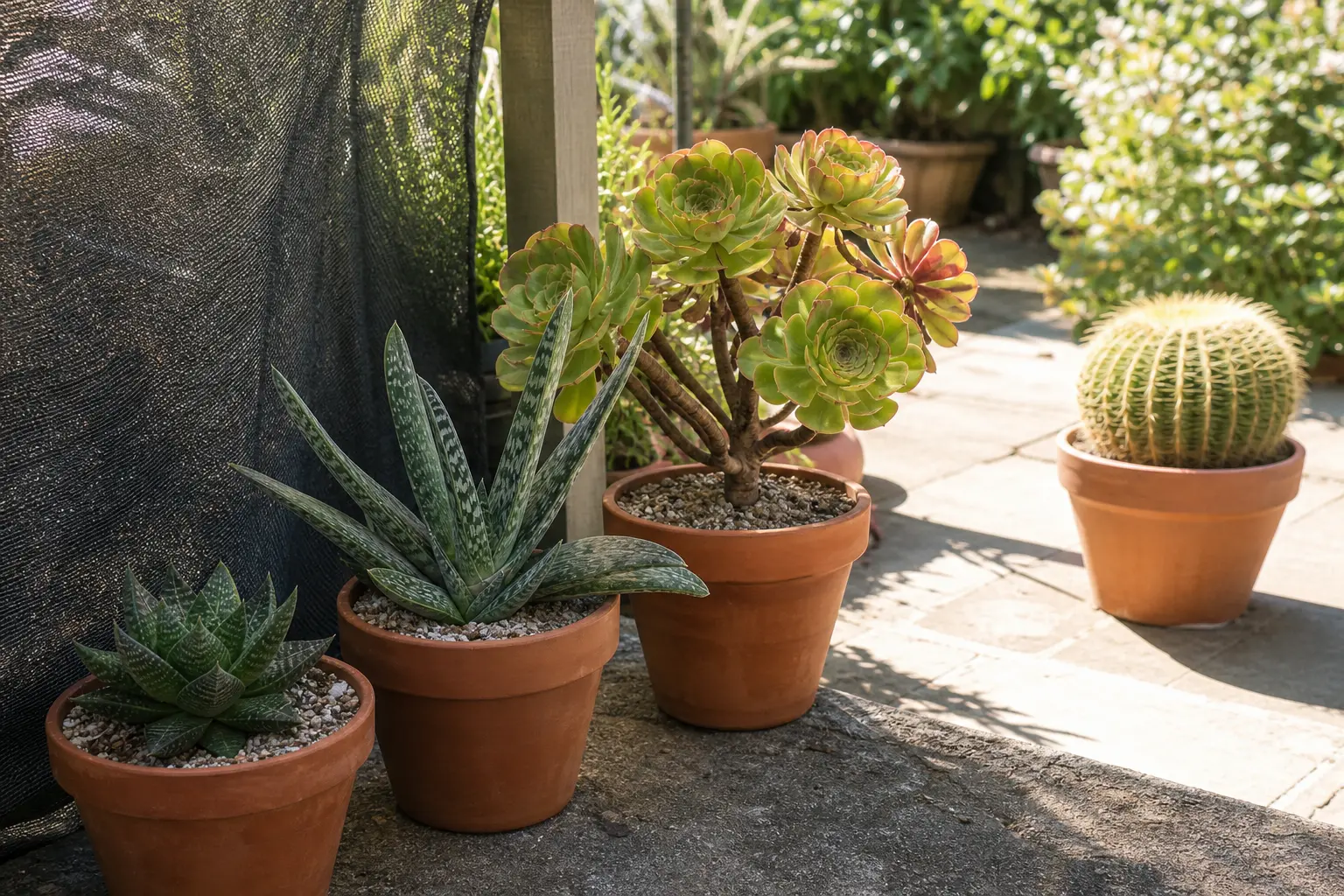
A prickly pear cactus, a Haworthia on a windowsill, and an Aeonium in a patio pot may all survive periods without water. Yet they evolved in different habitats, with different levels of heat, sun exposure, rainfall, and seasonal growth. Their ideal care can therefore be very different.
Drought Tolerance and Light Tolerance Are Different Adaptations
Drought tolerance is a plant’s ability to withstand limited water. Light tolerance is its ability to handle a particular intensity and duration of sun, along with the heat that comes with it. These traits often overlap, but they are not the same thing.
A succulent can be excellent at storing water and still suffer in hot, unfiltered afternoon sun.
How succulents survive dry conditions
Succulents have several adaptations that allow them to endure dry intervals:
- Water-storing tissues. Thick leaves, swollen stems, or fleshy roots act as reservoirs after rain or watering.
- Protective leaf surfaces. Many have waxy coatings, compact growth, hairs, or thick skins that slow water loss.
- Reduced leaf area. Spines, narrow leaves, tightly packed rosettes, and small leaves reduce the area through which moisture can evaporate.
- Efficient water use. Many succulents take in carbon dioxide at night rather than during the hottest part of the day, reducing water loss while photosynthesizing.
- Rain-responsive roots. Their root systems are often designed to absorb moisture quickly after brief rainfall, then sit in dry soil until the next wet period.
These traits help a plant cope with drought. They do not necessarily protect it from leaf temperatures that climb far above the surrounding air temperature in direct sun.
Why a drought-tolerant succulent can still burn in strong sun
A plant in a black pot on a south- or west-facing patio may experience conditions nothing like a dry but shaded rock crevice. Intense sun heats the leaves, pot, and root zone at once. Reflected light from walls, paving, glass, or gravel can make that exposure still harsher.
Sunburn occurs when light and heat exceed what leaf tissues can safely process. The result may be bleached patches, tan scars, crisp brown areas, or permanent discoloration. Stored water does not prevent this damage. In fact, a plant can lose moisture rapidly through hot leaves even when its potting mix is dry and it is technically drought adapted.
Light also changes dramatically by location:
- Indoor bright light is usually much weaker than outdoor sun, even beside a sunny window.
- Morning sun is cooler and gentler than late-afternoon sun.
- Filtered outdoor light beneath a shade cloth, tree canopy, porch roof, or open lattice can still be bright enough for healthy growth.
- Reflected heat near masonry, concrete, or glass can turn an otherwise reasonable site into a stressful one.
The right question is not simply, “Is this succulent drought tolerant?” It is, “What light and heat levels did this species evolve to handle?”
Why Haworthias and Gasterias Need Bright but Filtered Light
Many Haworthias and Gasterias are more tolerant of gentler light than sun-loving desert succulents. That does not make them plants for dim corners. They generally perform best in bright indirect light, dappled shade, or limited gentle sun.
Individual species and hybrids vary, so observe the plant rather than relying on a label alone.
Their natural preference for protected growing sites
Many Haworthias and Gasterias come from southern African environments where they often grow with some protection: beside rocks, under shrubs, among grasses, or partly sheltered in crevices. They may receive bright light for much of the day without being exposed to relentless overhead sun.
In cultivation, this often translates to:
- A bright east-facing window with a few hours of morning sun
- Strong light near a south- or west-facing window, set back from the glass or softened with a sheer curtain
- Outdoor shade with early sun and protection from intense afternoon exposure
- Bright, open shade under a covered patio or shade cloth
“Low light” is an unhelpful description if it suggests a dark shelf, interior bathroom, or windowless office. Haworthias and Gasterias can tolerate less direct sun than many Echeverias, but they still need enough usable light to photosynthesize, grow compactly, and dry their potting mix at a reasonable pace.
Leaf features that affect their sun tolerance
Haworthias commonly form small, compact rosettes with firm leaves. Some have translucent “windows” at the leaf tips. In their natural settings, these windows can help light reach photosynthetic tissue when much of the plant is sheltered or partly buried. They are not a sign that the plant wants harsh all-day sun.
Gasterias typically have thick, tongue-shaped leaves, often with pale spotting or textured surfaces. Their leaves can be sturdy, but sturdiness should not be confused with unlimited heat tolerance. Sudden direct sun, especially after indoor growing, can still cause scorching.
Compared with many high-sun rosette succulents, these plants are often better suited to protected light because of their growth habit and habitat. A compact rosette does not automatically mean a full-sun rosette.
Signs Haworthias and Gasterias are getting the wrong amount of light
Look for changes that develop over several weeks, not only a single imperfect leaf.
| Light issue | Common signs | Practical adjustment |
|---|---|---|
| Too much light or heat | Bleaching, reddish or brown stress coloring, dry patches, tan scars, shriveling despite dry soil | Move out of hot afternoon sun; use a sheer curtain, shade cloth, or brighter shade |
| Too little light | Stretching, leaning toward a window, weak or loose growth, faded markings, slow soil drying | Move gradually closer to a bright window or add a suitable grow light |
| Sudden change in light | Localized pale or brown burn marks, especially on exposed leaf surfaces | Reduce exposure and acclimate more slowly before increasing light again |
Red or bronze coloring is not always harmful; some plants color up under brighter light. However, if the color change comes with dry, thin, damaged, or bleached tissue, treat it as stress rather than a desirable trait.
Why Aeoniums Need a Different Light-and-Water Approach
Aeoniums need bright light to remain compact and attractive, but many are less comfortable in punishing summer heat than classic desert succulents. Their care is especially seasonal.
Aeoniums are not typical hot-desert succulents
Many cultivated Aeoniums trace their origins to island and Mediterranean-type climates, including the Canary Islands. These regions can be sunny, but their conditions are often moderated by coastal air, seasonal rainfall, elevation, or cooler nights.
Aeoniums commonly grow most actively during cooler parts of the year. In hot summer weather, many slow down or enter a semi-dormant state. Their rosettes may tighten, lower leaves may dry and drop, and growth can pause.
This is why an Aeonium can need more light than a Haworthia while still struggling in a scorching, west-facing summer position. Bright light supports sturdy stems and well-shaped rosettes; relentless heat can push the plant into stress or dormancy.
Adjusting Aeonium care by season
Match light and watering to the plant’s active period rather than following the same routine all year.
During cooler, brighter growing weather:
- Give Aeoniums bright light, with sun exposure suited to your climate.
- Water thoroughly when the potting mix has dried to an appropriate depth.
- Expect more active growth, especially when temperatures are mild.
During hot summer weather:
- Provide morning sun or bright filtered light in hot climates.
- Protect plants from severe afternoon sun and heat reflected from paving or walls.
- Water less often if the plant has clearly slowed or tightened into dormancy.
- Do not keep dormant roots constantly wet in an attempt to force growth.
In cool coastal climates, established Aeoniums may tolerate considerably more sun than they would in an inland area with hot, dry summers. Local conditions matter as much as the direction a window or patio faces.
Signs an Aeonium needs a change in placement
Aeoniums communicate stress through their rosettes and leaves.
- Excess heat: tightly closed rosettes, limp outer leaves, accelerated leaf drop, or a growth pause during summer.
- Too little light: long bare stems, wide open rosettes, leaves spaced farther apart, and weak, leaning growth.
- Too much direct sun: pale foliage, scorched edges, dry brown patches, or papery damage on the most exposed leaves.
Leaf drop is not automatically a crisis. Older Aeonium leaves naturally dry as stems lengthen, and some summer shedding is normal. Investigate further when leaf loss is sudden, extensive, or paired with mushy stems, blackened tissue, or persistently wet soil.
Match Light, Water, Soil, and Temperature Instead of Treating All Succulents Alike
Good succulent care comes from matching the whole growing environment to the plant. Light, temperature, watering, soil, pot size, and airflow all affect one another.
Choose light based on the species, not the “succulent” label
This broad comparison is more useful than treating every succulent identically:
| Plant group | Typical light preference | Main caution |
|---|---|---|
| Many cacti, Echeverias, Sedums, and Crassulas | High light; often direct sun when acclimated | Can still burn after sudden exposure or during severe heat |
| Many Haworthias and Gasterias | Bright indirect light, filtered light, or gentle morning sun | Dark rooms cause stretching and slow soil drying |
| Many Aeoniums | Bright light, often some sun in mild conditions | Hot afternoon sun and summer heat can cause stress or dormancy |
Species, cultivar, region, and season can shift these recommendations. A pale-leaved cultivar may scorch sooner than a green one; an indoor plant may need a much slower transition outdoors than a nursery-grown plant.
Water according to growth rate and drying conditions
Water thoroughly enough to moisten the root ball, then allow the mix to dry appropriately before watering again. Do not give small sips on a calendar schedule.
Check:
- Whether the potting mix is dry below the surface
- The plant’s current growth rate
- Temperature and light levels
- Pot size and material
- Seasonal dormancy
- Whether the pot has drainage
Low light, cool weather, and dormancy all slow water use. A Haworthia in a dim winter room may need water far less often than one in a bright, warm location. An Aeonium actively growing in cool weather may use more water than it does during a hot summer slowdown.
Drought tolerance does not mean permanent neglect. During active growth, even drought-adapted plants need periodic deep watering to replace what they have used.
Use soil and containers that prevent root problems
Use a fast-draining succulent mix in a container with drainage holes. The exact blend can vary, but the goal is consistent: water should move through the pot efficiently, while enough fine material remains to hold some moisture around the roots.
For Haworthias and Gasterias in lower-light settings, avoid oversized pots and dense, water-retentive mixes. Their soil will dry more slowly where light and airflow are limited. A smaller, appropriately sized pot reduces the amount of unused wet soil around the roots.
Terracotta can help a mix dry faster, while glazed ceramic and plastic tend to retain moisture longer. Neither is automatically better; choose based on your light, climate, watering habits, and soil mix.
Common Mistakes When Growing Low-Light-Tolerant Succulents
Most problems come from interpreting “tolerant” as “ideal.” A plant that survives a condition is not necessarily growing well in it.
Treating shade tolerance as no-light tolerance
Haworthias and Gasterias may remain alive in fairly low light, but prolonged dimness often leads to stretched growth, poor color, slow drying soil, and greater risk of overwatering.
Place them where they receive clear, usable daylight. If there is no suitable natural-light location, a grow light can be more effective than repeatedly moving the plant between a dark shelf and a sunny windowsill.
Moving plants into direct sun too quickly
Plants grown indoors have not developed the same tolerance as plants that have gradually adapted outdoors. A sudden move from a modestly lit room to full summer sun can burn leaves within days.
Acclimate slowly:
- Start with bright shade or brief morning sun.
- Increase exposure in small increments over one to three weeks.
- Watch the most exposed leaves for bleaching or heat stress.
- Pause or step back if damage appears.
Existing burn scars will not heal, though new growth can emerge healthy once the plant is placed correctly.
Watering on a fixed schedule
A calendar cannot account for a cloudy week, a heat wave, a cool room, dormancy, or a pot that has become root-bound. Instead of watering every seven or fourteen days, inspect the mix and the plant.
When in doubt, wait a little longer rather than watering soil that is still damp. But do not confuse “wait” with never watering: active plants in free-draining soil should receive a full drink once the mix has dried appropriately.
Conclusion
Drought tolerance describes how a succulent copes with limited water. It does not tell you how much direct sun, heat, or reflected light that plant can safely handle.
Haworthias and Gasterias usually prefer bright but filtered conditions because many are adapted to protected growing sites. Aeoniums need bright light as well, yet many grow best in milder seasons and need relief from extreme summer heat. By matching light, watering, soil, and temperature to the species rather than the “succulent” label, you can avoid both sunburn and overwatering while keeping plants compact and healthy.
FAQ
Are Haworthias and Gasterias true low-light plants?
They are lower-light tolerant than many sun-loving succulents, but they are not no-light plants. Bright indirect light, dappled outdoor shade, or gentle morning sun is usually more suitable than a dark room. If they stretch, lean, or lose their compact form, they need more light.
Can Aeoniums grow in full sun?
Yes, many Aeoniums can grow in full sun in mild climates or after gradual acclimation. In hot inland climates, intense summer afternoon sun can scorch leaves or trigger stress and dormancy. Morning sun with afternoon protection is often a safer choice.
Why is my succulent stretching even though it needs little water?
Stretching is usually a light problem, not a watering requirement. The plant is growing toward stronger light, producing elongated stems or wider spacing between leaves. Move it gradually to brighter conditions and avoid overwatering while it adjusts.
Should I water Haworthias, Gasterias, and Aeoniums less than other succulents?
Not automatically. Watering depends on light, temperature, growth rate, soil, and season. Haworthias and Gasterias may need less frequent watering in lower light because their pots dry slowly. Aeoniums may need more water during cool-season growth and much less during hot-weather dormancy. In every case, water after the mix has dried appropriately rather than following a fixed schedule.
You Might Also Like