How Do Leafless Trees Exchange Gases in Winter?
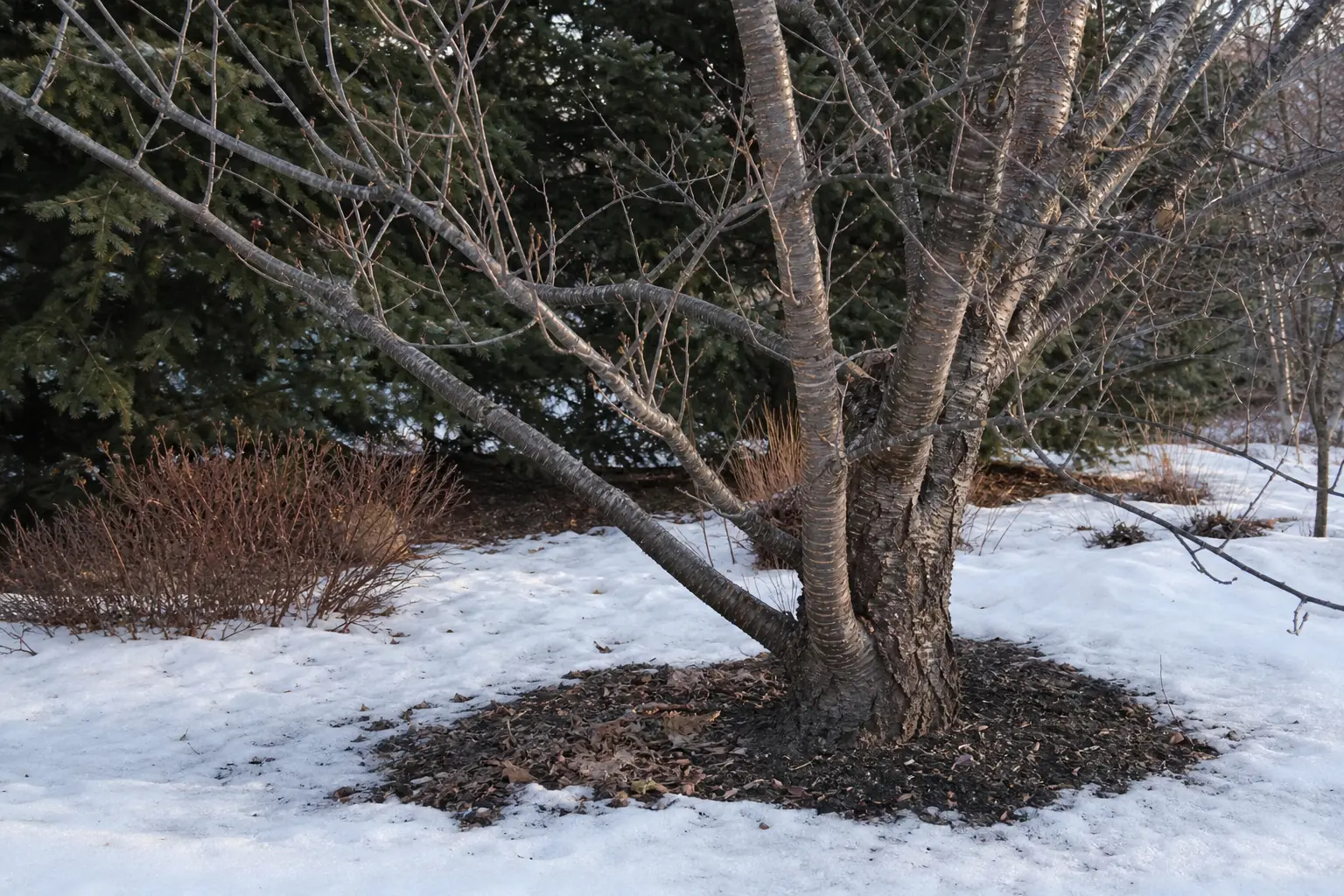
A leafless deciduous tree is not “asleep” in the sense of being inactive or dead. It still needs energy to keep its cells alive, maintain tissues, protect living buds, and prepare for spring growth. That means it continues to exchange gases throughout winter—just far more slowly than it does during the growing season.
In everyday language, people often ask how trees breathe in winter. Trees do not breathe with lungs, but their living cells still use oxygen and release carbon dioxide through a process called cellular respiration. When leaves are gone, much of that gas exchange occurs through small openings in bark and through air spaces in the soil around the roots.
Trees Still Respire After Their Leaves Fall
Deciduous trees—including maples, oaks, apples, birches, and many other familiar garden trees—shed their leaves to reduce water loss and avoid damage from freezing weather. Losing leaves greatly reduces their ability to capture sunlight, but it does not stop the tree’s basic life processes.
Living cells in the roots, trunk, branches, buds, and inner bark still need energy. They release that energy by breaking down stored sugars, using oxygen and producing carbon dioxide and water.
Respiration Is Different From Photosynthesis
The confusion usually comes from treating “breathing” and “making oxygen” as the same process. They are not.
| Process | What the tree needs | What it produces | When it occurs |
|---|---|---|---|
| Photosynthesis | Light, carbon dioxide, water | Sugars and oxygen | Only when living green tissues receive suitable light |
| Cellular respiration | Oxygen and stored or newly made sugars | Energy, carbon dioxide, water | Day and night, in all living cells |
During summer, a healthy leafy tree usually photosynthesizes strongly in daylight. Its leaves take in carbon dioxide and release oxygen. At the same time, every living part of the tree is also respiring.
During winter, a leafless deciduous tree has little or no leaf surface for photosynthesis. Yet respiration continues because its cells still need energy. Rather than producing a large amount of oxygen, the dormant tree is generally using oxygen and releasing small amounts of carbon dioxide.
Winter Dormancy Slows Activity Rather Than Stopping It
Dormancy is a protective state, not a complete shutdown. Short days, cold temperatures, and seasonal hormonal changes slow growth and reduce the tree’s energy demand. Buds remain tightly closed, new shoots do not elongate, and roots grow much more slowly or may temporarily stop in very cold soil.
However, many tissues remain alive:
- Dormant buds contain next season’s leaves and flowers.
- Inner bark and cambium contain living cells that will resume growth in spring.
- Fine roots may remain active whenever soil temperatures are suitable.
- Stored starches and sugars support maintenance and cold protection.
Respiration slows as temperatures fall because biochemical reactions proceed more slowly in cold conditions. A tree in deep winter dormancy therefore uses much less oxygen than an actively growing tree in July, but it does not stop using oxygen altogether.
How Trunks, Branches, and Roots Exchange Gases
Without leaves, gas movement does not disappear; it shifts to other parts of the plant. Oxygen from the surrounding air diffuses into living tissues, while carbon dioxide diffuses outward. This is passive movement driven by differences in gas concentration, not an active inhale-and-exhale cycle.
The route is not as direct or as rapid as gas exchange through a canopy full of leaves. Winter exchange is modest because the tree’s metabolism is modest.
Lenticels in Bark Allow Gas Exchange
Many woody stems have tiny porous areas called lenticels. They may look like raised dots, short horizontal marks, pale specks, or rough corky patches on bark. Cherry and birch trunks often show conspicuous horizontal lenticels, while on other species they are harder to notice.
Lenticels interrupt the otherwise protective outer bark and connect internal air spaces with outside air. Through them, oxygen can diffuse inward and carbon dioxide can move outward.
It is reasonable to say that a tree “breathes through its bark” in winter, but that phrase needs a little qualification. The tree is not using every inch of bark as a lung. Much of the outer bark is dead, corky, and designed to reduce water loss and physical damage. Gas exchange occurs through lenticels, cracks, young stem surfaces, and internal air spaces associated with living tissues.
Young twigs generally exchange gases more readily than old, heavily corked trunks. Some species also have green bark or young green stems that can carry out a small amount of photosynthesis when conditions allow. This is not enough to replace the work of a full leaf canopy, but it can contribute modestly.
Roots Need Oxygen From Air Spaces in the Soil
Roots also respire, and they need oxygen. Most root oxygen comes from air held in pore spaces between soil particles rather than directly from liquid water.
In a well-structured soil, both water and air occupy different pores:
- Larger pores tend to hold air after excess water drains away.
- Smaller pores retain water that roots can use.
- Oxygen diffuses through the air-filled pores to roots and soil organisms.
Fine roots are especially dependent on an adequate oxygen supply. If soil stays saturated for long periods, water fills the pores and oxygen moves much more slowly. Root respiration becomes difficult, even in winter.
This is why poor drainage can be harmful around trees. A tree may appear dormant above ground while its roots are stressed below ground. Compacted clay, standing water, deep mulch piled against the trunk, and containers without drainage can all worsen root-zone oxygen shortages.
Frozen soil creates a different limitation. Ice can block water movement and reduce gas diffusion through soil pores. The effect depends on soil texture, snow cover, moisture level, depth of freezing, and the tree species. Roots are often better protected under insulating snow than in exposed, dry, repeatedly frozen ground.
Dormant Buds and Inner Tissues Also Respire
Dormant buds may look inert, but they contain living embryonic leaves, stems, and sometimes flower parts. These tissues respire slowly throughout winter and depend on the tree’s stored carbohydrate reserves.
The cambium—the thin layer of living cells beneath the bark that produces new wood and inner bark—also remains alive, though it is largely inactive during deep dormancy. Living cells in the sapwood and inner bark need oxygen as well.
A tree’s woody structure is therefore not simply dead material holding up branches. The central heartwood in many mature trees is largely nonliving, but surrounding tissues contain active cells and air spaces that support winter survival.
Why Leafless Trees Produce Little or No Oxygen in Winter
Oxygen release is mainly a result of photosynthesis. Since deciduous trees have dropped their leaves, they have lost the large, light-catching surfaces that normally drive this process.
A leafless tree may still have a little photosynthetic activity in green twigs or bark, depending on the species. But in practical terms, its winter oxygen production is minimal compared with its production during the leafy growing season.
Meanwhile, respiration continues at a low rate. So a dormant deciduous tree is generally a small net user of oxygen and a producer of carbon dioxide during winter.
What Happens at Night and During Winter
At night, photosynthesis stops because it requires light. Respiration does not stop. This is true for every healthy tree, whether deciduous or evergreen.
During a bright summer day, photosynthesis in a leafy tree usually exceeds respiration, so the tree has a net uptake of carbon dioxide and net release of oxygen. At night, the balance reverses: respiration continues and the tree releases carbon dioxide.
In winter, leafless deciduous trees have little or no photosynthesis even during daylight. Their low level of respiration still continues around the clock.
Why Trees Do Not Produce Oxygen 24/7
No tree produces oxygen continuously through the full 24-hour day. Oxygen production depends on photosynthesis, and photosynthesis depends on usable light, functioning green tissues, adequate water, and suitable temperatures.
This matters when interpreting broad claims that a particular tree “gives oxygen 24/7.” Trees are valuable for many reasons, including shade, habitat, carbon storage, cooling, and seasonal oxygen production. But all plants respire, and none photosynthesize in darkness.
The important point is not that trees somehow fail in winter. They are using a survival strategy: conserving water and energy until conditions favor new growth.
How Cold and Frozen Soil Affect Winter Tree Function
Cold changes nearly every aspect of tree function. Enzymatic activity slows, roots absorb water less readily, and the lack of leaves sharply reduces transpiration—the upward pull created as water evaporates from foliage.
A dormant tree therefore needs much less water than it does in summer. Still, it is not entirely free from water stress. Evergreen trees, recently planted trees, and trees exposed to sun and wind can lose moisture during winter even when their roots cannot replace it easily.
Can Trees Absorb Water When the Ground Is Frozen?
Trees can absorb water during winter when at least part of the root zone remains unfrozen and the soil contains available moisture. In milder periods, roots may resume limited activity, especially in protected soils or climates with intermittent freezes.
When the soil is frozen solid around the active roots, water uptake is greatly restricted or stops. Ice is not readily available to roots in the way liquid soil water is. A tree may have snow or frozen water around it and still be unable to draw enough moisture through its roots.
This is particularly important for evergreens. Needles and broad evergreen leaves can lose water on sunny or windy winter days. If roots are locked in frozen soil, foliage may dry out, producing winter burn: browned needle tips, scorched leaf margins, or patchy dieback that becomes clearer in spring.
For newly planted trees, sensible fall watering before the ground freezes can help if the soil is dry. Avoid routine watering into already saturated or frozen ground, where water cannot soak in and may worsen drainage problems.
Why Winter Damage Can Occur Despite Dormancy
Dormancy improves a tree’s cold tolerance, but it does not make the tree invulnerable. Winter injury often results from a combination of stress rather than one low temperature alone.
Common problems include:
- Winter desiccation: foliage or twigs lose more water than roots can replace.
- Freeze-thaw injury: repeated temperature swings damage bark, buds, or roots.
- Sunscald: winter sun warms bark on exposed trunks, followed by rapid cooling after sunset.
- Root oxygen stress: saturated soil limits oxygen around roots.
- Frost heaving: alternating freezing and thawing can lift shallow-rooted young plants from the soil.
- Rodent damage: mice and voles may chew bark beneath snow cover.
For gardeners, the practical priorities are usually simple: plant species suited to the site, maintain good drainage, water newly planted trees adequately before hard freezes, keep mulch a few inches away from the trunk, and protect vulnerable young trunks from sunscald or animal damage where needed.
Deciduous vs. Evergreen Trees in Winter
Deciduous and evergreen trees both respire in winter, but they differ in how much photosynthesis they can perform.
A leafless maple or apple tree relies largely on stored energy and keeps gas exchange low through bark, buds, roots, and internal air spaces. An evergreen pine, spruce, holly, or rhododendron retains foliage, allowing at least some photosynthesis during suitable winter weather.
That does not mean evergreens operate as they do in summer. Cold temperatures, frozen soil, short days, and dry wind can severely limit their activity.
Why Conifers Can Stay Green
Conifers keep their needles because those needles are built to tolerate difficult conditions. Many have a waxy cuticle, small surface area, protected stomata, and internal features that reduce winter water loss. Their needles also contain compounds and cellular adaptations that help them withstand freezing.
Keeping needles gives conifers a head start when temperatures rise. On mild, sunny winter days, they may photosynthesize at a low rate without waiting to grow a new canopy.
The trade-off is water management. A leafy or needle-covered evergreen can lose moisture in winter, while a leafless deciduous tree avoids much of that risk by dropping its foliage.
How Winter Gas Exchange Varies by Species and Weather
Winter gas exchange is not identical for all trees. It varies with:
- Species and native climate adaptation
- Air and soil temperature
- Sunlight intensity and day length
- Snow cover and soil insulation
- Wind exposure
- Soil drainage and compaction
- Tree age, health, and recent transplanting
A mature native oak in deep dormancy may have very low metabolic activity during a hard freeze. A pine on a sunny, calm day above freezing may photosynthesize modestly. A newly planted evergreen in windy, frozen ground may struggle because its foliage continues to lose water while its roots cannot replenish it.
The visible difference—bare branches versus green needles—does not mean one tree is alive and the other is inactive. Both are living organisms adjusting their gas exchange and energy use to winter conditions.
Conclusion
Leafless trees exchange gases in winter through lenticels in their bark, young stems, internal air spaces, and their roots in oxygenated soil. Their living cells continue to respire, taking in oxygen and releasing carbon dioxide, although cold temperatures and dormancy slow the process dramatically.
Because deciduous trees have dropped their leaves, they carry out little photosynthesis and produce little oxygen during winter. Evergreens can photosynthesize on favorable days because they retain foliage, but they also continue to respire and may face winter water stress when soil is frozen.
A bare tree in January is not inactive. It is conserving resources, protecting its living tissues, and maintaining the slow, essential processes that allow it to leaf out again in spring.
FAQ
Do trees breathe through their bark in winter?
Yes, in a limited sense. Trees exchange gases through small porous structures in bark called lenticels, especially on young stems and twigs. Oxygen diffuses inward to living cells, and carbon dioxide diffuses outward. The bark is not a lung, but lenticels and internal air spaces provide a route for winter gas exchange when leaves are absent.
Do trees release oxygen in winter?
Leafless deciduous trees release very little oxygen in winter because oxygen release comes mainly from photosynthesis, and they have no leaves to capture much sunlight. They still respire, which uses oxygen and releases carbon dioxide. Evergreens may photosynthesize and release some oxygen on mild, bright winter days, but at a much lower rate than during the growing season.
Are dormant trees alive during winter?
Yes. Dormant trees are alive. Their buds, roots, inner bark, cambium, and other living tissues continue low levels of respiration and maintenance. Dormancy slows growth and metabolism to conserve energy; it does not stop all biological activity.
Do tree roots need oxygen in frozen soil?
Tree roots need oxygen year-round. They normally obtain it from air spaces in the soil. When soil is frozen or waterlogged, gas movement is restricted and roots may have less access to both oxygen and liquid water. Healthy trees can tolerate seasonal limitations, but prolonged saturation, poor drainage, or repeated severe freezing can contribute to root stress.
You Might Also Like