Do Snake Plants Benefit From Misting?
Snake plant misting is usually unnecessary. Snake plants (often sold as Sansevieria and now commonly classified as Dracaena trifasciata) are adapted to tolerate dry conditions and generally do well in the average home without added humidity.
In fact, regular misting can create more risk than benefit. Water that lingers between the upright leaves or collects near the crown can encourage rot and fungal problems, especially in cool rooms, low light, or areas with limited air movement.
For most plants, the better approach is simple: water the potting mix thoroughly only after it has dried sufficiently, use a pot with drainage, and keep the leaves reasonably clean. A snake plant does not need daily sprays to stay healthy.
Should You Mist a Snake Plant?
No—snake plants do not need regular misting.
They are among the more forgiving houseplants for homes with ordinary indoor humidity. Unlike plants from constantly humid tropical forest floors, snake plants have thick, water-storing leaves and are better suited to periods of dryness than to lingering moisture around their foliage.
An occasional light mist is unlikely to harm a healthy plant if the leaves dry quickly. However, it is not a useful routine care practice, and it should not be used to solve issues such as curling leaves, brown tips, slow growth, or drooping. Those symptoms are more often related to watering habits, light levels, root health, temperature stress, or accumulated salts in the potting mix.
Misting also produces only a short-lived change in the air around a plant. Once the droplets evaporate, humidity returns to the room’s normal level. That temporary effect rarely justifies repeatedly wetting the leaves.
If your snake plant is healthy in its current location, there is no need to add misting to its care routine.
Why Misting Can Be a Problem for Snake Plants
A snake plant can tolerate a missed watering much better than it can tolerate consistently wet conditions. While misting alone does not always cause a problem, it can add unwanted moisture to a plant that already prefers its soil and foliage to dry between waterings.
The risk is greatest when misting is combined with overwatering, a pot without drainage, dense potting soil, poor light, or a cool room. These conditions slow evaporation and make it easier for moisture-related problems to develop.
Moisture Can Collect at the Leaf Base
Snake plant leaves grow upright from a central crown or base. When water is sprayed over the foliage, droplets can run down the leaves and settle in the tight spaces where leaves overlap.
That trapped water may not evaporate as quickly as water on the exposed leaf surface. If it remains near the crown repeatedly, it can contribute to soft, discolored tissue or rot. This is especially concerning for compact varieties with tightly packed leaves, such as bird’s nest snake plants.
Be cautious if you notice any of the following near the soil line:
- Leaves becoming soft, translucent, or mushy
- Yellowing that starts at the base rather than at the tip
- A sour or stale smell from the potting mix
- Leaves that lean, collapse, or pull away easily
- Dark brown or blackened areas around the crown
These signs do not automatically mean misting is the only cause. Root rot is more commonly linked to soil that stays wet too long. Still, spraying the leaves can make an already damp situation worse.
If water accidentally collects between leaves, gently blot it with a soft cloth or paper towel rather than leaving it to sit.
Poor Airflow Makes Damp Leaves Riskier
Water on leaves is less concerning when it dries rapidly in a warm, bright, well-ventilated room. It becomes more problematic when the plant sits in stagnant air, dim light, or cool conditions.
For example, a snake plant placed in a dark bathroom, enclosed corner, or chilly room may stay damp longer after misting. The same plant might dry quickly near a bright window with normal air circulation. The issue is not simply that the leaves got wet; it is that they remain wet often enough to create an unfavorable environment.
Avoid misting if your plant is:
- In low light
- Near a cold window during winter
- In a room that stays cool for long periods
- Crowded closely among other plants or furniture
- Already showing signs of overwatering
- Planted in heavy soil or a container that drains poorly
Good airflow does not mean placing the plant directly in the path of a strong fan, heater, or air-conditioning vent. Constant drafts can stress the foliage. Instead, aim for an ordinary room with reasonable circulation and avoid keeping the plant in a closed, persistently damp space.
Misting Does Not Replace Proper Watering
Misting can give the impression that a plant has been watered, but it does not provide the root zone with the moisture a snake plant needs. The roots take up water from the potting mix, not from droplets on the foliage.
If the soil is dry enough that the plant needs water, misting the leaves will not correct the problem. Conversely, if the soil is still damp, misting can add moisture around the crown without helping the roots.
A better watering check is to feel the potting mix below the surface. Do not rely only on the very top layer, which can dry faster than the root zone. A wooden chopstick, finger, or moisture check deeper in the pot can help you judge whether the mix is still damp.
When it is time to water, apply water directly to the soil until the root ball is evenly moistened and excess water drains from the bottom. Then discard runoff rather than allowing the pot to sit in a saucer of water.
How to Meet a Snake Plant’s Humidity Needs
Snake plants are usually comfortable in normal household conditions. They do not require a humidifier, pebble tray, or routine misting to grow well.
Their tolerance for average indoor air is one reason they are commonly chosen for offices, bedrooms, living rooms, and other spaces where humidity changes through the year. They may grow more slowly in less-than-ideal conditions, but slow growth alone is not evidence that the air is too dry.
Typical Home Humidity Is Usually Enough
A snake plant is unlikely to struggle solely because a home feels a little dry. It can generally adapt to the humidity found in most heated or air-conditioned rooms, provided its other needs are met.
Before blaming dry air for leaf problems, check the more likely causes:
| Symptom | More likely explanation than low humidity | What to check |
|---|---|---|
| Yellow, soft leaves | Overwatering or poor drainage | Soil moisture, pot drainage, root condition |
| Wrinkled or slightly folded leaves | Prolonged underwatering | Whether the root ball has become very dry |
| Brown, crispy tips | Irregular watering, salt buildup, physical damage, or dry drafts | Watering pattern, water quality, vents, leaf damage |
| Pale or weak growth | Insufficient light | Distance from the nearest bright window |
| Leaf spots | Water sitting on foliage, injury, or disease pressure | Whether leaves are frequently sprayed or stay wet |
Snake plants do best with bright, indirect light, although they can tolerate lower light. In lower light, their soil dries more slowly, so watering—and any added moisture from misting—should be even more conservative.
Better Options for Very Dry Indoor Air
In unusually dry conditions, it is reasonable to make the overall environment more comfortable without spraying water directly onto the snake plant. This may be relevant during winter heating, in very dry climates, or when multiple humidity-sensitive plants share the same room.
Better options include:
- Use a room humidifier if several plants and people benefit from it. Position it so that it raises general room humidity rather than blowing a constant stream of moisture onto the snake plant.
- Group compatible houseplants loosely together. Plants release some moisture as they transpire, though grouping should not be so tight that air cannot circulate.
- Move the plant away from harsh dry drafts. Heating vents, radiators, and forced-air outlets can dry and damage leaf tips.
- Choose a more stable spot. A location away from abrupt swings in temperature and airflow is often more helpful than trying to compensate with misting.
- Maintain correct soil moisture. A plant that is regularly allowed to become bone-dry for extended periods may look dehydrated even if room humidity is fine.
Pebble trays are sometimes suggested for houseplants, but their effect is limited unless conditions allow enough evaporation to meaningfully change the air immediately around the plant. For a snake plant, they are rarely necessary and can be inconvenient if the pot ends up sitting in water.
If you use any humidity method, keep the pot itself out of standing water. The bottom of the container should rest above the water level, not in it.
When Humidity Is Actually a Concern
Humidity deserves attention when there is a clear environmental reason to suspect it is unusually low or unstable—not simply because snake plants are houseplants.
Consider the room conditions if the plant is close to a heating source, receives hot air from a vent, or sits beside an air conditioner that runs frequently. You may also notice dry air affecting other plants that are known to prefer higher humidity.
Even then, assess the whole care setup. A snake plant with brown tips may be reacting to a mix of factors: dry drafts, inconsistent watering, root stress, fertilizer buildup, or a damaged leaf edge. Raising humidity alone may not resolve the issue.
Be especially careful not to confuse “humidity-loving” care with “more water” care. A snake plant can tolerate somewhat more humid air, but it still needs a free-draining potting mix and time for the root zone to dry between waterings.
Better Care Practices Than Misting
If you want to improve your snake plant’s condition, focus on practices that support its roots and prevent moisture from lingering where it does not belong.
Consistent but restrained watering, a suitable pot, and clean leaves will do far more for the plant than a spray bottle.
Water the Soil, Not the Leaves
Water the potting mix around the base of the plant rather than spraying the leaves. Use a narrow-spout watering can, squeeze bottle, or cup that lets you direct water onto the soil without filling the leaf crown.
Wait until the soil has dried substantially before watering again. The exact timing depends on several conditions:
- Light level
- Season and room temperature
- Pot size
- Potting mix
- Whether the plant is actively growing
- How root-bound the plant is
A snake plant in bright light during warm weather may use water more quickly than one in a dim room during winter. Rather than following a rigid calendar, check the soil each time.
When watering, do it thoroughly enough to moisten the root ball. A tiny splash every few days can leave parts of the mix dry while keeping the upper layer and crown too damp. After watering, let excess drain completely.
If you are unsure whether to water, waiting a little longer is generally safer than watering early. Snake plants are drought tolerant, but they are not immune to rot.
Use a Pot With Drainage
A container with at least one drainage hole is one of the most important parts of snake plant care. Without drainage, excess water has nowhere to go, and the lower roots may remain wet long after the surface appears dry.
Choose a pot that is only modestly larger than the root ball when repotting. An oversized pot holds more unused soil around the roots, which can stay damp for too long.
The potting mix should also drain freely. A heavy, compacted mix holds moisture longer than a snake plant needs. A houseplant mix amended for better drainage, or a ready-made mix intended for succulents and cacti, can be suitable as long as it does not become hydrophobic or dry out so completely that water runs straight through without wetting the roots.
Terracotta pots can be useful for gardeners who tend to overwater because the porous material allows moisture to evaporate more readily. However, they are not mandatory. Plastic and glazed ceramic pots can also work well when they have drainage and watering is adjusted to the slower drying time.
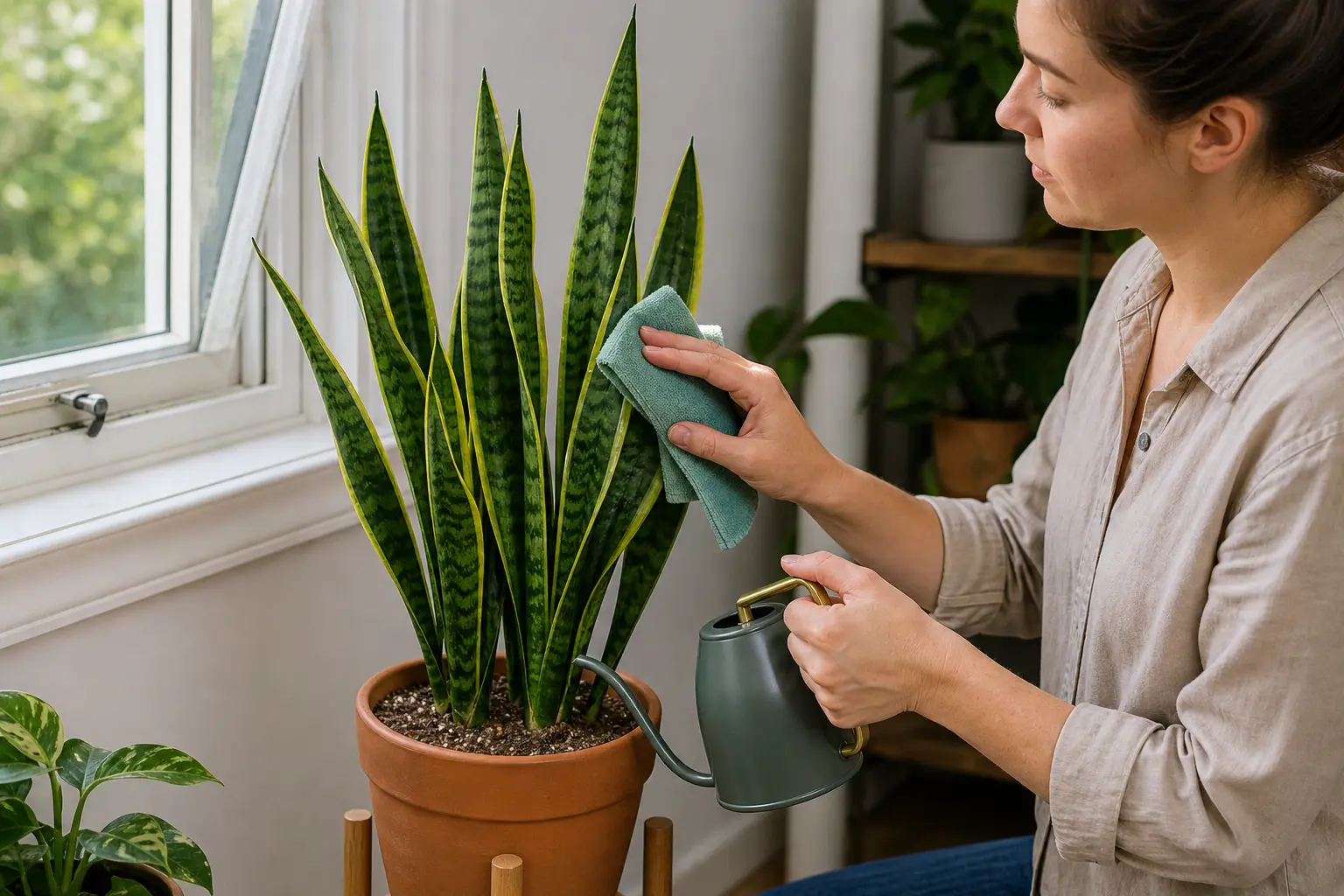
Wipe Dust From Leaves Carefully
Snake plant leaves can collect dust, particularly in indoor spaces with heating, pets, open windows, or frequent foot traffic. Dust can dull the plant’s appearance and reduce the amount of light reaching the leaf surface.
Instead of misting to clean the plant, wipe the leaves gently.
- Use a soft microfiber cloth or other clean, non-abrasive cloth.
- Dampen it lightly with plain water and wring it out well.
- Support each leaf with one hand while wiping with the other to avoid bending or creasing it.
- Wipe from the base upward toward the tip.
- Use a dry section of the cloth to remove any remaining moisture, especially near the leaf bases.
For a lightly dusty plant, a dry microfiber cloth may be enough. Avoid leaf-shine products, oils, milk, mayonnaise, and other home remedies that can leave residue or interfere with the natural surface of the foliage.
Do not scrub damaged areas or try to remove permanent scars. Snake plant leaves do not repair torn or bruised tissue. Cleaning should be gentle and cosmetic, not aggressive.
Conclusion
Snake plant misting is not needed for healthy growth. These resilient houseplants usually adapt well to ordinary indoor humidity, and repeatedly wetting their foliage can create avoidable problems when water collects at the leaf base or dries slowly.
Instead of misting, keep the plant in a pot with drainage, use a fast-draining mix, and water the soil only after it has had time to dry. If the leaves are dusty, wipe them with a lightly damp cloth and dry away excess moisture.
For most snake plants, less frequent interference is better care. Avoiding excess moisture around the crown and roots gives the plant the best chance to remain firm, upright, and healthy.
FAQ
Can I Mist My Snake Plant Occasionally?
You can mist a snake plant occasionally without necessarily harming it, provided the leaves dry quickly and water does not collect in the crown. However, there is little benefit to doing so, and it should not become a regular routine.
Skip misting if the plant is in low light, cool conditions, poor airflow, or a room where the foliage will stay damp. It is also best avoided if the plant has any signs of overwatering, softness at the base, or leaf spotting.
Do Snake Plants Like Humidity?
Snake plants tolerate average household humidity well and do not require high humidity. They can live in a somewhat more humid room as long as their soil drains properly and they are not kept constantly wet.
If your home is exceptionally dry, move the plant away from direct heating or air-conditioning drafts. A room humidifier can help moderate the general environment, but direct misting is usually unnecessary.
Should I Spray Water on Snake Plant Leaves?
It is better not to spray water on snake plant leaves as a routine practice. Spraying does not replace watering the roots, and it may leave moisture trapped where leaves meet at the base.
For cleaning, wipe the leaves with a soft cloth that is only lightly damp. Follow with a dry cloth if needed so no water remains in the leaf crevices.
How Often Should I Water a Snake Plant Instead?
Water when the potting mix has dried substantially, rather than on a fixed weekly schedule. Depending on light, temperature, pot size, and season, this may mean watering more often during warm, bright periods and much less often in winter or low light.
Before watering, check below the surface of the soil. If it still feels damp, wait. When it is time to water, soak the soil evenly and allow excess water to drain away completely.
You Might Also Like