How to Help a New Cactus Settle In and Start Growing
A new cactus usually does best when you resist the urge to change everything right away. Many problems begin when a cactus gets brighter sun, a new pot, new soil, heavy watering, and fertilizer all in the same week.
The safest cactus settling tips are simple: inspect the plant, give it stable light, keep the roots on the dry side, use fast-draining soil if repotting is needed, and watch how it responds. Cacti are tough, but a plant that has been shipped, handled in a shop, or moved from a greenhouse to your windowsill still needs time to adjust.
Give Your New Cactus a Gentle First Week
The first week is mostly for observation. Learn what condition the cactus is in before changing its care. Dry soil, corky marks, and minor scars are often normal. Soft tissue, pests, fresh wounds, or soggy soil are more urgent.
Place the cactus somewhere bright but protected, keep it away from your other plants, and avoid dramatic changes unless there is an obvious problem such as rot or pests.
Check for damage, pests, or soft spots
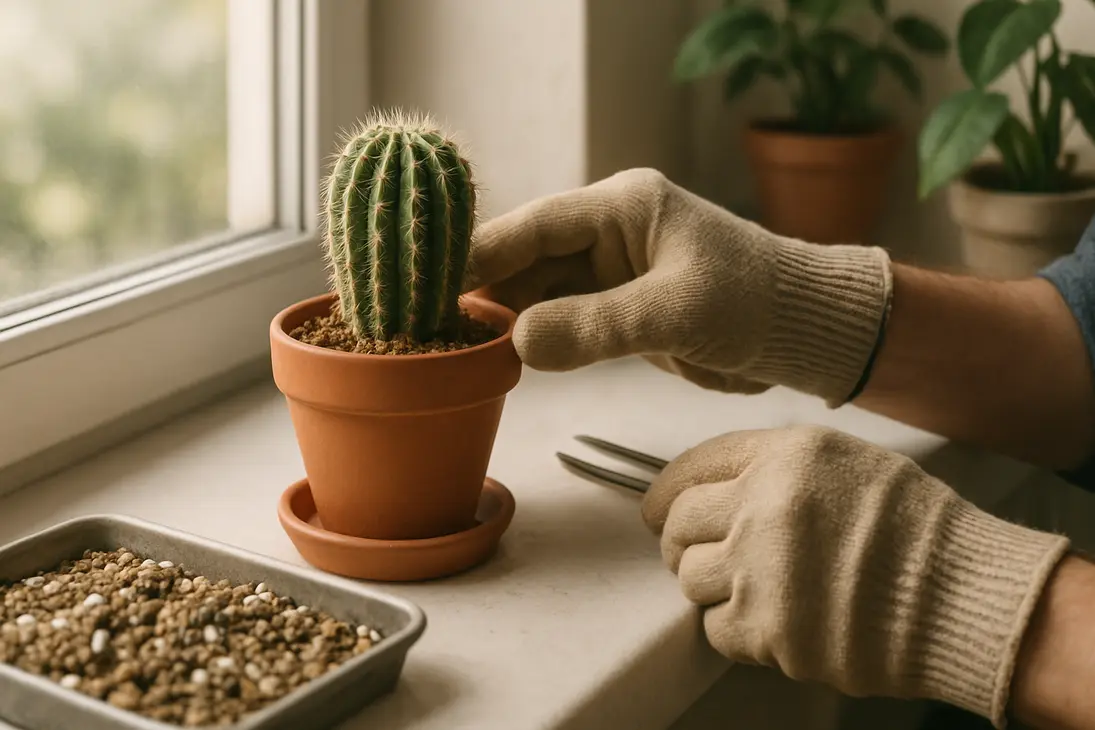
Inspect the cactus before you water or repot. Use good light and, if possible, a magnifying glass. Wear gloves or use folded newspaper, tongs, or a towel to handle spiny plants.
Look for:
- Soft, mushy, dark, or sunken areas, especially near the base
- Yellowing or translucent tissue
- Fresh breaks or open wounds
- White cottony clusters, often a sign of mealybugs
- Tiny moving insects around ribs, spines, flowers, or soil
- Webbing, speckling, or dusty patches, which may suggest mites
- A sour or rotten smell from the mix or plant base
Some marks are normal. Many cacti develop firm, tan, corky, or woody-looking areas near the base as they age. Old handling scars are also usually dry and firm. The key difference is texture: healthy scarring is firm; rot is soft, wet, spreading, or collapsing.
If the cactus has a small dry wound, leave it alone and keep it dry while it calluses. If the base is soft, remove the plant from the pot and inspect the roots. A rotting cactus needs prompt action, not routine settling-in care.
Keep it separate from other plants at first
Quarantine a new cactus for at least one to two weeks, especially if it came from a big-box store, plant swap, online shipment, or clearance shelf.
Keep it on a separate windowsill, table, or shelf where pests cannot easily move to nearby plants. Check it every few days, focusing on hidden places: between ribs, under offsets, around the crown, and near the soil line.
This quiet waiting period helps you catch pests early and see whether the plant is firming up, shrinking, discoloring, or staying stable.
Avoid fertilizing or heavy watering right away
A stressed cactus does not need an immediate “boost.” Fertilizer is useful only when the plant is actively growing and has healthy roots. Right after purchase or shipping, it can add unnecessary salts and encourage weak growth if light is poor.
Heavy watering is also risky, especially if you do not know the soil mix. Many store-bought cacti are sold in peat-heavy media that can stay wet too long indoors.
A safe first-week approach is:
- If the soil is wet or damp, let it dry.
- If the soil is bone dry, still wait a few days unless the cactus is severely shriveled.
- If the cactus was shipped bare-root, pot it into dry or barely moist gritty mix and wait several days before watering.
- If there are broken roots or fresh wounds, keep it dry until damaged areas have had time to callus.
Cacti usually tolerate a short dry period better than wet, damaged roots.
Choose the Right Light and Indoor Spot
Light is one of the biggest factors in whether a cactus settles in or slowly declines. Many desert cacti need more light than they get in a typical room, but a cactus that has been indoors, boxed, or kept under store lighting can burn if moved straight into harsh sun.
The goal is steady adjustment, not maximum sun on day one.
Start with bright indirect light
For the first week, place the cactus in bright indirect light or gentle morning sun. Indoors, this often means:
- Near an east-facing window
- A short distance back from a bright south or west window
- Behind a sheer curtain in a very sunny window
- Under a suitable grow light, but not extremely close to it
Bright indirect light should be strong enough that you can read comfortably during the day without a lamp. A cactus in a dim corner may survive for a while, but it will not grow well and may stretch.
If the cactus came from an outdoor nursery in full sun, it may tolerate brighter light sooner. If it came from a supermarket shelf, shipping box, or shaded greenhouse bench, treat it as light-sensitive at first.
Increase direct sun gradually
After the first week, increase direct sun in small steps. This is especially important for globular cacti, columnar cacti, and prickly pears that ultimately prefer strong light.
A simple acclimation schedule:
| Time after bringing it home | Light exposure |
|---|---|
| Days 1–7 | Bright indirect light or gentle morning sun |
| Week 2 | 1–2 hours of direct morning sun |
| Week 3 | 2–4 hours of direct sun, if healthy |
| Week 4 onward | Adjust based on species, season, and stress signs |
Use this as a guide, not a rule. Summer sun through a west-facing window can be intense, while winter sun may be mild. Outdoor direct sun is usually stronger than indoor sun through glass. If moving a cactus outdoors, harden it off slowly: shade first, then partial sun, then stronger exposure.
Watch for stretching, redness, or sunburn
A cactus tells you a lot through its shape and color.
Signs of too little light include:
- Thin, pale, or stretched new growth
- A columnar cactus narrowing at the top
- A round cactus becoming pointed
- Wide spacing between areoles or spines
- Leaning strongly toward the window
This stretched growth is called etiolation. It will not return to normal shape later, though better light can make future growth healthier.
Signs of too much light too quickly include:
- Bleached, yellow, tan, or white patches on the sun-facing side
- Sudden red, purple, or bronze stress coloring
- Dry, crispy scald marks
- Tissue that looks cooked or collapsed after hot sun
Some cacti naturally show red or purple tones in strong light, cool temperatures, or drought. Mild stress color is not always dangerous. But if the change is sudden, patchy, or paired with bleaching or softening, reduce sun exposure and let the plant recover.
Use a Pot and Soil Mix That Drains Fast
Good drainage is essential for cactus roots. Roots need oxygen as well as water. When soil stays wet too long, roots can suffocate and rot, especially indoors.
A new cactus can stay in its nursery pot for a while if the pot drains and the soil dries reasonably fast. Repotting is helpful when the soil is wrong, the pot has no drainage, or the roots are cramped or unhealthy.
Pick a pot with drainage holes
Always use a pot with drainage holes. A decorative cachepot is fine as an outer cover, but the cactus itself should sit in a pot that drains freely. After watering, empty any water that collects in the outer pot or saucer.
Both terracotta and plastic can work:
| Pot type | Best for | Trade-off |
|---|---|---|
| Terracotta | Beginners, humid homes, heavy-handed watering | Dries faster |
| Plastic | Very dry homes, small pots, careful growers | Holds moisture longer |
| Glazed ceramic | Decorative indoor displays | Must have drainage |
| Pot without drainage | Not recommended | High rot risk |
Choose a pot only slightly larger than the root ball. A pot that is much too large holds excess soil, and excess soil holds excess moisture.
Use a gritty cactus mix
Many bagged “cactus soils” still contain a lot of peat or fine organic matter. Indoors, that can stay wet too long. A gritty mix lets water move through quickly and leaves air spaces around the roots.
A practical cactus mix can include:
- Commercial cactus/succulent mix as a base
- Pumice
- Perlite
- Coarse sand, not fine play sand
- Crushed lava rock
- Small gravel or grit
- Fine bark in modest amounts, depending on species
For many indoor desert cacti, start with about half cactus potting mix and half mineral material such as pumice, perlite, or lava rock. In humid homes, or if you tend to overwater, use more mineral material.
Avoid dense garden soil in pots. It compacts, drains poorly, and can bring pests or pathogens indoors.
Also remember that not every plant sold near cacti wants the same mix. Holiday cacti, such as Thanksgiving cactus and Christmas cactus, are epiphytic jungle cacti. They usually prefer a more moisture-retentive but still airy mix than desert cacti.
Repot only when necessary
Do not repot just because the cactus is new. Repotting can damage roots, and damaged roots are more vulnerable to rot if watered too soon.
Repot soon if:
- The pot has no drainage hole
- The soil is staying wet for many days
- The cactus is planted in dense peat or soggy potting soil
- The plant is unstable or top-heavy
- Roots are circling heavily or coming out of drainage holes
- You suspect root rot or root pests
Wait to repot if the cactus is firm, stable, pest-free, and in soil that drains and dries well.
When repotting, handle the cactus gently. Remove loose old soil, but do not tear apart healthy roots unnecessarily. If roots break, let the plant sit dry in its new mix for several days before watering so small injuries can seal.
Water Carefully While the Roots Adjust
Watering is where many new cactus owners go wrong. Cacti need water when they are actively growing, warm, and in bright light. What they do not tolerate is sitting in damp soil without enough light, warmth, or airflow.
For a new cactus, wait until the soil is fully dry, then water thoroughly only when conditions are right.
Let the soil dry fully between waterings
Do not water on a fixed weekly schedule. A small cactus in terracotta near a sunny window may dry quickly. A large cactus in plastic, in peat-heavy soil, in a cool room may stay damp for weeks.
Check dryness by:
- Feeling the soil through the drainage hole
- Inserting a wooden skewer or chopstick and seeing if it comes out dry
- Lifting the pot to judge its weight
- Using a moisture meter cautiously, not as your only guide
When the soil is fully dry and the cactus is actively growing, water deeply until water runs from the drainage holes. Let the pot drain completely. Shallow sips can leave roots unevenly hydrated and may encourage weak surface rooting.
Water less in cool or low-light conditions
Cacti use water more slowly when temperatures are cool, days are short, or light is weak. In winter, many desert cacti grow very little indoors and may need only occasional water.
Water less when:
- The room is cool
- The cactus is not actively growing
- The mix is organic or slow to dry
- The cactus is in low light
- The plant was recently repotted
- Roots are damaged
- Humidity is high and airflow is poor
Water more carefully, not automatically more often, when the cactus is in strong light, temperatures are warm, new growth is visible, the pot is small or terracotta, or the mix is very gritty.
A cactus settling in after transport may pause growth even in good conditions. That does not always mean it needs water; sometimes it simply needs time.
Know the difference between thirst and rot
A thirsty cactus and a rotting cactus can both look wrinkled, but the treatment is opposite.
| Symptom | More likely thirst | More likely rot |
|---|---|---|
| Texture | Firm but wrinkled | Soft, mushy, collapsing |
| Soil | Dry for a long period | Damp, wet, or sour-smelling |
| Location | Even shrinkage or rib contraction | Often starts at base or one spot |
| Color | Normal or slightly dull | Yellow, black, brown, translucent |
| After watering | Gradually firms over days | Worsens or spreads |
A thirsty cactus is usually still firm. If the soil is fully dry and conditions are warm and bright, a thorough watering may help it plump back up over several days.
A rotting cactus feels soft. The base may darken or collapse, and the soil may smell unpleasant. Do not water a cactus you suspect is rotting. Remove it from the pot, inspect the roots, cut away rotten tissue if appropriate, and allow healthy cut surfaces to callus before attempting to reroot.
Avoid Common Cactus Settling Mistakes
The biggest beginner mistakes are understandable. People want to help a new plant recover quickly, so they water, fertilize, repot, move it around, and give it the sunniest spot possible. With cacti, that enthusiasm can backfire.
Better care is slower and more observant.
Overwatering a stressed cactus
Overwatering is not just “too much water at one time.” It is water given too often, held too long in the soil, or applied when the plant cannot use it.
A cactus is more vulnerable to overwatering when it has:
- Recently been shipped
- Damaged roots
- Been repotted
- Low light
- Cool temperatures
- Dense soil
- No drainage hole
If you are unsure, wait. A healthy cactus can usually tolerate a few extra dry days. Wet roots in poor conditions can decline quickly.
That said, do not never water. During warm, bright growing periods, cacti need thorough watering followed by complete drying.
Changing light, pot, and watering all at once
If your cactus starts declining after you changed everything in one weekend, it becomes hard to identify the cause. Was it sunburn, transplant stress, wet roots, pests, or fertilizer?
Make changes in stages when possible:
- Inspect and quarantine.
- Stabilize light.
- Let the soil dry.
- Repot only if needed.
- Wait before watering after root disturbance.
- Introduce stronger sun gradually.
- Fertilize later, only during active growth.
There are exceptions. If the cactus is sitting in a pot with no drainage and wet soil, repotting may be urgent. If pests are present, treat them promptly. But for a basically healthy cactus, gradual adjustment is safer.
Ignoring species-specific needs
“All cacti like the same care” is a common misconception. Many cacti need good drainage, but their light, temperature, watering, and growth patterns differ.
For example:
- Desert cacti such as many Mammillaria, Echinopsis, Ferocactus, and barrel-type cacti generally prefer strong light and dry periods between watering.
- Opuntia often wants very bright light and can stretch indoors if placed too far from a window.
- Columnar cacti may need more space and stronger light as they mature.
- Holiday cacti are true cacti, but they come from forest habitats and usually prefer bright indirect light, more regular moisture, and a chunkier organic mix.
- Young seedlings dry out more easily than mature cacti and need gentler handling.
If your cactus came with a label, use it. If not, compare its features with reliable cactus references or ask a cactus-focused community for help. Even a rough ID can prevent major care mistakes.
Expecting fast growth immediately
Cacti are not fast houseplants. Some grow noticeably during warm months; others seem still for long periods. A newly purchased cactus may spend weeks or months adjusting before producing visible growth.
Slow growth is not automatically a problem if the cactus is:
- Firm
- Not yellowing or rotting
- Not stretching
- Free of pests
- In bright enough light
- In a mix that dries properly
Indoor growth is limited by light. Even a sunny windowsill may be weaker than outdoor conditions. If you want better growth indoors, improve light, warmth, drainage, and watering before relying on fertilizer.
Fertilizer can be used lightly during active growth, but only after the plant is settled, rooted, and receiving enough light. Fertilizing a cactus in dim conditions often leads to weak growth rather than healthy size.
Conclusion
Helping a new cactus settle in is mostly about patience and restraint. Inspect it carefully, keep it separate from other plants at first, and avoid heavy watering or fertilizer right away. Give it bright light without shocking it with sudden harsh sun. Make sure the pot drains, and use a gritty mix if repotting is needed.
Once the roots are healthy and the plant is in the right spot, water deeply only after the soil has dried fully. Watch the cactus rather than the calendar. Firm tissue, stable color, and compact new growth are better signs of success than rapid change.
A cactus that settles slowly but steadily is on the right path. Dry roots, strong but gradual light, fast drainage, and careful observation are the cactus settling tips that matter most.
FAQ
How long does it take a new cactus to settle in?
A new cactus may settle in within a few weeks, but visible growth can take longer. If it was shipped, repotted, kept in low light, or moved during winter, it may pause growth for a month or more.
Judge settling by stability first: the cactus remains firm, develops no soft spots, shows no pests, and is not stretching or burning. New spines, fresh areoles, new pads, or slight growth at the crown are good signs, but they may not appear immediately.
Should I repot a cactus as soon as I bring it home?
Not always. If the cactus is firm, pest-free, in a pot with drainage, and the soil dries at a reasonable pace, you can let it adjust before repotting.
Repot sooner if the pot has no drainage, the soil stays wet too long, the plant is unstable, or you suspect root rot or pests. After repotting, especially if roots were disturbed, wait several days before watering.
Why is my new cactus shriveling?
Shriveling can mean thirst, root stress, or rot. First check the soil and the plant’s texture. If the cactus is firm and the soil has been dry for a long time, it may need deep watering in warm, bright conditions.
If the cactus is soft, discolored, or sitting in damp soil, do not water. That may be rot, and more water will make it worse. Remove the plant from the pot and inspect the roots and base.
Some mild wrinkling after shipping or repotting is normal while roots adjust. The important thing is whether the cactus stays firm and stable.
How can I make my cactus grow faster indoors?
Give it better growing conditions rather than trying to force it. Most indoor cacti grow better with:
- More bright light or a suitable grow light
- Gradual acclimation to direct sun
- A gritty, fast-draining mix
- Deep watering only after the soil dries
- Warm temperatures during the growing season
- Light fertilizer only when actively growing
Do not fertilize heavily to speed things up. Without enough light and healthy roots, fertilizer will not create strong growth. For many cacti, slow, compact growth is healthier than fast, weak growth.
You Might Also Like