Should You Remove an Old Bird of Paradise Leaf That Is Blocking a New Leaf?
Usually, no. An older bird of paradise leaf does not need removal simply because a new leaf is emerging beside it. These plants naturally grow in tight, fan-like clusters, and new leaves often push up between older stems.
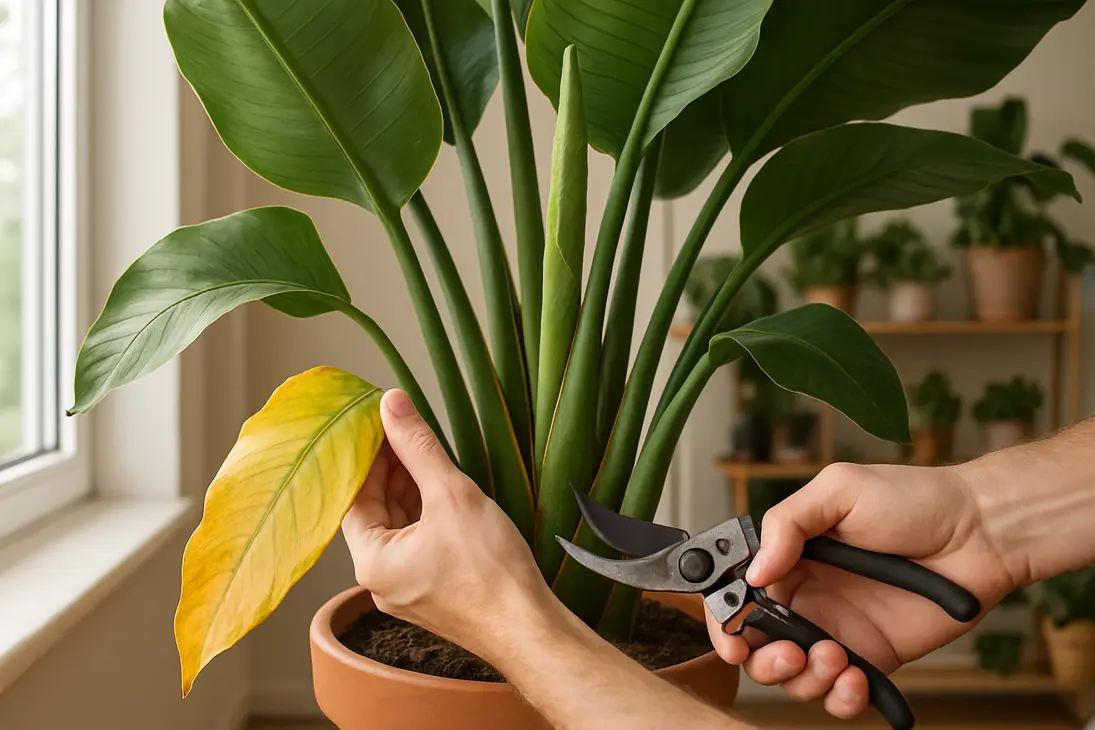
Remove the older leaf only if it is yellow, broken, diseased, or truly trapping and damaging the new spear. If pruning is needed, cut the old leaf stem carefully rather than pulling, cutting, or forcing the emerging leaf.
Check Whether the Old Leaf Is Actually Blocking New Growth
Bird of paradise leaves emerge as narrow, rolled spears from the center of a fan or clump. Because stems overlap closely, a new spear can look blocked when it is simply following its normal path upward.
Before pruning, check whether the new leaf is actually being pinched or is only brushing against older foliage.
Identify the New Leaf Spear and the Older Petiole
The new leaf spear is upright, firm, tightly rolled, and usually pointed at the tip. It emerges low in the plant near the center of the stems.
The older petiole is the long leaf stalk supporting an existing blade. Mature plants often have overlapping petioles that lean in different directions.
A new spear beside an old petiole is not automatically in trouble. It may grow taller than the old leaf, then turn toward available light. A slight curve from pressing against nearby stems is usually harmless.
Look for a real obstruction:
- The spear is sharply folded around an old stem.
- Its tip is caught beneath a drooping leaf blade.
- An old petiole is creating a deep crease or split.
- A broken stem is wedged across the new spear.
- The spear has stopped rising for weeks despite otherwise active growth.
If the spear remains upright, firm, and continues elongating, leave it alone.
Signs the New Leaf Is Stuck, Bent, or Damaged
A slight bend is common and rarely serious. Concern is warranted when the leaf appears compressed, injured, or unable to progress.
| What you see | What it may mean | Best response |
|---|---|---|
| Slight lean or curve in a firm green spear | Normal growth around stems or toward light | Monitor; do not force it straight |
| Blade caught behind an old floppy leaf | Minor obstruction | Gently move the blade aside or prune it if declining |
| Deep crease, crushed section, or torn tip | Pressure during emergence | Remove the offending old leaf if needed |
| Spear remains rolled but keeps getting taller | Normal slow unfurling | Maintain steady care and wait |
| Brown, black, soft, or wet-looking new growth | Rot, cold injury, watering issue, or pests | Inspect roots and growing conditions |
| Repeated distorted or scarred leaves | Ongoing stress or pest damage | Check light, watering, roots, and pests |
Damage such as a crease or tear will not repair itself, but one imperfect leaf is rarely a major problem.
Decide Whether to Keep or Remove the Older Leaf
The issue is not whether the leaf is old, but whether it remains useful or creates a genuine problem. Green leaves still photosynthesize and support new growth, so removing healthy foliage unnecessarily can weaken the plant.
Leave a Healthy Green Leaf in Place When Possible
Keep the old leaf if it is mostly green, firm, and only overlaps the new spear. Bird of paradise leaves commonly split along their veins, especially on large plants; splitting alone is not a reason to prune.
Leave it in place when:
- The new spear is still growing upward.
- The old petiole is not sharply pinching the spear.
- The leaf can be moved aside gently.
- The old leaf is structurally sound.
- Pruning would require cutting very close to new growth.
If the plant is merely crowded visually, give it brighter, more even light and rotate the pot gradually over time.
Remove Yellow, Torn, or Weak Older Leaves
Prune an older leaf if it is:
- Fully yellow or mostly brown.
- Broken or drooping across new growth.
- Soft, blackened, or developing spreading suspicious spots.
- Severely torn and no longer useful.
- Heavily infested with pests.
- Bent in a way that traps the new spear.
A small brown edge or partial yellowing is not urgent. If you need more room, remove only the one problem leaf first rather than thinning the whole plant.
Do Not Cut the Emerging New Leaf or Its Central Growth Point
The emerging spear is the next leaf. Cutting it will not help it unfurl or redirect growth; it only removes developing foliage.
Avoid cutting into the dense central cluster of stems. Bird of paradise plants grow from crowns and rhizomes at the base, often with several closely packed fans. A careless cut can damage hidden leaves or new shoots.
If you cannot clearly distinguish the old petiole from the new spear, wait a few days. New growth often becomes easier to identify as it lengthens.
How to Remove an Obstructing Bird of Paradise Leaf Safely
If an old leaf genuinely needs removal, make one clean cut low on its petiole without disturbing nearby stems.
Prune in good light so you can clearly see into the base of the plant.
Use Clean, Sharp Pruners or a Knife
Use sharp bypass pruners, strong scissors for thick stems, or a clean garden knife. Dull tools can crush the petiole and leave a ragged wound.
Before pruning:
- Clean soil from the tool.
- Wipe the blade with rubbing alcohol or wash it with hot, soapy water and dry it.
- Follow the old petiole from its leaf blade to its base.
- Identify the new spear and nearby young stems.
If disease or rot is present, clean the tool again before using it on another plant.
Cut the Old Stem Close to the Base Without Cutting Into Other Stems
Follow the unwanted petiole down as far as you safely can. Cut close to the base, but do not slice into the crown or neighboring stems. Leaving a short stub is safer than damaging new growth.
The exact cut angle matters less than making a clean cut with good control. Remove only the individual petiole, not the cluster of leaf bases around it.
Avoid Pulling, Twisting, or Tearing the Leaf Stem
Do not yank or twist the leaf off. Even a dead-looking leaf may be firmly attached, and pulling can tear the crown, disturb roots, or damage hidden shoots.
Hold the old leaf aside gently while cutting if necessary. Afterward, lift it away slowly so it does not scrape across the new spear.
Support a Bent New Leaf Rather Than Forcing It Open
If the new spear is bent but intact, leave it alone unless it cannot support itself. You can loosely tie it to a slim stake placed away from the crown.
Do not tape it tightly, squeeze it straight, or manually unroll it. Rolled leaves are fragile, and forcing them open can cause permanent splits and tears.
Help the New Leaf Unfurl After the Old Leaf Is Removed
Removing an obstruction may create space, but it will not make a rolled leaf open immediately. Unfurling depends on light, moisture, temperature, and overall plant health.
Give Bright Light and Consistent Watering
Bird of paradise plants need bright conditions indoors. Place the plant near a very bright window, with some direct sun if it has been acclimated.
Water thoroughly when the upper portion of the potting mix has dried, then let excess water drain. Avoid both constant sogginess and repeated severe drying. Large swings between drought and saturated soil can lead to slower, weaker, or damaged emerging leaves.
Maintain Moderate Humidity for Tightly Rolled Leaves
Very dry air can contribute to crisp edges and less smooth unfurling, especially near heating vents, radiators, or air-conditioning. Moderate household humidity is usually enough; move the plant away from direct dry airflow if needed.
A humidifier is generally more effective than occasional misting. Do not pour water into the rolled spear or crown, since trapped moisture can contribute to rot.
Check for Crowding, Root Binding, and Pest Damage
Large bird of paradise plants are naturally crowded above the soil, but severe root binding can make watering difficult and slow growth. Watch for roots circling heavily at drainage holes, water rushing through the pot, or soil drying unusually fast.
Repot only when the plant has clearly outgrown its container and is actively growing. Use a pot only modestly larger than the current one to avoid excess wet soil around the roots.
Also inspect new growth for pests:
- Fine webbing or pale stippling can indicate spider mites.
- Tiny insects or black specks can suggest thrips.
- Cottony clusters may be mealybugs.
- Sticky residue can indicate sap-feeding pests.
Pests can damage leaves while they are still rolled, making scars visible only after opening.
Be Patient With Slow or Slightly Scarred New Leaves
Bird of paradise is not an instant-response houseplant. A spear may take weeks to extend and open, especially in lower winter light or after a move. Once it opens, the blade and petiole may take additional time to firm up.
If a leaf was briefly pinched but remains green and continues opening, let it finish. Removing a cosmetically imperfect new leaf does not solve the underlying crowding.
When a Stuck New Leaf May Signal a Bigger Problem
One slow or bent leaf is usually minor. Repeated problems deserve closer attention.
Inspect the plant promptly if you notice:
- New spears turning black, mushy, or foul-smelling near the base.
- Soft stems or dark, wet crown tissue.
- Several stunted, distorted, or unopened leaves in a row.
- Yellowing across multiple leaves.
- Brown, soft, sour-smelling roots.
- Persistent pests in new growth.
- No growth during an expected growing period along with declining foliage.
Soft or blackened central growth can be more serious than an old leaf obstruction. Avoid adding more water until you have checked drainage, root health, and how long the mix stays wet. Remove only clearly dead or rotten tissue, and avoid cutting blindly into healthy crown tissue.
Conclusion
An old bird of paradise leaf that seems to block a new one often does not need removal. New leaves naturally emerge through crowded stems and usually grow past healthy older foliage.
Remove the old leaf only when it is yellow, broken, diseased, or truly pinching the new spear. Cut its petiole cleanly near the base, protect the new growth, and do not pull or force open the rolled leaf. Bright light, even watering, moderate humidity, and patience will help the new leaf unfurl normally.
FAQ
Can I cut off a healthy bird of paradise leaf to make room for a new one?
You can, but it is usually unnecessary. Healthy green leaves provide energy, and new leaves are adapted to emerge among close stems. Remove a healthy leaf only if it is truly crushing or trapping the new spear and you can prune it without risking new growth.
Will a new bird of paradise leaf grow if the old leaf stem is in the way?
Usually, yes. The new leaf may bend slightly or emerge at an angle, but it can still unfurl normally. Remove the old leaf only if it causes a sharp crease, deep pinching, or lies broken across the spear.
Should I pull apart a new leaf that is stuck in its sheath?
No. Do not peel or pull a new leaf open. The blade is fragile while rolled, and forcing it can tear the edges or create permanent splits. Improve care, remove only a true physical obstruction, and let the leaf open naturally.
How long does a bird of paradise leaf take to unfurl?
It varies with light, temperature, watering consistency, and plant health. Indoors, a new spear may take several weeks to extend and unfurl, especially in low-light periods. If it remains green, firm, and gradually gets taller, slow progress is usually normal.
You Might Also Like