Does Spanish Moss Harm Oak Trees?
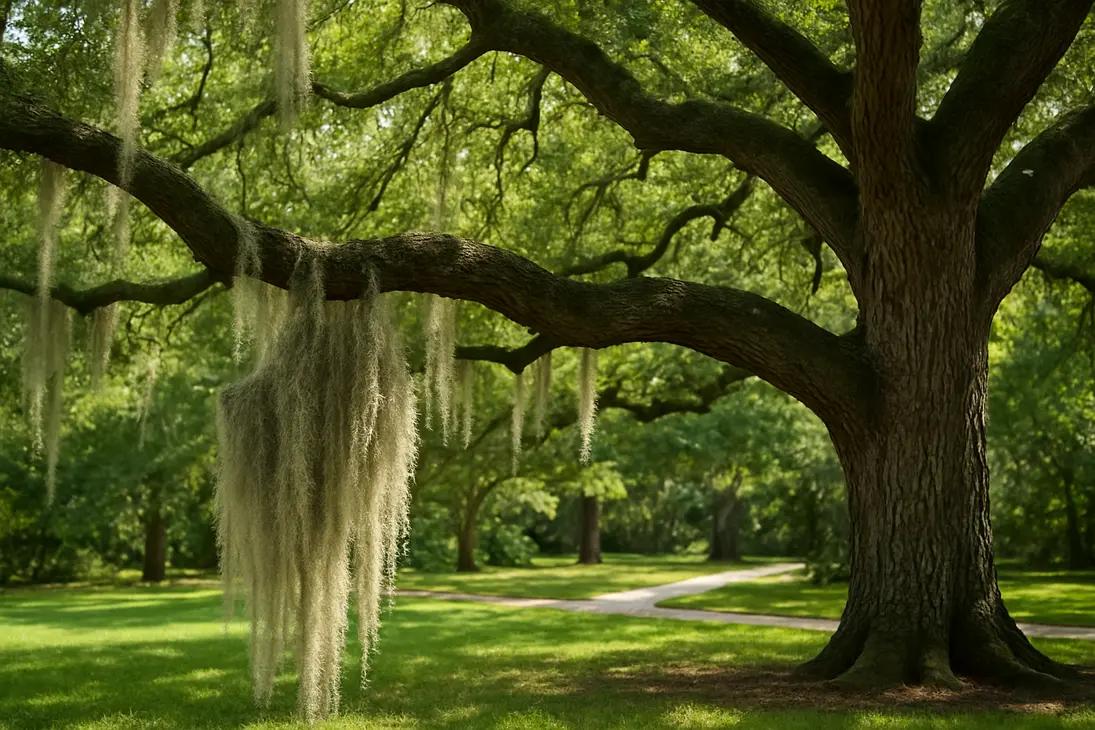
Spanish moss on oak trees can look beautiful, messy, or alarming when it hangs in thick gray curtains. If you have a live oak covered in it, it is natural to wonder whether the tree is being smothered or drained.
The short answer: Spanish moss usually does not harm healthy oak trees. It is not a parasite and does not take sap, water, or nutrients from the oak. However, extremely heavy growth can add weight, shade some leaves, or hide existing problems. Spanish moss is often blamed for decline it did not cause.
What Spanish Moss Is and Why It Grows on Oak Trees
Spanish moss is not a true moss. It is an epiphyte, meaning it grows on another plant for support. It belongs to the bromeliad family, the same broad family as pineapples and many air plants.
Spanish moss does not send feeding roots into oak tissue. It hangs from bark and branches and absorbs moisture and small amounts of nutrients from rain, humidity, dust, and airborne particles.
Oak trees, especially live oaks, are common hosts because they provide:
- Broad, spreading limbs that catch drifting strands
- Rough bark where pieces can lodge
- Open branching with good air movement
- Filtered sunlight in humid climates
- Stable support above ground disturbance
Spanish moss also grows on cypress, pecan, sweetgum, pine, and other trees. Mature live oaks are especially suitable because of their long horizontal limbs. Wind, birds, and falling fragments can move pieces from branch to branch.
Its presence does not automatically mean the oak is unhealthy. In many southern landscapes, Spanish moss oak trees are simply part of the local ecosystem.
Does Spanish Moss Damage or Kill Oak Trees?
Spanish moss does not directly damage or kill oak trees like a disease, borer, root rot, or parasitic plant. It does not pierce living tissue, steal sap, or feed from the oak’s vascular system.
Still, very dense moss can become a secondary stress factor, especially on trees already weakened by drought, age, root damage, storm injury, or decay.
Heavy Spanish moss may contribute to problems by:
- Adding weight: Wet moss is heavier than dry moss and can strain weak limbs.
- Shading leaves: Dense mats may block some light from inner or lower foliage.
- Catching wind: Thick growth can move in storms and add stress.
- Hiding defects: Moss can conceal dead branches, cracks, cavities, or decay.
- Making decline look worse: A thinning canopy can make moss appear more abundant.
For a vigorous oak with a full canopy, moderate Spanish moss is rarely a concern. For an old, damaged, or declining oak, heavy moss may add to existing stress.
The key distinction is this: Spanish moss is usually not the cause of oak decline, but excessive growth can make decline more noticeable and occasionally add stress.
Spanish Moss vs. Tree Parasites
Spanish moss is often confused with parasitic plants such as mistletoe, but it behaves very differently. Parasites draw water or nutrients from a host. Spanish moss only uses the tree as a perch.
| Growth | Relationship to oak | Takes nutrients from oak? | Main concern |
|---|---|---|---|
| Spanish moss | Epiphyte | No | Heavy growth may add weight or shade leaves |
| Mistletoe | Parasite | Yes | Can weaken branches |
| Lichens | Surface growth | No | Usually harmless |
| True mosses | Surface plants | No | Usually indicate moisture and shade |
| Fungal conks | Decay sign | Not in the same way | May signal rot or weakness |
This matters because removing Spanish moss will not solve problems caused by mistletoe, root disease, decay fungi, boring insects, or poor growing conditions.
When Spanish Moss May Signal an Oak Tree Problem
Heavy Spanish moss can sometimes signal that an oak is already declining.
As a canopy thins, more sunlight and airflow reach interior branches. That can help moss grow more noticeably or simply make it easier to see. A homeowner may think, “The moss is taking over,” when the actual sequence is:
- The oak becomes stressed by drought, root damage, age, disease, construction injury, soil compaction, or poor drainage.
- The canopy thins or branches die back.
- More light reaches the limbs.
- Spanish moss appears heavier.
- The moss gets blamed for the decline.
This is common with mature live oaks. Some deadwood can be normal in old trees, but sparse foliage, repeated limb loss, fungal conks, trunk cavities, bark loss, leaning, or root-zone disturbance should not be ignored.
If your oak has Spanish moss but also strong leaf growth, normal seasonal color, and sound limbs, there may be little to worry about. If it has moss plus dead branches, thinning foliage, mushrooms at the base, trunk damage, or sudden leaning, the tree needs a closer health and safety assessment.
Benefits of Spanish Moss in Oak Tree Ecosystems
Spanish moss is not just decoration. Where it grows naturally, it provides habitat and materials for wildlife.
Birds may use strands for nesting or search the moss for insects. Spiders, insects, and other small creatures shelter in the hanging masses. Bats and small animals may use dense growth for cover. On a large oak, Spanish moss becomes part of a layered ecosystem.
It also gives old shade trees a distinctive regional character. Not every plant growing on a tree is a threat.
If you handle Spanish moss, wear gloves and long sleeves, especially if it has fallen to the ground. Ground moss can harbor insects, mites, or other small animals.
When to Remove Spanish Moss from an Oak Tree
Removing Spanish moss is optional in many cases. Healthy oaks can carry moderate moss for years without harm. Removal or thinning makes more sense when the moss creates a practical issue.
Consider removing some Spanish moss when:
- It is dense and heavy on weak limbs.
- Limbs sag over a roof, driveway, walkway, patio, or play area.
- Storm damage or dead branches are hidden by moss.
- Moss blocks too much light from lower foliage or nearby plants.
- You want a cleaner appearance.
- You need better visibility for pruning or inspection.
Partial removal is often better than stripping the tree bare. Focus on the heaviest mats and branches near structures or foot traffic. Leaving some moss in higher or less problematic areas preserves habitat and avoids unnecessary disturbance.
For mature oaks, the real concern is often the condition of the limbs carrying the moss. A heavy curtain on a sturdy limb may be harmless. The same weight on a cracked, decayed, or poorly attached limb is more concerning.
Signs Removal May Be Worth Considering
Use Spanish moss as a reason to inspect the tree, not as an automatic diagnosis.
| What you notice | What it may mean | What to do |
|---|---|---|
| Heavy mats on sagging limbs | Added strain | Thin moss and inspect limbs |
| Sparse canopy | Tree stress or decline | Look for underlying causes |
| Dead branches hidden by moss | Safety issue | Remove deadwood safely |
| Dense moss blocking lower leaves | Shading | Thin selectively |
| Full green canopy with some moss | Often normal | Removal optional |
| Cracks, cavities, fungi, or leaning | Structural concern | Call a qualified tree professional |
| Moss over roofs or walkways | Maintenance concern | Remove in that area |
A few strands do not require action. Dense mats on compromised limbs do.
How to Manage Spanish Moss Without Hurting the Oak
The safest way to manage Spanish moss is to remove it physically and gently where reachable. You do not need to treat the tree as if it has an infection.
For low branches, pull moss off by hand while wearing gloves, eye protection, and long sleeves. For higher but reachable branches, use a long-handled rake, pole, or hook to lift loose strands. Work slowly; the goal is to tease the moss free, not yank the branch.
Good practices include:
- Work from the ground when possible. Avoid ladders under large trees unless conditions are stable and the work is light.
- Remove moss when dry. Dry moss is lighter and easier to handle.
- Start with heavy mats. Focus on stressed limbs and areas near structures.
- Avoid scraping bark. Do not use tools that wound branches.
- Inspect after removal. Look for cracks, decay, deadwood, or insect activity.
- Dispose of it thoughtfully. Fragments can spread if moved elsewhere.
If the moss is high in a mature oak, do not climb the tree unless trained and equipped. Large oaks can have hidden defects, and pulling moss while balancing on limbs is dangerous. A certified or experienced arborist can remove moss during pruning or inspection if needed.
Also focus on the oak’s overall health. A strong oak tolerates Spanish moss better than a stressed one.
Helpful oak-care practices include:
- Water during extended drought. Use deep, infrequent watering over the root zone.
- Mulch correctly. Keep mulch a few inches away from the trunk.
- Protect roots. Avoid parking, trenching, grade changes, and soil compaction beneath the canopy.
- Prune properly. Leave large, high, or structural cuts to professionals.
- Avoid unnecessary fertilizer. Fertilizing without soil information can create problems.
- Watch changes. Sudden thinning, dieback, or limb drop is more concerning than normal seasonal leaf changes.
If you remove moss but ignore drought stress, root damage, or decay, the tree may continue to decline.
What Not to Do
Aggressive moss removal can hurt the tree more than the moss does.
Avoid these mistakes:
- Do not yank hard on weak limbs.
- Do not climb a large oak casually.
- Do not use harsh chemicals as a shortcut. Herbicides, copper sprays, bleach, or homemade mixtures can damage leaves, bark, nearby plants, soil life, or runoff areas if misused.
- Do not assume removal cures tree decline.
- Do not remove living limbs just to eliminate moss.
- Do not scrape bark clean.
- Do not remove all habitat without a reason.
The best approach is selective: reduce excessive weight, uncover problem areas, and support the tree’s health.
Conclusion
Spanish moss on oak trees is usually harmless. It is an epiphyte, not a parasite, and it does not feed on the oak. Healthy live oaks and other mature oaks can often support it for many years.
Problems mainly arise when moss becomes extremely heavy on weak or storm-damaged limbs, or when it hides signs of decline. In many cases, heavy moss is a symptom of a thinning canopy rather than the cause.
If the oak is full, green, and structurally sound, removal is optional. If limbs sag, foliage is sparse, branches are dead, or moss hangs densely near structures and walkways, selective removal and tree inspection are sensible.
FAQ
Is Spanish moss a parasite on oak trees?
No. Spanish moss is not parasitic. It does not take nutrients, sap, or water from the oak. It uses branches for support and absorbs moisture and nutrients from air, rain, dust, and surrounding debris.
Should I remove Spanish moss from my live oak?
Not unless it bothers you or creates a practical concern. Moderate growth on a healthy live oak is usually harmless and can provide wildlife habitat.
Consider selective removal if the moss is very heavy, weighing down weak limbs, hiding dead branches, blocking too much light, or hanging over roofs, driveways, walkways, or outdoor living areas.
Can Spanish moss kill an oak tree?
Spanish moss rarely kills oak trees. When a moss-covered oak is declining, the real cause is usually drought, root damage, soil compaction, disease, pests, storm injury, age, construction disturbance, poor drainage, or decay.
Heavy moss can add stress to a weak tree, but removing it alone will not fix underlying problems.
Will Spanish moss grow back after removal?
Yes. Spanish moss can grow back where conditions remain favorable. Wind, birds, and broken fragments can spread it again.
Removal is best viewed as maintenance, not a permanent cure. If you want less moss, you may need to thin it periodically.
You Might Also Like