How to Rescue Leggy Dill and Fennel Seedlings Before You Get a Grow Light
Leggy dill and fennel seedlings are common indoors: they germinate well, then become pale, thin, stretched, and unable to stay upright. You may be able to save them until better lighting arrives, but the existing elongated stems will not become short and thick again.
The goal is to stop further stretching, prevent collapse, and support healthier new growth.
Act Now: Give Seedlings the Strongest Safe Light Available
Insufficient light is the usual cause of legginess. Even a bright room is often much dimmer than seedlings need, especially in winter or near shaded, curtained, or north-facing windows.
Until your grow light arrives, improve the available light without suddenly shocking the seedlings.
Use outdoor daylight when temperatures allow
Outdoor daylight is much stronger than window light. If conditions are mild, place seedlings outside for a few hours in a sheltered, bright location.
Start gradually:
- Set trays in bright shade or gentle morning sun for one to two hours.
- Bring them inside before intense afternoon sun.
- Increase outdoor time over several days.
- Protect them from wind, heavy rain, frost, and cold snaps.
Indoor-grown seedlings need time to adjust to direct sun, temperature changes, and air movement. Do not move soft windowsill seedlings straight into all-day sun and wind; they can wilt, scorch, or snap.
If outdoor conditions are unsuitable, use the brightest indoor spot available.
Make the brightest window setup work better temporarily
Place seedlings in the brightest available window, preferably one with several hours of direct sun. In the Northern Hemisphere, a south-facing window is often best.
To improve a window setup:
- Keep trays close to the glass without letting foliage touch cold panes.
- Clean the glass and remove nearby shadows.
- Use a pale wall, white board, or foil-covered board behind the tray to reflect light back toward plants.
- Keep trays level so seedlings do not lean or dry unevenly.
A windowsill may slow additional stretching, but it is usually a temporary solution rather than a full substitute for a grow light.
Rotate trays and avoid light blocked by curtains or glass obstructions
Turn trays a quarter-turn once or twice daily so stems do not keep leaning toward one direction.
Also check for hidden light loss from curtains, blinds, insect screens, furniture, overhangs, or nearby houseplants. Seedlings a few feet back from a window receive far less useful light than those directly beside it.
Rotation will not fix existing legginess, but it can limit one-sided bending.
Avoid suddenly placing indoor seedlings in harsh all-day sun
More light helps, but abrupt exposure can damage seedlings raised indoors. Move them gradually from bright shade to morning sun, then to longer outdoor periods.
If you need to leave them outdoors while away, choose bright shade or a sheltered site with morning sun and afternoon shade rather than an exposed patio.
Keep Thin, Floppy Seedlings Upright Until They Strengthen
Leggy stems bend because they cannot support the leaves above them. Temporary support can help, but dill and fennel stems are easily bruised. Avoid forcing them rigidly upright.
Add gentle airflow to encourage sturdier stems
Gentle air movement encourages seedlings to develop sturdier stems. Use a small fan on low and position it far enough away that leaves barely tremble.
Run it for short periods at first. The goal is a light breeze, not a constant blast that dries the mix or flattens plants.
Without a fan, you can lightly brush the tops of sturdier seedlings once daily after they have developed beyond their first seed leaves. Do not do this to seedlings that are already collapsing.
Support individual seedlings loosely if they are falling over
For seedlings that cannot remain upright:
- Insert a toothpick, bamboo skewer, or twig a short distance from the stem.
- Use a soft thread, fabric strip, or loose paper loop to guide the stem.
- Leave room for the stem to move and thicken.
- Remove support when new growth is stronger.
Do not use wire or tight ties. If many seedlings are leaning together, thinning is usually more useful than staking every plant.
Water carefully to prevent weak stems and soggy soil
Keep the potting mix evenly moist, not constantly wet. Water when the surface begins to feel dry instead of following a fixed daily schedule.
Water slowly at soil level, preferably around the container edge, and make sure pots have drainage holes. Do not let them sit in standing water.
Check floppy seedlings at the soil line. A dark, pinched, soft, or narrowed stem may indicate damping-off rather than ordinary legginess. Remove affected seedlings promptly; they will not recover.
Do not overfertilize leggy seedlings
Fertilizer cannot correct inadequate light. Heavy feeding can produce even more soft, fast growth.
For tiny seedlings with seed leaves or first true leaves, focus on light, spacing, airflow, and watering. Fresh seed-starting mix usually contains enough nutrition initially. If plants remain in containers for an extended time after lighting improves, use only a light feeding.
Thin and Space Crowded Dill and Fennel Seedlings
Dill and fennel are often sown densely because their seeds are small. Crowded seedlings compete for light, water, root space, and nutrients, which encourages more stretching.
Thinning improves airflow and gives the strongest plants room to develop.
Which seedlings to keep
Keep seedlings with:
- Thick stems relative to their height
- Green, healthy leaves
- Upright or only slightly leaning growth
- Space around them
- No yellowing, stem damage, or collapse
Do not automatically keep the tallest seedling. Under low light, it may simply be the most stretched. A shorter, darker green plant with a stronger base is often the better choice.
Keep one seedling per small cell. In a larger pot intended for a small dill clump, retain only enough plants that their leaves will not stay tangled.
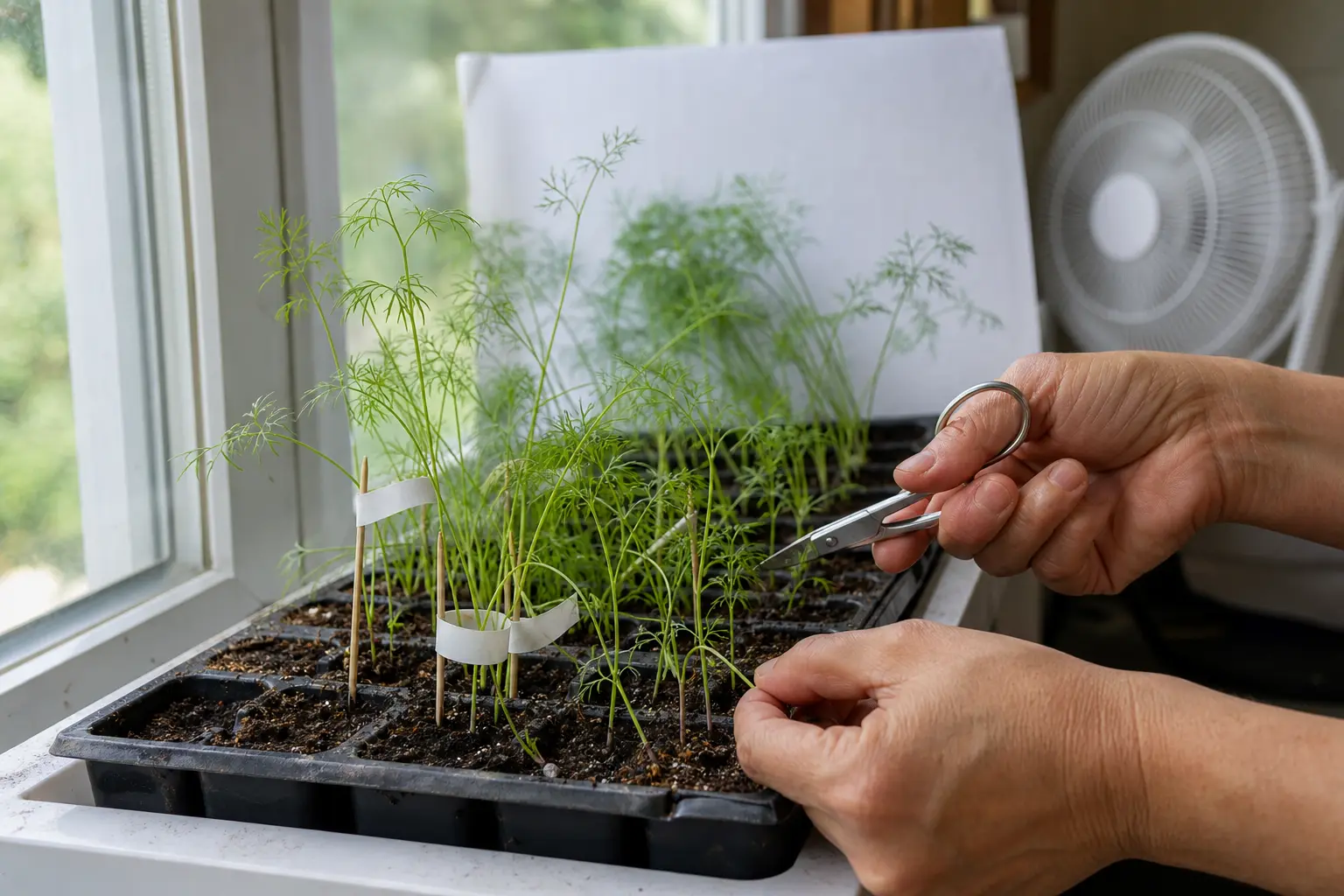
How to thin without disturbing nearby roots
Do not pull unwanted seedlings, since tangled roots can disturb the plant you want to keep.
Instead, use clean scissors to snip unwanted seedlings at soil level. Their roots can remain in the mix and break down naturally.
If a tray is extremely crowded, remove the weakest plants first and reassess in a few days. Do not wait too long, since crowded seedlings weaken quickly.
When to move seedlings to separate containers
Move seedlings only after they have true leaves—the feathery leaves that follow the first simple seed leaves.
If you want to save more than one seedling from a cell, separate them while young, before roots become heavily tangled. Water lightly beforehand, lift a small section of soil with a spoon or label, and handle plants by their leaves rather than stems.
Both herbs dislike unnecessary root disturbance. When seedlings are weak and intertwined, it is usually better to keep the best one or two and snip the rest.
Why dill and fennel should not be handled like deep-planted tomato seedlings
Tomatoes can form roots along buried stems, but dill and fennel should not be treated the same way.
Do not bury stretched stems up to the leaves to correct legginess. These plants are not reliable stem-rooters, and deeply buried soft stems can rot. Transplant at approximately the original soil depth, with firm but not compacted soil around the base.
Dill and fennel also tend to form taproots, so repeated transplanting and rough handling can set them back.
Decide Whether to Save or Restart Dill and Fennel
Not every leggy seedling needs to be discarded. Better light, more space, and gentle airflow can produce useful new growth. However, restarting is sometimes faster, especially with dill.
Signs seedlings are still worth keeping
Try to save seedlings if they have:
- Green leaves and active new growth
- Firm stems, even if long and thin
- No dark, mushy, or pinched area at soil level
- Well-drained potting mix
- Enough growing season remaining to establish
A plant that bends but springs back gently is more promising than one that lies flat and feels limp.
When restarting is the better option
Restart when seedlings are:
- Extremely tall and threadlike for their leaf size
- Pale, yellowing, or stalled
- Collapsing from damping-off or stem rot
- So crowded that roots cannot be separated
- Too stretched to stand without staking
- Early enough that a fresh sowing can catch up quickly
Dill germinates and grows quickly, so a new sowing under better light—or outdoors when conditions allow—may outperform severely stressed starts.
Differences between rescuing dill and rescuing fennel
Dill is generally forgiving of restarting and is often easiest to direct sow. A mildly leggy dill seedling can still become productive if planted carefully and supported during adjustment.
Fennel needs more caution because it dislikes root disturbance. Common herb fennel can grow into a large perennial or long-lived plant in suitable climates. Florence fennel is grown for its swollen base and needs steady growth to form a good bulb. If fennel seedlings are severely crowded or root-bound, restarting in individual cells or direct sowing may be preferable to aggressive separation.
Keep dill and fennel apart if you plan to save seed, as they can cross-pollinate.
When direct sowing outdoors may be easier than starting indoors
Direct sowing can be simpler when weather and soil conditions are suitable. Dill often performs well when sown where it will grow, avoiding transplant stress and receiving real sunlight from the start.
Direct sow when:
- Soil is workable and not waterlogged.
- Severe freezing weather has passed.
- You can protect emerging seedlings from slugs, birds, or heavy rain if needed.
- The site receives generous sun.
Sow thinly, then thin again after emergence so plants have room to develop.
Prevent More Leggy Growth When the Grow Light Arrives
A grow light can stop further stretching if it is positioned and timed correctly. It will improve new growth but cannot shorten existing stems.
Position the grow light close enough to seedlings
Follow the manufacturer’s recommended hanging height. Keep the light close enough to be clearly brighter than a window, but not so close that leaves bleach, curl, or feel hot.
Check seedlings daily during the first week. If they continue stretching, lower the fixture slightly if permitted. If leaves show pale patches, crisp edges, or heat stress, raise it. Adjust the light as plants grow.
Provide a consistent daily light schedule
Use a timer for a regular day-and-night cycle. Consistent daily lighting is more useful than irregular bursts.
Seedlings also need darkness. Leaving lights on continuously does not make plants sturdier and can interfere with normal growth rhythms.
Maintain airflow, spacing, and even moisture
Better light works alongside basic care:
- Run a gentle fan periodically.
- Thin or pot up plants before foliage overlaps heavily.
- Water thoroughly when needed, then let the surface begin drying.
- Avoid excessive fertilizer.
A grow light cannot overcome soggy soil, overcrowding, or disease.
Harden off seedlings before planting outdoors
Even seedlings raised under a grow light need hardening off. Over about a week, expose them gradually to outdoor shade, then morning sun, then longer periods of sun and wind.
Protect them from unusually cold, windy, or stormy weather. Once they can remain outside safely, plant them at their original soil depth and water them in well.
Conclusion
You can often save leggy dill and fennel seedlings by providing the strongest safe light available, reducing crowding, adding gentle airflow, and keeping the potting mix moist rather than wet. Loose temporary stakes can prevent stems from snapping while new growth strengthens.
Existing stretched stems will not become stocky, so judge success by greener leaves, firmer new growth, and less flopping. If seedlings are severely threadlike, diseased, or too tangled to manage, restarting—often by direct sowing outdoors—may be the easier path.
FAQ
Can leggy dill seedlings recover?
Leggy dill seedlings can recover enough to grow productively if stems remain firm, leaves are green, and stronger light arrives quickly. Existing stretched stems stay long, but new growth can become sturdier. Thin crowded seedlings, provide gentle airflow, and loosely support stems that are falling over.
Can I bury the long stems of dill or fennel seedlings deeper?
No. Do not bury dill or fennel as deeply as a leggy tomato seedling. Transplant at roughly the current soil level. Deeply burying soft stems can keep them too wet and increase rot risk.
Should I put leggy dill and fennel seedlings outside before I have a grow light?
Yes, if temperatures and weather are suitable. Acclimate them gradually, beginning with bright shade or mild morning sun in a sheltered location. Avoid immediately exposing indoor-grown seedlings to hot all-day sun, strong wind, or freezing conditions.
Why are my dill seedlings flopping over even when the soil is moist?
Moist soil does not correct weak, stretched stems. Dill often flops because of insufficient light, crowding, lack of airflow, or overly wet potting mix. Check stems at soil level: a dark, thin, collapsing stem may indicate damping-off, and affected seedlings should be removed.
You Might Also Like