Do Trees Get Tired? Understanding Tree Fatigue
Do Trees Actually Get Tired?
No, trees do not get tired the way people or animals do. A tree has no muscles to fatigue, no nervous system to feel exhaustion, and no brain that experiences tiredness. It does not “hold itself up” through effort.
But trees can become stressed, weakened, damaged, or depleted. When people ask, “Do trees get tired?” they are usually noticing a tree that looks droopy, thin, leaning, brittle, or slow to grow. Those signs often point to water stress, root trouble, disease, pests, storm damage, poor soil, decay, or age-related decline.
So the short answer is: trees do not get tired from standing, but they can become stressed or structurally compromised. A “tired-looking” tree may need water, mulch, pruning, soil care, pest diagnosis, or a safety inspection.
Why Trees Can Stand for So Long
Trees are self-supporting structures built to endure heat, cold, wind, rain, snow, drought, insects, and competition. Unlike animals, they are not constantly spending energy to remain upright. Their tissues form a strong, flexible framework.
The trunk carries weight and resists bending. Branches spread leaves toward sunlight. Roots anchor the tree and absorb water and minerals. New wood is added over time, helping the tree adapt to changing loads and injuries.
Trees Don’t Use Muscles to Stand
Animals stand by contracting muscles. Muscles use energy and eventually fatigue. If you stand in one place too long, your legs ache because your body is actively working.
A tree has no muscles that contract to hold the trunk upright. Its posture comes from structure: rigid plant tissues, especially wood, physically support the tree’s weight. It is more like a post, beam, or house frame than a standing animal.
Trees are still active. They move water, grow toward light, seal off injuries, and respond to stress signals. But standing does not require repeated muscular effort.
Wood Is Built for Long-Term Support
Wood combines strength, flexibility, and renewal. A tree adds new wood around the outside of the trunk and branches as it grows. Areas exposed to repeated stress, such as prevailing wind, may develop extra supporting wood.
Wood also bends. Swaying helps dissipate force, but flexibility has limits. Heavy ice, saturated soil, decay, weak branch attachments, and strong wind can exceed what a tree can handle.
Trees do not heal wounds like skin, but they can compartmentalize injured or infected tissue and grow around it. Wood does not get tired from standing, but it can weaken from decay, cracks, poor pruning, storm damage, and root injury.
Roots Anchor and Stabilize the Tree
Roots anchor the tree, absorb water, and help balance the weight of the trunk and crown. Most roots grow in the upper soil layers, where oxygen, moisture, and organic matter are more available, and many extend beyond the canopy edge.
Root damage is one of the most serious hidden causes of decline. Compacted, waterlogged, excavated, or extremely dry soil can kill roots or reduce anchorage. A tree may look acceptable for a while after trenching, paving, grading, or construction, then slowly thin, shed branches, or lean.
Roots grow where moisture, oxygen, loose soil, and space are available. They can lift pavement or enter damaged pipes, but they are also easily harmed by cutting, soil compaction, and grade changes.
What People May Mistake for a “Tired” Tree
A tired-looking tree usually has visible symptoms: drooping leaves, sparse foliage, dead twigs, reduced growth, early fall color, bark damage, or a lean. These signs mean the tree is responding to stress or injury. Some causes are temporary; others indicate decline or safety risk.
| What you see | Possible cause | Urgency |
|---|---|---|
| Leaves droop but recover | Heat or mild water stress | Monitor |
| Leaves stay wilted, scorched, or curled | Drought, root damage, disease | Act soon |
| Canopy thins throughout | Chronic stress, roots, age, disease | Investigate |
| One large branch dies | Breakage, canker, insects, disease | Inspect |
| Tree leans more than before | Root failure, soil movement, storm damage | Potentially urgent |
| Mushrooms or soft wood at base | Decay | Call an arborist |
| Bark splits, peels, or has wounds | Sunscald, injury, disease, cracks | Depends on severity |
Water Stress and Drought
Water stress is one of the most common reasons a tree looks exhausted. Leaves may droop, curl, brown at the edges, yellow early, or drop before autumn. New growth may be short, and severe drought can cause twig dieback.
Trees lose water through leaves during photosynthesis and cooling. When soil moisture is low, or roots cannot absorb enough water, the tree closes tiny leaf openings called stomata. This reduces water loss but also slows photosynthesis, leaving less energy for growth, defense, and repair.
Young trees are especially vulnerable because their roots are limited. Newly planted trees may need consistent watering for several growing seasons. Mature trees handle short dry spells better, but prolonged drought can still weaken them.
Deep watering is more useful than shallow sprinkling. During dry periods, water slowly over the area beneath and slightly beyond the canopy, while avoiding constantly soggy soil.
Heat, Wind, Snow, and Storm Damage
Weather can make trees look tired quickly. Heat increases water demand, dry wind pulls moisture from leaves, heavy rain can reduce oxygen around roots, snow and ice add weight, and storm gusts can crack limbs or shift roots.
A tree may droop after a hot afternoon and recover overnight. That can be normal. If leaves remain wilted in the morning, brown, or drop heavily, the stress is more serious.
After storms, inspect from a safe distance. Look for hanging limbs, fresh cracks, exposed roots, soil lifting on one side, or a new lean. Do not stand under damaged branches or remove large storm-broken limbs yourself. With snow and ice, brush light snow from reachable small branches if needed, but do not beat ice-covered branches with tools.
Poor Soil, Root Problems, or Compaction
A tree can have a sound-looking trunk and still struggle because its roots are stressed. Roots need moisture, oxygen, and space. Compacted soil limits all three.
Common root stressors include:
- Foot traffic or vehicles under the canopy
- Construction, grading, trenching, or paving
- Soil piled against the trunk
- Poor drainage or standing water
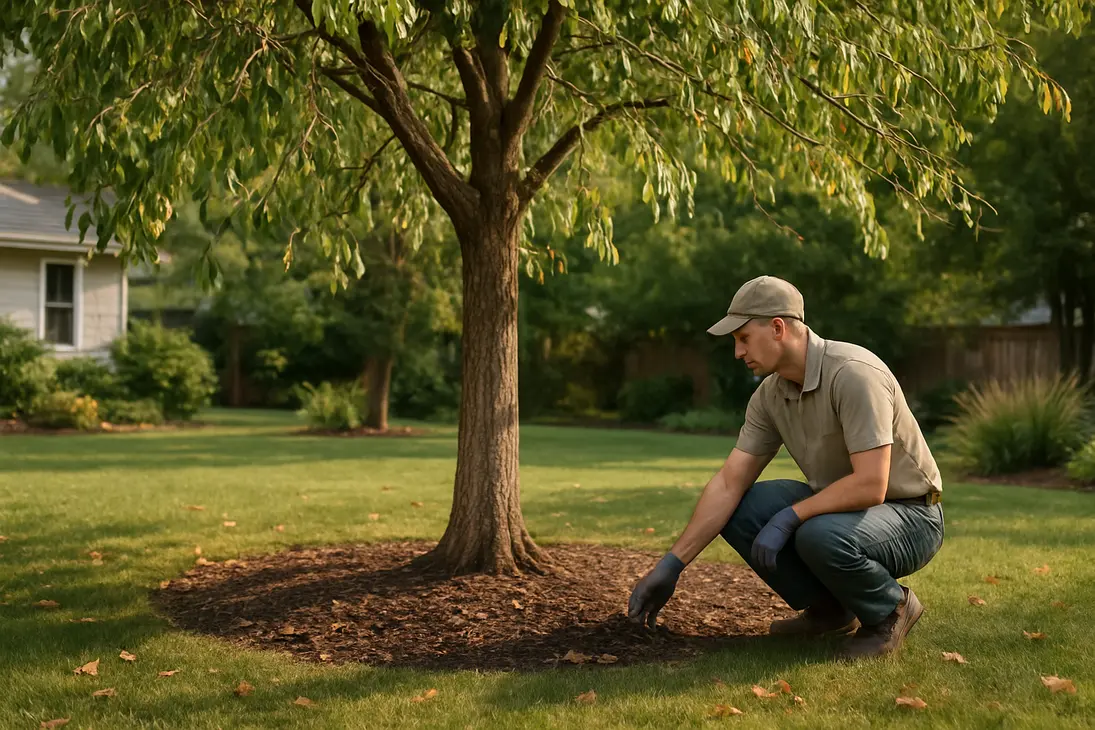
- Deep mulch against bark
- Heavy turfgrass competition
- Raised beds or hardscape over roots
Compaction is common in yards, parks, and new developments. When roots cannot spread, the tree may grow slowly, produce smaller leaves, thin out, or decline.
Some trees naturally lean toward light and remain stable. A sudden lean, increasing lean, cracked soil, or exposed roots is different and may indicate root plate failure. Avoid cutting major roots without professional guidance, especially near mature trees.
Disease, Pests, and Nutrient Deficiency
Diseases and pests can also create a tired appearance. Some affect leaves, while others attack bark, wood, roots, or water-conducting tissues.
Watch for dead branches, sawdust-like material, bark holes, cankers, oozing sap, dark staining, mushrooms near the base, yellowing between leaf veins, repeated early leaf drop, or stunted growth.
Nutrient deficiency is possible but often overdiagnosed. Yellow leaves do not automatically mean fertilizer is needed. Poor drainage, root damage, drought, high soil pH, and disease can all interfere with nutrient uptake.
For a valuable declining tree, a soil test and professional inspection are better than guessing. The solution may be watering, mulching, improving drainage, reducing compaction, pruning deadwood, pest treatment, or monitoring.
Do Trees Rest or Sleep?
Trees do not sleep like animals. They do not become unconscious, dream, or rest a brain. But they do have rhythms. Their activity changes between day and night and across seasons.
A tree’s life is tied to light, temperature, water, and internal chemical signals. It photosynthesizes when conditions allow, uses stored energy when needed, and slows growth during unfavorable periods. This is not sleep, but it is a regulated cycle.
Day-Night Plant Rhythms
During the day, leaves use sunlight to make sugars through photosynthesis. They also exchange gases and lose water through stomata. At night, photosynthesis stops, but the tree remains active. It still respires, moves sugars, maintains cells, and carries out repair and growth.
Some plants show visible daily movements, such as leaves changing angle or flowers opening and closing. Trees can also show subtle changes in branch position and water movement over a day-night cycle.
Calling this “sleep” is convenient but misleading. A tree at night is not asleep; it is operating differently. The practical takeaway is that trees live on cycles, and steady stress from drought, heat, poor soil, or root injury can disrupt normal function.
Winter Dormancy and Seasonal Slowdowns
In cold winters or dry seasons, many trees enter dormancy or slow down. Deciduous trees shed leaves, reduce water loss, and protect buds. Many evergreens also slow growth, even though they keep needles or leaves.
Dormancy is not sleep. It is a survival strategy that helps the tree conserve resources and avoid growing when water is frozen or scarce. A bare deciduous tree in winter is not necessarily dead or tired. Healthy buds, flexible twigs, and normal bark color can indicate life.
Seasonal slowdowns also affect care. Pruning, fertilizing, transplanting, and watering should match the tree’s growth cycle and local climate. Dead, damaged, or hazardous branches can be addressed when noticed, but major work should be timed carefully.
How to Help a Stressed Tree Recover
A stressed tree needs steady support, not quick fixes. Recovery can take months or years. Focus on reducing stress, protecting roots, and avoiding unnecessary injury.
-
Check soil moisture before watering.
Probe several inches into the soil under the canopy. If it is dry at root depth, water deeply. If it is soggy or sour-smelling, more water may worsen root problems. -
Water deeply during dry periods.
Apply water slowly over a broad area beneath the canopy, not just at the trunk. Young trees need extra attention while roots establish. -
Mulch properly.
Organic mulch helps conserve moisture, moderate temperature, and protect roots. Keep it away from direct trunk contact. Avoid “mulch volcanoes.” -
Protect the root zone.
Avoid parking, storing materials, trenching, or repeated foot traffic under the canopy. Before construction, fence off as much root area as possible. -
Prune carefully.
Remove dead, broken, or hazardous branches when needed. Do not top trees or cut large limbs without a clear reason. -
Improve soil gradually.
Mulch is often safer than digging around roots. If soil is compacted, an arborist may recommend air excavation or other site-specific methods. -
Do not assume fertilizer is the answer.
Fertilizer helps only when nutrients are truly limiting. A soil test can guide decisions. -
Watch for patterns.
A few yellow leaves may be normal. Whole-canopy thinning, large dead limbs, or decline over several seasons is more concerning.
Call a certified arborist or qualified tree professional if you notice a sudden or increasing lean, cracked or lifting soil around roots, large dead branches over targets, cavities, soft wood, mushrooms at the base, split trunks, major root damage, utility-line contact, or decline in a large or high-risk tree.
For small ornamental trees, careful home care may be enough. For large mature trees near homes or public areas, professional assessment is often worth the cost.
Conclusion
Trees do not get tired from standing. They are not using muscles, nerves, or willpower to hold up trunks and branches. Their strength comes from wood, roots, structure, and continuous growth.
What trees do experience is stress. Drought, heat, compacted soil, damaged roots, pests, disease, storms, and decay can make a tree look droopy, thin, weak, or unstable.
A better question is not “Is my tree tired?” but “What is stressing my tree, and is it structurally safe?” Deep watering during drought, proper mulching, root protection, careful pruning, and timely professional help can make a real difference.
FAQ
Can a tree get tired of holding up its branches?
No. A tree does not get tired of holding up branches because it does not use muscles. Branches are supported by woody structure. However, they can become too heavy, cracked, decayed, poorly attached, or overloaded by snow, fruit, or wind.
If a large limb sags lower than usual, has cracks or dead bark, or hangs over a roof, walkway, or driveway, have it inspected.
Why do trees droop if they are not tired?
Trees usually droop because of water balance, heat, root stress, or tissue damage. On hot afternoons, leaves may lose water faster than roots can replace it. If they recover by morning, the stress may be mild. If they stay wilted, scorch, curl, or fall early, the problem may be more serious.
Branches can also droop after storms, heavy snow, poor pruning, or structural cracking. Leaf droop and branch droop are different problems.
Do trees need sleep at night?
Trees do not sleep like animals. They have no brain and do not become unconscious. But they follow day-night rhythms. During daylight, they photosynthesize when conditions allow. At night, photosynthesis stops, but respiration, sugar movement, repair, and other living processes continue.
Seasonal dormancy is also not sleep. In winter or dry seasons, many trees slow growth, shed leaves, and conserve resources until conditions improve.
When should I worry that a tree is stressed or unsafe?
Worry more when symptoms are severe, sudden, or structural. A few wilted leaves during a hot afternoon may not be alarming. A new lean, cracked trunk, lifting roots, large dead limbs, fungal growth at the base, or canopy dieback is more serious.
Seek professional help if the tree could fall on a person, building, driveway, utility line, or neighboring property. Also call after construction damage, major root cutting, storm breakage, or unexplained decline in a mature tree.
You Might Also Like