Money Plant Decor Ideas for Styling Vines at Home
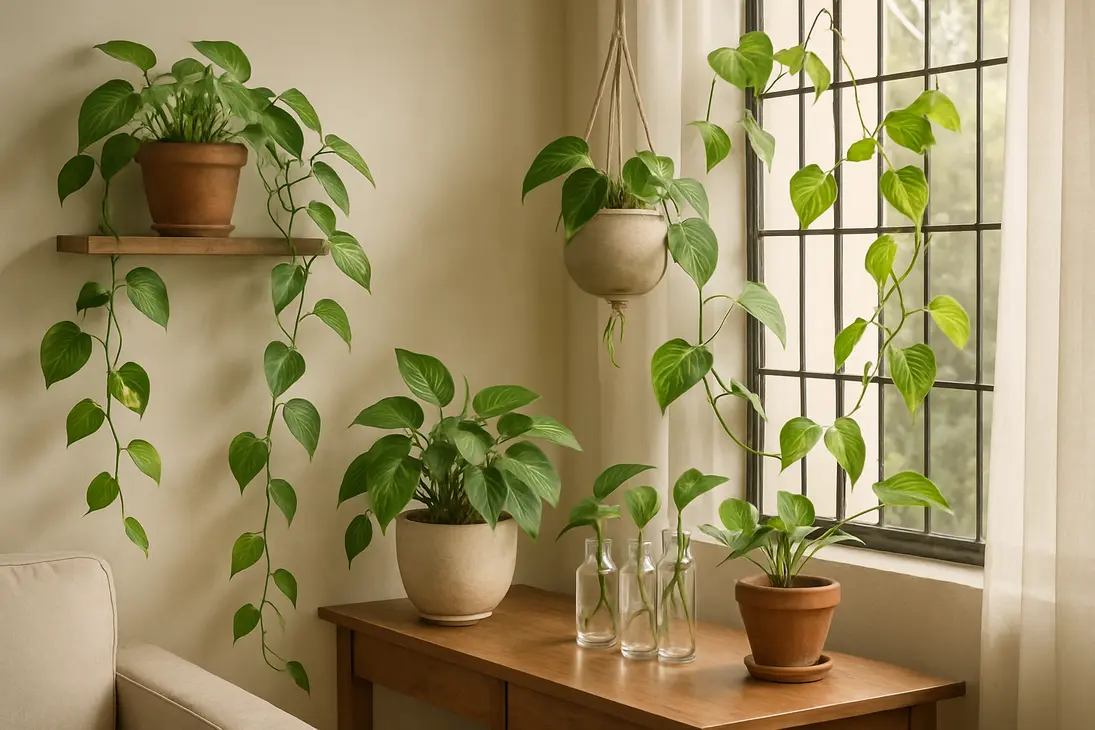
Money plant decor works because the plant naturally trails, climbs, and softens hard edges. One healthy money plant can spill from a shelf, frame a window, climb a pole, or grow into a leafy curtain when given support. In most homes, “money plant” refers to a pothos-type vine grown in soil or water, with heart-shaped green, golden, or variegated leaves.
Style with the plant’s habit instead of fighting it: give it bright indirect light, avoid soggy roots, guide vines early, and prune often enough to keep growth full rather than stringy.
Choosing the Right Spot for Money Plant Vines
A money plant can look good in many places, but it stays lush only where light, airflow, and access are right. Choose a spot that lets vines grow without becoming a dusty tangle.
Bright corners with indirect light
Bright corners give money plants enough light for new leaves without scorching them. Good spots include corners near east-facing windows, beside sheer-curtained balcony doors, or a few feet from a bright south or west window.
Indirect light matters most for variegated plants. Golden or marble-patterned leaves can fade in deep shade, while harsh sun may bleach or burn them. If the corner is bright enough to read in during the day but avoids hot direct sun, it is usually suitable.
Use a floor planter with a moss pole for height, or place the pot on a stand and let the vines cascade.
Window grills, balconies, and semi-shaded areas
Window grills and semi-shaded balconies work well because vines can be trained along bars, railings, or strings to create a leafy frame or light privacy screen. Mild morning sun is safer than hot afternoon sun, which can cause pale leaves, brown patches, and curling edges.
Keep the pot accessible for watering and pruning. Use soft ties, leave slack around stems, and make sure the container is stable. On windy balconies, train vines close to the wall so long stems do not snap.
Shelves, cabinets, and high ledges for trailing vines
Shelves and high ledges are easy places to style a money plant. A pot on a bookcase, kitchen cabinet, wardrobe, or wall shelf can create a simple green cascade.
Use a secure, lightweight pot and protect surfaces with a tray or liner. A nursery pot inside a decorative cover pot is often safer than a heavy ceramic pot on a narrow shelf. Make sure the plant remains reachable; if watering requires a ladder, it will likely be neglected. Prune regularly so the top stays full instead of leaving only long, bare strands.
Creative Ways to Decorate With Money Plant Vines
The best money plant decor ideas use the vine’s flexibility. You can let it hang, train it across a surface, guide it upward, or root cuttings in water for small accents.
Create a money plant curtain
A money plant curtain works well along a balcony grill, between pillars, across a shaded window, or behind a seating area. For fullness, start with several vines, multiple pots, or many rooted cuttings rather than one small plant.
Basic setup:
- Place pots or jars in a row on a stable shelf, ledge, or stand.
- Tie vertical strings, jute cords, or thin wires from the top support.
- Guide each vine along a string with soft ties.
- Pinch growing tips to encourage branching.
- Add cuttings to fill gaps.
A living curtain takes time. Let density build gradually instead of stretching a few thin vines across too much space.
Train vines around windows, pillars, or railings
Money plant vines can soften windows, pillars, stair rails, balcony rails, and room partitions. Use soft clips, cotton string, twist ties, or removable plant hooks. Avoid tight wire, which can cut into stems.
Around a window, guide vines up the sides first, then across the top. Around a pillar, spiral them upward with evenly spaced ties. On railings, keep vines on the inner side if wind, pets, or people may brush against them. Leave space for new leaves and make sure stems can still be removed or pruned later.
Let vines trail from hanging planters
Hanging planters show off trailing growth without using floor space. They suit living rooms, kitchens, bright bathrooms, covered balconies, and empty corners.
Choose drainage for soil-grown plants. If the decorative pot has no drainage, keep the plant in a removable nursery pot and water it separately so roots do not sit in water.
For a fuller basket, plant several cuttings around the rim. Prune bare vines and root those cuttings back into the pot. Hang the planter low enough to check the soil but high enough for vines to fall freely.
Style vines on wall hooks, trellises, or moss poles
Wall hooks and trellises turn money plant vines into living wall decor, especially on blank walls where shelves would feel heavy.
Removable hooks can hold light vines, but they may fail on textured walls, humid surfaces, or heavy growth. For long-term displays, use stronger hooks or a proper trellis. Avoid letting aerial roots cling directly to painted walls if marks are a concern.
Moss poles and coco poles create an upright look. When money plants climb in good light, they may produce larger leaves over time. This style works well beside sofas, entryways, and corners.
Use glass bottles or jars for simple tabletop decor
Money plant cuttings root easily in water, making bottles and jars useful for desks, bedside tables, consoles, and bathroom shelves. Use a cutting with at least one node submerged and keep leaves above the waterline.
Change cloudy water and rinse the jar if algae appears. For a styled look, group three bottles of different heights, use colored glass, or place one cutting in a narrow-necked vase. Water-grown plants are excellent for small accents, but soil is usually easier for large curtains or dense wall displays.
Pot, Planter, and Support Ideas
The container and support determine whether money plant decor looks intentional or messy. A simple plant can look designed when the pot, height, and vine direction are chosen carefully.
Ceramic, terracotta, and metal planters
Ceramic planters look clean and suit living rooms, bedrooms, and formal spaces. If there is no drainage hole, use the ceramic pot only as a cover pot.
Terracotta is breathable and helps soil dry more evenly, which is useful for people who overwater. It suits balconies, rustic shelves, and earthy interiors, but dries faster in hot weather.
Metal planters look modern but can heat up in sun and may rust if water sits inside. Use a plastic inner pot and tray. Match pot size to vine length: tiny pots with long vines can look unstable, while oversized pots may hold too much wet soil.
Transparent water jars and propagation bottles
Transparent jars suit minimal decor and narrow surfaces where soil pots feel bulky. Good options include clear jars, slim propagation tubes, reused bottles, wide jars for multiple cuttings, and amber or green glass.
Keep water containers away from harsh sun, which can heat the water and encourage algae. If roots become crowded, trim them lightly or move the cutting to a larger container. Repeated yellowing may mean the plant needs fresher water, better light, or soil.
Wall-mounted planters and hanging baskets
Wall-mounted planters save floor space and work well in entryways, above sideboards, near windows, and on balcony walls. Check the weight after watering because wet soil is much heavier than dry soil. Use proper anchors and avoid heavy planters above beds, sofas, or electronics unless they are securely fixed.
Hanging baskets are more flexible because they can be moved with the seasons. Choose one with a drip tray, or water the plant in a sink and hang it back after it stops dripping.
Stands, strings, clips, and small trellises for shaping vines
Supports turn long vines into decor. Without them, stems may fall behind furniture, tangle with cords, or creep across surfaces untidily.
Plant stands add height and layers. Strings work for curtains and vertical training. Clips guide vines across walls and windows. Small trellises keep tabletop plants compact.
Choose supports stronger than you think you need. Mature vines, wet ties, and humidity add weight, and weak adhesive hooks can drop without warning.
How to Keep Money Plant Decor Looking Fresh
Money plant decor changes as it grows. A small care routine keeps the display leafy, clean, and controlled.
Watering without causing root rot
Overwatering is a common problem. The danger is not only how much water you add, but whether roots sit in wet, airless soil.
For soil-grown money plants, water when the top layer feels dry. This may be about weekly in many homes, but it depends on season, pot size, light, and temperature. Check the soil rather than watering by habit.
Water thoroughly, let excess drain, and empty the saucer. If the pot has no drainage, repot or use it only as a cover pot. For water-grown plants, keep roots and nodes submerged but leaves above water.
Pruning long or sparse vines
Pruning keeps money plant decor full. Without it, vines can become long and bare, especially in low light.
Use clean scissors and cut just above a node. Remove very long, thin, or awkward stems first. If a hanging plant has only a few strands, cut some back and root the cuttings into the same pot to thicken the top. A controlled, leafy plant usually looks better than a tangled mass of stems.
Cleaning dusty leaves
Dust dulls leaves and reduces the plant’s ability to use light. Wipe leaves with a soft damp cloth every few weeks, or rinse the plant gently in a sink or shower if the pot is easy to move.
Support long vines while cleaning so they do not snap. Avoid heavy leaf-shine products; clean leaves already look naturally glossy.
Rotating the plant for even growth
Money plants grow toward light. Rotate the pot every couple of weeks so all sides grow evenly.
For wall-trained vines, rotation may not be possible. Instead, prune selectively and add rooted cuttings where the display looks thin. Starting with several stems facing different directions also helps.
Replacing yellow or damaged leaves
A few yellow leaves are normal, especially older leaves near the base. Remove yellow, torn, sunburned, or badly spotted leaves so the display looks tidy.
If yellowing becomes frequent, check the cause. Soft yellow leaves with wet soil may suggest overwatering. Crispy edges can point to underwatering, harsh sun, or dry air. Pale, leggy growth often means low light.
Common Styling Mistakes to Avoid
Money plant decor should be attractive, safe, and easy to maintain. Most problems happen when styling ignores plant care or room function.
Placing it in harsh direct sunlight
Money plants may tolerate gentle morning light, but strong direct sun can scorch leaves. This is common on hot balconies, west-facing windows, and glassy spots where heat builds.
If leaves develop bleached patches, dry brown marks, or curling, move the plant to bright shade or use a sheer curtain.
Letting pots sit in excess water
Decorative pots without drainage often hide standing water. The plant may look fine until the roots begin to rot.
After watering, check the saucer or cover pot and pour away extra water. If a planter has no drainage, keep the plant in a removable inner pot or use it for water-grown cuttings only.
Allowing vines to tangle or overcrowd the space
Long vines can tangle with curtain rods, fan chains, shelves, cables, and other plants. Guide them early before stems harden in awkward directions.
Keep vines away from ceiling fans, frequently opened windows, and electrical outlets. In small rooms, use one clear statement display instead of vines on every wall.
Using weak supports for long vines
A small adhesive hook may hold a young vine but fail after months of growth. Falling vines can tear stems, damage leaves, or knock over objects.
Use reliable supports for the main structure: a trellis, firm string, stable pole, or properly installed hook. Use light clips only for guiding individual stems, and loosen ties as stems thicken.
Ignoring scale in small rooms
Money plant decor should fit the room. A large curtain can look beautiful in a balcony or spacious living room but overwhelming in a small bedroom.
For small rooms, choose a compact hanging planter, tabletop bottle, or small trellis. Frame one feature, such as a mirror or window, and leave enough negative space for the plant to stand out.
Conclusion
Money plant decor is affordable, flexible, and easy to personalize. The same plant can trail from a shelf, climb a pole, frame a window, grow in bottles, or form a living curtain.
Start with bright indirect light, choose a secure pot, guide the vines clearly, and keep the display fresh with watering, pruning, cleaning, and occasional cuttings.
FAQ
Can I use a money plant as a wall decoration?
Yes. Use hooks, strings, clips, or a trellis to support the vines. Keep the pot accessible, and avoid letting roots attach directly to painted walls if marks are a concern.
How do I make a money plant grow like a curtain?
Start with several vines or pots, place them in a row, and guide stems along vertical strings or a grill. Pinch tips to encourage branching and add rooted cuttings to fill gaps.
Is it better to grow money plant decor in water or soil?
Soil is usually better for large, long-term displays. Water is best for small jars, propagation bottles, and tabletop accents. In either case, avoid rotting leaves or waterlogged roots.
How often should I water a money plant used for indoor decor?
Water a soil-grown money plant when the top layer feels dry. Let excess water drain and empty the saucer. For water-grown displays, refresh cloudy water and keep leaves above the waterline.
Sources
- Reddit gardening discussion showing a money plant curtain setup: https://www.reddit.com/r/gardening/comments/oq59l4/money_plant_curtain_this_curtain_of_money_plant
- Reddit houseplant discussion mentioning the risk of plants sitting in water: https://www.reddit.com/r/houseplants/comments/93j26u/i_often_get_asked_how_to_successfully_care_for_a
You Might Also Like