Fertilizing Houseplants Mistakes: What to Avoid and How to Fix Them
Fertilizer helps houseplants grow fuller leaves, stronger stems, and better flowers—but only when the plant can use the nutrients. Plants make energy from light through photosynthesis; fertilizer supplies mineral nutrients that support growth.
If a plant is in low light, cold temperatures, compacted soil, winter rest, or root trouble, extra fertilizer will not force healthy growth. Instead, it can leave salts in the potting mix, burn roots, and cause brown leaf tips.
Here are the most common fertilizing houseplants mistakes to avoid and how to fix them.
Using Too Much Fertilizer
Over-fertilizing is the most common houseplant feeding mistake. It often starts when a plant looks pale or slow, so more fertilizer seems like the answer.
Fertilizer contains dissolved salts. In the right amount, they provide nutrients such as nitrogen, phosphorus, potassium, calcium, magnesium, and trace elements. In excess, they can pull moisture away from roots, damage root tips, and build up in the potting mix.
More fertilizer does not mean faster growth. If the plant lacks light, has root damage, is overwatered, or is naturally slow-growing, fertilizer cannot override those limits.
Common signs of over-fertilizing
Over-fertilizing can resemble underwatering, sunburn, root rot, or pest damage, so compare symptoms with recent care.
| Symptom | Possible meaning |
|---|---|
| Brown, crispy leaf tips or edges | Salt buildup or root burn |
| White crust on soil or pot rim | Fertilizer or hard-water mineral buildup |
| Sudden wilting after feeding | Root damage from strong fertilizer |
| Stunted growth despite feeding | Low light, root stress, or excess fertilizer |
| Leaf drop after feeding | Shock in a stressed plant |
| Soft, weak growth | Too much nitrogen, low light, or both |
Timing is a major clue. If brown tips, wilting, or leaf drop appear soon after a strong feeding, over-fertilizing is likely.
What to do if you accidentally used too much fertilizer
If you mixed fertilizer too strong or applied it too often:
- Stop fertilizing immediately.
- Remove visible fertilizer such as granules, spikes, pellets, or top-dressing.
- Check soil moisture. If the mix is soggy, flushing may worsen root problems.
- Flush only if the pot drains well.
- Move the plant to gentle conditions: bright indirect light, stable temperature, and no extra stress.
- Trim only dead tissue. Brown tips will not turn green again.
If the plant is badly wilted, the soil smells sour, or roots are mushy, fertilizer may not be the only issue. Root rot may require repotting and removal of dead roots.
How to flush excess fertilizer from potting soil
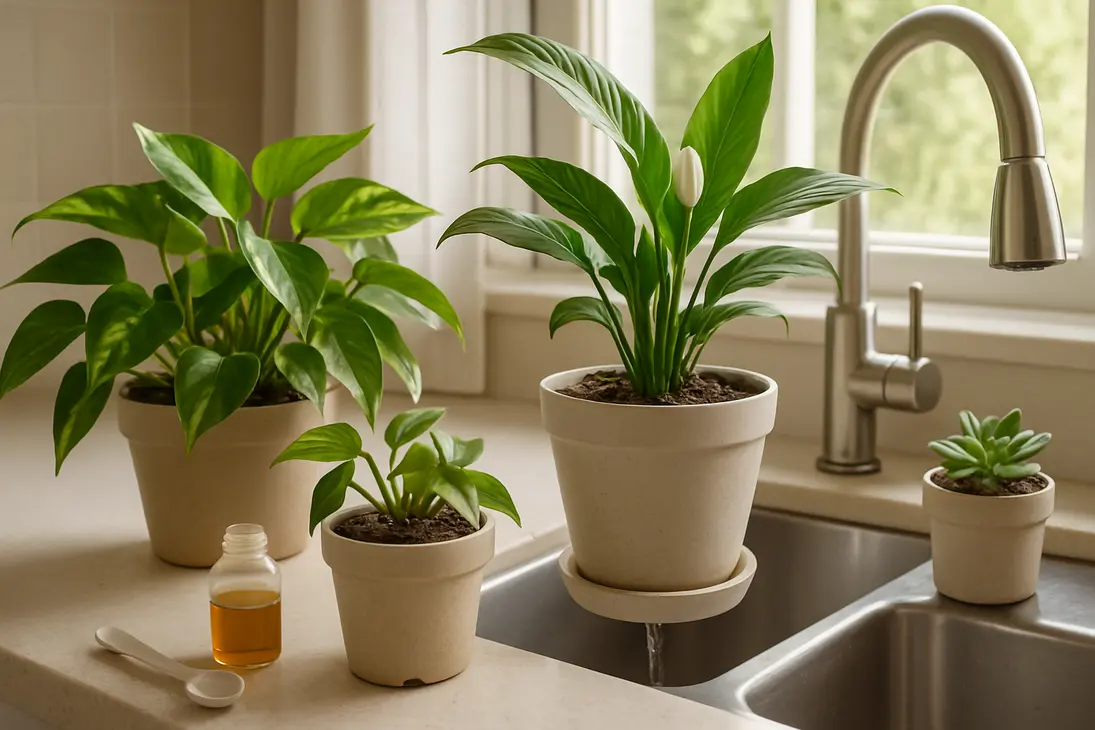
Flushing works best for pots with drainage holes and a mix that still lets water pass through.
To flush:
- Take the plant to a sink, tub, shower, or shaded outdoor spot.
- Slowly pour room-temperature water through the soil until it drains freely.
- Let the pot drain.
- Repeat once or twice if the dose was clearly excessive.
- Empty all runoff from saucers or cachepots.
Do not let the pot sit in salty water. After flushing, wait several weeks before feeding again, and resume at a weaker rate only if the plant is actively growing.
Fertilizing at the Wrong Time
Houseplants use nutrients most when producing new leaves, roots, stems, or flowers. For many indoor plants, that means spring through early fall, when light is stronger and days are longer.
Feeding at the wrong time leaves unused fertilizer in the potting mix, increasing the risk of salt buildup and root damage.
Fertilizing during winter dormancy
Many houseplants slow down in winter. They may not go fully dormant indoors, but shorter days and cooler windowsills often reduce growth. A plant that is barely growing does not need regular fertilizer.
Heavy winter feeding can cause brown leaf tips, weak stretched growth, wetter soil, and root stress. Exceptions include plants under strong grow lights, in warm rooms, and actively producing new growth.
For most houseplants, winter is a time to pause or greatly reduce fertilizer. A simple rule: if the plant is not making new growth, do not push it with fertilizer.
Feeding a plant that is dry, wilted, or stressed
Fertilizing a stressed plant is rarely the first fix. If a plant is wilted, bone-dry, heat-stressed, pest-infested, recently shipped, sunburned, or suffering from root trouble, fertilizer can make things worse.
Dry soil is especially risky because fertilizer solution can become concentrated around roots as the mix rehydrates unevenly.
If a plant is wilted:
- Check whether the soil is dry or wet.
- If dry, water thoroughly with plain water first.
- If wet, do not fertilize; check roots, drainage, and watering habits.
- Wait for stability and new growth before feeding.
Fertilizer supports growth. It does not rescue a plant from poor watering, rot, pests, extreme temperatures, or inadequate light.
Fertilizing too soon after repotting
Repotting disturbs roots, even when done carefully. Fine root hairs that absorb water and nutrients may be damaged, and fertilizer applied immediately afterward can irritate tender roots.
Many commercial potting mixes already contain starter fertilizer. If the label says it “feeds up to” a certain period or lists added nutrients, you usually do not need to feed right away.
After repotting, wait until the plant settles and shows recovery or new growth. A vigorous plant in spring may be ready in a few weeks. A slow-growing plant, succulent, or plant repotted in low light may need longer.
Choosing the Wrong Fertilizer or Strength
Houseplant fertilizers vary by nutrient ratio, concentration, release speed, and purpose. A fertilizer suitable for outdoor annuals, lawns, or vegetables may be too strong for an indoor pot.
The three main fertilizer numbers are the N-P-K ratio:
- N = nitrogen for leafy growth
- P = phosphorus for roots, flowers, and energy transfer
- K = potassium for overall function and stress tolerance
Balanced fertilizers work for many foliage houseplants. Flowering plants may benefit from bloom formulas, while cacti and succulents usually need lighter feeding.
Not reading the fertilizer label carefully
Many mistakes begin with ignoring the label. Some fertilizers are meant for weak, frequent use; others are designed for occasional feeding. Some are concentrates; others are ready-to-use.
Before applying fertilizer, check the dilution rate, application frequency, plant type, whether soil should be moist first, and whether the product contains slow-release nutrients. Measure carefully. A tablespoon and teaspoon are not interchangeable.
Using outdoor or garden fertilizer on houseplants
Outdoor fertilizers are not always unsafe, but they are often stronger than indoor plants need. Garden beds have more soil volume, rain, and different drainage. A houseplant pot is a much smaller, more closed system.
Outdoor fertilizer can cause problems when the concentration is too high, granules release unevenly near roots, the product is made for lawns or shrubs, or additives and odors are unsuitable indoors.
If using a general fertilizer, make sure it can be diluted for potted plants. When in doubt, choose one labeled for houseplants and start weak.
Applying full strength when half strength is safer
Many houseplants do well at half the label strength, especially in average indoor light. Less light means slower growth, which means lower nutrient demand.
Half strength is often safer for low-light plants, newly purchased plants, slow growers, succulents and cacti, small pots, plants with brown-tip problems, and winter or shoulder-season feeding.
This does not mean the label is wrong. It means the label cannot account for your exact light, temperature, pot size, and plant condition.
Fertilizing Without Considering Water, Soil, and Drainage
Fertilizer does not act alone. Its effect depends on water quality, soil moisture, drainage, pot size, and potting mix condition.
Many fertilizer problems are combined care problems: too much fertilizer plus compacted soil, dry roots, hard water, or no drainage hole. A draining pot and airy mix let excess water and salts move out. A compacted mix or pot without drainage keeps fertilizer around roots too long.
Fertilizing dry soil
Fertilizing very dry soil can shock roots. Dry potting mix often pulls away from the pot, so water runs down the sides instead of soaking evenly. If that water contains fertilizer, some roots may receive a strong dose while others stay dry.
A safer method:
- Check soil moisture first.
- If very dry, water with plain water.
- Let excess water drain.
- Fertilize later when the soil is lightly moist.
Applying diluted fertilizer as the watering itself can work if the mix is already slightly moist and the solution is properly diluted. Avoid fertilizer on a bone-dry root ball.
Letting fertilizer salts build up
In containers, salts remain in the pot unless water carries them out through drainage holes. They can come from fertilizer and, in some homes, mineral-rich tap water.
Signs of buildup include white crust on soil or pot rims, brown leaf tips, soil that resists wetting, and decline despite regular care.
To reduce buildup:
- Water thoroughly instead of giving tiny sips.
- Let water drain from the bottom.
- Empty saucers.
- Flush occasionally when appropriate.
- Repot when mix becomes compacted, crusty, or slow to drain.
If your tap water is very hard, occasional filtered, rain, or distilled water may help sensitive plants, though most houseplants do not require it.
Using homemade fertilizers without knowing their strength
Homemade fertilizers can be unpredictable indoors. Banana peels, coffee grounds, eggshells, potato peels, aquarium water, compost teas, and kitchen scraps may contain nutrients, but their strength and breakdown rate are hard to control in a pot.
Possible problems include fungus gnats, mold, odor, uneven nutrient release, excess moisture, residue, and pests. Eggshells break down slowly, coffee grounds can compact, and food scraps may rot before helping the plant.
For organic feeding, use a packaged product intended for indoor containers or a small amount of finished worm castings. Avoid burying fresh kitchen waste in houseplant pots.
Not Adjusting Fertilizer to the Plant’s Needs
Another common mistake is feeding every plant the same way. A pothos in bright indirect light, an orchid in bark, a cactus in sun, and a peace lily in low light do not have identical needs.
The right schedule depends on plant type, growth rate, light level, season, pot size, and soil type. Watch the plant, not just the calendar.
Feeding every plant on the same schedule
Monthly spring and summer feeding may suit many foliage plants, but it should not be automatic.
| Plant type | Typical feeding approach |
|---|---|
| Fast-growing foliage plants | Light, regular feeding during active growth |
| Flowering houseplants | Feed during growth and bloom cycles |
| Succulents and cacti | Infrequent, diluted feeding |
| Orchids | Weak, often specialized fertilizer |
| Slow-growing plants | Less frequent feeding |
| Low-light plants | Light or rare feeding |
Light is a major factor. A monstera in a bright room may need more nutrients than the same plant in a dim corner.
Fertilizing slow growers too often
Slow-growing plants are easy to overfeed because they do not respond quickly. Owners may keep adding fertilizer, hoping for a growth spurt, when the plant is simply growing at its natural pace.
Slow or low-feeding plants include many succulents, cacti, snake plants, ZZ plants, hoyas, and some palms. Feed only during active growth, use a diluted solution, and avoid winter feeding unless growth is obvious.
Healthy slow growth is better than forced weak growth.
Ignoring yellow leaves, brown tips, or weak growth
Yellow leaves, brown tips, and weak growth can signal many problems. The mistake is assuming every symptom means the plant is hungry.
Before fertilizing a struggling plant, check soil moisture, watering history, pests, light, root health, white crust on the soil, recent fertilizer use, and whether the plant is naturally dropping old leaves.
Nutrient deficiency is possible, especially in an actively growing plant that has not been fed for months. But fertilizer should come after basic care issues are ruled out.
If there are brown tips and salt crust, pause feeding and flush. If roots are healthy, growth is active, and no fertilizer has been used for a long time, a mild feeding may help.
Conclusion
The safest way to avoid fertilizing houseplants mistakes is to feed lightly, time it well, and adjust to the plant in front of you. Fertilize during active growth, follow the label, and start weaker than you think you need.
If you overdo it, stop feeding and flush the soil if drainage is good. If the plant is stressed, dry, wilted, newly repotted, or dormant, wait. Fertilizer works best alongside good light, proper watering, healthy roots, and suitable potting mix.
FAQ
How often should I fertilize houseplants?
Most common foliage houseplants can be fertilized lightly in spring and summer, often about once a month or according to the product label. Plants in bright light and active growth may need more frequent weak feeding. Plants in low light, winter rest, or slow growth need much less.
If the plant is not growing, do not keep feeding by habit.
Can too much Miracle-Gro hurt houseplants?
Yes. Too much of any concentrated fertilizer, including water-soluble products such as Miracle-Gro, can hurt houseplants if mixed too strongly or applied too often. Excess salts can burn roots, cause brown tips, trigger wilting, and leave crusty buildup.
If you used too much, remove visible product, flush the soil if the pot drains well, and stop fertilizing until recovery begins.
Should I water before or after fertilizing houseplants?
It is usually safest to fertilize when the soil is already lightly moist. If the soil is very dry, water first with plain water and fertilize later after the plant rehydrates.
If the soil is evenly slightly moist, properly diluted liquid fertilizer can be applied as part of watering, as long as excess drains away.
Is homemade fertilizer safe for indoor plants?
Homemade fertilizer can be risky indoors because strength and breakdown rate are unpredictable. Kitchen scraps, coffee grounds, banana peels, and similar materials may cause mold, odor, fungus gnats, or soggy soil.
A measured houseplant fertilizer or mild indoor-safe organic product is usually more reliable.
You Might Also Like