How Evolution Explains Ecosystems Preserved in Fossil Layers
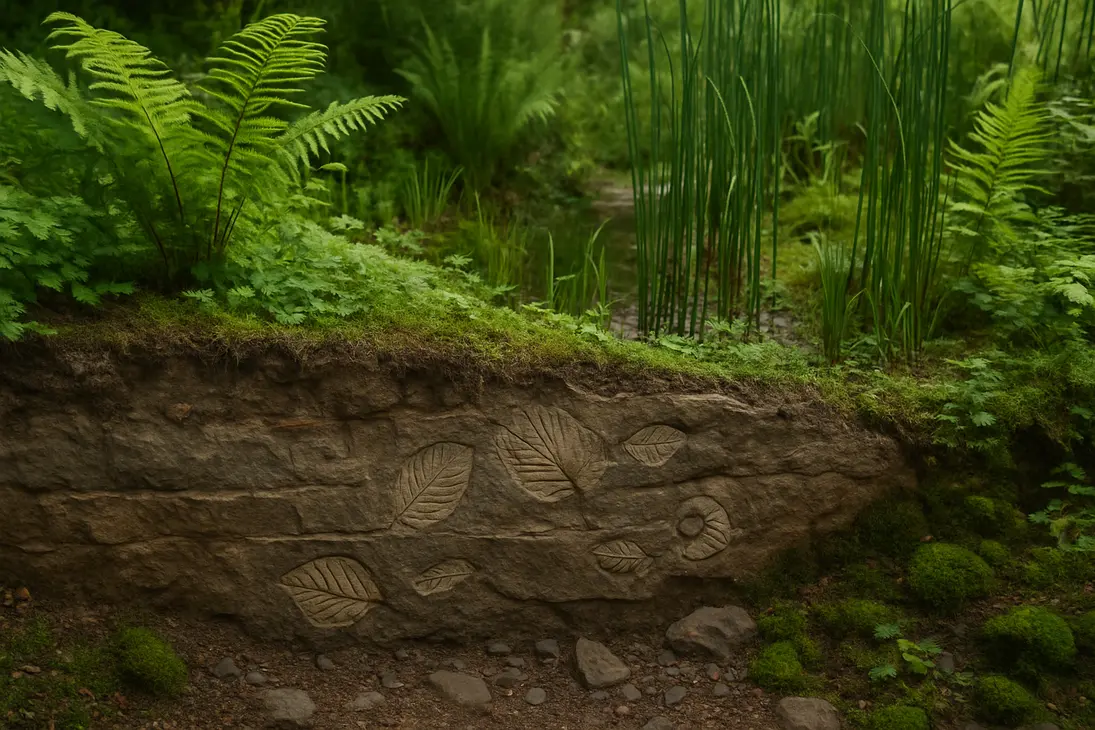
Fossil layers preserve more than bones. They may contain shells from shallow seas, pollen from forests, footprints on riverbanks, burrows in seafloor mud, leaves from swamps, and chemical traces of ancient conditions. Together, these clues help scientists reconstruct ecosystems that no longer exist.
Evolution explains why those ecosystems change through time. Older layers generally contain older forms of life; younger layers contain descendants, newly evolved groups, migrants, survivors, and communities rebuilt after extinction or environmental change.
What Fossil Layers Preserve About Ancient Ecosystems
A fossil layer is usually sedimentary rock: mud, sand, lime-rich ooze, volcanic ash, peat, or another material deposited in a sea, lake, river delta, desert, swamp, floodplain, or lagoon.
When organisms lived, died, shed parts, or disturbed sediment there, some evidence could be buried and preserved. Paleontologists use that evidence to infer both the organisms present and the conditions they lived in.
Fossil assemblages: snapshots of past life
A fossil assemblage is the group of fossils found together in a deposit. It is a snapshot of life from a time and place, though not a perfect one.
A limestone with corals, brachiopods, and crinoid fragments suggests a warm shallow sea. A shale with fish, freshwater shells, leaves, and fine mud may record a lake or delta. A coal seam with roots, spores, trunks, and compressed leaves points to a wetland.
Some assemblages preserve organisms that lived together. Others mix remains transported from nearby habitats, such as leaves washed into a river or pollen blown in from farther away. Fossils must therefore be interpreted with the surrounding rock.
Why fossils are usually incomplete records, not whole ecosystems
Fossil layers rarely preserve complete ecosystems. Most organisms decay, dissolve, are eaten, or are destroyed before fossilization. Hard parts such as shells, teeth, and bones preserve more often than worms, fungi, soft algae, jellyfish, or delicate plant tissues.
Preservation also favors certain environments, including muddy lake bottoms, floodplains, peat swamps, volcanic ash beds, and low-oxygen seafloors. Rocky uplands, fast streams, dry exposed soils, and acidic forests often leave little evidence.
The record is partial, but useful when body fossils, trace fossils, sediment, chemistry, and modern comparisons are considered together.
How rock type and burial environment shape what gets preserved
The rock itself is a clue because preservation depends on burial conditions, sediment type, oxygen, water chemistry, and later geological change.
| Rock or deposit type | Common evidence | Ecosystem clues |
|---|---|---|
| Limestone | shells, corals, marine microbes | shallow seas, reefs |
| Shale or mudstone | fish, leaves, pollen, burrows | lakes, deltas, quiet seafloors |
| Sandstone | tracks, burrows, bones, plant fragments | rivers, beaches, dunes |
| Coal | roots, wood, spores, compressed plants | peat swamps, wet forests |
| Volcanic ash | rapidly buried organisms, dateable minerals | sudden burial, volcanic activity |
| Ancient soils | root traces, burrows, soil structure | land surfaces, vegetation, climate |
Rapid burial can protect remains. Low oxygen slows decay. Fine sediment can capture delicate impressions, while coarse sediment may destroy them.
Why Different Fossil Layers Contain Different Ecosystems
Different fossil layers contain different ecosystems because life and environments changed. Species evolved, migrated, and went extinct. Seas advanced and retreated. Climates shifted. Continents moved, mountains rose, rivers changed course, forests spread, and deserts expanded.
Evolutionary change through time
Evolution means populations change over generations. Over long spans, lineages split, adapt, diversify, or disappear. Fossil layers preserve the results in sequence.
Older rocks contain organisms from earlier stages in life’s history. Younger rocks contain later branches. Trilobites occur in ancient Paleozoic marine rocks, non-bird dinosaurs appear before humans, and flowering plants become common only after earlier plant groups had long existed.
Evolution does not predict a smooth ladder of progress in every layer. It predicts branching, local variation, stability in some lineages, rapid diversification in others, and extinction. Fossils fit that expectation: organisms appear in ordered sequences, related forms cluster through time, and later ecosystems build on earlier biological possibilities.
Local ecosystem shifts caused by sea level, climate, and habitat change
Not every difference between layers reflects new species evolving. Sometimes the local environment changed.
One location might first be a shallow sea with clams and corals, later a coastal plain with plants and land animals, and later a desert or forest. Its fossil layers would show very different ecosystems even as global evolution continued.
Sea level is especially important because many fossil-rich rocks formed in marine settings. When seas covered continents, marine fossils accumulated. When seas retreated, rivers, floodplains, and land ecosystems replaced them.
Climate also reshapes communities. Warm humid conditions support different plants and animals than cold or dry conditions. A drying lake or shifting river can produce a sharply different fossil layer without requiring sudden global biological change.
Mass extinctions and ecological replacement
Mass extinctions create some of the clearest differences between fossil ecosystems. During these events, many lineages disappear across large regions in a geologically short time. Afterward, food webs reorganize.
Survivors may diversify into open ecological roles. New reef builders may replace old ones. Different predators may dominate. Plant communities may shift, changing herbivore communities. Evolution explains this replacement: extinction removes lineages, survivors adapt or migrate, and ecosystems reassemble.
Why fossil layers show patterns instead of random mixtures
If fossil layers were random, trilobites, dinosaurs, modern horses, ammonites, early fishes, flowering plants, and humans would be scattered unpredictably. They are not.
Fossils occur in consistent broad order. Cambrian marine animals, Carboniferous coal swamp plants, Mesozoic dinosaur-bearing ecosystems, and Cenozoic mammal-rich faunas each fit their time.
There are complications: erosion, redeposition, uneven preservation, and older fossils washed into younger rocks. These are usually recognizable from sedimentary context, wear, or conflict with other evidence. The larger pattern remains ordered because biological history unfolded through time.
How Scientists Connect Fossil Ecosystems Across the World
Paleontologists compare fossil layers across regions using fossils, sedimentary sequences, volcanic ash beds, magnetic signatures, radiometric dates, and field relationships. This turns local fossil ecosystems into a broader history of life.
Fossil succession and predictable ordering
Fossil succession is the predictable vertical order of fossils in sedimentary rocks. In undisturbed sequences, lower layers are generally older than higher layers. When many sequences are compared, the same broad fossil order appears repeatedly.
This principle was recognized before modern evolutionary theory. Evolution later explained it: species originate, persist for a time, and then go extinct or change into descendant populations. Because extinct species do not reappear millions of years later as the same species, fossils can help establish relative age.
Index fossils and global correlation
Index fossils help match rock layers from different places. Good index fossils are widespread, abundant, recognizable, and limited to a relatively short span of geological time.
Marine organisms often make useful index fossils because oceans allowed wide dispersal and marine sediments are common. Ammonites and certain planktonic microfossils have been widely used for correlation.
Index fossils let scientists connect layers of similar age even when local environments differed. One region may preserve shallow sea fossils while another preserves deeper offshore sediments, but shared index fossils can link them in time.
Radiometric dating and absolute ages
Fossils and rock position provide relative age. Radiometric dating can provide numerical ages when suitable minerals are present.
Sedimentary rocks are often difficult to date directly because their grains may be older than the layer. But volcanic ash beds within or near sedimentary sequences may contain minerals that crystallized during an eruption and can be dated by radioactive decay.
Combined with fossil succession, radiometric dating places fossil forests, reefs, lakes, and dinosaur-bearing floodplains within numerical time ranges. Strong age models usually use several lines of evidence, not one method alone.
Why similar fossil ecosystems appear on different continents
Similar fossil ecosystems can appear on different continents for several reasons.
Continents were not always in their current positions. Plate tectonics joined, split, and moved landmasses, so related fossils on separated continents may reflect earlier connections. Similar environments can also produce similar ecosystems: shallow tropical seas, coal swamps, and coastal wetlands may resemble one another in distant regions.
Migration matters too. Marine organisms spread through connected seas. Plants disperse by spores, seeds, wind, water, and animals. Land animals move through land bridges and habitat corridors. Evolution explains both similarity from shared ancestry and difference after isolation.
What Ancient Plants Reveal About Fossil Ecosystems
Animals often receive more attention, but plants are essential to reconstructing ancient ecosystems. They shaped habitats, soils, food webs, carbon storage, and atmospheric chemistry. Fossil leaves, wood, roots, spores, and pollen reveal moisture, temperature, seasonality, disturbance, and animal resources.
Extinct forests, coal swamps, and early land ecosystems
Early land ecosystems were not modern forests. Plants evolved from small non-vascular forms to vascular plants, spore-bearing forests, seed plants, conifers and relatives, and later flowering plants.
Carboniferous coal swamps are a key example. They included extinct tree-like lycophytes, horsetail relatives, seed ferns, and other plants unlike most modern forests. Their remains accumulated in waterlogged, low-oxygen settings and later became coal.
These wetlands supported insects, amphibians, early reptiles, microbes, and decomposers. Ancient plants also changed erosion and soil formation by rooting into land surfaces, stabilizing sediment, breaking down rock, and creating more complex habitats.
How plant evolution changed animal ecosystems
Plant evolution repeatedly changed animal life. When land plants spread, they provided food, shelter, and humid microhabitats. Taller forests created layered habitats: canopy, trunks, litter, wet soils, and open gaps.
Seeds supplied nutrient-rich food. Flowering plants later transformed terrestrial ecosystems and influenced insects, herbivorous dinosaurs, mammals, birds, and pollination relationships.
Plant defenses also mattered. Tough leaves, resins, toxins, thorns, silica, and seasonal growth influenced herbivore evolution. Herbivores then affected plants through grazing, browsing, seed dispersal, trampling, and nutrient cycling.
Fossil plants as clues to ancient climate and atmosphere
Fossil plants are strong climate indicators because vegetation is tied to temperature, rainfall, seasonality, and carbon dioxide.
Leaf shape can suggest climate. Growth rings in fossil wood may show seasonality, stress, or growth rate. Pollen and spores reveal regional vegetation even when large plant fossils are absent.
Stomata, the pores on leaves, can provide clues about ancient carbon dioxide, though interpretation requires comparison with living relatives and other evidence. Plants also influenced climate through photosynthesis, carbon burial, weathering, and soil formation.
What Evolution Does—and Does Not—Claim About Fossil Layers
Evolution does not claim every fossil layer preserves a complete ecosystem or that change must appear gradual in every local rock sequence. It also does not treat gaps as surprising. Fossilization is uneven, and geological records are interrupted.
Evolution does claim that life has changed through descent with modification, that lineages share common ancestry, and that fossils should show ordered patterns of appearance, persistence, change, and extinction.
Fossil layers are not a single global ecosystem stacked neatly
A common mistake is imagining fossil layers as one global stack: reef layer, swamp layer, dinosaur layer, mammal layer. Real geology is local and uneven.
At any one time Earth had oceans, lakes, deserts, forests, wetlands, mountains, islands, and polar regions. Different places deposited different sediments or none at all. Some layers were later eroded, buried, altered, or uplifted.
A marine layer and a land-animal layer may be the same age but represent different habitats. Similar-looking fossil forests may be different ages. Evolution explains biological order, while geology explains how that order is preserved unevenly.
Gaps in the fossil record do not erase broad evolutionary patterns
Gaps are expected. Fossilization requires burial, preservation, survival through geological processes, exposure, and discovery. Most organisms never fossilize, many fossil rocks remain buried, and others were destroyed by erosion, heat, pressure, or tectonic activity.
A gap in one place does not mean life stopped changing. Scientists compare many sequences and types of evidence.
Transitional fossils are important because they show combinations of traits linking broader groups or stages. But evolution does not require every generation to be preserved. The strength of the evidence lies in repeated order, expected transitional forms, and independent dating.
Evolution explains both continuity and sudden-looking changes in fossils
Some fossil sequences show gradual change. Others show long stability followed by sudden-looking shifts. Both can fit evolution.
A sudden-looking change may reflect rapid evolution, migration, environmental replacement, a gap in deposition, erosion of intermediate layers, or mass extinction. In geology, “sudden” may still mean thousands or hundreds of thousands of years.
Continuity is also common. Reefs, forests, plankton communities, predator-prey relationships, burrowing animals, and plant-herbivore interactions can persist while the species filling those roles change.
Conclusion
Ecosystems preserved in fossil layers are partial but meaningful records of life in specific environments: seas, swamps, rivers, lakes, forests, floodplains, and more. They include bodies, shells, pollen, spores, tracks, burrows, roots, microbes, and chemical traces.
Evolution explains why these ecosystems change through time. Species originate, adapt, spread, and go extinct. Ecosystems reorganize after climate shifts, sea-level change, continental movement, and mass extinction.
The fossil record is incomplete, but not chaotic. Its ordered patterns, supported by fossil succession, index fossils, radiometric dating, and geology, show a planet where life has been changing for billions of years.
FAQ
Why do fossil layers contain different ecosystems?
Because both life and environments changed. Evolution produced new organisms while older lineages went extinct. Sea level, climate, rivers, coastlines, volcanoes, and continental movement also changed habitats.
How do scientists know which fossil layers are older?
They use multiple methods together. Lower layers are generally older in undisturbed sequences. Fossil succession and index fossils compare rocks across regions. Radiometric dating of volcanic ash or nearby igneous rocks provides numerical ages.
Do fossil layers prove ecosystems changed through evolution?
They strongly support that conclusion, especially globally and through deep time. Fossil layers show ordered appearances and disappearances, transitions in major groups, extinction events, and replacement of ecological communities.
Why are extinct plants important for understanding fossil ecosystems?
Extinct plants shaped habitats, soils, food webs, carbon storage, and climate. Fossil leaves, wood, roots, pollen, and spores help reconstruct ancient forests, wetlands, grasslands, and climates.
You Might Also Like