Why Does Biology Encompass More Than Plants and Animals?
Biology is often introduced through familiar subjects: plants, animals, and the human body. Those examples are useful, but they represent only part of the field. Biology beyond plants and animals includes microscopic organisms, fungi, cells, genes, ecosystems, evolution, and the chemical processes that make life possible.
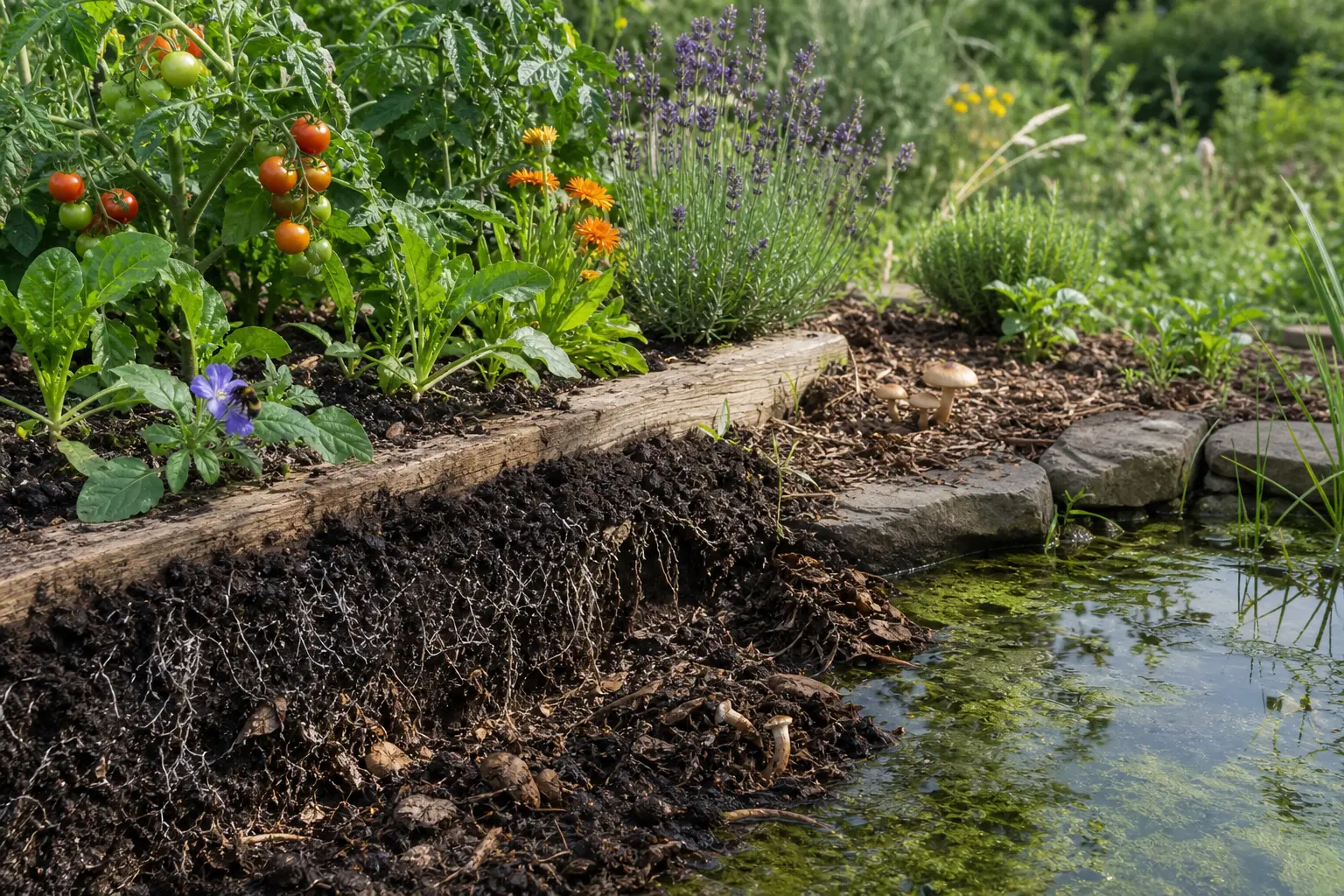
A garden makes this broader view easy to see. The tomato plant and visiting bee are obvious living things, but so are the bacteria around plant roots, the fungi decomposing fallen leaves, the microscopic organisms in a pond, and the microbes that cause or prevent plant disease. Biology studies all of them—and the relationships among them.
Biology Studies Life at Every Level
Biology is the science of life. It investigates living organisms, how they are built, how they obtain and use energy, how they reproduce, how they change over time, and how they interact with one another and their surroundings.
That scope ranges from molecules inside a single cell to entire forests, oceans, farms, and climate-influenced ecosystems. A biologist might study:
- The structure of a leaf or an insect wing
- How a bacterial cell divides
- How DNA passes traits from parents to offspring
- Why a fungal disease spreads through a crop
- How a wetland supports birds, microbes, plants, and fish
- How populations evolve in response to environmental change
Plants and animals are highly visible and familiar, so botany and zoology remain important parts of biology. But life is far more diverse than these two groups. Much of the living world is microscopic, and many essential biological processes happen below ground, underwater, or inside other organisms.
Biology also asks questions that go beyond “What is this organism called?” It asks how life functions and why it has taken its present form.
Living Things Beyond the Plant and Animal Kingdoms
The old habit of dividing living things into “plants” and “animals” is simple, but incomplete. Plants generally make sugars through photosynthesis, while animals obtain energy by eating other organisms. Yet many living things do neither in the same way, or combine traits that make a simple two-group system misleading.
Modern classification reflects evolutionary relationships and cell structure rather than appearance alone. Major groups studied in biology include bacteria, archaea, fungi, and a wide variety of eukaryotic organisms often grouped loosely as protists.
Microorganisms: Bacteria and Archaea
Bacteria and archaea are single-celled organisms without a nucleus. They are microscopic, but their effects are enormous.
Bacteria live in soil, water, air, decaying material, plant tissues, animal digestive systems, and on nearly every surface. Some cause disease, but many are beneficial or harmless. In a healthy garden soil, bacteria help break down organic material and transform nutrients into forms plants can use. Other bacteria form close relationships with plant roots, including legumes such as beans and peas.
Archaea are also single-celled and lack a nucleus, but they are distinct from bacteria in important genetic and chemical ways. Some archaea thrive in environments once considered too extreme for life, such as very salty water or hot springs. Others occur in ordinary soils, oceans, and the digestive systems of animals.
Neither group is “less biological” because its members are tiny. In fact, bacteria and archaea are central to studies of evolution, genetics, disease, soil health, and global nutrient cycles.
For gardeners, this perspective matters because soil is not simply a growing medium. It is a living system. Excessive disturbance, unnecessary chemical use, compacted ground, and repeated removal of organic matter can affect the organisms that support nutrient cycling and root health.
Fungi and Their Role in Ecosystems
Fungi are not plants. Although mushrooms may appear to grow from the soil like plants, fungi do not make food through photosynthesis. Instead, they absorb nutrients from their environment.
Fungi include mushrooms, molds, yeasts, mildews, and the threadlike organisms that spread through soil, wood, compost, and plant material. Their bodies often consist of fine filaments called hyphae. A network of hyphae, called a mycelium, can extend through a large area of soil or decaying wood.
Many fungi are decomposers. They break down dead leaves, fallen branches, old roots, and other organic matter that would otherwise accumulate. This releases nutrients back into the ecosystem, making fungi essential to soil formation and nutrient cycling.
Some fungi form beneficial partnerships with plant roots. Mycorrhizal fungi can extend the effective reach of a plant’s root system, helping it access water and certain nutrients. The plant, in return, provides sugars produced by photosynthesis.
Other fungi can be plant pathogens. Powdery mildew, rusts, damping-off diseases, and many root rots involve fungi or fungus-like organisms. This does not make fungi “bad.” It shows why biology studies relationships and conditions rather than assigning whole groups a simple good-or-bad label.
A mushroom in mulch may be a sign that organic material is decomposing, not a reason for alarm. However, mushrooms should not be assumed edible based on appearance, and gardeners should keep unidentified fungi away from children and pets.
Protists and Other Diverse Eukaryotes
“Protist” is a convenient informal term for a very diverse collection of eukaryotic organisms that are not animals, plants, or fungi. Eukaryotic cells have a nucleus and other membrane-bound structures, unlike bacterial and archaeal cells.
This broad category includes many algae, amoebas, paramecia, and other mostly microscopic organisms. Some protists photosynthesize, some consume other organisms, and some can do both depending on conditions. Their diversity is one reason biology cannot be reduced to a plant-and-animal subject.
Algae are especially important. Many algae live in water and use sunlight to produce food. They provide the base of many aquatic food webs and contribute substantially to oxygen production. Not all algae are plants, even when they resemble aquatic plants in a pond or aquarium.
In a garden setting, algae may appear as a green coating on damp soil, seed trays, pots, birdbaths, or water features. Small amounts are often simply a sign of light and moisture. Heavy algae growth can indicate that water is still, nutrient-rich, or receiving too much sun.
Protists also include organisms that can affect human, animal, and plant health. Their study helps biologists understand disease transmission, water quality, evolution, and the complexity of single-celled life.
Where Viruses Fit in Biology
Viruses occupy a special place in biology because scientists do not all classify them as living. They are not cells, do not grow or produce energy independently, and cannot reproduce without entering a host cell.
A virus contains genetic material—DNA or RNA—inside a protective coating. Once it infects a suitable host cell, it uses the cell’s machinery to make more viral particles. This dependence on a host is the main reason viruses sit at the boundary between living and nonliving.
Even so, viruses are essential to biological study. They evolve, spread through populations, interact with immune systems, influence ecosystems, and affect plants, animals, fungi, bacteria, and archaea.
Gardeners encounter this relevance when plant viruses cause symptoms such as unusual mottling, distorted leaves, stunting, or reduced yields. A virus cannot be treated in the same way as a nutrient deficiency or many fungal diseases. Good diagnosis matters: removing seriously infected plants, cleaning tools, managing insect vectors where appropriate, and avoiding propagation from affected plants may help limit spread.
Biology Also Examines How Life Works
Biology is not only concerned with identifying organisms. It also investigates the processes that connect all living things. A botanist examining roots, a microbiologist studying bacteria, and a geneticist analyzing DNA may be asking different questions, but each is trying to explain how life works.
Cells, Genes, and Molecular Processes
Cells are the basic units of life. A plant, animal, fungus, or bacterium may look very different at the organism level, yet each relies on cells to carry out essential functions.
Cells take in materials, release waste, respond to their environment, build proteins, use energy, and maintain internal conditions. Plant and animal cells share many structures, but they also differ. Plant cells have cell walls and chloroplasts, for example, while animal cells do not. Fungal cells have walls too, but their walls differ chemically from plant cell walls.
Genes are segments of DNA that contain instructions used by cells. They influence traits such as flower color, disease resistance, fruit shape, enzyme production, and aspects of growth. Genes do not act in isolation: environmental conditions can affect how traits are expressed.
Molecular biology studies processes at this small scale, including:
- How DNA is copied before cells divide
- How cells use genetic instructions to make proteins
- How enzymes speed up chemical reactions
- How cells communicate and respond to stress
- How mutations create genetic variation
These topics apply across biology. Understanding a genetic disease in people, breeding disease-resistant crops, and tracking bacterial resistance to antibiotics all depend on the same broad principles of inheritance and molecular function.
Growth, Reproduction, Evolution, and Inheritance
All organisms must obtain resources, maintain themselves, and reproduce in some form. The details vary widely. A bean plant produces seeds, a bacterium may divide into two cells, a fungus releases spores, and some organisms reproduce both sexually and asexually.
Biology examines how those strategies affect survival. A plant that produces many small seeds uses a different approach from one that produces fewer, larger seeds. A bacterium that divides rapidly may respond quickly to favorable conditions. A fungus that spreads through spores can colonize new areas when moisture and temperature are suitable.
Evolution is another major reason biology covers more than plants and animals. Evolution explains how populations change over generations as inherited variation interacts with environmental pressures. It helps explain why organisms share certain traits, why pathogens can become harder to control, and why local conditions favor some species over others.
For example, repeatedly using the same pest-control method can favor pests or disease organisms that survive it. This is why integrated pest management emphasizes observation, prevention, physical controls, habitat management, and carefully chosen treatments rather than automatic repeated spraying.
Ecosystems and Relationships Between Organisms
No organism exists entirely alone. Ecology, a branch of biology, studies how organisms interact with one another and with nonliving factors such as soil, water, temperature, light, and nutrients.
A vegetable bed is an ecosystem, even if it is small and managed by a gardener. Its living components may include crops, weeds, earthworms, insects, spiders, birds, fungi, bacteria, and nematodes. Its nonliving conditions include soil texture, drainage, rainfall, sunlight, organic matter, and temperature.
Biologists study relationships such as:
- Predation: ladybirds feeding on aphids
- Pollination: bees transferring pollen between flowers
- Decomposition: fungi and bacteria breaking down dead material
- Competition: plants competing for light, water, and nutrients
- Mutualism: root-associated microbes and plants benefiting each other
- Parasitism: pathogens drawing resources from a host
This systems view explains why a gardening problem rarely has only one cause. Yellow leaves, for example, may result from poor drainage, nutrient imbalance, root damage, pest activity, disease, temperature stress, or a combination of factors. Biology helps identify the mechanism rather than relying on a single assumption.
Why Studying More Than Plants and Animals Matters
Studying biology beyond plants and animals matters because human health, food systems, environmental stability, and everyday life depend on organisms and processes that are easy to overlook.
Microbes can cause disease, preserve food, help digest it, enrich soil, and produce useful compounds. Fungi can recycle nutrients, support plant roots, spoil crops, and provide medicines. Genes influence inherited traits and guide modern breeding and biotechnology. Ecosystems regulate water, fertility, pest populations, and carbon movement.
Medicine, Disease, and the Human Microbiome
Medicine depends heavily on microbiology, cell biology, immunology, genetics, and virology. Many illnesses involve bacteria, viruses, fungi, parasites, or disruptions in normal body processes at the cellular level.
The human microbiome—the collection of microorganisms that live in and on the body—is another example of biology beyond animals. Humans are animals, but human health is influenced by communities of microbes, especially in the gut, on the skin, and in the mouth. These organisms interact with the body in complex ways, and their effects cannot be understood by studying human cells alone.
Biology also helps distinguish between different types of infection. Antibiotics target bacteria, not viruses. Antiviral treatments, vaccines, hygiene measures, and immune responses involve different biological mechanisms. Accurate diagnosis is therefore important in both human and plant health.
Agriculture, Decomposition, and Nutrient Cycles
Food production relies on more than crops and livestock. Productive soil depends on organisms that decompose organic matter and recycle nutrients. Pollinators support many fruiting plants. Predators and parasitoids can help limit some pests. Root-associated microbes can affect plant nutrient access and resilience.
Compost offers a practical example. It is not just a pile of dead leaves turning into dark material. Bacteria, fungi, and small invertebrates break down organic matter over time. Their activity produces a stable material that can improve soil structure and contribute nutrients when used appropriately.
The same biological principles explain why compost needs a balance of moisture, air, and varied organic materials. A waterlogged, compacted pile may decompose slowly and smell unpleasant because different microbes dominate under low-oxygen conditions. A dry pile may remain largely unchanged because decomposers need moisture to work effectively.
Biotechnology and Conservation
Biotechnology uses biological systems, cells, or molecules to create useful products and solve problems. It includes familiar practices such as fermentation, as well as modern work involving genetics, tissue culture, diagnostics, and microbial production.
For gardeners and growers, biotechnology may contribute to disease testing, improved crop varieties, biological pest controls, and propagation methods. It can offer useful tools, but it does not eliminate the need for good growing conditions, crop diversity, sound hygiene, and careful observation.
Conservation also requires a broad biological perspective. Protecting a species means more than protecting visible animals or planting more trees. It may require conserving soil organisms, pollinator habitat, wetlands, fungal communities, food webs, and genetic diversity within populations.
A landscape can look green while still supporting limited biodiversity. Diverse habitats—with native plants suited to the site, flowering resources across the season, shelter, water where appropriate, and reduced unnecessary disturbance—usually support a wider range of life.
Conclusion
Biology encompasses more than plants and animals because life itself is more diverse than those two familiar groups. Bacteria, archaea, fungi, protists, and viruses all help answer important questions about health, food, ecosystems, evolution, and the mechanisms of living systems.
The field also reaches beyond organism names and categories. It studies cells, genes, reproduction, disease, decomposition, inheritance, and ecological relationships. Whether you are looking at a forest, a pond, a compost heap, or a raised vegetable bed, biology is happening at every scale—from molecules inside cells to interactions across an entire ecosystem.
FAQ
Is biology only the study of plants and animals?
No. Biology is the study of life and life processes. It includes plants and animals, but also bacteria, archaea, fungi, protists, cells, genes, ecosystems, evolution, and many disease-causing organisms. Biology also studies how living things interact with their environments.
What are the main branches of biology besides botany and zoology?
Major branches include microbiology, genetics, cell biology, molecular biology, ecology, evolution, mycology (the study of fungi), microbiology, marine biology, immunology, physiology, biochemistry, and conservation biology. These fields often overlap. For example, plant disease research can involve botany, mycology, microbiology, genetics, and ecology at the same time.
Are fungi plants?
No. Fungi are their own major group of organisms. Unlike plants, fungi do not photosynthesize or make sugars from sunlight. They absorb nutrients from organic material or through relationships with other organisms. Mushrooms, molds, yeasts, and many decomposers are fungi.
Why are viruses studied in biology if they are not always considered living?
Viruses are studied in biology because they contain genetic material, evolve, infect cells, affect populations, and strongly influence health and ecosystems. Although they cannot reproduce or carry out metabolism on their own, they interact closely with living organisms and are essential to understanding disease, genetics, immunity, and evolution.
You Might Also Like