Why Is a ZZ Plant Classified as a Monocot?
A ZZ plant is classified as a monocot because it belongs to a lineage of flowering plants whose seeds, flowers, pollen, internal stem structure, and evolutionary history place them in the monocot group.
At first glance, this can seem surprising. Zamioculcas zamiifolia has glossy, divided leaves, chunky underground growths, and a shrub-like outline that do not resemble the classic image of a monocot such as grass, a lily, or a palm. Its visible features are also less straightforward than the simplified “parallel veins equals monocot” rule taught in basic botany.
The reason a ZZ plant is a monocot is not based on one houseplant feature alone. It is based on the full set of traits used by botanists to classify flowering plants.
ZZ Plant Taxonomy: Where It Fits Among Monocots
The botanical name for the ZZ plant is Zamioculcas zamiifolia. It is a flowering plant in the arum family, Araceae.
Araceae includes many familiar indoor plants, including:
- Peace lilies (Spathiphyllum)
- Philodendrons (Philodendron)
- Monsteras (Monstera)
- Anthuriums (Anthurium)
- Chinese evergreens (Aglaonema)
- Calla lilies (Zantedeschia)
The arum family is part of the monocot group, sometimes called monocotyledons. Monocots are one of the major branches of flowering plants, alongside eudicots, which are the group most people mean when they casually say “dicots.”
A simplified classification looks like this:
| Taxonomic level | ZZ plant placement |
|---|---|
| Kingdom | Plantae |
| Major flowering-plant group | Monocots |
| Order | Alismatales |
| Family | Araceae |
| Genus | Zamioculcas |
| Species | Zamioculcas zamiifolia |
So, the short answer is simple: the ZZ plant is a monocot because its family, Araceae, is a monocot family. Its classification reflects evolutionary relationships, not whether every visible feature matches a beginner’s textbook drawing of a monocot leaf.
The Monocot Features of a ZZ Plant
Monocots are identified through a collection of reproductive, developmental, and anatomical characteristics. No single visible houseplant trait is reliable in every species.
The most dependable evidence comes from the plant’s seed embryo, floral biology, pollen, and its place in the flowering-plant family tree. Leaf venation, root form, and growth habit can support the classification, but these characteristics have exceptions—especially among aroids.
One Seed Leaf in the Embryo
The defining characteristic of a monocot is found inside its seed: the embryo has one cotyledon, or seed leaf.
A cotyledon is the first leaf-like structure in the developing embryo. It helps the young plant use stored food as it begins to grow. Monocot embryos have one cotyledon; eudicot embryos generally have two.
This trait gives monocots their name:
- Mono = one
- Cotyledon = seed leaf
In practice, most ZZ plant owners will never see this feature. Houseplants are usually bought as mature, vegetatively propagated plants rather than grown from seed. ZZ plants also flower infrequently indoors, and producing viable seed is not a normal part of home cultivation.
Still, the one-cotyledon embryo is fundamental to why Zamioculcas zamiifolia belongs among monocots. It is a developmental trait inherited from its monocot ancestors, whether or not it is visible in a pot on a windowsill.
Flower Structure and Pollen
Many monocots have flowers arranged in parts of three: three petals, three sepals, or floral structures built around multiples of three. Lilies are a familiar example.
ZZ plants belong to the arum family, where flowers are highly specialized and do not look like an ordinary lily bloom. Instead, a ZZ plant produces an inflorescence made of two main parts:
- A spadix, the thick central spike covered with tiny flowers
- A spathe, a modified leaf-like bract that partly surrounds the spadix
The ZZ plant’s flower is usually short, pale cream to yellowish, and tucked near the base of the plant. It may be partly hidden by foliage or soil-level growth. For that reason, many indoor ZZ plants never seem to flower at all.
The individual flowers on the spadix are extremely small and reduced in form. This makes it difficult to count obvious “parts in threes” as you might on a tulip or daylily. The broader floral structure and reproductive anatomy, however, are consistent with the ZZ plant’s monocot relatives in Araceae.
Pollen also provides botanical evidence. Monocot pollen commonly has structural features that differ from typical eudicot pollen, often including a single main aperture or furrow. Pollen characteristics vary among plant families and are not something a home gardener can use without magnification and botanical reference material. They are nevertheless among the reproductive traits scientists use when studying plant relationships.
In other words, the ZZ plant’s unusual flower does not make it less of a monocot. It shows how specialized monocot flowers can become within the arum family.
Leaf Veins, Roots, and Stem Growth
Several commonly taught monocot traits can be seen, at least partly, in ZZ plants. They need to be interpreted carefully.
Leaf veins: Many monocots have parallel veins running from the base toward the tip of the leaf. ZZ plant leaflets do not display crisp, ruler-straight parallel lines. Each leaflet has a prominent central midrib, with finer side veins branching outward. This can look more like the netted venation associated with eudicots.
That does not overturn its classification. The arum family contains many exceptions to the simplest leaf-vein rule. Some aroids have curved, pinnate, or partly networked vein patterns rather than the strongly parallel veins of grasses.
Roots: Monocots commonly develop roots from stems or underground growth structures rather than relying on one long-lived taproot. ZZ plants produce roots from their underground rhizomes. These roots form a spreading, branching system rather than a single central taproot like that of a young carrot or dandelion.
Stem growth: Most monocots lack the vascular cambium that allows many eudicots to form progressively thicker, true woody trunks and branches. A ZZ plant does not make wood in the manner of a rose, maple, or ficus tree. Its underground rhizomes can become thick and substantial, but that is not the same as woody secondary growth.
The practical lesson is that visible traits can support identification, but they should not be used in isolation. A ZZ plant is a monocot even though it does not look like a blade of grass or a lily.
Why ZZ Plants Can Be Confusing to Identify
ZZ plants are unusually good at hiding the features people expect to see in a monocot.
Their leaves are leathery and glossy. Their underground parts are thick and swollen. Their flowers are small and often concealed. Even the upright structures that people casually call “stems” are largely parts of compound leaves rather than woody branches.
This combination can lead people to assume that ZZ plants must be shrubs, bulb plants, or eudicots. None of those assumptions is correct.
Rhizomes Are Not Bulbs or Woody Stems
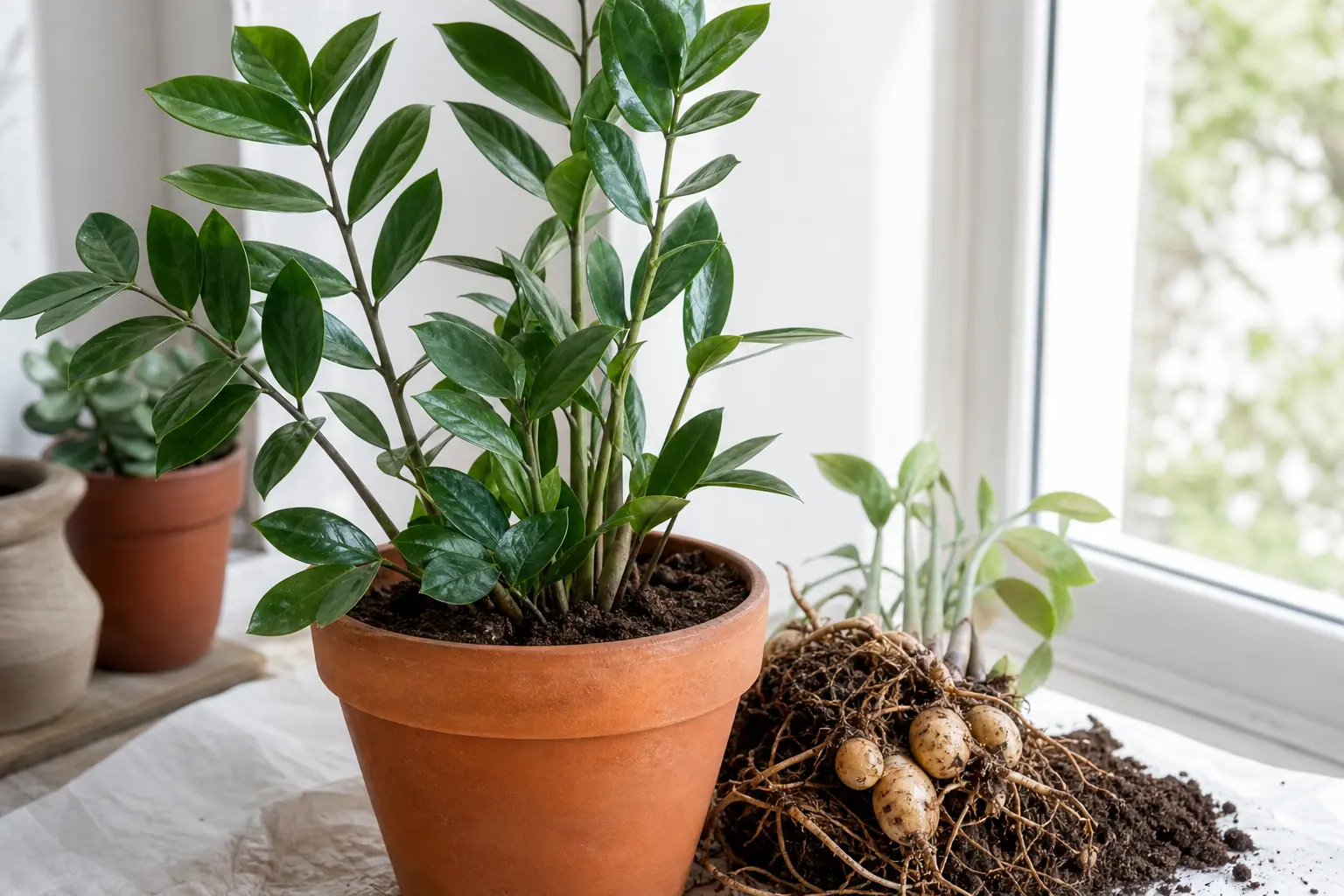
The thick potato-like structures beneath the potting mix are rhizomes. They are modified underground stems that store water and energy and produce roots and new leaves.
A rhizome is different from a bulb.
A true bulb, such as an onion or tulip bulb, has a short stem surrounded by thick, layered storage leaves. A ZZ rhizome is solid and swollen rather than layered. It spreads horizontally or irregularly beneath the soil and sends up new leaves as it grows.
ZZ rhizomes are also not woody roots or miniature trunks. They do not indicate that the plant is a shrub or a tree-like eudicot. They are a survival feature that helps the plant endure dry periods in its native habitat.
This storage ability explains much of the ZZ plant’s reputation for tolerating neglect. It does not mean the plant is immune to poor conditions. In particular, persistently wet potting mix can deprive roots of oxygen and encourage rot around the rhizomes and roots.
The “nearly unkillable” reputation can therefore be misleading. A ZZ plant may tolerate being watered late far better than it tolerates being watered too often.
Compound Leaves Can Hide Vein Patterns
A ZZ plant’s upright growth is often mistaken for a branching stem. In botanical terms, each upright structure is a large, pinnately compound leaf.
The leaf consists of:
- A lower leaf stalk, or petiole
- A central axis, called a rachis
- Multiple individual leaflets attached along that axis
Because the leaflets are arranged in pairs along a central stalk, the plant can look somewhat like a young woody shrub. This arrangement also distracts from the individual leaflet veins that people try to use for quick monocot-versus-dicot identification.
Look closely at one leaflet and you will see a strong midrib, with subtler veins extending outward. They are not as visually obvious as the linear veins on a palm, grass, or dracaena leaf. The leaflets’ thick, waxy surface further obscures them.
This is a good reminder that leaf venation is a useful clue, not a final verdict. Many plant families contain forms that do not fit the introductory botany chart perfectly.
What Monocot Classification Does—and Does Not—Tell You About ZZ Plant Care
Knowing that a ZZ plant is a monocot is useful botanically, but it does not provide a watering schedule or determine where the plant should sit in your home.
Its care needs come more directly from its anatomy and natural adaptations:
- Water-storing rhizomes and fleshy tissues help it withstand dry intervals.
- Slow growth means it uses water more gradually than a fast-growing tropical plant.
- Roots and rhizomes are vulnerable when kept in dense, wet potting mix.
- It grows best with bright, indirect light, though it can tolerate lower light at the cost of slower growth.
The monocot label does not mean that every ZZ plant needs the same treatment as a peace lily, orchid, palm, or grass. Those are all monocots, but their habitats and water needs are very different.
For ZZ plant care, let the potting mix dry substantially before watering again. Water thoroughly when needed, then allow excess water to drain away. Avoid leaving the pot in a saucer of water, and use a container with drainage holes.
Slow growth is also normal. A ZZ plant may remain healthy while producing only a small number of new shoots in a season, especially in lower light. Do not respond to slow growth by watering more often. Extra water does not speed growth when light and temperature are limiting; it more often creates a rot risk.
If the plant is growing new leaves, remains firm at the base, and has healthy green foliage, a slow pace is usually part of its normal growth habit rather than a sign that it needs constant intervention.
Conclusion
The ZZ plant is a monocot because Zamioculcas zamiifolia belongs to the monocot arum family, Araceae, and shares the developmental and reproductive characteristics of that group.
Its seed embryo has one cotyledon, its flower structure and pollen align with monocot ancestry, and its roots and non-woody growth pattern support that classification. Its glossy compound leaves and thick rhizomes can make the usual visual clues harder to recognize, but they do not make it a dicot, a shrub, or a bulb plant.
The ZZ plant is a useful example of why plant classification depends on more than one visible feature. Parallel leaf veins are a helpful starting point, but evolutionary relationships and reproductive traits give the more reliable answer.
FAQ
Is the ZZ plant a monocot or a dicot?
The ZZ plant is a monocot. Its scientific name is Zamioculcas zamiifolia, and it belongs to Araceae, the arum family. Araceae is a monocot family.
Although ZZ leaflets do not have dramatically parallel veins, the plant’s classification is based on its complete botanical relationship and reproductive characteristics—not on leaf veins alone.
Is a ZZ plant related to peace lilies and philodendrons?
Yes. ZZ plants, peace lilies, philodendrons, monsteras, anthuriums, and Chinese evergreens are all members of the arum family, Araceae.
They differ greatly in appearance and care preferences, but they share the family’s characteristic spadix-and-spathe flower arrangement. A ZZ plant’s flower is much less showy than a peace lily’s, and it is often hidden close to the soil.
Why does a ZZ plant not have obvious parallel leaf veins?
The “monocots have parallel veins” rule is an oversimplification. It is often clear in grasses, lilies, and many palms, but not in every monocot family.
ZZ plant leaflets have a central midrib and finer branching veins that can be difficult to see through their thick, shiny surfaces. Aroids, including ZZ plants, frequently show vein patterns that are less obviously parallel than those of textbook monocot examples.
Do ZZ plant rhizomes mean it is a bulb plant?
No. ZZ plants grow from water-storing rhizomes, not true bulbs.
Bulbs are made of layered, fleshy leaf bases surrounding a short stem, as in onions and tulips. ZZ rhizomes are swollen underground stems that store water and produce roots and new leaves. They help the plant survive dry periods, but they do not change its classification as a monocot.
You Might Also Like