What Are the 10 Differences Between Dicot and Monocot Plants?
The main differences between dicots and monocots involve their seeds, leaves, flowers, roots, stems, and pollen. Both are flowering plants, but they follow different structural patterns that can help gardeners, students, and plant lovers identify them.
The defining distinction is simple: monocot embryos have one cotyledon, while dicot embryos usually have two cotyledons. A cotyledon is the first seed leaf or leaflike food-storage structure within a developing seed. From there, several other traits tend to occur together—but no single visible trait is reliable in every plant.
Monocots, Dicots, and Eudicots: What the Terms Mean
Monocots and dicots are groups of angiosperms, or flowering plants. Angiosperms make seeds enclosed within an ovary, which matures into a fruit. That fruit may be obvious, such as a tomato or apple, or inconspicuous, as in many grasses.
- Monocots have one cotyledon in the embryo. Common examples include grasses, lilies, orchids, palms, onions, and corn.
- Dicots traditionally describe flowering plants with two cotyledons.
- Eudicots are the largest and most familiar subgroup of traditional dicots. Beans, roses, sunflowers, tomatoes, maples, and oaks are eudicots.
In modern botany, “dicot” is a useful everyday term, but it is not a precise evolutionary group. Most plants commonly called dicots are more accurately called eudicots. There are also flowering plants outside both the monocot and eudicot groups, so the old monocot-versus-dicot split does not describe every flowering plant perfectly.
10 Key Differences Between Monocot and Dicot Plants
The following table compares the usual patterns. Think of these as clues that work best in combination, not as rules without exceptions.
| Feature | Monocots | Dicots/Eudicots |
|---|---|---|
| 1. Cotyledons (seed leaves) | One cotyledon | Two cotyledons |
| 2. Leaf venation | Usually parallel veins | Usually netlike or branching veins |
| 3. Flower parts | Usually in multiples of three | Usually in multiples of four or five |
| 4. Stem vascular bundles | Scattered through the stem | Usually arranged in a ring |
| 5. Root system | Usually fibrous or adventitious roots | Often a primary taproot with lateral roots |
| 6. Root vascular tissue | Numerous xylem strands around a central pith | Star-shaped central xylem, often with little or no pith |
| 7. Pollen | Typically one opening or furrow | Typically three openings or furrows in eudicots |
| 8. Leaf base and petiole | Leaf base often wraps around the stem; petiole may be absent | Leaves often have a distinct petiole and non-sheathing base |
| 9. Secondary growth | Usually limited; most do not form typical wood | Common in many groups because a vascular cambium can form wood |
| 10. Seed food storage and emergence | Endosperm often remains as a food reserve; protective structures such as coleoptiles occur in grasses | Food reserves are often stored in cotyledons; seedlings typically emerge without coleoptiles |
Here is what those differences mean in practical terms.
-
Cotyledons are the defining feature. A bean seedling commonly emerges with two broad seed leaves. A corn seedling has one cotyledon, although it remains largely inside the seed and is not always visible above ground.
-
Leaf veins provide a quick field clue. Grass blades, iris leaves, and lily leaves usually have veins that run side by side from base to tip. Rose, bean, squash, and maple leaves usually have veins that branch and reconnect into a network.
-
Flower-part numbers are especially useful when flowers are present. Lilies often have six tepals—two sets of three—while a buttercup may have five petals and a geranium commonly has five.
-
Stem anatomy differs internally. In a monocot stem, transport tissues occur in separate bundles scattered through the cross-section. In a typical eudicot stem, the bundles form a ring near the outside.
-
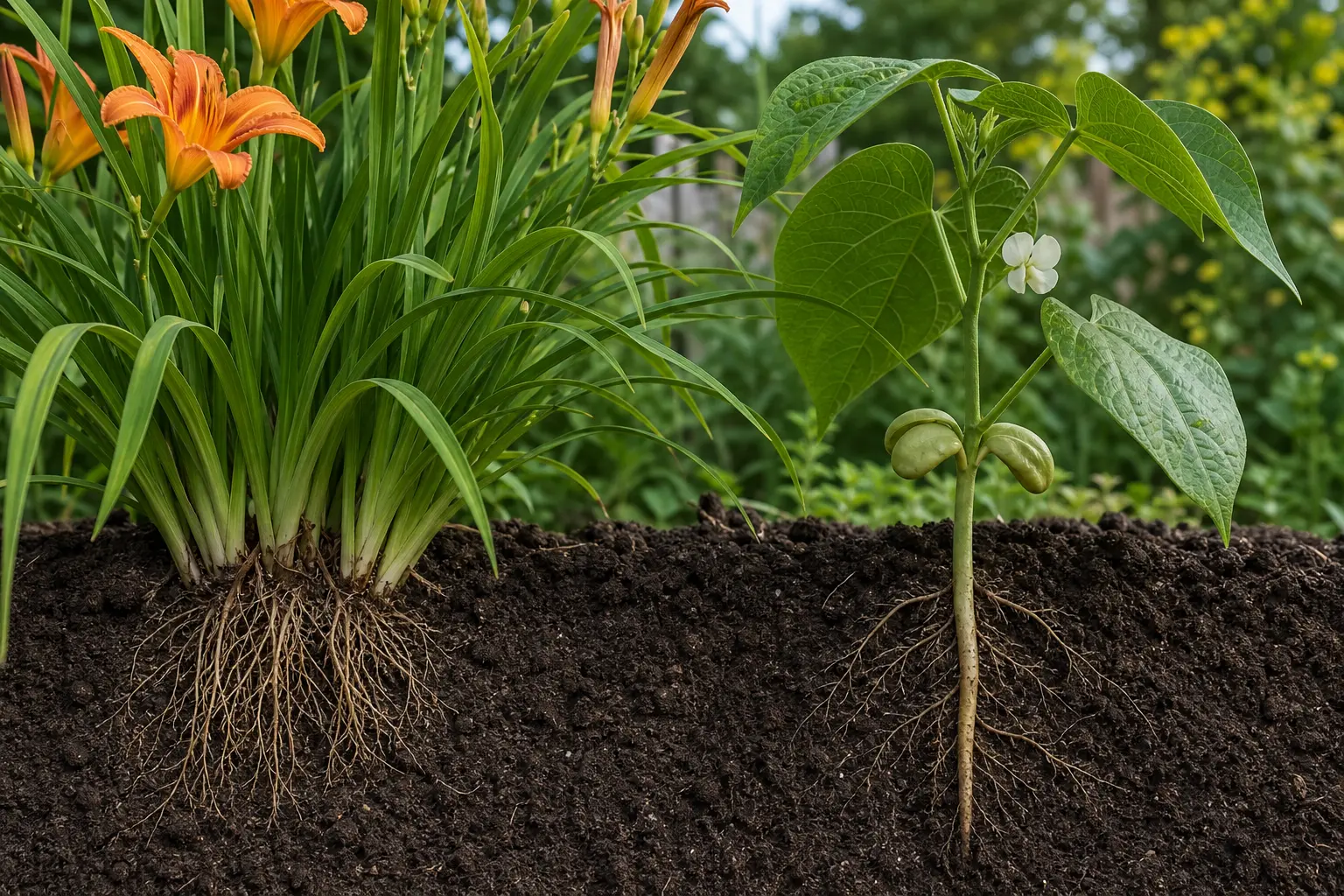
Root systems often look different when plants are lifted. Grasses form dense masses of fine roots. Young bean plants often develop one thicker central root with side branches.
-
Root cross-sections differ as well. This is primarily a laboratory or microscope-level distinction. Monocot roots often show a central pith surrounded by numerous xylem strands, while eudicot roots often show a star-shaped central xylem pattern.
-
Pollen structure supports modern classification. Most eudicots produce pollen with three openings, called apertures or furrows. Monocot pollen usually has one. This is highly useful to botanists but not usually to home gardeners.
-
Leaves attach differently in many cases. Monocot leaves often clasp or sheath the stem, as in grasses, corn, and daylilies. Eudicot leaves frequently attach by a distinct stalk, or petiole, as with tomatoes, beans, and roses.
-
Secondary growth explains much of the woody-versus-herbaceous pattern. Many eudicots can add layers of wood year after year. Most monocots cannot form wood in the same way, although palms and a few other monocots can still become tall, long-lived, and trunk-like.
-
Seeds and emerging seedlings are built differently. In cereals such as corn and wheat, the endosperm remains a major food store. Grasses also produce protective structures such as a coleoptile, a pointed sheath that protects the first shoot as it pushes through soil. In many eudicots, the cotyledons hold much of the stored food and may emerge above the soil surface.
Why Stem Vascular Bundles Affect Growth Form
Plants move water upward through xylem and sugars through phloem. In many eudicot stems, these tissues are arranged in a ring with a layer of dividing cells, the vascular cambium, between them.
The cambium can produce new xylem inward and new phloem outward. Repeated growth adds wood, thickens branches and trunks, and allows many eudicots to become shrubs or trees. Oaks, maples, roses, and many fruit trees follow this pattern.
Most monocots have scattered vascular bundles without a continuous vascular cambium. This arrangement generally prevents the familiar annual thickening that creates a woody tree trunk. That is why grasses, lilies, and onions remain herbaceous.
However, it is important not to use stem texture as a shortcut. A palm looks tree-like but is a monocot. Its trunk is supported by specialized tissues and bundled vascular strands rather than the typical ring-and-cambium system of an oak or maple.
How Seeds and Seedlings Differ
Cotyledon number is the starting point for distinguishing monocots from dicots, but it is not always easy to see. Some cotyledons remain inside the seed or below the soil, while others emerge and resemble the plant’s first leaves.
A bean seedling often makes the distinction clear: its two large cotyledons can rise above the soil and feed the young plant before its true leaves expand. In contrast, corn has one cotyledon and its first shoot is protected by a coleoptile.
Seed structure can be more dependable than leaf shape or stem appearance because it reflects embryo development. Still, some seeds are difficult to dissect or interpret without experience. For everyday identification, use seedlings as one clue alongside mature leaves and flowers.
How to Identify a Monocot or Dicot in Everyday Plants
In the garden, you rarely need to cut a stem cross-section or inspect pollen under magnification. Start with traits that are visible, then check more than one before drawing a conclusion.
A practical identification sequence is:
- Look at the leaf veins.
- Count the flower parts if the plant is blooming.
- Notice whether leaves have a sheathing base or a clear petiole.
- Check the root system only if the plant is already being removed or transplanted.
- Use seeds or seedlings for confirmation when possible.
Check Leaves and Flowers First
Leaves and flowers provide the fastest clues.
A plant is more likely to be a monocot if it has:
- Long, narrow leaves with parallel veins
- Leaf bases that wrap around or clasp the stem
- Flowers with parts in groups of three, such as three or six petals or tepals
- A grasslike, lilylike, irislike, or palm-like growth habit
A plant is more likely to be a eudicot if it has:
- Broad leaves with netted, branching veins
- A noticeable petiole between leaf blade and stem
- Flowers with parts in groups of four or five
- Branched stems and broadleaf foliage
For example, a daylily with strap-shaped parallel-veined leaves and six flower segments is strongly indicative of a monocot. A sunflower with netted leaves and flower structures organized in fives is a eudicot.
Flower heads can complicate counting. A sunflower is not one single flower; it is a cluster of many tiny flowers. Look closely at an individual floret if you want to use flower-part numbers as evidence.
Use Roots, Stems, and Seeds for Confirmation
Roots can help when you are dividing perennials, weeding, or transplanting.
- A dense mat of similarly sized roots suggests a monocot, as in lawn grass, iris, or onion.
- One dominant main root with smaller side roots suggests a eudicot, as in many young beans, dandelions, and carrots.
Stem anatomy is more definitive but less convenient. If you cut a fresh, non-woody stem crosswise, a typical eudicot may show vascular bundles in a rough ring. A monocot stem often has bundles scattered throughout the tissue. This is easiest to see in classroom specimens or under magnification.
Seedlings offer another confirmation point. Two seed leaves indicate a dicot-type embryo, while one indicates a monocot embryo. Remember that the first true leaves may not resemble the cotyledons.
Avoid Treating Any One Trait as a Rule
Gardeners often rely on leaf veins because they are easy to see, but venation alone can mislead. Some monocots have broader leaves with less obviously parallel veins, and some non-monocot plants have leaves that do not show a textbook netted pattern.
Likewise:
- A woody stem does not automatically mean eudicot; palms are monocots.
- An herbaceous plant is not automatically a monocot; tomatoes, beans, sunflowers, and many annual flowers are eudicots.
- A fibrous root system is suggestive, not conclusive, because growing conditions and damage can alter root appearance.
- A plant without visible flowers may be difficult to classify confidently from one trait alone.
Use at least two or three features. Parallel veins plus flower parts in threes plus fibrous roots make a strong monocot case. Netted veins plus five-part flowers plus two cotyledons make a strong eudicot case.
Common Examples of Monocots and Dicots
Familiar plants show why these categories are useful. Monocots include many staple grain crops and ornamental bulbs, while eudicots include a large share of broadleaf vegetables, shrubs, and deciduous trees.
Examples of Monocots
Common monocots include:
- Grasses, including lawn grasses and bamboo
- Wheat
- Rice
- Corn
- Lilies and daylilies
- Orchids
- Palms
- Onions, garlic, and leeks
- Tulips, daffodils, and iris
- Bananas
Many garden weeds are monocots as well, especially grassy weeds. Their narrow, parallel-veined leaves and fibrous roots can make them easier to distinguish from broadleaf weeds.
Examples of Dicots and Eudicots
Common dicots—more precisely, mostly eudicots—include:
- Beans and peas
- Roses
- Sunflowers
- Tomatoes
- Peppers
- Squash and cucumbers
- Oak trees
- Maple trees
- Apples and pears
- Many shrubs, including hydrangeas and lilacs
Not all eudicots are woody. Tomatoes, basil, zinnias, marigolds, and beans are soft-stemmed plants, yet they still have the typical two-cotyledon, net-veined, and usually four- or five-part floral patterns.
Why Bananas Are Monocots but Many Fruit Trees Are Dicots
Whether a plant produces fruit tells you nothing about whether it is a monocot or eudicot. “Fruit” is a botanical term for the mature ovary of a flowering plant, and flowering plants across many groups make fruits.
Bananas are monocots. Their leaves have broadly parallel veins, their leaf bases form overlapping sheaths that create a pseudostem, and their roots are fibrous. Their flowers also follow the monocot tendency toward parts in threes.
By contrast, apple, peach, pear, cherry, and citrus trees are eudicots. They typically have netted leaf veins, flower parts in fours or fives, and woody stems produced through secondary growth.
The key point is that a banana plant is not a tree in the same structural sense as an apple tree. Its apparent “trunk” is formed mainly from tightly overlapping leaf bases, not a woody trunk built by a vascular cambium.
Conclusion
The most important difference between monocots and dicots is the number of cotyledons in the seed embryo: monocots have one, while dicots traditionally have two. In practice, most familiar dicots are eudicots.
Leaf veins, flower-part numbers, root systems, stem vascular bundles, pollen, and growth habits provide useful supporting evidence. For a reliable identification, look for several matching traits rather than relying on one feature such as a woody stem or parallel veins.
FAQ
Are all flowering plants either monocots or dicots?
No. Monocots are a distinct major group of flowering plants, but “dicots” is an older broad category that does not include all flowering plants with two cotyledons in a single natural evolutionary group. Many familiar traditional dicots are eudicots, but other flowering plant lineages fall outside both monocots and eudicots.
Is a woody stem proof that a plant is a dicot?
No. Woody growth is common in many eudicots because they can form a vascular cambium and add wood each year. However, palms are monocots with tall, trunk-like stems. Conversely, many eudicots, including beans and tomatoes, are herbaceous rather than woody.
Can leaf venation alone identify a monocot or dicot?
Not reliably. Parallel veins strongly suggest a monocot, and netted veins strongly suggest a eudicot, but exceptions and unclear cases exist. Confirm your identification with flowers, leaf attachment, roots, seeds, or seedling cotyledons when possible.
What is the difference between a dicot and a eudicot?
“Dicot” is the traditional term for flowering plants with two cotyledons. “Eudicot” is a more precise modern classification for the largest group within those traditional dicots, characterized in part by pollen with three openings or furrows. Most garden plants people call dicots—such as roses, beans, tomatoes, maples, and sunflowers—are eudicots.
You Might Also Like