What Are the Best Perennial Vines for Zone 5 Gardens?
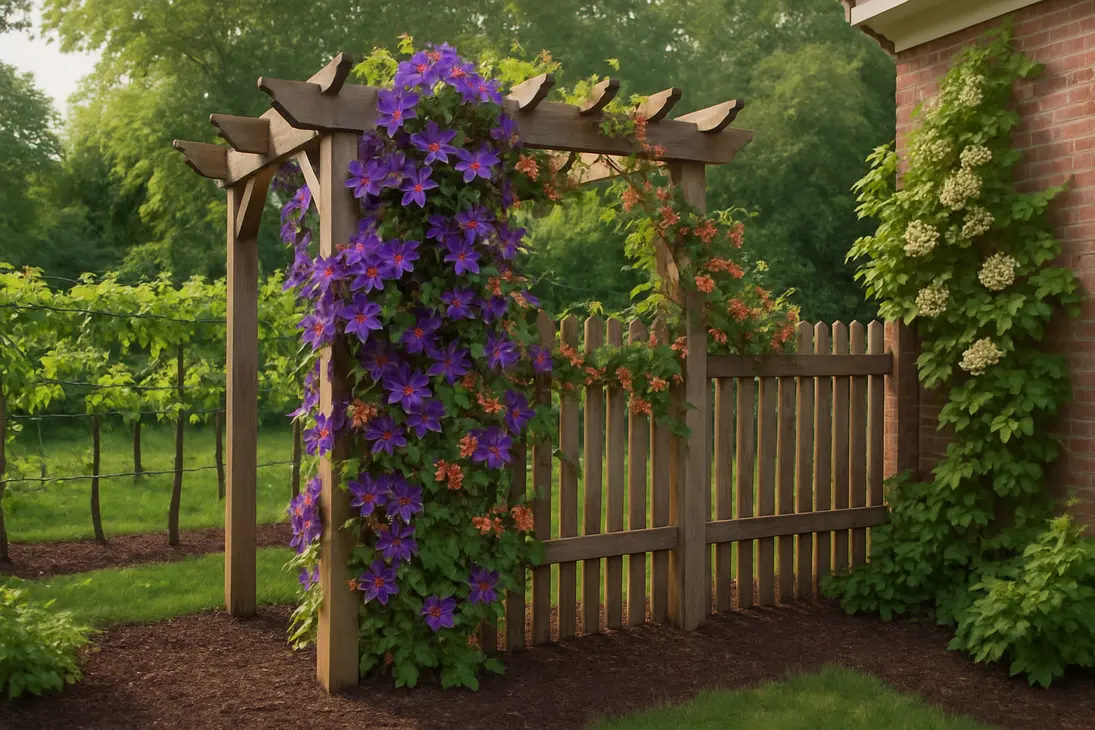
The best perennial vines for Zone 5 are cold-hardy, suited to your light and soil, and matched to a support strong enough for their mature size. Top choices include clematis, coral honeysuckle, climbing hydrangea, grapes, hardy kiwi, and American wisteria. Trumpet vine, hops, groundnut, and maypop can also work, but they need more caution or management.
Start with the job you want the vine to do: flowers, shade, privacy, wildlife value, food production, or covering a wall, fence, arbor, or pergola. A vine that works on a large structure can quickly overwhelm a small decorative trellis.
Understanding Zone 5 Before Choosing a Perennial Vine
Zone 5 has average annual winter lows of about -10°F to -20°F. A true perennial vine must survive winter in the ground and regrow from its roots, crown, or woody stems.
Cold hardiness matters, but it is not enough. A hardy vine can still fail in deep shade, compacted soil, soggy ground, or on a weak support.
Zone 5 vs. Zone 5b
Zone 5 is usually divided into:
| Zone | Typical winter low |
|---|---|
| Zone 5a | -15°F to -20°F |
| Zone 5b | -10°F to -15°F |
That 5-degree difference matters with marginal vines such as maypop passionflower or less-hardy wisterias. A plant labeled hardy to Zone 5 may survive in a sheltered Zone 5b courtyard but struggle in an exposed Zone 5a site with drying winter wind.
Microclimates also matter. South-facing walls, fenced yards, and urban lots may be warmer than exposed rural sites, while low spots where cold air settles can be harsher than the zone map suggests.
Why winter hardiness matters more than summer heat
Hardiness zones are based on winter lows, not summer temperatures. For perennial vines, the main question is whether the plant can survive the coldest part of winter and return the next year.
Summer heat affects growth, flowering, watering, and disease pressure, but winter survival determines whether the vine is truly perennial in Zone 5. Some vines die back and return from roots; others keep woody stems alive and may bloom on older wood.
Matching vines to sun, soil, and available support
Before choosing a vine, check:
- Light: Grapes, hops, trumpet vine, wisteria, and many clematis bloom or fruit best in full sun. Climbing hydrangea tolerates shade.
- Soil: Most vines prefer well-drained soil. Groundnut tolerates moister sites. Grapes dislike soggy ground.
- Support: Clematis needs thin supports. Grapes need wire or arbor support. Climbing hydrangea clings to rough surfaces. Wisteria and hardy kiwi need very strong structures.
A common mistake is planting a vigorous sun-loving vine in shade or putting a heavy woody vine on a flimsy trellis.
Best Flowering Perennial Vines for Zone 5
Flowering vines can soften fences, frame entrances, cover arbors, and attract pollinators. In Zone 5, choose cold-hardy species or cultivars rather than tender vines that behave like annuals.
Clematis
Clematis is one of the best flowering perennial vines for Zone 5 because many varieties are hardy, floriferous, and appropriately sized for home gardens. Flowers may be purple, blue, pink, red, white, or bicolor.
Most clematis prefer full sun to part sun, moist well-drained soil, and a cool, mulched root zone. They climb well on trellises, obelisks, fences, wire mesh, or nearby shrubs.
Pruning depends on group:
- Group 1: Blooms on old wood; prune lightly after flowering.
- Group 2: Blooms on old and new wood; prune lightly in spring.
- Group 3: Blooms on new wood; cut back hard in late winter or early spring.
For beginners, Group 3 clematis are often easiest because they can die back in winter and still bloom on new growth.
Honeysuckle Vine
For Zone 5, the best honeysuckle vine is usually coral honeysuckle (Lonicera sempervirens) or another noninvasive, cold-hardy ornamental honeysuckle. It produces tubular flowers that attract hummingbirds and pollinators without the same problems as more aggressive types.
Coral honeysuckle grows best in full sun to part sun and flowers more heavily with good light. It works well on fences, arbors, and sturdy trellises.
Avoid Japanese honeysuckle (Lonicera japonica) where it is invasive. It may be fragrant, but it can overrun shrubs, fences, and natural areas. Check the botanical name before buying.
Climbing Hydrangea
Climbing hydrangea is one of the best perennial vines for Zone 5 shade. It climbs by clinging rootlets and can attach to masonry, large trees, or strong wooden structures. Mature plants produce white lacecap-style flowers in early summer.
Its drawback is slow establishment. It may take several years to flower well, but mature plants can become large, long-lived, and relatively self-sufficient.
Use climbing hydrangea for part shade to shade, north or east-facing walls, woodland-style gardens, and large sturdy structures. Avoid weak fences, painted siding, and small trellises.
Trumpet Vine
Trumpet vine (Campsis radicans) is cold-hardy, fast-growing, and dramatic in bloom. Its orange to red trumpet-shaped flowers attract hummingbirds and can cover a large arbor, pergola, or strong fence.
The problem is vigor. Trumpet vine can sucker, self-seed, and become difficult to remove. It is best for large spaces where regular pruning is acceptable.
If you grow it, provide full sun, a very strong support, and frequent pruning. Remove suckers promptly and avoid heavy fertilizing, which can produce leaves instead of flowers.
American Wisteria
American wisteria (Wisteria frutescens) is usually a better Zone 5 choice than Chinese or Japanese wisteria. It is generally less aggressive while still producing hanging clusters of lavender-blue flowers.
It needs full sun, a very strong arbor or pergola, regular pruning, and patience. Even American wisteria becomes woody and heavy, so keep it away from gutters, rooflines, small trees, and flimsy lattice.
Best Edible Perennial Vines for Zone 5
Edible perennial vines make vertical space productive. In Zone 5, choose cold-hardy varieties and make sure your growing season is long enough for fruit or harvest.
Grapes
Grapes are among the most reliable edible perennial vines for Zone 5. Cold-hardy American, hybrid, and some wine grape cultivars can thrive with full sun, good airflow, and proper pruning.
Grapes need well-drained soil, a permanent wire trellis or arbor, and annual dormant pruning. They fruit on new shoots from one-year-old wood, so unpruned vines often become tangled and less productive.
For table grapes, choose cultivars bred for cold climates. Local nurseries often carry better regional options than general retail stores.
Hardy Kiwi
Hardy kiwi (Actinidia arguta and related species) can survive Zone 5 and produce small, smooth-skinned kiwi fruits. The vines are attractive and productive once established, but they are vigorous.
Hardy kiwi needs a heavy-duty arbor or trellis, full sun to part sun, consistent moisture, and room to grow. Most varieties need both male and female plants for fruit, although some self-fertile cultivars exist. Late spring frosts can damage new growth and reduce crops.
This is a good vine for gardeners willing to train and prune, not for a small ornamental trellis.
Hops
Hops are perennial bines rather than true vines, but they serve a similar garden role. The roots overwinter, and the stems grow rapidly each season. Female plants produce cones used in brewing and arrangements.
Hops prefer full sun, rich well-drained soil, and tall supports, often 10 feet or more. They die back in winter and regrow quickly in spring. Because they can spread by rhizomes, plant them where edges can be controlled. They provide summer screening but no winter privacy.
Groundnut Vine
Groundnut (Apios americana) is a native perennial vine grown for edible tubers and ornamental pea-like flowers. It prefers moist, rich soil and fits well in food forests, rain garden edges, or naturalistic plantings.
It is less predictable than grapes or kiwi. Tubers may take time to size up, yields vary, and the vine can wander if happy. Give it a trellis, fence, or shrubs to climb and place it where some spreading is acceptable.
Maypop Passionflower, with caution on hardiness
Maypop (Passiflora incarnata) has striking flowers and edible fruit, but its Zone 5 reliability is mixed. It is more dependable in warmer zones, though some gardeners overwinter it in protected Zone 5 sites with heavy mulch.
Treat maypop as an experiment, not a guaranteed perennial. Plant it in full sun, choose a sheltered location, mulch deeply after the ground cools, and expect top growth to die back. If it survives, it usually returns from the roots.
Low-Maintenance and Native-Friendly Vine Choices
Low-maintenance does not mean no maintenance. The easiest perennial vines are those whose mature size fits the structure and space.
Best choices for low-maintenance gardens
For manageable Zone 5 vines, consider:
- Clematis: Especially Group 3 types, which are simple to prune.
- Coral honeysuckle: Good flowers and wildlife value without invasive behavior.
- Climbing hydrangea: Slow to establish but fairly self-sufficient with enough space.
- American wisteria: More manageable than Asian wisterias, though still large.
- Grapes: Productive and dependable if you prune annually.
For small spaces, clematis is usually the safest first choice. For shade, climbing hydrangea is better than forcing a sun-loving vine to perform poorly.
Best vines for pollinators and wildlife
Good wildlife-friendly vines for Zone 5 include coral honeysuckle, trumpet vine, American wisteria, Virginia creeper, and groundnut. Coral honeysuckle and trumpet vine are especially attractive to hummingbirds. Virginia creeper offers wildlife value and fall color, though it is vigorous and not right for every structure.
Native-friendly planting also means avoiding vines that escape into natural areas.
Vines to avoid or manage carefully in Zone 5
Some vines survive Zone 5 too well. Avoid or manage these carefully:
- Oriental bittersweet: Highly invasive and damaging to trees and natural areas.
- Japanese honeysuckle: Fragrant but often invasive.
- Chinese and Japanese wisteria: Beautiful but extremely vigorous and invasive in some regions.
- Porcelain berry: Attractive berries, but invasive in many areas.
- English ivy: Can damage surfaces and spread aggressively.
- Trumpet vine: Native in parts of North America but aggressive in gardens.
- Hops and hardy kiwi: Useful edibles, but vigorous enough to need boundaries and pruning.
If you inherit an unknown vine, identify it before encouraging it.
Planting and Caring for Perennial Vines in Zone 5
A perennial vine is a long-term planting, so placement and support matter more than fast first-year growth.
When to plant perennial vines
In Zone 5, plant most perennial vines in spring or early fall. Spring planting gives roots a full season to establish. Early fall planting can work if done several weeks before the ground freezes.
Avoid late fall planting for marginally hardy vines, and avoid planting during summer heat unless you can water consistently. Container-grown vines are easiest to establish, though bare-root grapes and kiwi can do well when planted correctly in early spring.
Choosing the right trellis, arbor, fence, or wall support
Match the support to the vine’s climbing method and mature weight.
| Vine | Best support |
|---|---|
| Clematis | Thin trellis, wire mesh, obelisk, shrub |
| Honeysuckle | Trellis, fence, arbor |
| Climbing hydrangea | Masonry, large tree, strong wall structure |
| Trumpet vine | Heavy arbor, pergola, strong fence |
| American wisteria | Very strong arbor or pergola |
| Grapes | Wire trellis, arbor, pergola |
| Hardy kiwi | Heavy-duty trellis or arbor |
| Hops | Tall poles, twine, overhead supports |
Install supports before or at planting. Retrofitting around a mature vine is difficult and can damage the plant. Keep vigorous vines away from siding, gutters, rooflines, utility meters, and small ornamental trees unless you plan to prune often.
Watering, mulching, and winter protection
New vines need consistent moisture while roots establish. Water deeply rather than sprinkling lightly. Most prefer evenly moist but not waterlogged soil.
Mulch with 2 to 3 inches of shredded bark, leaves, or composted material, keeping it slightly away from crowns and stems. For winter protection, mulch after the ground cools, give marginal vines extra protection, avoid late-season fertilizer, and water well in dry falls. Wait until spring growth begins before deciding which woody stems are dead.
Pruning basics for healthy growth and flowering
Pruning varies by vine:
- Clematis: Prune by group.
- Grapes: Prune every dormant season.
- Hardy kiwi: Prune in winter and lightly in summer.
- Hops: Cut dead bines to the ground after frost or in early spring.
- Trumpet vine: Prune hard in late winter or early spring.
- Climbing hydrangea: Prune lightly after flowering if needed.
- Wisteria: Prune in winter and often again in summer.
The biggest mistake is ignoring pruning for years, then trying to fix an overgrown vine all at once. Light, regular pruning is easier.
Conclusion
The best perennial vines for Zone 5 depend on your goal and site. For flowers, clematis and coral honeysuckle are reliable, garden-friendly choices. For shade, climbing hydrangea is one of the strongest options. For edible gardens, grapes are the most dependable, while hardy kiwi, hops, groundnut, and maypop suit gardeners willing to manage vigor or experiment with hardiness.
Choose vines that fit the space from the beginning. A well-matched perennial vine can add height, flowers, fruit, privacy, and wildlife value for years without becoming a constant pruning project.
FAQ
What perennial vines come back every year in Zone 5?
Reliable perennial vines for Zone 5 include clematis, coral honeysuckle, climbing hydrangea, trumpet vine, American wisteria, grapes, hardy kiwi, hops, and groundnut. Maypop passionflower may return in protected sites but is less dependable.
What is the fastest-growing perennial vine for Zone 5?
Trumpet vine, hops, hardy kiwi, and some honeysuckles are among the fastest-growing options. Fast growth is useful for screening, but it also means stronger supports and more pruning.
Are there edible perennial vines that survive Zone 5 winters?
Yes. Grapes are the most dependable edible perennial vines for Zone 5. Hardy kiwi, hops, groundnut, and sometimes maypop can also work depending on site, cultivar, and winter protection.
What perennial vine grows well in shade in Zone 5?
Climbing hydrangea is one of the best shade-tolerant perennial vines for Zone 5. It grows in part shade to shade and produces white flowers once mature. Clematis and honeysuckle tolerate part shade but usually flower better with more sun.
You Might Also Like