What Is the Longest-Living Tree Species?
Quick Answer: The Longest-Living Verified Tree Species
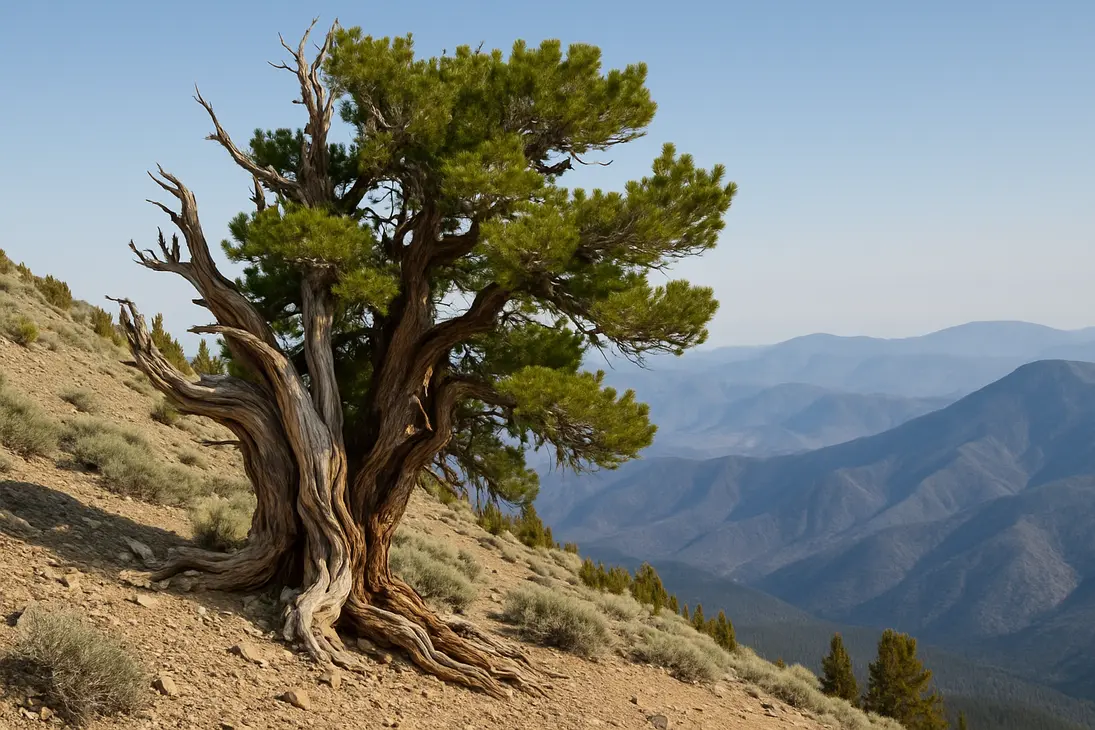
The longest living tree species, when defined as a single, non-clonal tree with a scientifically checkable age, is generally the Great Basin bristlecone pine (Pinus longaeva).
Individual Great Basin bristlecone pines in the western United States are known to be more than 4,800 years old, and at least one living tree has been reported as over 5,000 years old. Some began growing before the Egyptian pyramids were built.
Other species have impressive claims, including Patagonian cypress, yews, giant sequoias, olives, bald cypress, and ancient clonal systems such as Pando and Old Tjikko. But the answer depends on what counts: a single trunk, a genetic clone, or an estimated age from a partly hollow tree.
For the strongest answer: Great Basin bristlecone pine is the longest-living verified non-clonal tree species.
Great Basin bristlecone pine: the leading verified species
Great Basin bristlecone pines grow in cold, dry, high-elevation sites in California, Nevada, and Utah. They are not huge like giant sequoias. The oldest individuals often look twisted, weather-beaten, and partly dead.
That harsh appearance helps explain their survival. They grow extremely slowly in rocky, nutrient-poor soils with little competition. Their dense, resinous wood resists decay, and old trees can survive with only a narrow strip of living bark feeding a few branches.
The best-known living bristlecone pine is Methuselah, in California’s White Mountains. Its exact location is kept secret to prevent vandalism and root damage. Methuselah is usually described as over 4,800 years old. Another unnamed Great Basin bristlecone pine has been reported as over 5,000 years old, though details are limited for protection.
“Verified” vs. “estimated” tree ages
Tree age claims vary in reliability. A verified age usually comes from annual growth rings, often supported by cross-dating, radiocarbon dating, or other evidence.
Estimated ages are less certain. They may rely on trunk size, growth rate, historical records, or partial samples. These methods can be useful, but trees do not grow at one steady rate. A tree may grow quickly when young, then slowly for centuries, or nearly stop during drought or stress.
That is why a bristlecone pine with a strong ring count is usually treated more cautiously than a tree claimed to be 5,000 or 6,000 years old from size or modeling alone.
Longest-Living Tree Species to Know
Many tree species live for centuries, but only a few regularly reach ages measured in thousands of years.
| Tree species | Approximate known or claimed lifespan | Certainty | Notes |
|---|---|---|---|
| Great Basin bristlecone pine (Pinus longaeva) | Over 4,800 years verified; possibly over 5,000 | Very strong | Best answer for oldest verified non-clonal tree |
| Patagonian cypress / alerce (Fitzroya cupressoides) | Possibly over 5,000 years | Debated | Oldest claims use modeling or partial sampling |
| Giant sequoia (Sequoiadendron giganteum) | Often over 2,000; sometimes over 3,000 | Strong | Enormous, but generally younger than bristlecones |
| Yew (Taxus species) | Often claimed at 1,000–3,000+ years | Difficult | Hollow trunks complicate dating |
| Olive (Olea europaea) | Hundreds to 1,000+ years; some claimed older | Often estimated | Ancient cultivated trees are hard to date |
| Bald cypress (Taxodium distichum) | Over 2,000 years in some cases | Strong for some trees | Long-lived wetland conifer |
| Huon pine (Lagarostrobos franklinii) | Very old individuals; older clonal stands | Mixed | Depends on individual tree vs. clone |
Great Basin bristlecone pine — over 4,800 years verified
The Great Basin bristlecone pine remains the benchmark because its oldest known individuals have been dated with tree-ring science. These trees form narrow annual rings that can often be counted and matched against regional climate patterns.
Their longevity comes from difficult conditions: high elevation, short growing seasons, dry air, wind, strong sun, and poor soils. Few plants compete there, and the trees add tiny amounts of growth each year. “Long-lived” does not always mean large or lush; some of the oldest trees are slow, conservative survivors.
Patagonian cypress / alerce — possibly over 5,000 years, but debated
The Patagonian cypress, or alerce, grows in the temperate rainforests of southern Chile and Argentina. It is a massive, slow-growing conifer with decay-resistant wood. One famous tree, sometimes called Gran Abuelo, has been estimated by some researchers to be over 5,000 years old.
The debate is about proof. The oldest claims are not always based on a complete ring count from center to bark. In very large or decayed trees, researchers may core part of the trunk and model the missing center. That can produce a plausible age range, but it is less certain than a complete ring sequence.
Alerce may rival bristlecone pine, but bristlecone pine remains the safer verified answer.
Giant sequoia — commonly over 2,000 years, sometimes over 3,000
Giant sequoias are among the largest living things on Earth and can live for more than 2,000 years. Some have been dated to over 3,000 years.
Their strategy is different from bristlecone pine. They are adapted to fire-prone Sierra Nevada forests, where thick bark protects living tissue and fire can reduce competition, open cones, and prepare seedbeds. Sequoias win for size and grandeur, but their verified ages generally do not exceed the oldest bristlecone pines.
Yew trees — ancient but often difficult to date precisely
Yews, especially European yews, are famous ancient trees associated with churchyards, estates, and historic sites. Some are claimed to be 2,000 or 3,000 years old, sometimes more.
The problem is that old yews often become hollow. The oldest central wood may decay away, leaving no complete ring record. Yews can also split, layer, fuse, and regenerate, blurring the line between one original trunk and later growth.
Many yews are unquestionably ancient, but exact ages are often hard to prove.
Other long-lived species: olive, bald cypress, and Huon pine
Olive trees can live for many centuries, and some Mediterranean olives are claimed to be 1,000 to 2,000 years old or more. They resprout from old wood and tolerate heavy pruning, but hollow, renewed trunks make precise dating difficult.
Bald cypress is a long-lived wetland tree of the southeastern United States. Some individuals have been documented at more than 2,000 years old, though logging has removed many old specimens.
Huon pine, native to Tasmania, is known for decay-resistant wood, slow growth, and ancient clonal stands. It belongs in the oldest-tree discussion, but the answer depends on whether you count individual stems or clonal systems.
Individual Trees vs. Clonal Trees: What Counts as the Oldest?
“Oldest tree” sounds simple, but it depends on definition. Some records refer to one continuous trunk and root system. Others refer to clonal organisms: genetic individuals that keep producing new stems as older ones die.
Both are impressive, but they are not the same record.
Oldest single trees
A single tree is the familiar case: one organism with a continuous life history. The oldest verified single trees include Great Basin bristlecone pines and some other ancient conifers.
For this record, scientists look for evidence that the living tree began growing thousands of years ago and persisted as the same individual. Bristlecone pines are especially useful because their ancient wood can preserve long ring sequences. If the heartwood is rotten, burned, or missing, proving age becomes much harder.
Oldest clonal tree systems, including Pando and Old Tjikko
Clonal trees complicate the question. A clonal colony is made of genetically identical stems produced by the same root system or vegetative network. Individual trunks may be young, while the clone is ancient.
Pando is a large clonal colony of quaking aspen in Utah. Its many trunks share a root system. The stems are not as old as bristlecone pines, but the clone may be thousands of years old, possibly far older, though estimates vary.
Old Tjikko is a Norway spruce in Sweden known for an ancient root system estimated at around 9,500 years old. The visible trunk is much younger, but the genetic individual has persisted by producing replacement stems.
If you count clones, some tree systems are older than bristlecone pines. If you mean one above-ground tree that has stood for millennia, bristlecone pine remains the clearer answer.
Why this distinction changes the answer
The phrase “oldest tree species” can mean:
- Oldest verified individual non-clonal tree
- Oldest living genetic individual, including clones
- Species capable of producing the oldest known trees
In everyday use, the first definition is usually intended. That is why Great Basin bristlecone pine is so often named as the longest-living tree species.
Clonal organisms show a different route to longevity. Instead of keeping one trunk alive for 5,000 years, they keep a genetic individual alive by renewal.
How Scientists Determine a Tree’s Age
Tree dating is careful work, and the older the tree, the more likely some evidence is missing or damaged.
Tree-ring counting and core sampling
The most familiar method is counting annual growth rings. In many temperate and high-elevation trees, each year produces a visible ring. Researchers can take a narrow core from the trunk with an increment borer, ideally reaching the center, then count rings from bark to pith.
For ancient trees, ring counting is often combined with cross-dating: matching patterns of wide and narrow rings among trees in the same region. A drought year, for example, may create narrow rings across many trees. This helps confirm that rings have not been missed or double-counted.
Core sampling avoids cutting the tree down, but it is not perfect. The core may miss the center, the oldest wood may be decayed, or rings may be extremely compressed.
Radiocarbon dating
Radiocarbon dating can help when ring counts are incomplete or when researchers need to date dead wood, roots, or buried material. It measures radioactive carbon decay in organic material.
It is especially useful for clonal systems and old wood fragments, but it usually does not provide the year-by-year precision of a complete tree-ring record. It is best used alongside other evidence.
Historical records and growth estimates
Some tree ages are estimated from documents, photographs, planting records, or known site histories. This can work well for trees in parks, estates, or cities.
Growth estimates are riskier. A large trunk does not always mean extreme age, and a small tree is not always young. Fast growth in good conditions and slow growth under stress can distort assumptions based on size alone.
Why hollow trunks make old trees hard to date
Many ancient trees become hollow, including yews, olives, and chestnuts. A hollow trunk can still support a living tree because the active water- and sugar-conducting tissues are near the outside.
But when the central wood disappears, the earliest rings disappear too. Scientists may estimate age from remaining wood, trunk form, or records, but exact dating becomes much harder. Bristlecone pines are important partly because their dead wood can remain intact for a very long time in dry mountain environments.
Why Some Tree Species Live for Thousands of Years
Extreme longevity usually comes from a combination of slow growth, durable wood, stress tolerance, and a relatively protected habitat.
Slow growth in harsh environments
Many of the oldest trees grow slowly. That can be an advantage: slow growth reduces resource demand and may produce dense, durable wood. In harsh sites, a tree that survives on little water and few nutrients may outlast faster-growing competitors.
Great Basin bristlecone pines are the classic example. Their mountain sites are cold, dry, rocky, and exposed, with short growing seasons and little competition.
Dense, resinous, or decay-resistant wood
A tree cannot live for thousands of years if decay destroys it quickly. Dense, resinous, or decay-resistant wood helps slow fungi and insects. Bristlecone pine and Huon pine are known for wood that can persist long after parts of the tree die.
This does not make them invincible. Fire, drought, pests, lightning, logging, and soil disturbance can still kill ancient trees.
Ability to survive partial death and regrow
Ancient trees are often partly dead. A bristlecone pine may live through one strip of bark. A yew or olive may hollow out and keep growing from outer tissue. A clonal aspen may lose stems while the root system survives.
Trees do not heal like animals; they seal off damage and grow around it. Species that can keep functioning after losing limbs, heartwood, or bark have a better chance of surviving for centuries.
Protection from fire, pests, and human disturbance
Place matters. Some trees live long because they grow where people rarely cut, plow, burn, or build. High mountains, remote wetlands, and protected forests can act as refuges.
Human disturbance is one of the biggest reasons trees fail to reach their potential lifespan. Logging, soil compaction, root damage, altered water flow, and construction can kill trees long before old age would. Even foot traffic around famous ancient trees can harm roots, which is why some locations are kept secret.
Conclusion
The best answer to “What is the longest-living tree species?” is the Great Basin bristlecone pine (Pinus longaeva). It has the strongest record as the longest-living verified non-clonal tree species, with individuals known to be over 4,800 years old and reports of living trees over 5,000 years old.
Patagonian cypress may rival it if the oldest estimates are confirmed. Giant sequoias can exceed 3,000 years. Yews and olives can be ancient but are hard to date. Clonal systems such as Pando and Old Tjikko may be older still if you count genetic individuals rather than single trunks.
For a single, scientifically verified tree species, choose Great Basin bristlecone pine. For clonal organisms, the records become older but less straightforward.
FAQ
What is the oldest living tree species in the world?
Using the common standard of verified non-clonal individual trees, it is the Great Basin bristlecone pine (Pinus longaeva). Known individuals exceed 4,800 years, and some may be over 5,000 years old.
Is Methuselah the oldest tree?
Methuselah is one of the oldest known living non-clonal trees, at over 4,800 years old. It may not be the absolute oldest, because another unnamed Great Basin bristlecone pine has been reported as older. Details are often kept private to protect the trees.
Are clonal trees older than bristlecone pines?
Some are. Old Tjikko and Pando are often discussed as older clonal systems. However, their visible trunks are much younger than the full clone, so they are usually separated from single-tree records.
Can any tree live forever?
No known tree lives forever. Some species survive for thousands of years, and clonal systems can renew themselves for very long periods, but trees can still die from drought, fire, disease, pests, storms, competition, or human disturbance.
You Might Also Like