What Are the Applications of Forensic Botany?
Forensic botany applies plant science to legal investigations. It can link a person, vehicle, object, or body to a place; help locate buried remains; estimate how long something has been in an environment; and support cases involving drowning, timber theft, drug cultivation, and environmental damage.
A seed in a trouser cuff, moss on a vehicle mat, pollen on a jacket, or roots growing through fabric may seem ordinary. In context, these traces can help answer: Where has this object been? Did someone move through a particular habitat? How long has an item or body been there? Is a witness account consistent with the evidence?
What Forensic Botany Is and Why It Matters
Forensic botany is the identification, comparison, and interpretation of plants and plant-derived evidence in legal cases. It may involve pollen, spores, seeds, leaves, roots, algae, wood, fibers, plant DNA, and plant chemicals.
It draws on several areas of plant science:
- Taxonomy, to identify plants or plant groups
- Anatomy, to examine wood, fibers, leaves, stems, and microscopic structures
- Palynology, the study of pollen and spores
- Ecology, to understand where plants grow
- Genetics, to compare or identify plant material
- Phenology, the study of seasonal events such as flowering, fruiting, and leaf fall
Forensic botany matters because different places leave different botanical signatures. A wet meadow, roadside verge, pine plantation, riverbank, city park, and abandoned lot may all produce different combinations of pollen, seeds, soil, roots, and plant fragments.
Plant evidence is rarely a stand-alone “smoking gun.” More often, it supports or challenges other evidence by strengthening a timeline, narrowing a search area, linking two places, or showing that a statement is unlikely.
Types of Plant Evidence Used in Investigations
Botanical evidence ranges from visible plant parts to microscopic traces. Its value depends on how distinctive it is, how well it was collected, and whether comparison samples are available.
| Evidence type | What it may reveal | Key limitation |
|---|---|---|
| Pollen and spores | Location, season, habitat contact | Easily transferred or contaminated |
| Seeds, fruits, leaves | Route, season, plant community | Many species are widespread |
| Wood and fibers | Timber type, source, processing | Species-level ID may be difficult |
| Plant DNA | Species ID or sample comparison | DNA may be degraded or databases incomplete |
| Soil, roots, algae | Burial, water exposure, habitat type | Samples are often mixed and variable |
Pollen and Spores
Pollen and spores are valuable because they are tiny, abundant, and often persistent. Pollen grains have durable outer walls and distinctive shapes, surface patterns, and sizes. Spores from ferns, mosses, fungi, and algae may also help characterize a place.
Pollen can occur on clothing, shoes, hair, vehicles, tools, packaging, bodies, and buried objects. Because plants release pollen in particular seasons and habitats, a pollen profile may suggest both where and when contact occurred.
A single common pollen type rarely proves much. A mixture from a wet meadow, damp woodland, or coastal habitat is usually more informative than one grain.
Seeds, Fruits, Leaves, Wood, and Fibers
Larger plant parts are often easier to notice. Seeds lodge in socks, shoe treads, tires, carpets, and animal fur. Burrs cling to clothing. Leaf fragments may be trapped in a vehicle grille or undercarriage. Twigs, bark, sawdust, and wood chips may occur on tools or at a scene.
These materials may indicate contact with a habitat, a season, or an activity such as gardening, farming, timber work, or movement through woodland. Their condition—fresh, dried, burned, decayed, or processed—can also matter.
Wood evidence is useful in illegal logging, timber theft, suspicious fires, and tool-related cases. Wood anatomy can identify a genus or species group, while growth rings, saw marks, or physical matching may sometimes be relevant. Plant-derived fibers such as cotton, flax, hemp, or jute may appear in textiles, rope, sacks, paper, or packaging.
Plant DNA and Chemical Signatures
Plant DNA analysis can help when visual identification is not enough. DNA barcoding may identify fragments to species, and other molecular methods may compare plant material from two sources. In limited circumstances, genetic variation may help distinguish populations or link material to an individual plant.
Chemical signatures may help identify plant-derived drugs, resins, oils, pigments, waxes, timber products, or residues. However, DNA and chemical profiles can change with heat, water, sunlight, decay, storage, plant age, and processing, so results should be interpreted alongside other evidence.
Soil, Roots, Algae, and Aquatic Plants
Forensic botany often overlaps with soil science and aquatic ecology. Soil may contain roots, pollen, seeds, spores, algae, fungal material, and tiny plant fragments. Soil from a boot, shovel, vehicle, or body can sometimes be compared with soil from a suspected location.
Roots are useful because they grow through and around buried objects. Root penetration, root age, and disturbance patterns may help show whether soil was moved or whether an object has been buried long enough for roots to grow into it.
Aquatic plants, algae, and diatoms may assist in cases involving bodies, vehicles, or objects recovered from water. They can help characterize freshwater, marine, or brackish environments, though contamination and movement can complicate interpretation.
Major Forensic Botany Applications
The main applications involve association, location, time, movement, and environmental context. Plant evidence helps investigators ask: What touched what? Where did it happen? How long ago? Was the account plausible?
Linking a Suspect, Victim, or Object to a Crime Scene
One common application is linking a person, object, vehicle, or body to a scene. Plant material transfers easily. A suspect walking through vegetation may pick up pollen, seeds, burrs, grass fragments, leaf hairs, or mud containing roots and spores. A vehicle driven along an unpaved track may collect plant traces in tires, wheel wells, mats, and radiator areas.
The link is strongest when the plant assemblage is distinctive. One grass seed is weak evidence because grasses are widespread. A combination of local weed seeds, shrub pollen, moss fragments, and soil from a particular habitat may be more useful.
Forensic botanists usually phrase conclusions cautiously. Rather than saying plant evidence “proves” someone was at a scene, they may say the material is consistent with contact with that scene and differs from comparison samples from other relevant locations.
Locating Buried or Hidden Human Remains
Vegetation can help search teams find buried or hidden remains because plants respond to soil disturbance, nutrients, moisture, shading, and compaction. Searchers may look for:
- Unusually lush or stressed vegetation
- Differences in plant height, color, or density
- Disturbed soil, exposed roots, or mixed soil layers
- Plants that colonize disturbed ground
- Root growth around buried objects
These signs are not conclusive. Animal burrows, old trash pits, gardens, utility work, tree falls, and natural soil variation can produce similar patterns. Botanical clues are therefore used with dogs, ground-penetrating radar, aerial imagery, soil probes, witness information, and other search methods. Season also matters: disturbance may be obvious during spring growth but hard to see in winter, drought, dense woodland, or leaf litter.
Estimating Time Since Death or Time Since Deposition
Plants can sometimes help estimate how long a body, object, or burial has been in one place. This is often better described as estimating time since deposition, because botanical evidence usually shows how long something has interacted with the environment, not necessarily when death occurred.
Timing clues may include:
- Roots growing through clothing, bones, containers, or bindings
- Leaf litter layers above or below an object
- Flowering, fruiting, or pollen seasons
- Vegetation succession on disturbed soil
- Algal growth on submerged items
If roots have grown through fabric beneath a body, root age and growth season may help establish a minimum time in place. If autumn leaves lie undisturbed above an object, the object may have been there before or during leaf fall, depending on the scene.
These estimates are usually ranges, not exact dates. Plant growth depends on temperature, moisture, light, soil, species, disturbance, and local climate.
Reconstructing Movement Between Locations
Botanical traces can help reconstruct movement through different environments. A sequence might suggest contact with a garden, then woodland, then a riverbank. Ornamental pollen and mulch may point to landscaped areas; moss, bracken spores, and leaf fragments may suggest shaded woodland; reed pollen, algae, and muddy roots may indicate a wetland or stream margin.
Plant evidence can also test statements. Someone may claim they stayed on a paved road, but their shoes may contain seeds and mud consistent with a marshy field. A vehicle said to have remained in town may carry plant fragments from a rural track.
Investigators must still consider innocent explanations, including pets, gardening, work sites, public transport, stored clothing, parks, or earlier travel.
Investigating Drowning, Illegal Logging, Drug Cultivation, and Environmental Crimes
Forensic botany is also used outside homicide and assault cases.
In suspected drowning cases, aquatic algae, diatoms, and plant fragments may help assess whether a body or object was in a particular water environment. These findings must be integrated with pathology, water sampling, and scene evidence.
In illegal logging and timber trade cases, wood anatomy, DNA, and chemical methods may help identify timber species, compare seized wood to a suspected source, or detect protected species. This is useful when processed timber lacks bark, leaves, or fruit.
In drug cultivation cases, botanical evidence can help identify plant material, growth stage, cultivation methods, potting media, fertilizer residues, and links between grow sites and suspects.
Environmental crime cases may involve damaged vegetation, illegal dumping, contaminated sites, invasive plant movement, unlawful harvesting, or habitat destruction. Botanical evidence can document what was present, what changed, and whether plant communities were disturbed.
How Forensic Botanists Analyze Plant Evidence
Analysis begins at the scene. The final opinion depends heavily on how evidence is recognized, collected, packaged, labeled, and compared.
Crime Scene Collection and Chain of Custody
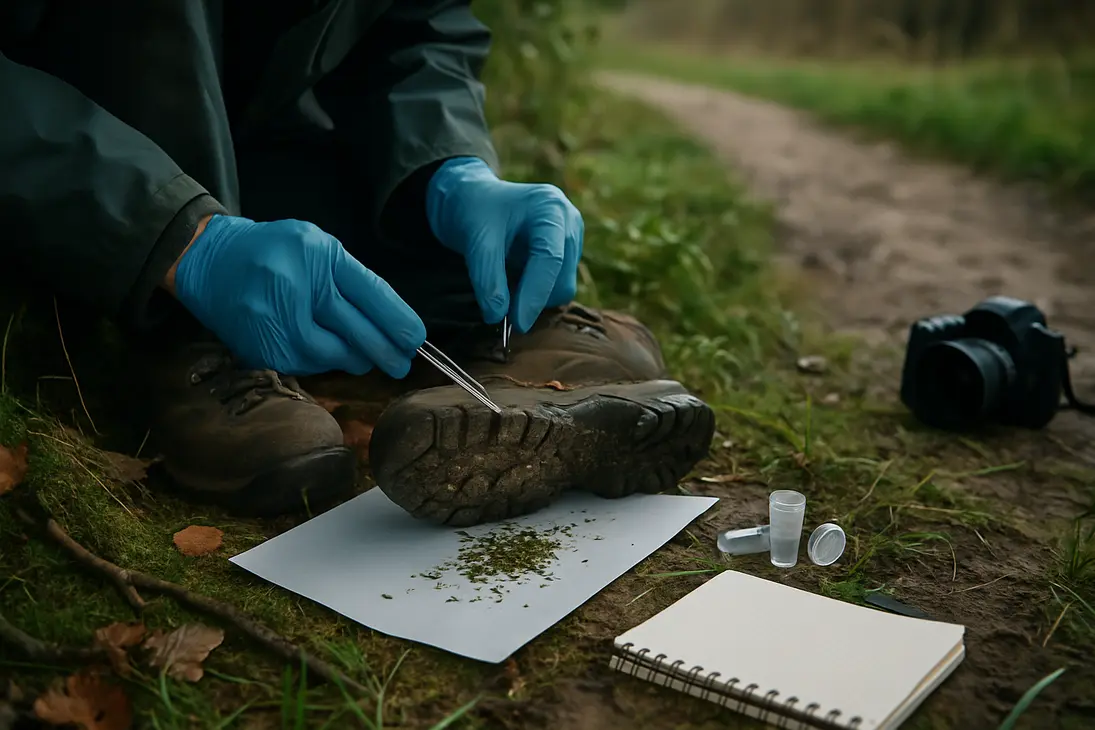
Plant evidence is vulnerable to contamination and loss. Pollen can blow away, seeds can fall from clothing, wet plant material can mold, and soil can mix if samples are poorly packaged.
Good practice includes:
- Photographing evidence before removal
- Collecting whole items, such as shoes or clothing, when possible
- Using clean tools and changing gloves between samples
- Packaging dry plant material in paper when decay is a concern
- Keeping wet material cool and documenting its condition
- Taking comparison samples from relevant locations
- Recording sampling points, habitat descriptions, dates, and weather
- Maintaining chain of custody
Comparison samples are essential. A seed on a shoe means little without knowing what plants occur at the alleged scene and at alternative locations.
Microscopy, Taxonomy, and Reference Collections
Many identifications rely on microscopy and reference collections. Pollen grains, spores, seed coats, leaf hairs, wood cells, and fibers can be compared with known specimens.
Reference materials may include herbarium specimens, pollen slides, seed collections, wood samples, photographs, floras, and regional plant keys. Local knowledge matters because plant communities vary by region and season.
Classical botany remains important. DNA tools are useful, but an experienced botanist can often recognize whether a fragment is grass, sedge, moss, conifer, hardwood, or ornamental material and decide which tests are worthwhile.
DNA Barcoding and Molecular Methods
DNA barcoding uses short genetic regions to help identify species. Other molecular methods may compare samples, detect mixtures, or distinguish related plants.
These methods are useful for powdered, shredded, fragmented, or processed material; for comparing plant traces from clothing with plants at a scene; and for testing timber or plant products for protected species.
Limitations are practical. DNA may be degraded in old, heated, submerged, or chemically treated samples. Some plant groups are genetically difficult to separate, and databases may be incomplete for regional varieties, hybrids, ornamentals, or poorly studied species. DNA results should be interpreted with morphology, ecology, and case context.
Mapping, Databases, and Seasonal Growth Data
Forensic botanists may use maps, vegetation surveys, flowering calendars, herbarium records, aerial imagery, and seasonal growth data. These help place evidence in time and space.
Mapping can show whether a plant is widespread or restricted to certain habitats. Seasonal records can indicate whether it was likely flowering, shedding pollen, fruiting, or dormant. Aerial imagery may show disturbance, crop growth, fire damage, clearing, or changes in search areas.
Plant timing is not perfectly predictable. Weather, urban heat, irrigation, mowing, drought, shade, and soil fertility can all change growth patterns. Reliable opinions account for local conditions.
Limits, Challenges, and Misconceptions
Forensic botany is powerful but context-dependent. It usually does not provide a precise location or exact date. It provides consistencies, exclusions, probabilities, and investigative leads.
Major limitations include:
- Contamination: Pollen, seeds, and soil transfer easily.
- Secondary transfer: Plant material may come indirectly from another person, pet, vehicle, or stored object.
- Seasonal variation: The same scene changes through the year.
- Common plants: Widespread species may have limited value.
- Incomplete databases: DNA, pollen, and distribution records may lack relevant species.
- Mixed samples: Clothing, vehicles, carpets, and soil often contain traces from many contacts.
- Environmental change: Mowing, flooding, fire, landscaping, construction, and decomposition can alter scenes.
- Courtroom scrutiny: Methods, documentation, qualifications, and interpretation must be defensible.
Another misconception is that forensic botany is mostly high-tech. In practice, it often combines field observation with specialist lab work. Knowing when a plant flowers, how a seed disperses, or where a moss grows can be as important as a DNA result.
The strongest conclusions are cautious: what the evidence supports, what it does not prove, and what alternatives remain possible.
Conclusion
Forensic botany helps investigators link people and objects to places, locate buried remains, estimate time since deposition, reconstruct movement, and investigate drowning, timber crime, drug cultivation, and environmental harm.
Its value depends on careful collection, good comparison samples, expert identification, and cautious interpretation. Used properly, plant evidence adds important context and can answer questions other evidence leaves open.
FAQ
What is forensic botany used for most often?
It is most often used to link people, objects, vehicles, or bodies to places or environments. Pollen, seeds, soil with plant material, wood fragments, and leaves can show possible contact with a scene or route.
Can plants really help determine how long a body has been in one place?
Yes, but usually as an estimated range or minimum time, not an exact date. Roots, seasonal pollen, leaf litter, plant succession, and algal growth can provide timing clues when interpreted with weather, soil, season, species, and other evidence.
Is pollen evidence reliable in criminal investigations?
Pollen evidence can be reliable when it is collected properly, protected from contamination, compared with good reference samples, and interpreted by a qualified specialist. It is strongest when the pollen profile is distinctive and fits the case context.
What skills does a forensic botanist need?
A forensic botanist needs plant identification, field ecology, microscopy, and evidence-handling skills. Depending on the case, they may also need palynology, plant anatomy, wood identification, DNA methods, mapping, soil science, or aquatic ecology.
You Might Also Like