Why Is My Pothos Not Developing Nodes for Propagation?
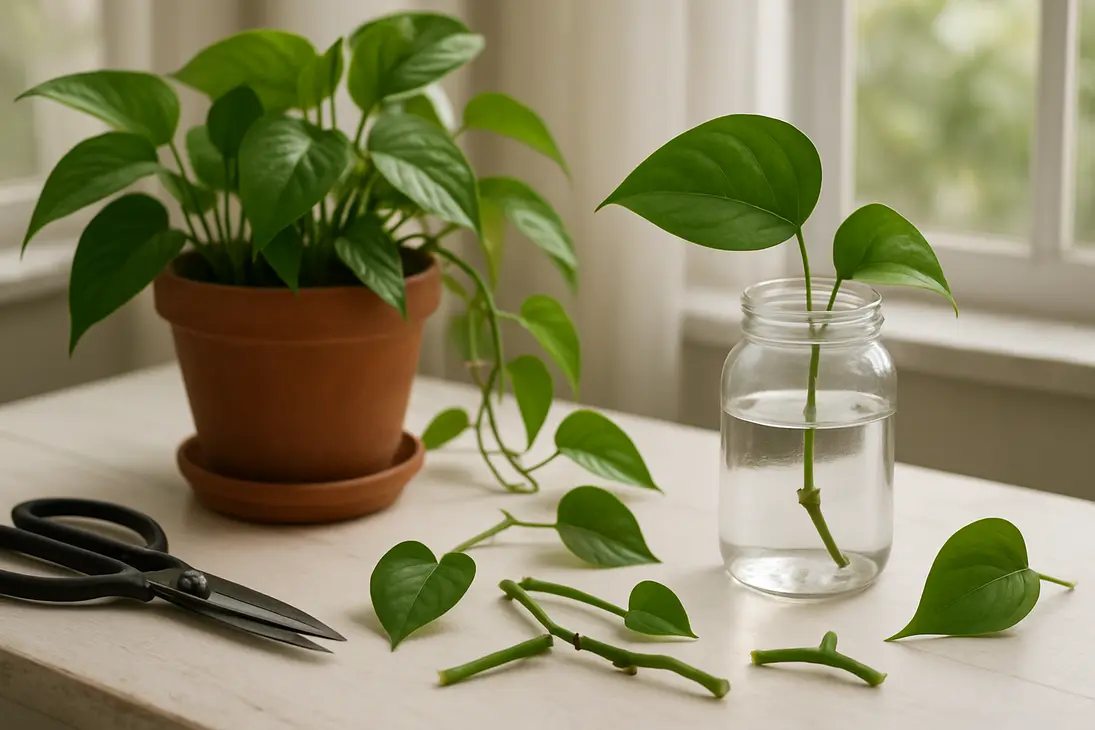
If your pothos cutting is sitting in water with no roots, no new leaf, and no visible “node development,” check the cutting first. Pothos does not create a brand-new node on a leaf-only cutting. A cutting must already include a piece of stem with a node before it can root and grow into a new vine.
Many pothos propagation problems are really node-identification problems. A leaf can stay green in water for weeks, but without a node attached, it has no growing point capable of producing a new plant.
Start by Confirming You Have a Real Pothos Node
A pothos node is an existing part of the stem, not something that appears later because the cutting is in water or soil. Roots and new shoots usually emerge from or near that node.
If you placed only a leaf and its small leaf stem in water, it may look alive for a while, but it will not become a new pothos plant. You need a section of vine with at least one node.
What a pothos node looks like
On pothos, the node is the slightly swollen joint on the vine where a leaf attaches. It may look like a small bump, ridge, nub, or ring around the stem. You may also see a tiny brown aerial root beginning near it.
Nodes repeat along the vine: leaf, node, bare stem, next leaf, next node. On young vines, they can be subtle. Look for the point where the leaf’s petiole connects to the main vine.
Node vs. leaf stem, aerial root, and internode
| Plant part | What it is | Can it grow a new pothos plant? |
|---|---|---|
| Node | Joint on the main stem where the leaf attaches | Yes, if healthy |
| Petiole / leaf stem | Stalk connecting the leaf blade to the vine | No, not by itself |
| Aerial root | Brown nub or root-like growth near a node | Helpful, but not the same as a node |
| Internode | Bare stem between two nodes | No, not by itself |
The most common mistake is confusing the petiole with the stem. A leaf with only its petiole attached is not a true pothos cutting. An aerial root is a good sign because it usually forms at a node, but the cutting still needs the actual node and growth point.
Why a single leaf without a node will not grow into a new plant
A pothos leaf does not contain the dormant bud tissue found at a stem node. It may absorb water and remain attractive for a long time, but it cannot produce a new vine.
If your cutting has no visible piece of main vine, patience will not fix it. Start over with a proper stem cutting that includes at least one node.
Why Pothos Nodes Stall, Fail to Root, or Produce No New Growth
Once you confirm the cutting has a real node, consider whether that node is healthy and in the right conditions. Pothos is forgiving, but propagation still depends on light, warmth, oxygen, clean moisture, and an undamaged growth point.
The cutting was made in the wrong place
For pothos, cut just below a node so the node stays on the cutting. If you cut above the node and leave it on the mother plant, the piece you put in water may be only an internode and leaf.
A good cutting has:
- at least one node
- at least one healthy leaf, unless using a leafless wet-stick method
- a short piece of stem below the node
- no mushy, blackened, or collapsed tissue
If dividing a long vine, make sure every section includes a node.
The node or growth point is damaged, dried out, or rotting
The node is where rooting and new growth happen, so damage matters. A node may stall if it was crushed by dull scissors, left to dry too long, or kept in stagnant water or soggy soil.
A healthy node feels firm. It may be green, tan, or brownish. A failing node may look black, slimy, hollow, or collapsed. If the node itself is mushy, the cutting is unlikely to recover.
The cutting has too little light or warmth
Pothos cuttings root best in bright, indirect light and steady household warmth. They do not need harsh sun, but they do need enough light to keep the leaf functioning.
Low light can keep a cutting alive but inactive. Cool rooms also slow rooting, especially near drafty windows in winter. Avoid direct midday sun, which can overheat water jars and scorch tender leaves.
Water is stagnant, dirty, or covering too much of the cutting
Water propagation works well, but the water should stay reasonably clean. Stagnant water loses oxygen and can encourage rot. Refresh it when it becomes cloudy, smells bad, or develops a film.
Only the node and lower stem need to be submerged. Keep leaves above water. Underwater leaves decay quickly and foul the container. Avoid cramming many cuttings into a narrow jar, since one rotting stem can affect the rest.
Soil propagation is too wet, compacted, or poorly drained
Soil propagation can work well, but you cannot see root development, so moisture balance is important. A small unrooted cutting in a large pot of wet soil may rot before it roots.
Use a small pot with drainage holes and a light, airy mix. Keep the medium lightly moist around the node, not soggy. Yellowing leaves, dark stems, or sour-smelling soil often indicate excess moisture and poor oxygen.
The plant is stressed from yellowing leaves, root issues, or overfeeding
Cuttings from stressed plants often perform poorly. Yellowing leaves, limp vines, pest damage, root rot, and fertilizer burn can all reduce cutting quality.
Take cuttings from the healthiest part of the plant. If the whole plant is declining, improve its care first when possible. A strong parent vine gives you firmer stems, clearer nodes, and better stored energy for rooting.
How to Propagate Pothos So the Node Develops Properly
Successful propagation is mostly about choosing the right cutting and keeping the node in a stable, moist, oxygenated environment.
Choose a healthy vine with visible nodes
Select a vine with firm stems, healthy leaves, and clear nodes. Avoid sections with yellow leaves, mushy stems, pest damage, very soft new growth, or old bare stems with weak-looking nodes.
A slightly mature vine often propagates better than a very tender tip. Existing aerial roots near the nodes are a bonus.
Cut just below the node
Use clean, sharp scissors or pruners. Cut just below a node, leaving a short stem tail beneath it. This puts the node near the bottom of the cutting where it can be submerged or buried.
For water propagation:
- Identify the node.
- Cut just below it.
- Remove any leaf that would sit underwater.
- Place the node in water.
- Keep the leaf above the water line.
You do not need a long stem below the node. Too much bare stem can rot before roots form.
Use single-node or multi-node cuttings correctly
Single-node cuttings are efficient because each node can become one plant. Each piece should include one node and usually one leaf.
Multi-node cuttings are more forgiving because they have more stored energy and more possible rooting points. They are useful if you want a fuller start. However, long cuttings with many leaves may wilt because they lose more water. If that happens, remove one or two lower leaves and root the remaining nodes.
For a fuller pot, root several single-node or two-node cuttings together, then plant them as a group.
Keep the node in water, moss, or soil while leaves stay above the medium
The node must touch the rooting medium. If it is floating above water or sitting above the soil surface, roots may not form.
You can root pothos in:
- Water: easiest for watching roots
- Moist sphagnum moss: useful for humidity and root checks
- Light potting mix: good for soil-adapted roots
- Perlite or a perlite mix: airy and helpful for rot-prone cuttings
The principle is always the same: node in contact with moisture, leaves exposed to air and light. Moss should be damp, not dripping. Soil should be gently firmed around the node, not packed tightly.
Provide bright indirect light and steady warmth
Place cuttings in bright, indirect light. A spot near a bright window, filtered by a sheer curtain or set back from direct sun, is often ideal.
If the room is cool, move the cutting away from drafts. Avoid heaters that dry it out and hot windowsills that overheat the water. If nothing changes after several weeks but the cutting is still firm and green, try a brighter location before giving up.
Pot up once roots are long enough to support growth
For water-rooted pothos, pot up when roots are long enough to anchor the cutting and take up moisture. A practical target is when several roots are a few inches long, or when the main root has begun branching.
Use a small pot with drainage holes and a loose, well-draining mix. Plant gently, water thoroughly once, let excess water drain, and keep the mix lightly moist while the cutting adjusts. Some temporary wilting can happen after the move, but the plant should recover if roots are healthy.
How to Encourage More Node Activity on the Mother Plant
If you want more cuttings, focus on healthy vine growth. Pothos already has nodes along its stems, but good care and pruning encourage those nodes to produce shoots.
Improve light without scorching the leaves
Pothos tolerates low light, but it grows more slowly there. In dim conditions, vines may stretch and leaves may become smaller.
Move the plant closer to a bright window, but avoid sudden harsh sun. Variegated pothos often needs brighter indirect light to grow well and maintain markings. Pale, crispy, or bleached patches mean the light is too intense.
Water only when the mix has partly dried
Overwatering is a common cause of pothos decline. Water when the upper portion of the potting mix has dried, not on a fixed schedule.
Use your finger or a wooden skewer to check moisture. If the surface is dry but the deeper mix is still wet, wait. Empty saucers and cachepots so the pot is not sitting in water.
Use a loose, well-draining potting mix
A dense mix holds water around roots too long and reduces oxygen. That weakens the plant and can lead to poor cuttings.
A good pothos mix should drain freely while holding some moisture. Standard houseplant mix amended with perlite, orchid bark, or coco chips often works well. If water drains very slowly or the root ball stays wet for many days, the mix may be too compacted.
Fertilize lightly during active growth
Pothos does not need heavy feeding. Too much fertilizer can damage roots and contribute to brown tips, yellowing, or stress.
Feed lightly during active growth. If the plant is not growing because conditions are dark or cold, fertilizer will not force healthy node activity. Do not fertilize fresh, unrooted cuttings.
Prune vines to stimulate branching from existing nodes
Pruning encourages a fuller pothos because the plant may activate a node below the cut and produce a side shoot.
Cut just above a node on the mother plant. Then use the removed vine for propagation, making sure each cutting has its own node. Pruning does not create new nodes; it encourages dormant buds at existing nodes to grow.
When to Wait, Recut, or Give Up on a Cutting
A stalled cutting is not always a failed cutting. Pothos can root quickly in good conditions, but it can also sit quietly for weeks. The key question is whether the node is still firm and alive.
Normal rooting timelines for pothos cuttings
In favorable conditions, pothos cuttings often show root nubs within one to three weeks. Usable roots may take several weeks longer. Cooler temperatures, low light, or unhealthy cuttings slow the process.
| Time after cutting | What you may see |
|---|---|
| First week | Little visible change; leaf should stay firm |
| 1–3 weeks | Small root nubs or early roots |
| 3–6 weeks | Longer roots; possible bud swelling |
| After potting | New leaves once roots adjust |
New leaves usually come after roots begin developing, so roots without leaves are not automatically a problem.
Signs the node is still alive
Keep waiting if:
- the stem is firm
- the node is not black or mushy
- the leaf is mostly green
- water stays reasonably clear
- small white or tan bumps are forming
- roots are growing, even slowly
A cutting with roots but no new leaf may simply need more time and bright indirect light.
Signs of rot or failure
Act quickly if you see:
- mushy stem tissue
- blackened node
- foul-smelling water
- cloudy water that returns quickly after changes
- yellowing leaves plus a soft stem
- a slimy coating around the cut end
- stem collapse when touched
If the node itself is mushy or hollow, the cutting is unlikely to recover.
When to trim back to a healthier node
Recut if rot is below the node but another healthy node remains on the cutting. Use clean scissors and remove all soft or blackened tissue.
After recutting, rinse the cutting, clean the container, add fresh water or medium, and submerge only the healthy node. If you have a long cutting, divide it into smaller sections so one rotten end does not ruin the entire vine.
When to start over with a fresh cutting
Start over if the cutting has no node, the only node is rotten, the stem is soft through the middle, all leaves have yellowed, or the cutting keeps declining after many weeks.
It can feel wasteful, but a fresh, properly cut node from a healthy vine usually roots faster and more reliably than a failing cutting.
Conclusion
Pothos propagation depends on an existing, healthy node. A leaf and petiole alone will not develop a new node or grow into a new plant. If your cutting has a node but nothing is happening, check whether the cut was made correctly, the node is firm, and the conditions are warm, bright, clean, moist, and oxygenated.
Most pothos node problems come down to either a missing node or a stressed node. Choose healthy vine sections, keep the node in contact with water or a lightly moist medium, keep leaves above the surface, and give the cutting time to root before expecting new leaves.
FAQ
Can a pothos grow a new node after being cut?
No. A pothos cutting cannot create a brand-new node where none existed. Nodes are already present along the stem. However, pruning can activate dormant growth points at existing nodes, which is why cutting back a vine can encourage branching.
Why is my pothos cutting growing roots but no leaves?
This is usually normal early on. The cutting often develops roots first so it can support future top growth. If the roots are healthy and the node is firm, give it more time and bright indirect light. If no shoot appears after a long period, the growth point may be damaged.
Can I propagate pothos from just a leaf?
No. A pothos leaf without a node may stay green in water for a while, but it will not become a new plant. You need a piece of stem with at least one node.
How long does it take for a pothos node to grow roots?
In good conditions, a pothos node may start forming root nubs in about one to three weeks, with longer roots developing over the next several weeks. Cool temperatures, low light, unhealthy cuttings, or stagnant water can slow rooting. Firm green cuttings are worth waiting on; mushy or blackened nodes are not.
You Might Also Like