Can You Propagate Leaf Cuttings in Water?
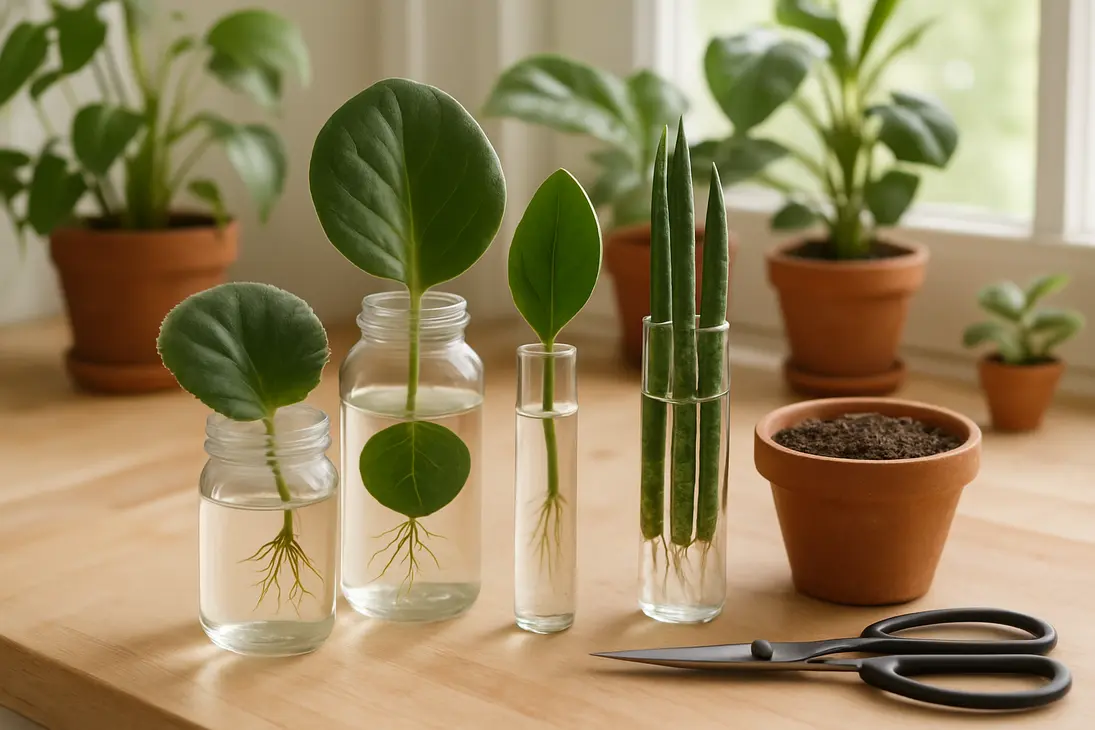
Yes, you can propagate some leaf cuttings in water, but rooting a leaf is not always the same as growing a new plant.
Many houseplants can produce roots from a leaf, petiole, or leaf section. However, a rooted leaf only becomes a complete plant if it also has tissue that can produce shoots. That is why a snake plant leaf section can eventually make a pup, while a single pothos leaf may grow roots and never make a vine.
The key question is not just “Will it root?” but “Can this cutting grow both roots and new growth?”
Can Leaf Propagation Work in Water?
Leaf propagation can work in water for plants that can regenerate from a leaf base, petiole, vein, or leaf section. African violets, peperomias, begonias, snake plants, and some succulents are common examples.
Other plants need a stem, node, crown, or offset. Some leaves root but never become full plants.
What “Leaf Propagation” Really Means
“Leaf propagation” can mean several things:
- A whole leaf with a petiole — common with African violets and some peperomias.
- A leaf section — common with snake plants and some begonias.
- A leaf plus a small piece of stem or node — needed for many vining plants.
- A succulent leaf on soil or near water — common with echeveria-type succulents.
Roots absorb water and nutrients. Shoots produce future stems and leaves. Some leaf cuttings can make both; others can only make roots.
Water Propagation vs. Soil Propagation
Water propagation is popular because roots are visible, progress is easy to monitor, and the setup is simple.
Soil propagation is less visible but often better for plants that dislike constant moisture, especially many succulents.
| Method | Best For | Main Advantage | Main Risk |
|---|---|---|---|
| Water propagation | African violets, peperomias, snake plant sections, some begonias | Easy to see roots | Rot or difficult transition to soil |
| Soil propagation | Succulents, many begonias, rot-sensitive plants | Roots form in their long-term medium | Harder to monitor progress |
Water is useful, but it is not always the safest or fastest option.
Why Some Leaves Root but Never Grow New Shoots
A leaf may root without producing a new plant if it lacks a node, bud, or other meristematic tissue. Meristematic tissue can create new stems, shoots, or plantlets.
Pothos is the classic example. A pothos leaf with a petiole may root in water, but without a node on the vine, it usually cannot grow a new vine. The same applies to many philodendrons, monsteras, hoyas, and similar plants. These are better propagated from stem cuttings with at least one node.
Best Plants for Leaf Propagation in Water
The best candidates are plants that can form both roots and new shoots from a leaf base, petiole, or leaf section.
Plants That Often Work from Leaf Cuttings
Good choices for leaf propagation in water include:
| Plant | Cutting Type | Notes |
|---|---|---|
| African violet | Whole leaf with petiole | Very reliable; plantlets form near the base. |
| Peperomia | Leaf with petiole or leaf section | Works well for many thick-leaved types. |
| Snake plant | Leaf section | Roots in water but may take months to pup. |
| Rex begonia | Leaf section or wedge | Often better in moist medium, but possible. |
| Cape primrose / Streptocarpus | Leaf section | Usually done in moist medium. |
| ZZ plant | Leaflet with base | Very slow; rhizome formation takes patience. |
African violets are especially beginner-friendly. A healthy leaf with 1 to 2 inches of petiole can root in water and later produce tiny plantlets.
Snake plant sections are also common. Cut a firm leaf into sections and mark the bottom end, because only the original bottom should go into water or potting mix.
Plants That Need More Than Just a Leaf
Some plants are mistaken for leaf-propagation candidates because their leaves can root. For a complete plant, they need a node or stem section.
These include:
- Pothos
- Philodendron
- Monstera
- Syngonium
- Hoya
- Tradescantia
- Ficus elastica, in most practical home settings
For these plants, take a stem cutting with at least one node. A leaf attached to a node is fine; a leaf alone is usually not enough. With pothos, the node is the small joint where the leaf and aerial root emerge, and that node must be in water.
Plants That Are Better Propagated in Soil
Many succulents can be propagated from leaves, but water is usually not the best method.
Better soil candidates include:
- Echeveria
- Graptopetalum
- Sedum
- Crassula ovata, or jade plant
- Kalanchoe
- Many cacti and succulent-like plants
Succulent leaves store water. When submerged or kept too wet, they may turn translucent, mushy, or black. Most do better after the cut end calluses and the leaf is placed on a barely moist, gritty mix.
Jade is a good example. A single leaf may root and sometimes grow, but a small stem cutting is usually faster and more reliable.
How to Propagate a Leaf Cutting in Water
Water propagation is simple, but clean cuts, correct placement, good light, and timely potting matter.
Choose a Healthy Leaf
Choose a mature, healthy leaf from a plant that is actively growing. Avoid leaves that are yellowing, limp, diseased, pest-damaged, very old, or very young.
For African violets and peperomias, choose a firm middle leaf. For snake plants, choose a firm leaf and cut it into sections large enough to stand or rest securely in water, often about 3 to 5 inches long.
Make a Clean Cut
Use clean scissors, a sharp knife, or pruners. A clean cut reduces crushing and rot risk.
Basic cutting types:
- African violet: Leaf with 1 to 2 inches of petiole.
- Peperomia: Leaf with petiole, or a leaf section for some types.
- Snake plant: Leaf sections with the bottom end marked.
- Begonia: Leaf wedge or section that includes a main vein.
For thick or rot-prone leaves, let the cut end dry briefly before placing it in water.
Place the Cutting in Water Correctly
Use a small glass, jar, or propagation tube that holds the cutting upright. Keep only the petiole, cut end, or lower section in water. The leaf blade should stay dry whenever possible.
Use room-temperature water and bright, indirect light. Avoid hot direct sun, which can overheat the water and stress the cutting.
For African violets, only the petiole should sit in water. For snake plant sections, submerge only the bottom inch or so. If needed, support the cutting with foil, plastic wrap, or a narrow-necked bottle.
Change the Water and Watch for Roots
Change the water every few days, or sooner if it becomes cloudy. Rinse the container if slime forms.
Rooting time varies. Some cuttings root in a few weeks; others take months. ZZ leaflets and snake plant sections are especially slow.
Healthy signs include white root nubs, new roots from the cut end, firm leaf tissue, and no foul smell. Thin, pale water roots are normal.
Move the Cutting to Soil at the Right Time
Do not wait until roots are long and tangled. Potting is usually easier when roots are about 1 to 2 inches long and the cutting still looks healthy.
Use a small pot with drainage holes. Large pots hold too much moisture around small roots.
To pot up:
- Fill the pot with a light, well-draining mix.
- Make a hole for the roots.
- Set the cutting gently in place.
- Firm the mix lightly.
- Water once to settle the soil.
- Keep it in bright, indirect light.
- Keep the mix lightly moist at first, not soggy.
A pause in growth after potting is normal while the roots adapt.
Common Leaf Propagation Problems and Fixes
Most failures come from rot, unsuitable plant choice, missing growth tissue, poor light, or trouble moving from water to soil.
The Leaf Is Rotting
Rot appears as mushy tissue, browning or blackening, cloudy water, or a sour smell.
Common causes include dirty tools, old leaves, too much tissue submerged, stale water, low light, cool conditions, or using water for a plant that prefers drier propagation.
To fix it, remove the cutting, trim away soft tissue if healthy material remains, wash the container, submerge less of the cutting, and move it to brighter indirect light. For succulents, switch to soil propagation. If the cutting has collapsed or smells bad, discard it.
Roots Form but No New Plant Grows
This is usually a tissue problem, not a water problem. The leaf may be able to root but unable to produce a new shoot.
This often happens with single leaves from pothos, philodendron, monstera, and similar plants. Without a node, the leaf has no growing point for a new vine.
Use the correct cutting: a node for vining plants, a petiole for leaf-petiole plants, the proper vein or section for begonias, and correct bottom-end orientation for snake plants.
Nothing Happens for Weeks
Some leaf cuttings are slow. Snake plants, ZZ plants, and certain begonias can take a long time.
If the leaf is firm and not rotting, keep waiting. Check for bright indirect light, warmth, clean water, the correct part submerged, and a plant type suited to leaf propagation.
Avoid repeatedly pulling or cutting it to check for progress. If nothing happens after many weeks and the leaf declines, start again with a fresher cutting or try soil propagation.
New Growth Is Weak or Stalled
Weak or stalled growth may come from low light, depleted leaf energy, poor timing, or transplant stress.
Help the cutting by giving bright indirect light, using a small pot, keeping the mix lightly moist during adjustment, avoiding heavy fertilizer, and protecting it from cold drafts or harsh sun.
If a rooted cutting collapses after planting, the mix may have stayed too wet or dried completely before the roots adapted. Aim for steady, gentle moisture at first.
Water vs. Soil: Which Method Should You Choose?
Neither method is best for every plant. Choose based on the plant’s growth habit and moisture tolerance.
When Water Propagation Makes Sense
Water propagation is a good choice when the plant is known to root well in water, you want to monitor roots, or you are propagating leaves with petioles, such as African violets.
It also helps in dry indoor air, where exposed cuttings wilt quickly. Water is especially useful for beginners because progress is visible.
When Soil Propagation Is Better
Soil propagation is usually better when the plant is succulent, rots easily in water, or forms roots best in contact with a medium. It also avoids the transition from water roots to soil roots.
Succulent leaves should generally be propagated in a dry-to-lightly-moist gritty mix. Let the end callus first, place the leaf on the surface, and water sparingly. Begonias also often do better in soil or a moist propagation medium than plain water, especially with leaf wedges and vein cuttings.
How to Transition Water Roots Into Potting Mix
Water roots are used to constant moisture, so the move to potting mix can be delicate.
To make it easier:
- Pot when roots are short.
- Use a small pot with drainage.
- Choose a light mix suited to the plant.
- Pre-moisten the mix so it is damp, not waterlogged.
- Keep humidity steady if the cutting wilts.
- Avoid harsh sun.
- Gradually reduce moisture once new growth appears.
For African violets, use a light African violet-style mix. For peperomias, use a well-draining houseplant mix. For snake plants, use a freer-draining mix and water carefully.
The goal is not to keep the soil as wet as the jar. The goal is to prevent sudden drying while roots adjust.
Conclusion
Leaf propagation in water is possible, but it depends on the plant. Some leaves can grow roots and form new plants. Others can root but never produce shoots because they lack the right growth tissue.
For best results, choose a suitable plant, take the correct cutting, keep only the necessary part in water, and pot it before the roots become too long. For vining plants like pothos and philodendron, include a node. For succulents, soil is often safer than water.
Once you understand the difference between rooting and producing a new plant, leaf propagation becomes much less confusing.
FAQ
Can you propagate a plant from just one leaf?
Yes, but only with certain plants. African violets, some peperomias, snake plants, begonias, and some succulents can produce new plants from a leaf or leaf section.
Many common houseplants, including pothos, philodendron, monstera, and hoya, usually need a node or stem section.
How long does a leaf cutting take to root in water?
Some leaf cuttings root in 2 to 4 weeks. Slower plants may take 6 to 12 weeks or longer. African violets and peperomias are usually faster than snake plants or ZZ plants.
Light, warmth, leaf health, and plant type all affect timing.
Why did my leaf grow roots but no new leaves?
The cutting may lack the tissue needed to produce shoots. Some leaves can form roots but cannot create a new stem or growing point.
This is common with single pothos, philodendron, monstera, and similar leaves. Use a cutting with a node.
Should leaf cuttings be propagated in water or soil?
Use water for plants that root well that way, such as African violets, peperomias, and snake plant sections. Use soil or a lightly moist propagation medium for succulents and plants that rot easily in water.
Water is easier to observe. Soil often produces roots that adapt more smoothly after propagation.
You Might Also Like