Can a 3 cm Honey Mesquite Seedling Be Watered Only Once a Week?
Short Answer: Usually Not on a Fixed Weekly Schedule
Usually, no—not while a honey mesquite (Prosopis glandulosa) seedling is only about 3 cm tall and newly planted in a garden bed.
Mature honey mesquite is notably drought tolerant, but a tiny seedling has a very small, shallow root system. It cannot yet reach moisture deeper in the soil, and it can dry out quickly in sun, heat, wind, or sandy ground. During its first weeks after planting, watering only once a week is often too infrequent.
The better approach is to keep the root zone evenly moist but never waterlogged. That does not mean watering every day automatically. It means checking the soil and watering when the area around the young roots is beginning to dry.
A weekly schedule may eventually work if the weather is mild, the soil holds moisture well without becoming soggy, and the seedling is beginning to establish roots. It is rarely a reliable starting rule for a 3 cm plant.
Water According to Soil Moisture, Weather, and Drainage
A calendar is less useful than a quick soil check. Two garden beds only a few metres apart may dry at very different rates because of sun exposure, soil texture, reflected heat from walls, wind, mulch, or competition from nearby plants.
For a young mesquite, the aim is simple: provide enough water to support new root growth, then gradually allow the soil to dry a little more between waterings as the plant becomes established.
Check the Root Zone Before Watering
Before watering, insert a finger, narrow trowel, wooden plant label, or chopstick into the soil a few centimetres from the stem. Check roughly 2–5 cm below the surface, where the seedling’s roots are likely to be.
Use the feel of the soil as your guide:
- Water now: Soil is dry or only faintly cool below the surface, and it does not cling together when lightly pressed.
- Wait and check again: Soil is still cool and slightly moist but not muddy.
- Do not water: Soil is dark, wet, sticky, or leaves moisture on your finger or tool.
Do not judge solely by the soil crust. The surface may look dry after a sunny afternoon while the root zone beneath remains adequately moist. Conversely, a damp-looking surface can conceal dry soil below if water has only been applied lightly and repeatedly.
Checking before watering prevents both common problems: letting a tiny seedling dry out completely and keeping its roots constantly wet.
Adjust for Heat, Sun, Wind, and Soil Type
A 3 cm honey mesquite seedling will use and lose water at very different rates depending on its conditions.
| Condition | Likely effect on watering needs |
|---|---|
| Hot, dry weather | Soil dries faster; check daily and water as needed. |
| Full afternoon sun | Increases heat stress and evaporation, especially in the first weeks. |
| Windy position | Dries foliage and soil quickly; seedlings may wilt even when temperatures are moderate. |
| Sandy or gravelly soil | Drains rapidly and may need more frequent watering. |
| Raised bed | Often warms and dries faster than in-ground soil. |
| Heavy clay or compacted soil | Holds water longer; water less often and watch for poor drainage. |
| Cool, cloudy, or rainy weather | Reduces moisture loss; watering may be needed much less often. |
| Nearby mature plants or lawn roots | Compete for water and can dry the seedling’s small rooting area quickly. |
Sun is not automatically harmful to honey mesquite, which is adapted to bright conditions once established. The challenge is the transition period. A newly transplanted seedling can lose water through its leaves faster than disturbed roots can replace it. In very hot weather, temporary afternoon shade for several days may help it settle in, particularly if it was grown indoors, in a greenhouse, or under shade cloth.
Water Deeply but Gently Around the Seedling
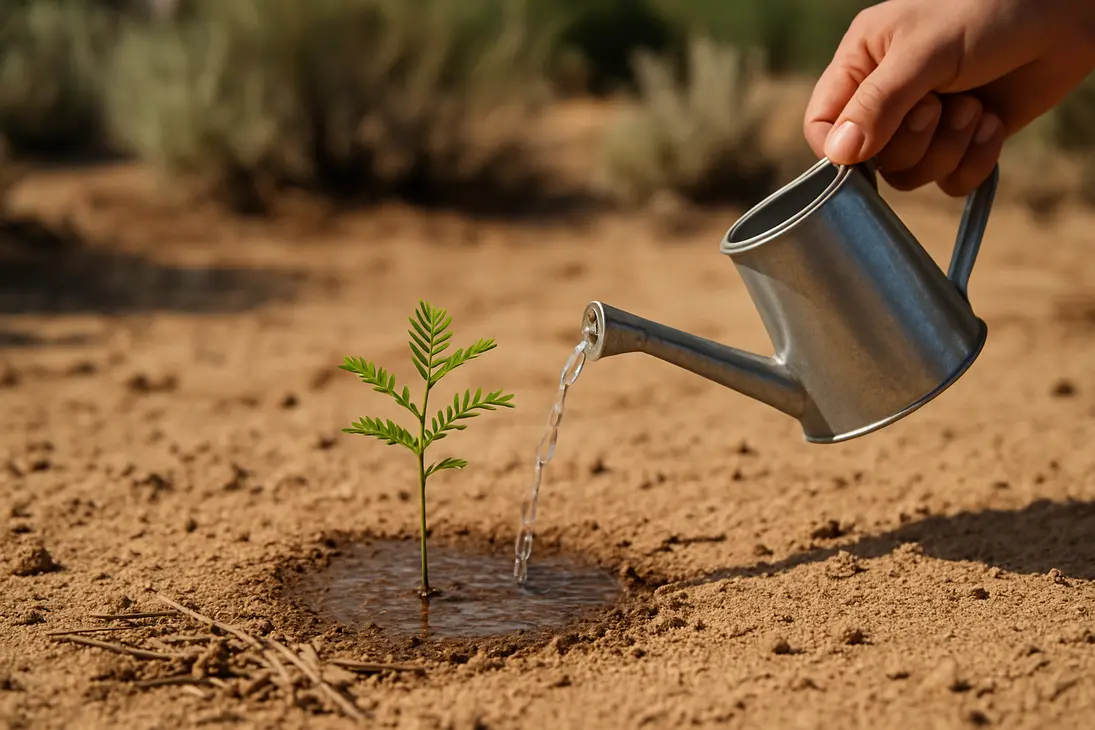
“Water deeply” for a 3 cm seedling does not mean flooding a large area or soaking the bed for hours. Its roots occupy only a small zone.
Apply water slowly around the seedling rather than directly blasting the stem. A gentle trickle from a watering can, hose set to a soft flow, or drip emitter allows water to sink in rather than run off. Stop if water begins pooling for more than a few minutes.
The goal is to moisten the small root ball and the soil immediately around it. Watering a slightly wider circle encourages roots to grow outward, but avoid saturating a broad area when the plant has barely any roots to use that moisture.
A useful routine is:
- Water slowly until the top few centimetres of soil are evenly moist.
- Wait a minute for water to soak in.
- Check that the seedling remains upright and soil has not washed away from the stem.
- Recheck the root zone the following day rather than watering again automatically.
A Practical Watering Schedule for the First Weeks in a Garden Bed
The following is a starting framework, not a rigid prescription. Soil moisture should always decide whether water is actually needed.
Immediately After Planting
Water the planting hole after setting the seedling in place. This settles soil around the roots and removes large air pockets without the need to press or compact the soil heavily.
Plant at the same depth it was growing before. Do not bury the stem deeper to make it stand upright; a leaning seedling usually needs gentle support, improved planting contact, or a correction to light exposure—not a deeply buried stem.
After watering, the soil should feel moist around the root zone but should not become a puddle. If the hole fills with water and remains full, drainage needs attention before more irrigation is added.
During Establishment
For the first two to four weeks, check the seedling’s root zone daily during warm, sunny, windy, or dry weather. You may need to water more than once a week, sometimes every day in fast-draining soil or intense heat.
That does not mean daily watering is always correct. In cool weather or moisture-retentive soil, the root zone may stay adequately moist for several days. Skip watering whenever the soil beneath the surface is still wet.
A practical pattern for a newly planted seedling is:
| Time after planting | What to do |
|---|---|
| Planting day | Water gently and thoroughly enough to settle the soil around roots. |
| First 7–10 days | Check soil daily. Water whenever the root zone is beginning to dry. |
| Weeks 2–4 | Continue frequent checks; start allowing the upper soil layer to dry slightly between waterings. |
| After visible new growth | Gradually extend the interval between waterings if the seedling remains firm and the soil is drying normally. |
New growth is encouraging, but it is not an invitation to stop paying attention. A very small mesquite can still be vulnerable to a sudden dry spell, heat wave, or watering system failure.
After the Seedling Is Established
Honey mesquite develops drought tolerance through a larger, deeper root system. Once it has put on sustained new growth, remains upright through warm weather, and no longer dries rapidly between waterings, you can begin reducing watering frequency.
Rather than switching abruptly to once a week, extend the gap gradually. Let the upper few centimetres dry, then water thoroughly enough to encourage roots to explore deeper soil. Over time, established mesquite generally benefits more from occasional deep watering during prolonged drought than from frequent shallow sprinkling.
However, drought tolerance is a trait of a developed plant, not a guarantee for a 3 cm seedling. A young plant that dries completely and repeatedly may stall, shed leaves, or die before it has the root system that makes mesquite resilient.
Avoid Overwatering and Poor Drainage
Outdoor soil can absolutely be overwatered. Water does not always drain away quickly, particularly in compacted ground, clay-rich soil, low spots, or beds amended with fine material that stays wet around the planting hole.
Roots need oxygen as well as water. When pore spaces in the soil remain filled with water, roots cannot function normally. This can produce a confusing result: the seedling looks wilted even though the soil is wet.
Avoid repeated light watering just because the surface looks dry. It can leave the deepest root zone saturated while encouraging roots to stay near the surface.
Signs the Seedling Is Getting Too Much Water
No single symptom proves overwatering, but these signs together point to soil that is staying wet too long:
- Soil remains wet, dark, and cool for days after watering.
- Growth is slow despite warm weather and adequate light.
- Leaves become pale, yellowish, limp, or soft rather than crisp and dry.
- The seedling wilts while the soil is clearly wet.
- Green algae, a pale crust, or fuzzy mold appears repeatedly on the soil surface.
- The stem base looks soft, darkened, or constricted.
- Roots are sparse, brown, or weak if the seedling is carefully lifted for inspection.
Surface mold is often a sign of persistent surface moisture and limited airflow rather than proof that the plant itself is diseased. Still, it is worth correcting the conditions that allow it to persist.
Signs It Needs Water
Underwatering is more likely when you find dry soil below the surface and the seedling’s foliage loses firmness during warm weather.
Look for:
- Dry, loose soil 2–5 cm below the surface.
- Wilting that improves after a careful watering.
- Dry or crisp leaf edges.
- A seedling that feels less firm or begins to droop during a hot, dry period.
- Rapid drying of the root zone in sandy, windy, or exposed conditions.
Heat can cause temporary midday drooping even when soil is moist. Check again in the evening or early morning before deciding the plant needs water. If it firms up as temperatures drop and the root zone is moist, adding more water may create a drainage problem instead of solving one.
What to Do if Soil Stays Wet or Develops Surface Mold
First, stop watering on schedule and let the surface dry slightly. Do not let the root ball become bone-dry, but do not add water to already wet soil.
Then address the cause:
- Make sure the bed is not in a low, poorly drained position.
- Break up compacted soil around—but not directly under or through—the roots.
- Avoid a deep layer of fine compost or dense mulch that stays wet against the stem.
- Pull mulch back a few centimetres from the stem base.
- Use only a thin, airy mulch layer around the seedling to reduce evaporation while allowing airflow.
- Water slowly and less often, checking below the surface first.
- Confirm that irrigation emitters, sprinklers, or roof runoff are not soaking the plant between hand waterings.
If the stem base is collapsing, darkening, or narrowing, act promptly: reduce excess moisture, improve drainage, and protect the plant from further disturbance. A tiny seedling can decline quickly once its roots are damaged.
Troubleshoot Slow Growth or a Leaning Seedling
Slow growth or a leaning stem does not automatically mean the seedling needs more water.
A mesquite seedling may struggle after transplanting because roots were disturbed, the root ball dried during planting, or it was moved suddenly from sheltered conditions into intense sun and wind. It may also lean toward the strongest light source, stretch if it previously grew in weak light, or bend after physical damage from rain, animals, or handling.
Consider these possibilities before changing your watering routine:
| Symptom | Possible causes besides lack of water |
|---|---|
| Slow growth | Transplant shock, cool soil, root disturbance, poor drainage, inadequate light, nutrient imbalance, or pest damage |
| Leaning toward one side | Uneven light, wind exposure, loose soil around roots, or a stretched stem |
| Wilting in wet soil | Overwatering, root stress, disease, or heat stress |
| Yellowing leaves | Persistently wet roots, nutrient issues, transplant stress, or natural loss of the earliest leaves |
| Bending or collapsing at soil level | Stem damage, damping-off-type disease, excessive moisture, or pest injury |
Gently firm loose soil around the root zone if the plant wobbles, but do not pack it hard. A small twig stake can provide temporary support in a windy spot, tied loosely with soft material. Remove support once the stem can stand on its own.
Check for chewing insects, cutworms, or damage at the soil line. Also confirm that the plant receives enough direct light for its stage of acclimation. Mesquite ultimately prefers sun, but a newly planted 3 cm seedling may need a short adjustment period if it was raised in gentler conditions.
Conclusion
A 3 cm honey mesquite seedling should not usually be watered only once a week by default. During establishment, its small root system needs soil that remains lightly and consistently moist, especially in hot, sunny, windy, or sandy conditions.
Check the root zone frequently, water gently when it is beginning to dry, and avoid keeping the soil constantly wet. Once the seedling has rooted into the bed and is producing steady new growth, you can gradually increase the time between waterings. Weekly watering is suitable only when the soil and weather conditions allow the young plant to stay adequately hydrated between those applications.
FAQ
Should I water a honey mesquite seedling every day?
Not automatically. Check it every day during warm, dry, or windy weather, but water only when the soil around the roots is beginning to dry. In sandy soil or a very hot garden bed, daily watering may be necessary for a short period. In cool weather or clay-heavy soil, daily watering may be excessive.
How do I know whether my mesquite seedling is established?
A seedling is becoming established when it produces continued new growth, remains firm and upright, and does not wilt quickly as the upper soil dries. You may also notice that it begins using water more steadily and can go longer between waterings without stress.
For a plant only 3 cm tall, think in terms of weeks or longer rather than assuming it is established after a few days in the ground.
Can honey mesquite seedlings survive drought?
Older, well-rooted honey mesquite plants can tolerate dry conditions very well. Tiny seedlings are much less drought resistant because their roots are shallow and limited. A brief dry period may be survivable, but repeated or prolonged drying can severely slow growth or kill a newly planted seedling.
Should I mulch around a tiny honey mesquite seedling?
Yes, but use a light layer and keep it away from the stem. A thin ring of coarse mulch can reduce soil evaporation and limit temperature swings. Leave several centimetres of bare space around the stem so moisture, mulch, and fungal growth do not remain pressed against the base of the plant.
You Might Also Like