What Does Low Light Mean for Houseplants?
“Low light” is one of the most misunderstood labels in houseplant care. It does not mean a plant can live in a dark corner, windowless bathroom, or interior room with the lights switched off. It means the plant can tolerate and, in some cases, grow with limited natural daylight compared with plants that need bright indirect light or direct sun.
When choosing low light houseplants, the most useful question is not “Which plants like low light?” but: How much usable daylight does this exact spot receive? A plant placed a few feet from a shaded window has a very different experience from one placed across a large room, even when both areas look adequately lit to you.
Low Light Does Not Mean No Light
Plants need light to photosynthesize: the process that produces the energy they use to maintain leaves, roots, and new growth. In low-light conditions, a plant receives less energy, so its growth and water use slow down. But it still needs enough daylight to keep functioning.
A low-light-tolerant plant can often cope with a less-than-ideal location better than a sun-loving plant can. That tolerance is not the same as a preference for darkness.
Low light vs. bright indirect light
Both terms describe light that is not harsh, direct sun on the foliage, but they are not interchangeable.
Bright indirect light is usually found close to a window where sunlight is softened by a sheer curtain, reflected from a pale wall, or blocked from directly striking the plant. The area may receive strong ambient daylight for much of the day.
Low light is dimmer. It might be a few feet back from a north-facing window, beside an east-facing window that is shaded by trees, or in a spot that receives daylight but little or no direct sun. A low-light location is still visibly connected to a window or another daylight source.
A plant that is happy in bright indirect light may survive in low light, but it will usually grow more slowly and may become less full, less colorful, or more prone to leaning.
Why a room can look bright to people but still be dim for plants
Human eyes adjust remarkably well to indoor conditions. A room with pale walls, overhead lights, and large furniture may feel bright enough to read in, yet still provide very little plant-usable daylight away from the window.
Plants do not benefit meaningfully from ordinary household lamps unless those lamps are designed and positioned as grow lights. They also experience a sharp drop in light intensity as they move away from a window. That is why the middle of a bright living room can be far dimmer than the windowsill.
The room’s overall appearance can be misleading. Assess the light where the leaves will sit, not how bright the room seems when you walk through it.
Survival in low light vs. active growth
A plant can remain alive in a dim spot for months while gradually using stored energy and producing little or no new growth. This is survival, not necessarily success.
In a suitable low-light position, a tolerant foliage plant may grow slowly, hold its leaves well, and produce modest new growth during brighter seasons. In a spot that is too dark, it may stop growing entirely, shed older leaves, develop sparse stems, or decline after watering becomes difficult to manage.
This distinction explains why a “low-light” label can feel disappointing. The label usually means the plant tolerates lower light than many alternatives—not that it will become large, lush, fast-growing, or flowering in a dim corner.
How to Tell Whether a Spot Is Low Light
There is no universal indoor light map because every home differs. Nearby buildings, tree cover, window size, wall color, curtains, and season all change the result. Still, window direction, distance, and obstructions give you a practical starting point.
Window direction and the light it provides
Window direction affects both the strength and timing of daylight. These descriptions assume the Northern Hemisphere; reverse north and south if you are in the Southern Hemisphere.
| Window direction | Typical indoor light | What it often means for plants |
|---|---|---|
| North-facing | Gentle, relatively consistent daylight with little direct sun | Often low to medium light, especially in winter or behind obstructions |
| East-facing | Mild direct morning sun, then indirect light | Often suitable for many foliage plants placed near the window |
| West-facing | Stronger afternoon sun | Can provide bright indirect light nearby; direct sun may be intense |
| South-facing | The strongest and longest sun exposure | Usually bright light near the window, though it can become low light farther into the room |
A north-facing window is not automatically too dark. A large, unobstructed north-facing window can provide enough diffuse daylight for many low-light houseplants. Conversely, a small north-facing window facing a brick wall or dense evergreen trees may offer very little usable light.
How distance from a window reduces light
Distance is one of the biggest factors in indoor plant placement. Light falls away quickly as you move into the room.
As a general rule:
- On the sill or within 1 to 3 feet of a window: usually the brightest indoor location, though direct sun may need filtering for sensitive plants.
- About 3 to 6 feet away: often medium or lower indirect light, depending on window direction and obstructions.
- About 6 to 10 feet away: commonly low light only if the window is large and bright; otherwise, it may be insufficient.
- More than 10 feet away: often too dark for reliable growth without a grow light, particularly in winter.
These are not fixed measurements. A plant three feet from a small shaded window may receive less light than a plant eight feet from a large south-facing window. Still, distance is important enough that moving a plant a few feet closer can noticeably improve its condition.
The effect of curtains, buildings, trees, and tinted glass
Anything between the sky and your plant lowers the available light. Common light reducers include:
- Heavy curtains, blinds, or shades that stay partly closed
- Deep porches, balconies, and roof overhangs
- Nearby apartments or houses
- Dense trees, especially evergreen trees
- Frosted, tinted, dirty, or insect-screened glass
- Plants placed behind furniture, in alcoves, or around a corner from the window
Sheer curtains are useful when direct sun is too intense, but they still reduce light. Thick curtains can turn a reasonably bright window into a low-light position. Seasonal changes matter too: deciduous trees may allow useful winter light after their leaves drop, while shorter winter days reduce the total amount of daylight available.
When a room is too dark for houseplants without a grow light
A room is generally too dark for houseplants when it has no window, receives only borrowed light from another room, or remains gloomy during the day unless electric lights are on.
A simple practical test is to visit the location around midday on a clear or bright overcast day. If you cannot comfortably see the plant’s shape, leaf color, and potting mix without switching on a light, it is too dark for long-term plant growth.
Even a plant that tolerates low light needs daylight or a suitable grow light. Windowless rooms can still hold houseplants, but the light must be supplied intentionally rather than assumed.
What to Expect From Houseplants in Low Light
Low light changes how a plant looks and behaves. Matching expectations to the location prevents frustration—and helps you recognize when a plant needs a brighter position.
Low-light-tolerant plants still need enough light to grow
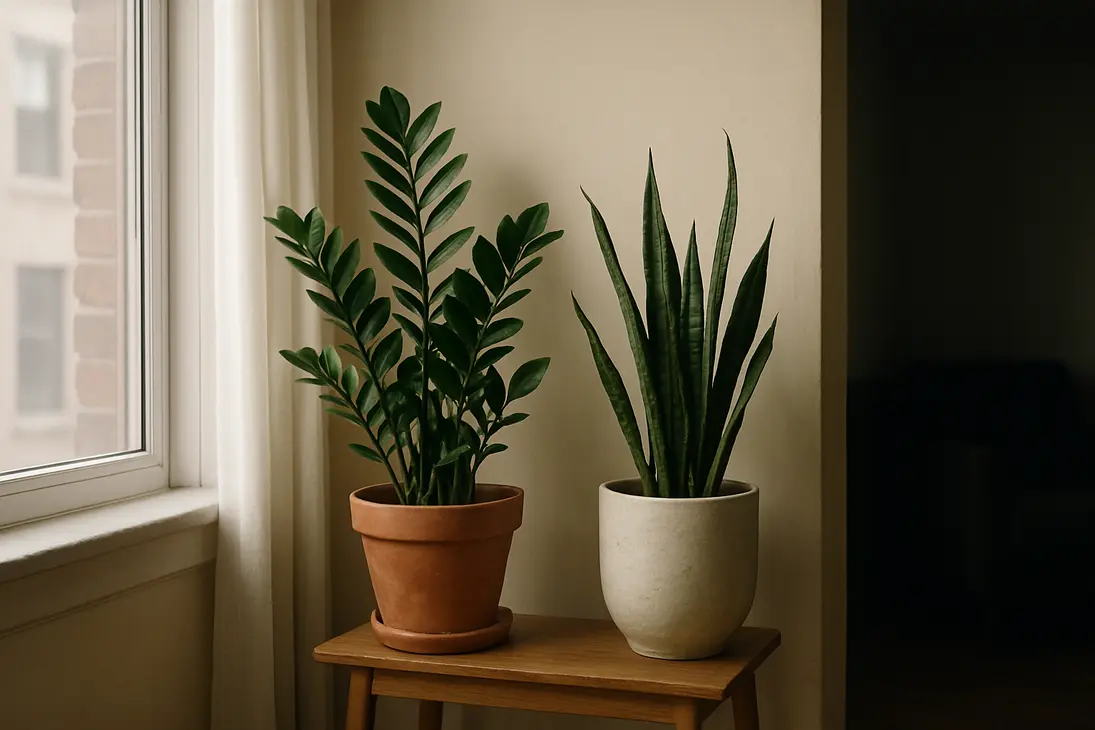
Many popular foliage plants are described as low-light tolerant because they evolved beneath taller vegetation or can maintain themselves with modest light. Examples often include snake plants, ZZ plants, cast-iron plants, Chinese evergreens, heartleaf philodendrons, and some dracaenas.
Even these plants generally do better near the brighter end of their acceptable range. They may stay alive in a dim location, but they usually become fuller and grow more reliably with brighter indirect light.
Variegated forms deserve special caution. White, cream, pink, or pale sections contain less chlorophyll than green leaf tissue, so variegated plants usually need more light than their all-green counterparts. A variegated pothos or philodendron may gradually lose patterning or become sparse in a spot where a solid-green variety would cope.
Why flowering and large, fast-growing plants usually need more light
Flowers, fruit, large leaves, and rapid growth all require energy. In low light, most houseplants direct their limited resources toward basic survival rather than producing blooms or dramatic new foliage.
That is why flowering plants, palms, bird of paradise, citrus, many succulents, and large fast-growing plants are usually poor choices for genuinely dim areas. A bird of paradise may remain alive for a while away from a bright window, for example, but it is unlikely to develop the strong, substantial growth expected of the plant.
Likewise, a large plant is not automatically a low-light plant. Mature specimens may look impressive in a dim corner for décor purposes, but their long-term health depends on whether they can receive enough light there.
Signs a houseplant is not getting enough light
Low light is not always the only cause of decline, so look at several symptoms together rather than diagnosing from one yellow leaf.
Common signs of insufficient light include:
- New growth that is small, pale, or slow to appear
- Long gaps between leaves on climbing or trailing plants
- Stems stretching or leaning strongly toward the window
- A plant that grows unevenly on the window-facing side
- Loss of variegation or weaker leaf color
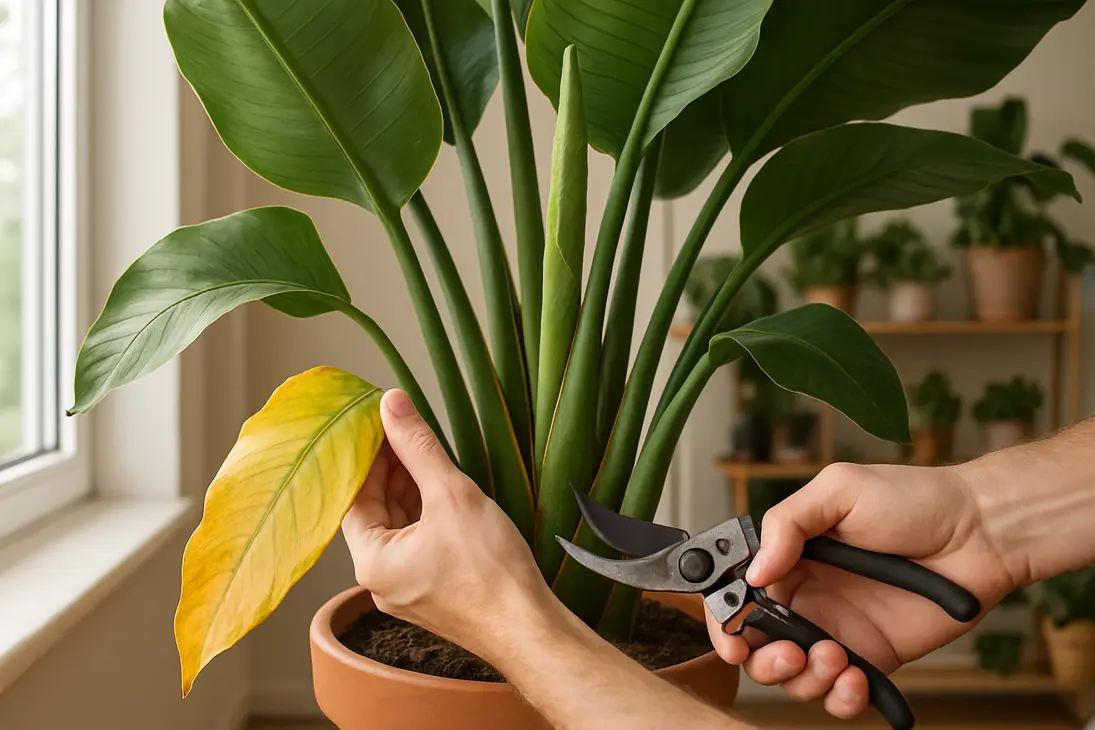
- Lower leaves yellowing and dropping over time
- Potting mix staying wet much longer than usual
- A flowering plant that produces leaves but no blooms
Plants naturally turn toward light, so a slight lean is normal. A pronounced lean, repeated stretching, or bare stems indicate the plant is trying to reach a stronger source.
Adjusting Care for Low-Light Conditions
The lower the light, the slower most houseplants use water and nutrients. Good low-light care is often less about doing more and more about avoiding excess.
Water less often when light is low
Because a plant grows slowly in low light, it typically draws less water from the potting mix. Soil that dried in a week near a bright window may take two weeks or longer in a shaded location.
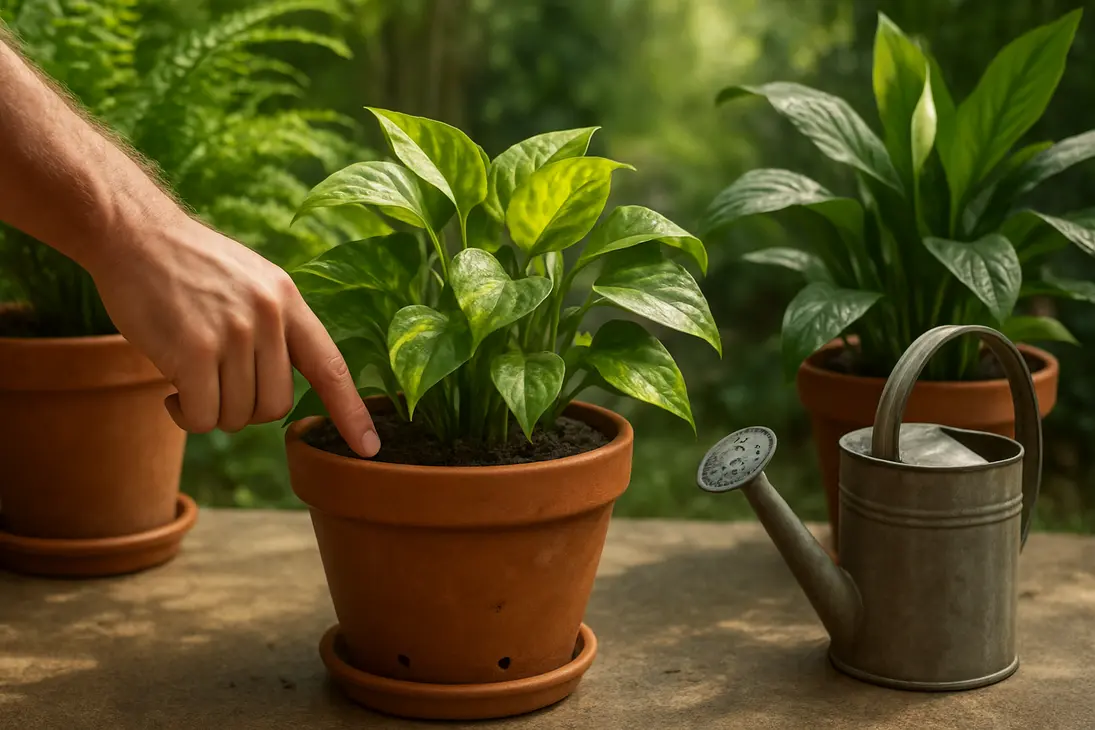
Do not water by the calendar. Check the mix before watering by feeling below the surface, lifting the pot to judge its weight, or using a moisture probe carefully. Let the appropriate amount of mix dry for that particular plant before watering again.
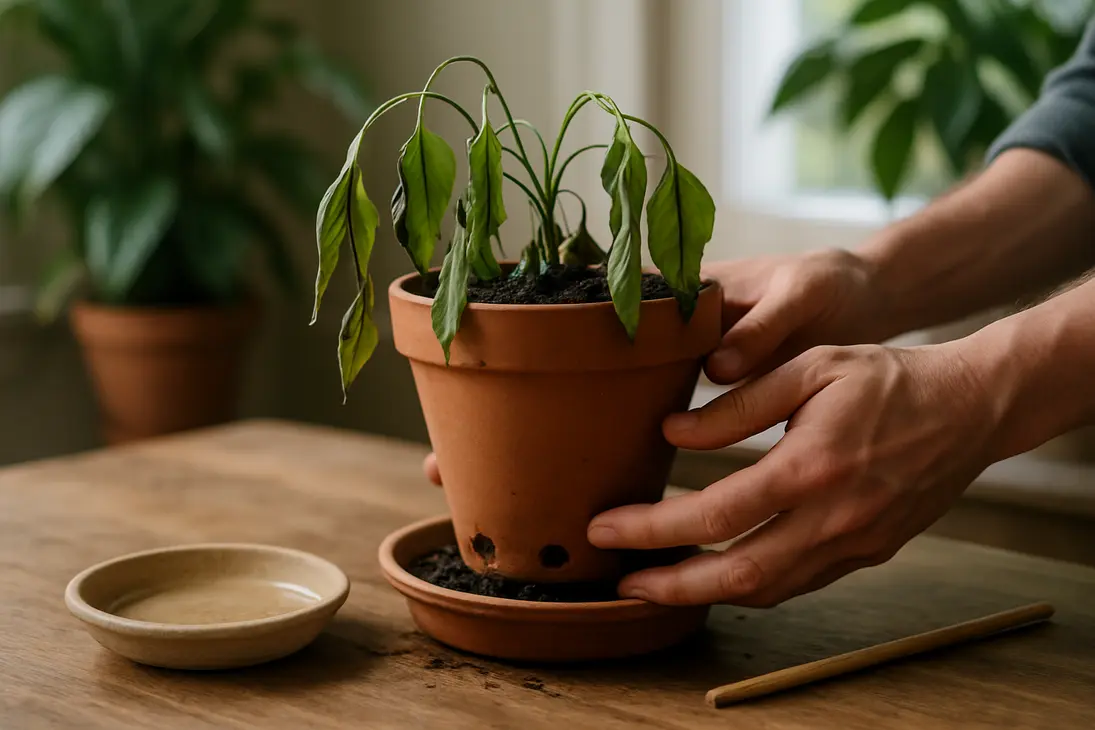
Overwatering is especially common in low-light conditions because the plant cannot use water quickly. Constantly wet soil limits oxygen around the roots and can lead to root damage. Yellow leaves, drooping, and leaf loss are often blamed on low light alone when the underlying problem is low light combined with overly frequent watering.
Avoid fertilizing plants that are not actively growing
Fertilizer is not a substitute for light. If a plant is barely growing because conditions are dim or winter days are short, feeding it heavily will not make it grow faster.
Wait until you see healthy, active growth before applying fertilizer, and follow the product directions. A plant struggling in a very dark spot needs better light first, not more nutrients. If it has been sitting in the same potting mix for years, repotting into fresh mix may eventually help, but only after placement and watering are addressed.
Rotate plants and monitor their response
Turn plants a quarter-turn every week or two if they lean toward a window. Rotation encourages more balanced growth, although it cannot compensate for a location that is too dark.
Give a placement change time. Plants do not transform overnight, and moving them repeatedly can make it harder to judge what is helping. Watch for these positive responses over several weeks or months:
- New leaves that are closer in size to older leaves
- More even growth
- Firmer stems
- Improved leaf color
- Potting mix drying at a more predictable rate
If a plant reacts badly after a move, check whether it was exposed to sudden hot direct sun, cold drafts, or a major watering change. Moving from very low light into stronger light is usually beneficial, but tender foliage may need a gradual adjustment if direct sun is involved.
When to add a grow light or move the plant closer to a window
Move the plant closer to a window when possible. It is often the simplest, lowest-maintenance solution. A small plant stand, wall shelf, hanging planter near the glass, or table placed beside the window can make a greater difference than changing fertilizer or soil.
Add a grow light when:
- The only suitable location is far from a window
- The room has no natural daylight
- Winter light is consistently inadequate
- You want stronger growth, variegation, or flowering than the window can support
- The plant repeatedly stretches or declines despite careful watering
Choose a grow light intended for plants and position it close enough to provide useful illumination, following the manufacturer’s guidance. A decorative lamp across the room rarely provides enough intensity. Keep the duration consistent, and avoid leaving a grow light on all day and night; plants also need a regular dark period.
Conclusion
Low light means reduced daylight, not no daylight. A suitable low-light spot still has enough natural light for a tolerant plant to photosynthesize, even if growth is modest. The darkest corner of an otherwise bright room may not meet that standard.
The “low-light” label is best treated as a tolerance range, not a guarantee. Place the plant as close to a window as your space allows, reduce watering when growth slows, and watch how the plant responds. Matching the plant to the real conditions in your home matters far more than relying on a tag in the shop.
FAQ
Is a north-facing window considered low light?
Often, yes—especially in the Northern Hemisphere—but not always. A large, unobstructed north-facing window can provide gentle, usable indirect light for many low-light houseplants. A small north-facing window shaded by buildings, trees, blinds, or heavy curtains may be too dim.
Place the plant near the window first and observe it over time. Moving it farther into the room can quickly turn a workable low-light placement into an insufficient one.
Can houseplants live 10 to 12 feet from a window?
Some low-light-tolerant foliage plants may survive 10 to 12 feet from a large, bright window, particularly in an open room with reflective walls. However, that distance is too dim for many plants to grow well, and it becomes less reliable in winter or when the window is shaded.
At that distance, expect slower growth and water less often. If the plant stretches, sheds leaves, or the soil stays wet for a long time, move it closer or add a grow light.
Do low-light houseplants grow in dark rooms?
No. Low-light houseplants do not grow in darkness. They need natural daylight or a properly positioned grow light to photosynthesize.
A windowless room can support plants only when supplemental lighting provides the light they need. Ordinary ceiling lighting may make the room usable for people, but it usually does not provide enough plant light for healthy long-term growth.
Why is my low-light plant dying in a low-light spot?
The spot may be darker than the label suggests, or the plant may be receiving too much water for the low level of light. Low-light plants use water slowly, so soil that remains damp can damage roots.
Also consider distance from the window, seasonal light loss, cold drafts, pests, compacted soil, and whether the plant is actually suited to the location. Start by moving it closer to daylight, checking the roots and potting mix, and allowing the soil to dry appropriately before watering again.
You Might Also Like