How Often Should You Water Trees in Pots in Hot, Humid Weather?
The Short Answer: Check Daily, Water When the Root Zone Starts to Dry
In hot, humid weather, most potted trees should be checked daily, but not automatically watered daily. Water when the top 2–3 inches of potting mix feel dry, then water deeply until moisture runs from the drainage holes.
Containers dry faster than ground soil because roots are confined, pot walls heat up, and there is no deep soil reserve. Humidity can also be misleading: the air may feel damp while the root ball is drying, or the surface may look dry while the lower mix is still wet.
Think in terms of checking frequency and watering frequency:
| Situation | How often to check | Typical watering need in hot, humid weather |
|---|---|---|
| Newly potted tree in a small or medium container | Daily | Often daily |
| Established tree in a large container | Daily in heat | Every 1–3 days |
| Small pot in full sun or wind | Daily, sometimes twice | Daily or twice daily in heat waves |
| Large glazed/plastic pot in partial shade | Daily at first | Every 2–4 days if mix stays moist |
| Rainy, humid stretch | Still check | Only if the root zone is drying |
The goal is evenly moist—not constantly soggy, not bone dry.
Newly Potted or Young Trees
Newly potted trees need close attention because their roots have not yet grown into the surrounding mix. The original nursery root ball may dry faster than the fresh potting mix around it, especially if the tree was tightly rooted before repotting.
For the first few weeks, check daily. Push a finger or wooden skewer into the soil near the trunk and again near the pot edge. If the root ball is dry 2–3 inches down, water thoroughly.
A young tree in a small container may need water every day in hot weather. Afternoon wilting that recovers by evening can be heat stress, but wilting that remains the next morning usually means the roots are too dry or damaged.
Established Trees in Larger Containers
Established trees in larger containers usually have more moisture buffer, but they still need regular checks. A 20- or 30-gallon pot holds more mix than a small patio container, yet a larger canopy also pulls more water.
In hot, humid weather, an established tree in a large pot may need watering every one to three days depending on sun, wind, pot material, mix, and species. Do not assume a large pot can go a week without attention.
When Twice-a-Day Watering Makes Sense
Twice-a-day watering is not the default, but it can be useful when:
- A small container is in full sun.
- The pot is exposed to reflected heat from concrete, brick, or walls.
- The tree is actively growing, fruiting, or has a dense canopy.
- The mix drains very quickly.
- The tree wilts by midday and the mix is dry again by late afternoon.
- Fabric, terra-cotta, or unglazed clay pots dry rapidly.
If needed, water deeply in the morning and check again in late afternoon. Only water a second time if the root zone has actually dried.
How to Tell If a Potted Tree Needs Water
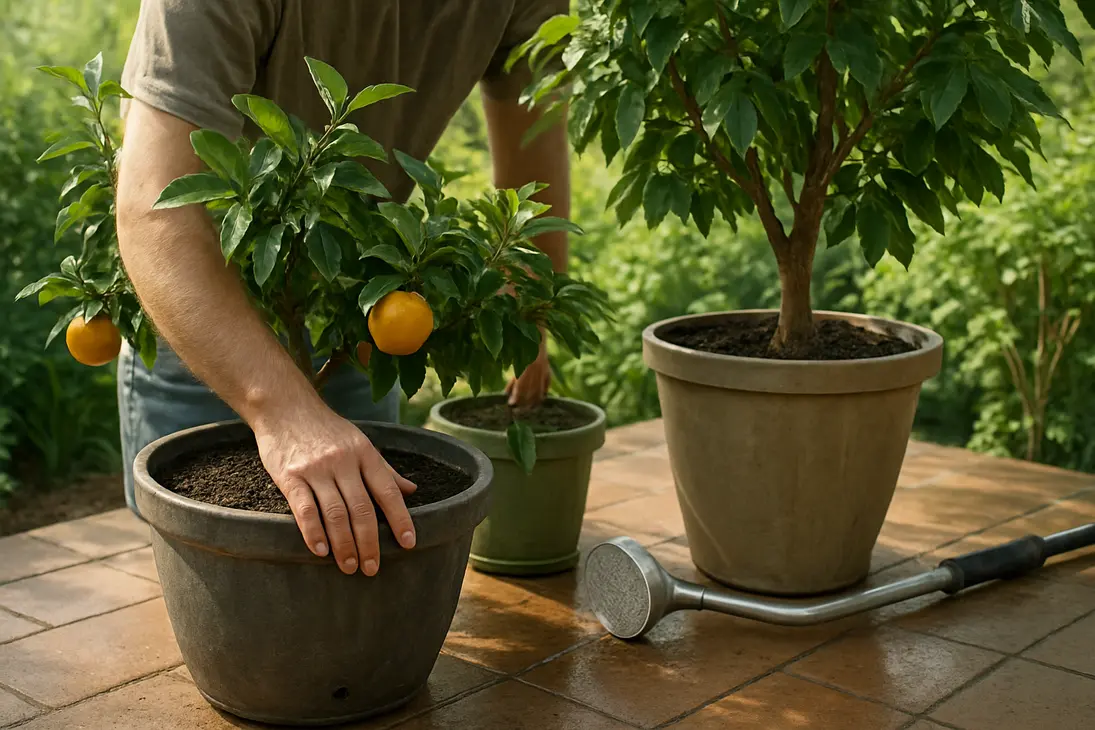
The simplest test is still the best: put your finger 2–3 inches into the potting mix. If that layer is dry, most potted trees need water. If it is still damp, wait and check later.
Use more than one clue when possible:
- Finger test: Check 2–3 inches down, both near the trunk and near the pot edge.
- Wooden skewer or dowel: Insert it into the root zone. If it comes out cool and darkened, the mix is moist; if dry and clean, water.
- Moisture meter: Helpful for large pots, but test several spots and do not rely on one reading.
- Pot weight: Learn how the pot feels after watering and when dry. This works best for smaller containers.
- Mix pulling from the edge: Shrinking mix is too dry and may repel water.
- Leaf cues: Limp leaves, curling, dull color, crispy edges, or leaf drop can signal water stress.
Humidity does not guarantee moist roots. A black plastic pot on a sunny patio can dry quickly even when the air is muggy. Rain may also miss the pot because foliage sheds water away, or it may wet only the surface.
When in doubt, check below the surface before watering.
How Much Water to Give a Tree in a Pot
When a potted tree needs water, give enough to moisten the full root zone. In most cases, that means watering until water runs freely from the drainage holes.
Avoid small “sips.” A light splash may darken the surface while leaving deeper roots dry. Over time, roots concentrate near the top, the lower mix dries unevenly, and the tree becomes less resilient in heat.
If the pot has a saucer, empty it after drainage unless the tree specifically tolerates wet roots. Most common potted trees, including citrus, figs, olives, Japanese maples, bay laurel, dwarf conifers, and many ornamentals, should not sit in stagnant water.
Best Time of Day to Water
Morning is usually best. The tree starts the day hydrated, and the foliage and pot surface can dry before night.
Late afternoon or early evening is fine if the tree is genuinely dry, especially during a heat wave. Avoid leaving disease-prone foliage wet overnight, and do not leave the pot standing in a full saucer.
Midday watering is acceptable if the tree is dry and wilting. It is better to water a thirsty container at noon than to let the root ball bake until evening. Water the soil, not the leaves, and apply water slowly enough for it to soak in.
Why Drainage Holes Matter
A potted tree must have drainage holes. Without them, excess water collects at the bottom, reducing oxygen and increasing the risk of root rot.
If using a decorative cachepot, keep the tree in a nursery pot inside it and remove the inner pot to water and drain. If the tree is planted directly in a container without holes, repot it into one that drains. Gravel at the bottom does not solve the problem if water has nowhere to leave.
Watering Slowly vs. Flooding the Pot
Very dry potting mix can become hydrophobic and shed water. In that case, water may run down the sides and out the holes while the center stays dry.
Water in stages:
- Apply water evenly across the surface.
- Wait a minute or two.
- Water again until it drains from the bottom.
- Repeat if the pot was extremely dry.
For large containers, a watering wand, drip emitter, or slow-running hose works better than dumping in a bucket all at once.
What Changes a Potted Tree’s Watering Schedule
No single schedule fits every potted tree. Two similar trees can need different routines if one is in a clay pot on a sunny patio and the other is in a plastic pot under light shade.
The main factors are pot size, pot material, tree size, exposure, wind, potting mix, mulch, and the tree’s natural water needs.
Small Pots vs. Large Pots
Small pots dry faster because they hold less mix and have more exposed surface area relative to volume. A tree in a 5-gallon pot may need daily water in hot weather, while the same species in a 25-gallon container may go two or three days.
Large pots are not automatically low-maintenance. A large leafy tree can use a lot of water, and a root-bound tree has less potting mix left to hold moisture. If a tree needs water constantly despite a reasonable pot size, it may need root-pruning, repotting, or a larger container.
Clay, Plastic, Wood, and Fabric Containers
Container material affects drying speed:
| Container type | Watering effect |
|---|---|
| Unglazed clay/terra-cotta | Dries faster |
| Plastic | Holds moisture longer but can overheat |
| Glazed ceramic | Holds moisture fairly well |
| Wood | Moderate retention and better insulation |
| Fabric grow bags | Dries quickly |
| Metal | Can heat rapidly in sun |
Dark containers in full sun can become much hotter than the surrounding air. If the pot is too hot to touch comfortably, the roots are under stress. Afternoon shade, a light-colored outer pot, or shading the container can reduce heat and water stress.
Full Sun, Shade, Wind, and Heat
Full sun increases water use, and wind can be just as drying. A humid, breezy balcony may dry pots faster than a sheltered garden corner. Reflected heat from paving, walls, fences, and brick also raises container temperatures.
Shade reduces water demand, but it can create problems if the mix stays wet too long. Keep checking the root zone; simply water less often.
Mulch helps slow surface evaporation. Use 1–2 inches of bark fines, pine straw, composted wood chips, or similar mulch, keeping it a few inches away from the trunk.
Species also matters. Citrus, figs, bananas, willows, and many fruiting trees tend to be thirstier in warm weather. Olives, bay laurel, pomegranate, and some Mediterranean species prefer to dry slightly between waterings. Japanese maples like consistent moisture but dislike soggy roots and hot, exposed pots.
Avoiding Overwatering and Underwatering
Overwatering and underwatering can look similar. Both can cause wilting, yellowing leaves, leaf drop, and poor growth. The difference is in the potting mix and roots.
A dry tree wilts because it cannot take up enough water. An overwatered tree wilts because damaged roots cannot function properly, even though the pot is wet. Always check the mix before adding more water.
Signs You’re Overwatering
Common signs of overwatering include:
- Mix stays wet for several days or smells sour.
- Leaves yellow, especially older leaves.
- New growth is weak, soft, or pale.
- The tree wilts while the mix is damp.
- Fungus gnats appear.
- Water sits in the saucer.
- Roots are brown, mushy, or foul-smelling.
Overwatering is common in oversized pots with small trees, containers without enough drainage, heavy mixes, or shaded locations during humid weather.
To correct it, pause watering until the upper mix begins to dry. Empty saucers and make sure drainage holes are open. If the mix is heavy, compacted, or sour-smelling, repotting into a better-draining container mix may be necessary.
Signs You’re Underwatering
Common signs of underwatering include:
- Leaves droop, curl, or look dull.
- Leaf edges turn brown and crispy.
- New shoots wilt first.
- The pot feels unusually light.
- Mix pulls away from the pot edge.
- Water runs straight through without soaking in.
- Leaves drop after repeated dry spells.
Underwatering is especially hard on newly potted trees because young roots can die back when they repeatedly dry out.
To fix a very dry pot, water slowly and repeatedly. If the container is small enough, set it in a tub of water for 20–30 minutes so moisture can wick up through the drainage holes, then let it drain completely. For large pots, use several slow passes until the root ball is evenly moist.
How to Fix an Inconsistent Watering Routine
If you are unsure whether you are watering too much or too little, use a simple routine for one week:
- Check the pot at the same time each morning.
- Feel 2–3 inches down in two places.
- Water only when that zone is dry or nearly dry.
- Water deeply until it drains.
- Empty the saucer.
- Note how long it takes to dry again.
After a week, you should see a pattern. The tree may need water every morning during extreme heat, every other day in partial shade, or twice daily only during heat waves.
Drip irrigation can help, but it still needs checking. Emitters clog, timers fail, and a spring setting may be wrong for midsummer. For large potted trees, two or more emitters placed on opposite sides of the pot usually wet the root zone more evenly than one near the trunk.
Conclusion
In hot, humid climates, potted trees should usually be checked daily and watered deeply when the upper 2–3 inches of potting mix start to dry. Daily checking is wise; automatic daily watering is not always wise.
Small pots, young trees, full sun, wind, fabric or clay containers, and heat waves may require daily or twice-daily watering. Larger containers, partial shade, moisture-retentive mixes, and established trees may need water less often.
The best routine is simple: check the root zone, water thoroughly when needed, let excess water drain, and adjust as the weather and tree change.
FAQ
Should I water trees in pots every day in summer?
Check them every day in summer, especially in hot, humid weather. Water when the top 2–3 inches of mix feel dry. Some trees need daily watering, but others may only need water every two or three days.
Is once a day or twice a day better for potted trees?
Once a day is enough for many potted trees if you water deeply. Twice a day is useful only when the pot dries again by late afternoon, such as during extreme heat or in small, fast-draining containers.
How often should I water a newly planted tree in a pot?
Check a newly planted potted tree daily for the first several weeks. It may need water every day in hot weather because the original root ball can dry before roots grow into the new mix.
Do larger potted trees need less water than smaller ones?
Larger pots hold more moisture, so they often dry more slowly. But larger trees also use more water, and root-filled containers can dry fast. Large potted trees still need regular checks in hot weather.
You Might Also Like