Can Clumping Bamboo Grow Indoors in Pots?
Is Indoor Potted Bamboo Realistic?
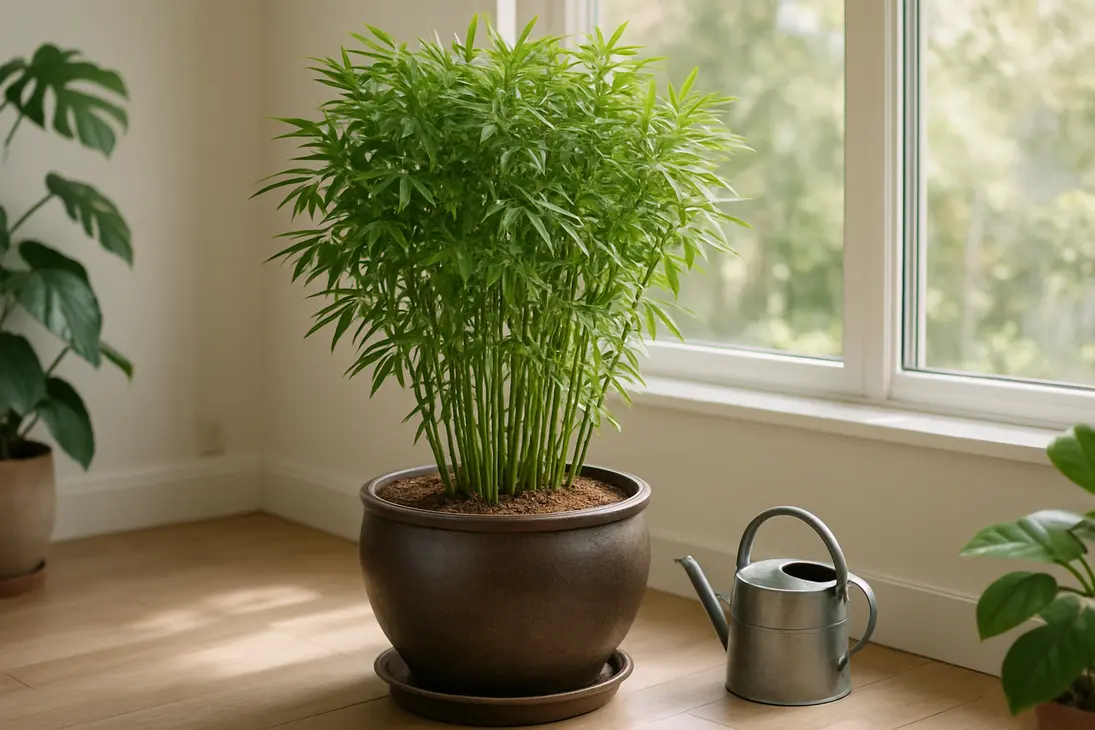
Yes—indoor clumping bamboo in pots can work, but it is not as effortless as growing a pothos or snake plant. True bamboo is a vigorous grass with an active root system, a high demand for light, and a tendency to outgrow small containers. It can make an attractive architectural houseplant in a bright room, conservatory, sunroom, or beside a large window, but it needs regular attention.
The most realistic indoor candidates are compact clumping bamboos kept in substantial containers. Even then, expect to manage watering, feeding, pruning, and root crowding. A bamboo that is happy outdoors in full sun may survive indoors but become thin, sparse, and weak if the room is dim.
Before buying, decide whether you can provide:
- Very bright natural light, ideally close to a bright window
- A pot large enough to support a dense root mass
- Drainage and a place to water thoroughly
- Regular watering during active growth
- Enough ceiling height for the variety you choose
- Periodic repotting, division, or root pruning
A clumping bamboo is generally easier to contain than a running type, but “clumping” does not mean it will remain small forever.
Clumping vs. Running Bamboo: What to Buy
Bamboos spread through underground stems called rhizomes. Their rhizome habit determines whether the plant forms a tight mound or sends shoots outward.
| Type | Growth habit | Suitability for indoor pots |
|---|---|---|
| Clumping bamboo | Rhizomes grow close to the parent plant, producing a gradually widening clump | Usually the better choice |
| Running bamboo | Rhizomes travel horizontally and can produce shoots well away from the original plant | Usually unsuitable and harder to manage |
Choose a bamboo clearly identified as clumping. Many plants in the genera Fargesia and Bambusa are clump-forming, while many Phyllostachys bamboos are runners.
A pot limits a running bamboo’s reach, but it does not make it low-maintenance. Its rhizomes may circle densely inside the container, emerge through drainage holes, distort thin plastic pots, or escape if the pot sits directly on soil outdoors. Indoors, a runner can become severely congested surprisingly quickly.
How to Confirm a Plant Is Actually Clumping Bamboo
Do not rely on a retail tag that simply says “bamboo.” Ask for the full botanical name and look it up before purchasing. A reputable nursery should be able to tell you both the species or cultivar and whether it has clumping or running rhizomes.
Useful checks include:
- Look for Fargesia, Bambusa, or another genus known for clumping growth.
- Avoid plants labelled only as “ornamental bamboo,” “hardy bamboo,” or “screening bamboo” without a botanical name.
- Ask whether the plant is pachymorph (clumping) or leptomorph (running).
- Inspect the base of an established plant, if possible. Clumping bamboo produces culms close together from a central crown, rather than widely spaced shoots connected by long rhizomes.
Visual clues alone are not always reliable, especially with small nursery plants. Correct identification matters more than assumptions about the plant’s appearance.
True Bamboo vs. “Lucky Bamboo” Grown in Water
Plants sold as lucky bamboo are usually not bamboo at all. Lucky bamboo is typically Dracaena sanderiana, a tropical houseplant with cane-like stems. It is often grown in water, pebbles, or a small amount of potting mix.
True bamboo is a grass. It has culms, nodes, leaf-bearing branches, and an expanding rhizome system. While it needs consistently moist soil, it is not a plant to grow permanently with its roots submerged in a decorative vase.
If you want a low-light plant for a desk or a small vessel of water, lucky bamboo is the more suitable option. If you want real bamboo foliage and upright culms, plan on a large pot, potting mix, and much brighter conditions.
Choose a Smaller Bamboo for Indoor Conditions
Species selection is the biggest factor in whether indoor bamboo remains manageable. A bamboo described as “clumping” may still reach several metres outdoors. Container restriction can reduce its ultimate size, but relying on root restriction alone can lead to a stressed, crowded plant rather than a neat one.
Choose a naturally compact clumper, then give it enough room to remain healthy.
Look for Compact Clumping Varieties
For indoor growing, look for smaller forms rather than tall screening bamboos. Common possibilities include compact cultivars of Bambusa multiplex, often sold as hedge or dwarf clumping bamboo, and smaller Fargesia types.
A few practical considerations:
- Compact Bambusa multiplex cultivars can be useful in warm, bright indoor spaces. They are clumping, upright, and generally better suited to year-round indoor warmth than mountain bamboos.
- Fargesia species and cultivars are clumping bamboos often valued for graceful foliage and better tolerance of bright indirect light. However, many prefer cool, humid conditions and may struggle beside heating vents or in hot, dry rooms.
- Avoid purchasing tall timber bamboos, even when young. A small plant can quickly become unsuitable for an ordinary ceiling height.
Read the mature dimensions as an indication of the plant’s vigour, not a promise of its indoor size. A bamboo listed at 2–3 metres tall is still likely to need a substantial container and periodic height management.
Match the Bamboo to Your Available Light
Bamboo is not a low-light houseplant. Bright indirect light is the minimum practical starting point for many compact clumping types, while some varieties perform best with several hours of direct sun.
A good indoor site might be:
- Near an east-facing window with gentler morning sun
- A short distance back from a bright south- or west-facing window
- In a glazed porch or sunroom, with protection from intense summer heat
- Beneath a quality grow light when natural light is inadequate
Watch how the plant responds rather than relying only on compass direction. A room with a large shaded window may be much dimmer than it appears to human eyes.
If leaves scorch, move the bamboo slightly away from harsh afternoon sun or use a sheer curtain. If new growth is thin and stretched, the plant needs more light, not more fertilizer.
When a Bamboo Alternative May Be the Better Houseplant Choice
A bamboo alternative is often the better decision for apartments with low light, limited floor space, or inconsistent watering. Consider a palm, dracaena, rhapis palm, areca palm, or upright ficus if you want a leafy screen-like plant without bamboo’s dense rhizome growth.
Choose lucky bamboo if you want the familiar segmented stems in a small decorative container. Choose a palm or dracaena if your room is moderately bright rather than intensely bright. True bamboo is most rewarding when you specifically want bamboo and can meet its conditions.
Set Up the Right Pot, Soil, and Location
A healthy container setup gives bamboo a reserve of moisture and root room while preventing the waterlogging that causes root decline. Small decorative pots are rarely a long-term solution.
Use a Large, Heavy Pot With Drainage Holes
Start with a pot only moderately larger than the nursery root ball, but do not choose a shallow container. Bamboo needs depth and width for its roots and rhizomes.
For a young compact bamboo, a container around 35–45 cm wide may be workable initially. An established plant often needs a pot 50–60 cm wide or larger, depending on the variety and desired size. The goal is not to give unlimited space, but to avoid packing the roots into a cramped pot within one growing season.
Use a heavy ceramic, fibreglass, concrete, or sturdy resin pot. Bamboo becomes top-heavy, especially near windows where it leans toward light. A lightweight pot can tip as the plant grows.
Every pot needs drainage holes. Set it on a saucer or waterproof tray indoors, but empty standing water after watering. Do not create a false drainage layer of gravel at the bottom; it reduces usable root space and does not replace drainage holes.
Choose a Moisture-Retentive but Free-Draining Potting Mix
Bamboo prefers evenly moist soil, but saturated compost excludes air from the roots. Use a quality peat-free or standard indoor/outdoor container mix amended for structure and drainage.
A practical mix can include:
- Quality all-purpose potting mix
- Compost or coir for moisture retention
- Perlite, pumice, or fine pine bark for air space and drainage
The finished mix should hold moisture after watering but release excess water freely. Dense garden soil is a poor choice indoors because it compacts in pots and drains slowly.
After planting, water deeply to settle the mix around the roots. Keep the crown at the same depth it was growing in its nursery pot.
Place Bamboo in Bright Light and Add a Grow Light if Needed
Position the pot before it becomes too heavy to move. Keep foliage away from cold winter glass, hot radiators, and air-conditioning vents. Sudden blasts of dry heat often cause leaf-edge browning.
When daylight is weak, a grow light can make the difference between survival and healthy growth. Place the light above or slightly to the side of the canopy, following the manufacturer’s distance guidance, and run it on a consistent daily schedule. Rotate the pot every week or two so growth stays balanced.
A grow light supplements poor winter conditions; it does not solve problems caused by an undersized pot, compacted soil, or overwatering.
Care for Clumping Bamboo in Pots Long Term
Container bamboo dries out faster and exhausts nutrients more quickly than garden-grown bamboo. Its care changes with season, light levels, room temperature, and root congestion.
Water Thoroughly Without Leaving Roots Waterlogged
Water when the top few centimetres of potting mix begin to feel dry, then water slowly and thoroughly until excess drains from the bottom. Empty the saucer afterward.
Do not rely on a fixed calendar schedule. A bamboo near a sunny window may need water several times a week during warm weather, while one in a cool, dim room may need much less in winter.
Signs the plant is too dry include:
- Leaves curling inward or looking dull
- Crispy brown tips and margins
- Potting mix pulling away from the pot sides
- A very light pot when lifted
Yellowing leaves and soft, persistently wet soil suggest overwatering or poor drainage. Check the roots before assuming the plant needs more water.
Fertilize During Active Growth
Feed during spring and summer, when the bamboo is producing new shoots and foliage. Use a balanced fertilizer formulated for container plants, following the product label rather than applying extra in hopes of faster growth.
Pause or greatly reduce feeding in low-light winter conditions. Fertilizing a plant that is not actively growing can lead to salt buildup in the potting mix.
Every few months, flush the container with water until it runs freely from the drainage holes. This helps wash out accumulated fertilizer salts, which can contribute to brown leaf tips.
Manage Height, Yellow Leaves, and Indoor Humidity
Bamboo naturally sheds some older leaves, so an occasional yellow leaf is not automatically a problem. Widespread yellowing, however, points to stress: low light, overwatering, root crowding, pest pressure, or abrupt changes in temperature.
To manage size:
- Remove dead, weak, or overcrowded culms at soil level.
- Thin selected culms to improve light and airflow through the clump.
- Shorten overly tall culms just above a node, understanding that the cut culm will not resume upward growth.
- Trim branchy side growth lightly if it becomes untidy.
New culms emerge at their intended height, so pruning is mainly a way to maintain appearance rather than permanently reduce the plant’s genetic size.
Average indoor humidity is usually tolerable, but very dry heated air can worsen brown tips and attract spider mites. Keep the plant away from vents, group it with other plants, or use a humidifier if the room is consistently dry. Misting alone has only a short-lived effect.
Repot or Divide Root-Bound Bamboo
Inspect bamboo in spring or early summer. If roots circle tightly around the pot, rhizomes press against the sides, water rushes straight through without soaking the mix, or new growth becomes smaller, it is time to act.
You have three choices:
- Move it to a larger pot if you want a larger plant.
- Divide the clump into smaller sections, each with roots and culms.
- Root-prune and replant in the same container if you need to maintain the current size.
Division and root pruning are physical jobs. Use a clean, sharp spade, pruning saw, or heavy knife as appropriate, and expect dense roots. Remove damaged or dead material, refresh the potting mix, water well, and keep the bamboo out of harsh sun while it re-establishes.
Prevent Common Indoor Bamboo Problems
Most indoor bamboo problems come back to a mismatch between the plant’s vigour and the conditions available. Light, water, container size, and root health should be checked together.
Why Bamboo Declines in Low-Light Rooms
Low light causes bamboo to use stored energy faster than it can replace it. Growth slows, new culms may be thin, leaves become sparse, and the plant gradually declines.
Moving a struggling bamboo from a dark corner to a brighter location is more effective than repeatedly fertilizing it. Make the transition gradually if the new site receives direct sun, since foliage accustomed to dim conditions can scorch.
If a bright window is unavailable, use a grow light or choose a more shade-tolerant houseplant instead.
What to Do When the Pot Is Full of Roots
A bamboo cannot remain indefinitely in a pot that is solid roots and rhizomes. Watering becomes difficult: the plant may dry out rapidly, or water may run through channels without reaching the root ball.
Remove it from the pot and assess the root mass. If the roots are healthy and cream to tan rather than black and mushy, divide, root-prune, or upsize the container. Replace depleted soil rather than simply adding fertilizer.
Do not wait until the pot cracks or the plant collapses. Root management is routine maintenance for long-term container bamboo.
Can Clumping Bamboo Spread or Break Out of a Pot?
Clumping bamboo does not send long-running rhizomes in the way running bamboo does, but its clump expands outward over time. In a pot, rhizomes can circle, push against the container wall, and occasionally emerge through drainage holes.
A sturdy container with drainage holes, regular inspections, and timely repotting will keep it manageable. Keep the pot off garden soil if it is moved outdoors for summer, so roots cannot grow into the ground unnoticed.
A pot is a boundary, not a permanent substitute for maintenance.
Conclusion
Indoor clumping bamboo in pots is possible, especially for gardeners with a bright room, a compact variety, and enough space for a large draining container. It is best treated as a substantial container plant rather than a small, low-care houseplant.
Choose a confirmed clumping bamboo, match it to your light levels, water deeply without leaving it wet, and expect to repot, divide, or root-prune it over time. If your room is dim or your available pot is small, a bamboo-look alternative will usually be the easier and healthier choice.
FAQ
What is the best clumping bamboo for growing indoors in pots?
Compact clumping cultivars of Bambusa multiplex are often practical for warm, very bright indoor spaces. Smaller Fargesia varieties can also work where conditions are bright but relatively cool and not excessively dry.
The best choice depends less on a single “best” variety than on your room. Check the botanical name, mature size, temperature preferences, and light requirements before buying.
How big should a pot be for indoor bamboo?
Choose a deep pot with drainage holes that is modestly larger than the existing root ball. A young plant may begin in a container around 35–45 cm wide, while a mature compact bamboo often needs 50–60 cm or more.
The pot should be heavy enough to prevent tipping and large enough that the plant does not become root-bound immediately.
Does clumping bamboo stay small in a container?
A container limits bamboo’s size, but it does not make a naturally large bamboo small. It may produce shorter culms and spread more slowly than it would in the ground, yet the roots will eventually fill the pot.
Select a compact variety from the start and maintain it through thinning, division, root pruning, or repotting.
Can bamboo grow indoors without direct sunlight?
Some clumping bamboos can grow in very bright indirect light, particularly close to a large window. However, true bamboo generally declines in dim rooms. A grow light can supplement natural light where needed.
If the room receives only low or indirect ambient light, choose lucky bamboo, dracaena, or another houseplant better adapted to those conditions.
You Might Also Like