How to Identify a Plant From a Picture
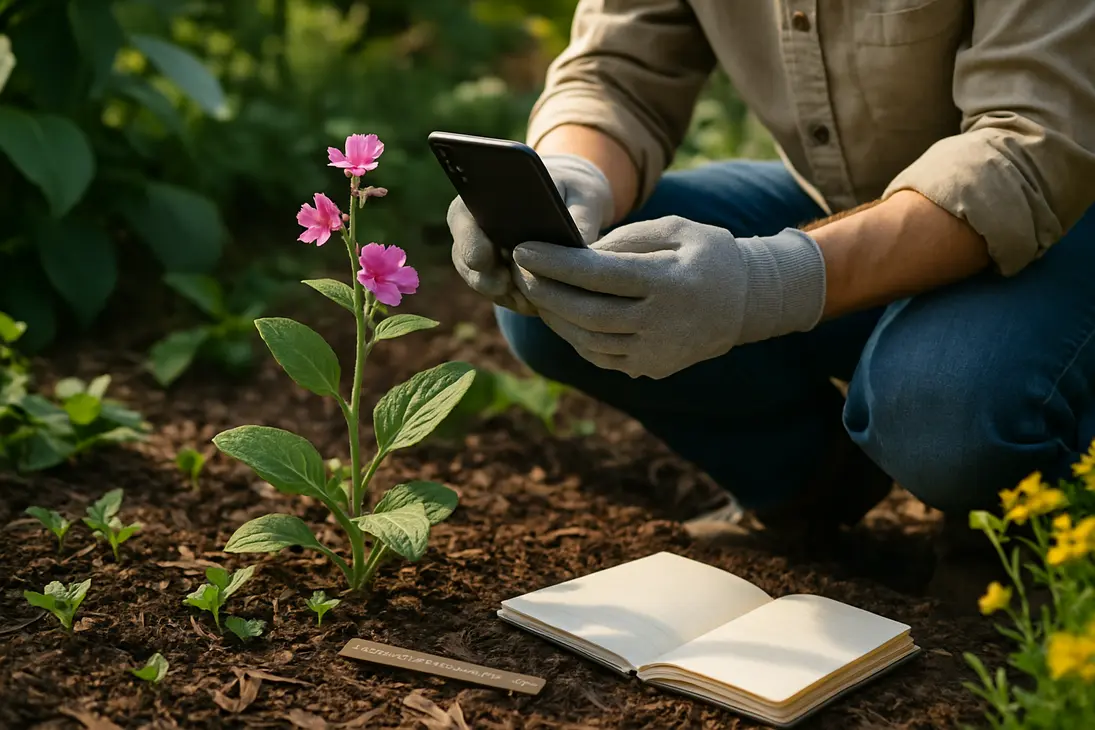
Plant identification from a picture is often the fastest way to name an unfamiliar weed, wildflower, houseplant, tree, or garden volunteer. The reliable approach is simple: take several clear photos, use an app or image search to generate possible matches, then confirm the result against the plant’s features and local conditions.
Apps are useful, but they are not final authorities—especially when the plant may be edible, toxic, invasive, medicinal, or harmful to pets or livestock.
Start With the Right Plant Photos
Most plant ID mistakes start with poor evidence. A single blurry leaf may work for a common houseplant, but it is rarely enough for seedlings, grasses, weeds, shrubs, trees, or look-alike wild plants. Take photos that show the whole plant, close details, size, and setting.
Photograph the whole plant
Start with the entire plant. This shows growth habit, which often rules out wrong matches.
Try to capture:
- Full height and width
- Whether it grows upright, trailing, climbing, clumping, sprawling, or as a rosette
- Whether it has one main stem, many stems, or vine-like growth
- Its setting: lawn, garden bed, woodland, pot, roadside, or indoor container
Two plants may have similar leaves, but one may be a low rosette while another becomes a tall branching stem. If the plant is large, take a wide shot first, then move in.
Capture close-ups of leaves, flowers, fruit, bark, and stems
Close-ups help confirm the identification. Photograph every useful feature that is present:
- Leaves: top, underside, young and mature leaves
- Flowers: front view, side view, and flower clusters
- Fruit or seeds: berries, pods, cones, capsules, nuts, hips, or seed heads
- Stems: smooth, hairy, square, round, ridged, thorny, spotted, or woody
- Bark: especially for trees and shrubs
- Leaf attachment: opposite, alternate, whorled, or basal
Do not rely on flowers alone. Flower color can vary, and many plants bloom briefly. Leaves, stems, fruit, and growth habit often provide steadier clues.
For trees, include bark, buds, leaves, overall shape, and fruits or cones. For grasses and sedges, seed heads, stem bases, and leaf bases are often more useful than a general lawn photo.
Use good lighting and a plain background
Plant ID tools work best when the plant is sharp, well lit, and separated from the background.
For better photos:
- Use natural light, preferably bright shade or overcast light
- Avoid glare, deep shadows, filters, and heavy color edits
- Tap your phone screen to focus
- Move distracting leaves, mulch, tools, or other plants aside
- Hold a leaf or flower against a plain background
- Avoid shooting through windows or screens
If the plant is tiny, move close enough to show detail but not so close that the camera cannot focus.
Include scale and location when possible
Size and location can change the answer. A close-up may make a tiny weed look like a shrub seedling. Include a ruler, coin, hand, glove, label, or trowel for scale.
Also record:
- Country, state, province, or region
- Sun or shade
- Soil moisture: dry, average, damp, or boggy
- Setting: lawn, vegetable bed, woodland edge, roadside, container, or indoor pot
- Season and month
- Whether it was planted, self-seeded, or found wild
You do not need to share your exact address. General regional information is usually enough.
Use a Plant Identification App or Image Search
Once you have good photos, use a tool to generate possible names. Apps, Google Lens, image search, online databases, and local plant groups all help in different ways. Treat the first result as a lead, not a verdict.
Plant identification apps
Plant identification apps compare your photo to image databases and suggest likely matches. They often work well for common garden plants, weeds, houseplants, trees, succulents, and wildflowers.
To use them well:
- Upload a clear whole-plant photo first.
- Add leaf, flower, fruit, stem, or bark close-ups.
- Review several suggested matches.
- Read the description, not just the name.
- Compare the result with your actual plant.
Free versions may be enough for basic ID, though they may include ads or scan limits. Paid apps may be more convenient, but cost does not guarantee accuracy.
Apps tend to struggle with seedlings, dormant plants, damaged leaves, hybrids, cultivars, grasses, sedges, plants without flowers or fruit, and rare regional species.
Google Lens and image search tools
Google Lens and similar tools are convenient starting points, especially for common ornamentals, houseplants, and garden weeds.
Their weakness is overconfidence. They may match the general look of a glossy leaf, purple flower, or red berry rather than the correct species. Use image search to build a shortlist. If the same name appears repeatedly in credible results, investigate it. If every result differs, your photos may lack enough information.
Online plant databases and gardening forums
Databases are useful once you have a possible name. Search the name with terms such as “leaf arrangement,” “native range,” “lookalikes,” “seedling,” or your region.
Local forums, native plant societies, nursery staff, extension services, and gardening groups can help with regional weeds, invasives, and volunteer seedlings.
When asking online, include several clear photos, general location, plant size, habitat, whether it is wild, planted, or potted, and any scent, sap, thorns, berries, flowers, or unusual texture. Avoid posting one close-up leaf with no context.
What to look for in a good plant ID tool
A useful plant ID tool should help you compare possibilities, not just hand you one name. Look for:
| Feature | Why it matters |
|---|---|
| Multiple matches | Lets you compare options |
| Confidence indicators | Shows how certain the tool is |
| Photos of key parts | Helps visual checking |
| Range information | Rules out unlikely suggestions |
| Botanical and common names | Reduces name confusion |
| Toxicity or invasiveness notes | Supports safer decisions |
| Multiple-photo upload | Improves difficult IDs |
No tool is best for everything. A houseplant app may work well indoors, while a local database may be better for native wildflowers or invasive weeds.
Check the Result Before You Trust It
The first suggestion may be right, but it may also be a convincing mistake. Confirmation matters most when the plant affects food, health, pets, livestock, or the environment.
Compare leaf shape, flower color, growth habit, and season
After an app suggests a name, compare your plant with reliable descriptions and photos.
Check:
- Leaf shape and edge: oval, heart-shaped, lobed, divided, smooth, toothed, spiny, or wavy
- Leaf arrangement: opposite, alternate, whorled, or basal
- Flowers: color, petal count, shape, clusters, and attachment
- Growth habit: annual, perennial, shrub, vine, tree, or grass-like plant
- Season: bloom or fruit timing
- Size: height and spread
- Stems: hairy, square, woody, thorny, milky, or tendrilled
Do not rely on color alone. Lighting, age, soil, and cultivars can all change flower or leaf color.
Check whether the plant grows in your region
A suggested identification should make geographic sense. Plants can travel through gardens, compost, bird droppings, pots, and seed mixes, so location is not proof, but it is a strong filter.
Ask:
- Is it common, planted, native, or naturalized where I live?
- Is it hardy in my climate?
- Does it grow in this habitat?
- Is it known locally as a weed or invasive plant?
- Would it appear in this season?
A tropical houseplant may be plausible indoors but unlikely outdoors in a cold winter garden. If the suggested species is not known from your region, check close relatives or common lookalikes.
Look at several possible matches
Many plants have lookalikes. Compare at least three likely candidates before choosing a name.
Focus on traits that separate similar plants: leaf arrangement, hairs, seed pod shape, flower clusters, sap color, scent, square versus round stems, thorns, prickles, tendrils, or climbing habit.
If you cannot separate two possibilities, say so. “Likely wild violet” is better than confidently naming the wrong species. For routine garden care, genus-level identification may be enough. For eating, medicine, livestock safety, or ecological reporting, it is not.
Be cautious with toxic, edible, or medicinal plants
Never eat a plant, make tea from it, feed it to animals, or use it medicinally based only on an app result. Some edible plants have dangerous lookalikes, and some plants are safe only in certain parts or after specific preparation.
Be especially cautious with:
- Mushrooms and fungi
- Wild berries
- White umbel-shaped flowers, such as carrot-family lookalikes
- Bulbs resembling onions or garlic
- Plants with milky sap
- Unknown seeds or pods
- Plants accessible to children, cats, dogs, horses, goats, or poultry
If safety is involved, confirm through a qualified local expert, extension office, poison control resource, veterinarian, or experienced botanist.
Learn the Basic Clues That Help Identify Plants
You do not need to become a botanist to improve. Learn a few visible traits, and you will catch wrong app results more easily.
Leaves: shape, edges, veins, and arrangement
Leaves are often the first clue, especially before flowers appear.
Observe:
- Shape: round, oval, narrow, heart-shaped, arrow-shaped, lobed, divided
- Edges: smooth, toothed, serrated, scalloped, spiny, deeply cut
- Veins: parallel, netted, palmate, pinnate
- Texture: glossy, dull, leathery, fuzzy, rough, waxy
- Arrangement: opposite, alternate, whorled, or basal
Leaf arrangement is especially useful. Opposite leaves grow in pairs across from each other. Alternate leaves appear one at a time along the stem. Whorled leaves circle the stem in groups. Basal leaves grow mainly from the base. Photograph how leaves attach, not just one attractive leaf.
Flowers: color, petal count, and bloom time
Flowers help, but look beyond color. Note petal number, shape, symmetry, clusters, position on the stem, bloom season, and scent.
Flower shape can point to plant families. Mint-family flowers are often two-lipped and paired with square stems and opposite leaves. Pea-family flowers have a distinctive banner-wing-keel form. Daisy-family flowers often have central disks and ray petals.
Take one front view and one side view. The side view shows the flower tube, sepals, bracts, and attachment.
Stems, bark, thorns, and sap
Stems are often decisive. Check whether they are round, square, ridged, flattened, smooth, hairy, sticky, prickly, green, red, purple, spotted, woody, hollow, climbing, twining, or tendrilled.
Do not break unknown plants unnecessarily, and avoid touching sap with bare skin. Some sap is irritating or toxic.
For woody plants, photograph bark, buds, leaf scars, thorns, lenticels, and branching pattern. Young and mature bark may look different, so include both if possible.
Plant size, habitat, and growing conditions
Setting helps separate likely from unlikely IDs. Record height, spread, sun exposure, soil moisture, nearby plants, whether the plant grows alone or in a colony, and whether it is in disturbed soil, mulch, lawn, woodland, wet ground, or potting mix.
A runner-forming plant in a damp lawn suggests different possibilities than a single seedling in a tomato pot. A vine climbing a fence is not the same as a shrub leaning against it.
What to Do When You Still Can’t Identify It
Some plants are difficult from photos, especially seedlings, grasses, sedges, hybrids, damaged plants, dormant stems, and immature perennials. If results conflict, do not force an answer. “Unknown for now” is better than a wrong name.
Take more photos at a different growth stage
Plants change through the season. A seedling may be unidentifiable until it flowers or fruits.
Take new photos when true leaves appear, buds open, fruit or seed heads form, leaves mature, fall color appears, or dormant bark and buds become clear. Keep earlier photos. A sequence showing rosette, flowers, and seed heads is often more useful than one image.
Ask a local nursery, extension office, or plant group
Local knowledge often solves difficult IDs. Ask a nursery worker, extension office, master gardener group, native plant society, botanical garden, or experienced local plant group.
Provide everything in one message: location, whole-plant photos, close-ups, size, habitat, date, flowers or fruit, scent, sap, thorns, and whether you planted it or it appeared on its own.
Be open to partial answers. “Likely in this genus” or “needs flowers to confirm” is careful identification, not failure.
Keep a record of where and when you found it
A simple record helps you identify the plant later and learn local patterns. Use a notebook, phone album, spreadsheet, or garden journal.
Record the date, location, photos, size, habitat, suggested names, advice received, and changes over time. This is especially useful for weeds and volunteer seedlings that return each year.
Recheck when flowers or fruit appear
Flowers and fruit often confirm what leaves cannot. If the plant is safe to leave temporarily, wait and recheck.
Before letting an unknown mature, consider whether it is crowding desirable plants, could be invasive, is accessible to pets or children, has suspicious berries or sap, or may spread seed.
If you remove it, wear gloves and avoid composting seed heads, diseased material, or invasive plants. For a low-risk mystery plant, move it to a “wait and see” pot to prevent spreading while it develops identifiable features.
Conclusion
The best way to identify a plant from a picture is to combine technology with observation. Take clear photos of the whole plant, leaves, stems, flowers, fruit, bark, and growing site. Use an app, Google Lens, image search, database, or plant community to generate possible names. Then verify the result by checking leaf arrangement, flower structure, growth habit, season, and regional likelihood.
Plant identification apps are fast and helpful, but not always right. Be cautious with seedlings, damaged plants, lookalikes, and anything edible, toxic, medicinal, invasive, or dangerous to pets. When unsure, take more photos, wait for flowers or fruit, and ask someone with local plant knowledge.
FAQ
Can I identify a plant from just one photo?
Sometimes. One clear photo may identify a common houseplant, distinctive flower, or familiar shrub. For better accuracy, take at least three photos: the whole plant, leaves, and flowers, fruit, stems, or bark if present. Include size and general location.
What is the best free way to identify a plant from a picture?
Use Google Lens or another image search tool, then compare suggested names with reliable plant databases or local gardening resources. Many plant ID apps offer free basic scans. For hard cases, ask a regional gardening group, native plant society, nursery, or extension office.
Are plant identification apps always accurate?
No. They work best with clear photos of common plants that have distinctive leaves, flowers, or fruit. They are less reliable with seedlings, dormant plants, hybrids, damaged leaves, grasses, and close lookalikes. Always check the result against the plant’s features and your region.
Can a plant ID app also diagnose plant health problems?
Some apps include disease or plant health diagnosis, but treat those results as suggestions. Yellow leaves, brown edges, wilting, spots, and stunted growth can come from watering, drainage, light, pests, disease, nutrients, temperature stress, or transplant shock.
For serious problems, photograph the whole plant, affected and healthy leaves, stems, soil, pot, and growing conditions, then ask local extension services or experienced nursery staff.
You Might Also Like