How Do Farmers Determine How Much Water Plants Need?
Farmers do not use one fixed watering rule for every field. How much water plants need depends on crop type, growth stage, rooting depth, weather, soil, rainfall, and irrigation-system efficiency.
The goal is to keep enough usable water in the root zone without saturating soil, leaching nutrients, causing runoff, or wasting water. Farmers estimate crop water use, measure soil moisture, account for rainfall, and apply only what is needed.
Start With the Crop’s Water Requirement
A crop’s water requirement changes throughout the season. Newly seeded crops may need frequent moisture near the surface, while mature crops with deeper roots may need larger, less frequent irrigations.
Farmers begin with crop-specific guidance and adjust it for their field conditions, planting dates, weather, soil, and equipment.
Crop type and rooting depth
Different crops draw water from different soil depths. Shallow-rooted plants can dry out quickly, while deep-rooted crops can use water stored farther below the surface.
Root depth also increases as plants develop. Seedlings depend on moisture near the surface; established crops generally need irrigation that reaches deeper into the active root zone.
For example:
- Leafy greens and recently transplanted vegetables often need consistently moist upper soil.
- Corn, grains, and many established field crops can use deeper soil moisture once roots develop.
- Fruit trees and vines may have extensive roots but can need more water during rapid fruit growth and hot weather.
Surface dryness alone is not a reliable guide. What matters is whether active roots have access to enough water.
Water needs at germination, vegetative growth, flowering, and harvest
Plants do not use water at the same rate all season.
During germination and establishment, seeds need moisture for uniform emergence, but excessive water can limit oxygen and increase rot risk.
During vegetative growth, water demand rises as leaf area expands and transpiration increases.
At flowering, pollination, fruit set, or tuber formation, many crops are especially sensitive to water stress. A shortage during these stages can reduce yield or quality even if water is supplied later.
Near harvest, irrigation needs vary. Some crops need continued water for fruit sizing or grain filling, while others may benefit from reduced irrigation to prevent splitting, improve drying, or allow field access. Farmers follow crop-specific recommendations rather than assuming more water is always better.
Plant density and field coverage
Dense crop canopies usually use more water because more leaves are transpiring. Young, widely spaced plants leave exposed soil, so evaporation may be a larger share of water loss.
Farmers also consider whether they are watering individual plants with drip irrigation, full beds, bare soil between young plants, or areas with uneven stands. These conditions affect how much water reaches useful roots and how much is lost from the soil surface.
Account for Weather, Soil, and Rainfall
The same field can need very different amounts of irrigation from one week to the next. Hot, dry, windy conditions increase water use, while cool, humid, cloudy weather usually reduces it. Soil determines how much water can be stored for later use.
Evapotranspiration: water lost through soil evaporation and plant transpiration
Farmers commonly use evapotranspiration, or ET, to estimate water lost from a field.
ET includes:
- Evaporation from soil, wet leaves, or residue.
- Transpiration through plants as roots take up water and leaves release it.
Weather services, advisers, and farm tools may provide reference ET based on local weather. Farmers adjust it for the crop and its growth stage using a crop coefficient:
Crop water use = reference ET × crop factor
A small seedling uses water differently from a mature crop with a full canopy. ET is most useful when compared with soil-moisture readings, rainfall, and crop observations.
Temperature, sunlight, wind, and humidity
Several weather conditions affect crop water demand:
| Condition | Effect on plant water demand |
|---|---|
| High temperature | Usually increases water use and soil drying |
| Bright sunlight | Increases evaporation and transpiration |
| Wind | Speeds moisture loss from leaves and soil |
| Low humidity | Encourages faster transpiration |
| Cloudy, cool weather | Often reduces water demand |
| High humidity | Can slow transpiration |
A hot, windy day can create a large water deficit soon after irrigation. Conversely, watering on a fixed schedule during cool or rainy weather can cause overwatering.
Farmers use forecasts for planning but also consider current root-zone moisture. Expected rain may not justify delaying irrigation if the soil is already dry or the forecast is uncertain.
Soil texture, water-holding capacity, and drainage
Soil texture affects water storage and irrigation timing.
Sandy soils absorb water quickly but do not hold much plant-available water, so they often need smaller, more frequent irrigations.
Clay-rich soils can hold substantial water but may absorb it slowly. Applying water too quickly can cause runoff, ponding, or prolonged saturation.
Loam soils often balance drainage and water-holding capacity, although compaction, organic matter, soil depth, and field variability also matter.
Farmers may manage different zones separately. Sandy ridges, compacted headlands, low spots, and shallow soil over gravel may not respond the same way to the same irrigation amount.
Effective rainfall versus rainfall that runs off or drains below the roots
Rainfall totals do not show how much water the crop actually received. Farmers consider effective rainfall: the portion that enters and remains in the active root zone.
Rain may be less effective when it:
- Falls intensely and runs off
- Lands on saturated soil
- Drains below roots
- Is intercepted and evaporates
- Wets only the soil surface
A steady rain that infiltrates deeply may replace irrigation. A brief storm that produces runoff may do little for deeper roots. Farmers often check soil moisture after rain rather than relying only on a rain gauge.
Measure Water Available in the Root Zone
Reliable irrigation decisions combine estimates with direct field evidence. Farmers need to know not only how much water was applied, but how much remains available to roots.
Soil moisture sensors and probes
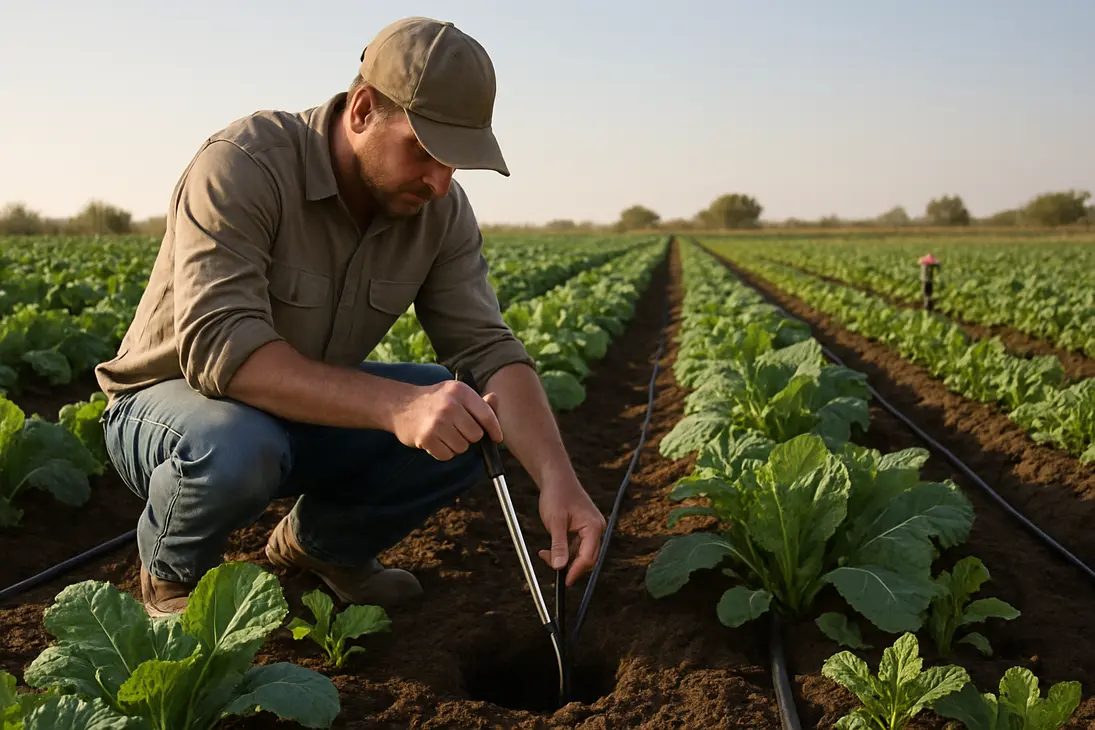
Farmers may use soil probes, sensors at multiple depths, tensiometers, or portable meters to measure moisture below the surface.
Sensor placement should match the active root zone. A shallow sensor may show dry soil while deeper roots still have water; a sensor placed too deep may not represent a young crop.
Readings from several depths can show whether irrigation is reaching the intended depth or moving too far downward. Sensors require proper installation and interpretation, and they may not represent every part of a variable field.
Manual soil checks and field observations
A shovel, auger, spade, or soil probe can reveal conditions that surface inspection misses. Manual checks can show:
- How deep irrigation has penetrated
- Whether soil is dry, moist, saturated, or compacted
- Whether roots are shallow or restricted
- Whether water is pooling above a dense layer
The soil “feel” method is less precise than calibrated sensors but remains useful when applied consistently. It can also confirm sensor readings and identify local problem areas.
Tracking irrigation, rainfall, and soil-water depletion
Many farmers keep a simple water balance: starting with available root-zone water, subtracting estimated crop use, and adding effective rainfall and irrigation.
Useful records include:
| Record item | Why it matters |
|---|---|
| Irrigation date and duration | Shows when water was applied |
| System flow or application rate | Estimates water delivered |
| Rainfall amount | Helps reduce unnecessary irrigation |
| ET or weather conditions | Indicates likely water use |
| Soil moisture readings | Confirms root-zone refill |
| Crop stage | Identifies sensitive periods |
A consistent notebook or farm-management system can reveal patterns, such as faster drying during canopy expansion or uneven sprinkler application.
Watching plants for early signs of water stress
Plants can signal water shortages, but visible stress may mean growth has already been affected. Farmers prefer to detect declining soil moisture before crops wilt or slow down.
Possible signs include dull leaf color, leaf rolling, prolonged drooping, slow growth, poor fruit sizing, and uneven development. Severe stress can cause leaf scorch, flower drop, or crop damage.
These symptoms can also result from nutrient problems, root disease, compaction, insects, herbicide injury, or heat. Farmers check soil moisture and roots before deciding that more irrigation is needed.
Turn Measurements Into an Irrigation Schedule
An irrigation schedule answers two questions: When should water be applied? and How much should be applied?
The aim is to refill depleted plant-available water without pushing water below the root zone.
Replacing the water the crop has used
A common approach is to replace water lost since the previous useful rain or irrigation. If ET, weather, and field observations show that the crop has used a certain amount of water, the next irrigation is planned to replace that deficit.
The goal is not to keep soil saturated. Roots need oxygen as well as water. Farmers irrigate before soil becomes dry enough to limit growth while leaving enough storage space for water to infiltrate.
They also account for irrigation efficiency. Not all water leaving the system reaches roots; some may be lost to evaporation, wind drift, runoff, leaks, or uneven distribution.
Applying water evenly with drip, sprinkler, or surface irrigation
The irrigation method affects scheduling and monitoring.
Drip irrigation applies water close to roots and supports frequent, precise applications. It is useful for row crops, orchards, and vegetables, but clogged emitters, damaged lines, and pressure variation can create dry zones.
Sprinkler irrigation can cover large areas and help establish crops, but wind and heat can reduce uniformity. Farmers watch for dry strips, poor overlap, and runoff.
Surface irrigation, including furrow and flood methods, relies on water moving across the field. It can work well on suitable land, but field leveling and timing are critical.
Regardless of the system, farmers verify distribution rather than relying only on run time.
Adjusting schedules for changing weather and crop stage
A schedule that worked last week may be wrong this week. Farmers adjust for heat waves, wind, cloud cover, rainfall, canopy growth, and sensitive reproductive stages.
A young crop in cool weather may need only enough water to maintain shallow-root moisture. As roots and canopy develop in hotter conditions, the field may need deeper or more frequent irrigation. After substantial effective rain, irrigation may be delayed until the root zone begins to dry again.
Checking that water reaches roots without excessive runoff or deep percolation
After irrigating, farmers check whether water reached the intended depth using a soil probe, sensor readings, or an inspection pit.
Warning signs include:
- Runoff before water soaks in
- Puddles that persist after irrigation
- A shallow wet layer over dry deeper soil
- Saturation below the active root zone
- Uneven crop growth after irrigation
- Nutrient leaching below root depth
If water runs off, farmers may reduce the application rate, use shorter cycles with soaking periods, improve field conditions, or repair equipment. If water does not reach deeper roots, a longer or differently timed irrigation may be needed.
Avoid Overwatering and Underwatering
Both too little and too much water can reduce crop performance. The correct amount supports healthy roots and meets crop demand without saturating soil.
Signs plants are receiving too little water
Underwatered crops may show:
- Wilting or leaf rolling beyond the hottest part of the day
- Slow growth or reduced leaf expansion
- Smaller fruit, grain, or other harvested parts
- Premature leaf aging
- Uneven stands in dry field areas
- Dry soil through much of the root zone
Plants may droop temporarily during intense midday heat even when soil moisture is adequate. Farmers check whether plants recover as temperatures decline and examine root-zone moisture before irrigating.
Risks of overwatering, nutrient loss, and root disease
Excess water fills soil pores that normally contain air. Roots can function poorly in saturated soil, and wet conditions may favor root diseases.
Overwatering can also leach mobile nutrients below the root zone, waste water and energy, delay field operations, and contribute to runoff. Signs may include yellowing leaves, weak growth, persistently wet soil, algae or moss, root discoloration, and poor vigor despite frequent watering.
Because these symptoms can overlap with nutrient deficiencies and disease, farmers inspect soil and roots before changing irrigation.
Why frequent shallow watering may not meet deep-rooted crop needs
Frequent light irrigation can keep the surface moist while leaving deeper soil dry. This can encourage shallow rooting and make established crops more vulnerable to heat or irrigation interruptions.
Deep-rooted crops often need water to reach a meaningful portion of the active root zone. That does not require one heavy application that causes runoff or deep drainage. On slow-draining soils, farmers may use cycle-and-soak irrigation: smaller applications separated by pauses that allow water to infiltrate.
Shallow watering is still useful during germination, transplant establishment, or when roots are naturally near the surface.
Conclusion
Farmers determine how much water plants need by balancing crop demand with water already available in the root zone. They consider crop type, rooting depth, growth stage, ET, weather, soil texture, rainfall, and irrigation-system performance.
The most reliable approach is not watering by the calendar alone. Farmers estimate water use, measure root-zone moisture, account for effective rainfall, and verify that irrigation reaches crops evenly without causing runoff, saturation, or deep drainage.
FAQ
How much water does a crop need each day?
Daily water use varies widely. A young crop in cool, cloudy weather may use little water, while a mature crop with a full canopy can use much more during hot, sunny, dry, or windy conditions.
Farmers estimate daily use from ET and crop stage, then confirm conditions with soil-moisture checks. The goal is to replace water as crops use it without exceeding the root zone’s storage capacity.
What is evapotranspiration, and why do farmers use it?
Evapotranspiration is the combined loss of water through soil evaporation and plant transpiration. It helps farmers estimate how quickly a field is losing water.
ET is especially useful when weather changes quickly, but it should be combined with crop stage, rainfall records, soil-moisture measurements, and irrigation-system knowledge.
How do farmers know when soil is dry enough to irrigate?
Farmers check moisture in the active root zone using sensors, probes, soil sampling, and field observations. They also track recent irrigation, effective rainfall, and estimated crop water use.
Irrigation is generally needed when enough available water has been depleted that waiting longer could limit growth or yield. The threshold depends on crop type, growth stage, soil, rooting depth, and irrigation capacity.
Can too much irrigation damage crops?
Yes. Excess irrigation can reduce oxygen around roots, encourage root diseases, leach nutrients, cause runoff, and waste water and energy.
The safest approach is to apply water based on measured root-zone needs, then verify that irrigation reached the intended depth without leaving soil saturated or sending water below active roots.
You Might Also Like