How Much Water Should a Honey Mesquite Seedling Get?
Direct Answer: Is More Than 30 ml Too Much for a 3-Inch Seedling?
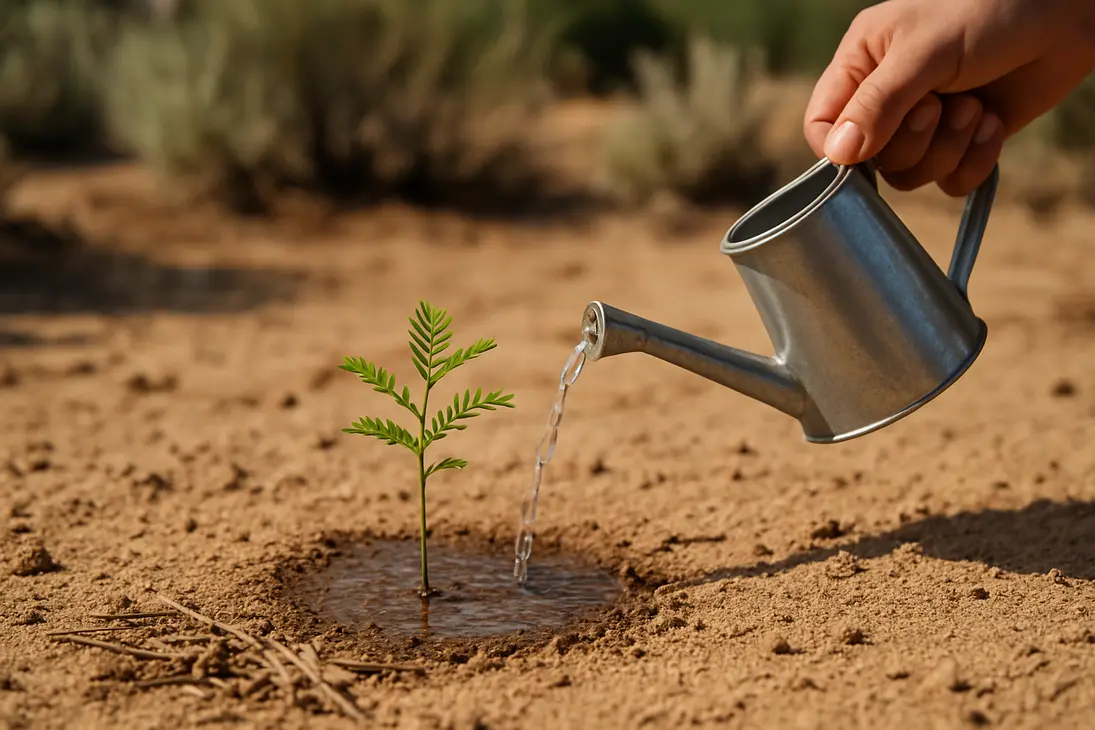
More than 30 ml of water is not automatically too much for a 3-inch honey mesquite seedling growing in a garden bed. Thirty milliliters is only about 2 tablespoons, which is a small amount once it spreads into outdoor soil.
In a pot, 30 ml may noticeably moisten the mix. In a garden bed, it may evaporate, move into surrounding soil, or fail to reach the young root zone. If the bed drains well, a honey mesquite seedling can usually receive more than 30 ml at one watering.
The better question is:
Is the soil around the roots moist below the surface, and does it have time to partially dry before the next watering?
Honey mesquite is desert-adapted, but a 3-inch seedling does not yet have the deep root system that helps mature mesquite survive long dry periods. It needs enough moisture to keep young roots active, but it should not sit in constantly soggy soil.
A good rule is: water enough to moisten the root area, then wait until the upper soil begins to dry before watering again. Avoid tiny daily splashes just because the surface looks dry.
Why the soil surface may look dry the next day
It is normal for the soil surface to look dry the day after watering, especially in a garden bed. The top layer dries much faster than the soil below because it is exposed to sun, wind, and warm air.
A dry-looking surface does not necessarily mean the seedling needs water immediately. Moisture may still be available around the roots.
Surface drying is faster with:
- Sun exposure: Bare soil in direct sun can dry quickly.
- Wind: Moving air pulls moisture from the surface.
- Sandy or gritty soil: Water drains down, leaving the top dry.
- Low humidity: Dry air speeds evaporation.
- Small watering amounts: A tiny splash may wet only the top layer.
For honey mesquite seedling watering, visible surface moisture is a poor guide. Check where the roots are: below the surface.
When a small seedling needs a deeper soak instead of a tiny splash
A 3-inch seedling is small above ground, but its roots need a usable pocket of moisture. If you give only 30 ml at a time, the water may wet only a shallow spot and never move deeply enough to support good root growth.
A deeper soak does not mean flooding the bed. It means applying water slowly so it moves into the soil instead of running away. For a seedling this small, the wetted area does not need to be large, but it should reach below the top crust.
In a garden bed, aim to moisten the soil a few inches deep around the root zone. Depending on the soil, that may take more than 30 ml. Sandy soil may need several small pours. Clay soil may need slow watering with pauses so water can soak in.
After watering, wait a few minutes and check. If the top is wet but the soil 1–2 inches down is still dry, the seedling did not receive enough useful water.
The risk of keeping the crown constantly wet
While more than 30 ml can be fine, constantly wetting the base of the stem is not ideal. The crown is where the stem meets the soil. Young seedlings can suffer if this area stays damp all the time, especially in heavy soil or humid weather.
The problem is not one careful watering. It is repeated watering directly against the stem when the soil never has a chance to breathe.
To reduce risk:
- Do not leave the seedling sitting in a muddy depression.
- Avoid piling wet mulch against the stem.
- Water around the small root zone rather than only onto the crown.
- Let the soil surface begin to dry between waterings.
- Make sure the bed drains reasonably well.
Honey mesquite can handle moisture during establishment, but it should not be treated like a swamp plant.
How to Check Whether the Seedling Actually Needs Water
The most reliable way to decide whether to water is to check below the surface. A fixed daily amount such as 30 ml can mislead you. On a hot, windy day in sandy soil, it may be too little. In cool weather or clay soil, repeated watering may be too much.
Finger test: check 1–2 inches below the surface
For a 3-inch honey mesquite seedling, the finger test is usually enough.
Gently insert your finger into the soil about 1–2 inches away from the stem. Check 1–2 inches below the surface without disturbing the roots too much.
Use this guide:
| Soil feel 1–2 inches down | What it means | What to do |
|---|---|---|
| Dry, dusty, or loose | Root zone is likely too dry | Water slowly |
| Slightly cool and barely moist | Usually acceptable | Wait and check later |
| Evenly moist but not sticky | Good moisture level | Do not water yet |
| Wet, muddy, or sour-smelling | Too wet or poorly aerated | Stop watering and let it dry |
| Hard crust on top but moist below | Surface dried only | Do not water just because the top looks dry |
Morning checks are often easiest to interpret because the soil has cooled overnight and has not yet been heated by afternoon sun.
Be gentle. A 3-inch seedling has a small root system, and repeated digging right next to it can cause damage. Check beside the seedling, not under it.
Using a wooden skewer or moisture meter
If you do not want to use your finger, a wooden skewer, chopstick, or thin bamboo stick can help.
Push it into the soil near the seedling, wait a minute, then pull it out. If the wood comes out clean and dry, the soil is likely dry. If it comes out darker with soil particles sticking to it, there is moisture below the surface.
A moisture meter can also help, but use it as a guide rather than an absolute answer. Cheap meters can be inconsistent in sandy, salty, or unevenly wet soil. If you use one, test in a few spots and compare the reading with how the soil actually feels.
The key question is simple: Is there still moisture where the young roots are growing?
Signs of underwatering vs. overwatering in young mesquite
Honey mesquite seedlings can show stress from both too little water and too much water. Some symptoms overlap, so always check the soil before reacting.
| Symptom | More likely underwatering | More likely overwatering |
|---|---|---|
| Leaves limp in hot afternoon but recover by morning | Possible heat stress | Less likely |
| Leaves remain wilted in the morning | Likely if soil is dry | Possible if roots are damaged |
| Soil 1–2 inches down is dry | Yes | No |
| Soil is wet, sticky, or smells stale | No | Yes |
| Stem base looks dark, soft, or constricted | No | Possible crown/root problem |
| Leaves yellow while soil stays wet | Less likely | More likely |
| Growth slows | Possible | Possible |
Underwatering usually shows up when the soil is dry below the surface and the seedling does not recover overnight. Overwatering is more likely when the soil stays wet for long periods, especially if leaves yellow, growth stalls, or the stem base looks unhealthy.
Do not respond to every wilted afternoon leaf with more water. In hot conditions, small seedlings may droop temporarily even when soil moisture is adequate. Morning condition tells you more.
A Practical Watering Method for Honey Mesquite Seedlings in a Garden Bed
For a 3-inch honey mesquite seedling in a garden bed, use a slow, careful watering method rather than a fixed daily dose. The goal is to wet the young root zone, not keep the surface visibly damp.
A simple method:
- Check the soil 1–2 inches below the surface.
- If it is dry, water slowly around the seedling.
- Apply water in small pours, allowing each pour to soak in.
- After a few minutes, check whether the soil is moist below the surface.
- Do not water again until the upper root zone begins to dry.
This may mean watering more than 30 ml at one time. That is fine if the water soaks in and the soil does not stay soggy.
If 30 ml disappears immediately and the soil below remains dry, give another small amount and check again. If water pools or the soil stays wet the next day, reduce the amount or increase the interval.
Water around the root zone, not directly against the stem
Because the seedling is only 3 inches tall, its roots are still close to the stem. Even so, avoid pouring all the water directly onto the stem base.
Water in a small circle around the seedling. At this size, that circle may be only a few inches across. As the seedling grows, widen the watering area to encourage roots to spread.
A shallow watering ring can help in sandy or sloped soil. Make a very low rim of soil around the seedling, but do not create a deep bowl that keeps the crown wet. The goal is to hold water long enough for it to soak in, not to create a puddle.
If you use mulch, keep it thin and pulled slightly away from the stem. Mulch can reduce evaporation, but mulch packed against the crown can hold too much moisture.
Water slowly so it soaks in instead of running off
A sudden pour can run across the surface without wetting the root zone evenly. This is common in dry, compacted, or crusted soil.
Slow watering works better. You can use:
- A small watering can with a gentle rose
- A cup or bottle used in several small pours
- A drip emitter set away from the stem
- A very slow hose trickle for a short period
If the soil repels water at first, wet it lightly, wait a minute, and then water again. This gives dry soil time to accept moisture.
After watering, check the depth. If only the top is damp, the seedling received surface moisture but not a root-zone soak. If the soil is muddy against the stem, shift watering slightly outward and reduce direct crown wetting.
Adjust for heat, wind, soil type, and mulch
There is no single watering amount that works every day because outdoor conditions change. Adjust honey mesquite seedling watering to the bed and weather.
| Condition | How it changes watering |
|---|---|
| Hot sun | Soil dries faster; check more often |
| Wind | Surface and small root zones dry quickly |
| Sandy soil | Water drains fast; may need more frequent checks |
| Clay soil | Holds water longer; water less often and more slowly |
| Mulch | Reduces evaporation; may allow longer gaps |
| Cool or cloudy weather | Seedling uses less water |
| Recent rain | Check below surface before adding more |
| Raised bed | Often drains faster than in-ground soil |
| Compacted bed | Water may run off |
In heavy soil, daily watering can create a wet, airless root zone. In sandy soil, daily watering may still be inadequate if each watering is only a tiny splash.
Your best schedule is observation: check, water if needed, then allow partial drying.
How Mesquite’s Desert Roots Change Its Watering Needs
Honey mesquite is known for surviving dry conditions, but that drought tolerance develops with its root system. A mature mesquite can access moisture far below the surface. A 3-inch seedling cannot.
This is why young mesquite watering can feel confusing. The plant is desert-adapted, but the seedling still needs establishment care.
Seedlings need help before the taproot develops
A honey mesquite seedling begins forming a strong root system early, including a taproot. However, at 3 inches tall, it is still limited. If the surrounding soil dries completely for too long, the seedling may not have enough root reach or stored energy to recover.
During this stage, consistent but not constant moisture is helpful. Think of it as supporting establishment, not pampering the plant indefinitely.
The seedling needs:
- Enough moisture to keep young roots alive
- Air in the soil, not waterlogged conditions
- Time between waterings for the upper soil to dry slightly
- Gradual encouragement to root deeper and wider
If you water only the surface every day, roots may stay shallow. If you water deeply enough and then wait, roots are encouraged to explore downward.
Deep, less frequent watering encourages stronger roots
For mesquite, deeper watering is usually better than frequent shallow watering once the seedling is stable. That does not mean a tiny seedling should be left dry for long periods. It means each watering should be useful.
A tiny splash wets the surface and evaporates quickly. A slow soak moistens the root zone and encourages roots to grow into surrounding soil.
As the plant grows, gradually widen the watering area. For a young seedling, “deep” may mean only a few inches. For an older sapling, it means much deeper. Match the watering depth to the plant’s size and root development.
Reduce supplemental watering as the plant establishes
As the honey mesquite becomes established, reduce how often you water. Do this gradually rather than suddenly.
You might move from frequent moisture checks to less frequent but deeper watering as growth becomes stronger. Over time, the plant should rely more on natural rainfall and deeper soil moisture, assuming it is planted in a suitable climate and soil.
Avoid training mesquite to expect constant shallow irrigation. A mesquite that receives small surface waterings every day may not develop the same resilient root pattern as one watered deeply and less often.
A sensible progression looks like this:
- New 3-inch seedling: Check soil often; water when the upper root zone is drying.
- Actively growing young seedling: Water more deeply, but allow longer gaps.
- Established sapling: Water during prolonged dry spells or extreme heat rather than by habit.
- Mature tree: Supplemental water is usually occasional, not constant, unless conditions are unusually dry or the site is restricted.
Always adjust to local conditions. A seedling in a hot, exposed desert garden needs different care than one in mild weather with mulched soil.
Conclusion
More than 30 ml of water can be perfectly fine for a 3-inch honey mesquite seedling growing in a garden bed, especially if the soil drains well. In many outdoor beds, 30 ml is so small that it may not moisten the root zone enough.
Do not judge the seedling’s water needs by whether the soil surface looks damp the next day. The surface often dries quickly while moisture remains below. Instead, check 1–2 inches down with your finger, a wooden skewer, or a moisture meter.
The best approach is to water slowly around the root zone, moisten the soil below the surface, and then let the upper soil begin to dry before watering again. Keep the crown from staying constantly wet, avoid tiny daily splashes, and gradually shift toward deeper, less frequent watering as the seedling establishes.
FAQ
Should I water a honey mesquite seedling every day?
Not automatically. A 3-inch honey mesquite seedling may need frequent checking, especially in hot or windy weather, but it should not be watered every day unless the soil below the surface is actually drying that quickly.
Check 1–2 inches down. If it is dry, water. If it is still moist, wait. Daily watering in sandy soil during extreme heat may sometimes be reasonable, but daily watering in clay or poorly drained soil can cause problems.
Is it bad if the soil surface is dry the day after watering?
No. A dry surface the next day is often normal. Sun and wind can dry the top layer quickly even when the root zone still has moisture.
Before watering again, check below the surface. If the soil 1–2 inches down is still slightly moist, the seedling may not need more water yet.
Can a honey mesquite seedling be overwatered?
Yes. Honey mesquite seedlings can be overwatered if the soil stays wet and airless, especially around the crown. Overwatering is more likely in heavy clay soil, compacted beds, cool weather, or beds that drain poorly.
Warning signs include persistently wet soil, yellowing leaves, stalled growth, a soft or dark stem base, and a sour smell from the soil. If you see these signs, stop watering until the soil begins to dry and improve drainage if needed.
Is watering different in a pot than in a garden bed?
Yes. A pot has limited soil volume and can dry faster or stay wetter depending on the potting mix and drainage holes. In a small pot, 30 ml may be a meaningful amount. In a garden bed, 30 ml is usually very small.
Potted honey mesquite seedlings need excellent drainage. Water until the mix is evenly moist, then let the upper mix begin to dry before watering again. Never leave the pot standing in water. In a garden bed, focus on whether the surrounding root zone is moist below the surface and whether water drains away properly.
You Might Also Like