How Would a Tree Respond to Dog Urine?
If a Tree Could Talk: The Immediate “Response”
If a tree could talk after a dog lifted a leg against it, its response would probably be: “Really? On me?” Not panic. Not instant doom. More like irritation.
A single dog marking a trunk or the soil at its base is usually not enough to seriously harm an established tree. Mature trees are large, buffered organisms with wide root systems, protective bark, and stored energy. One small splash of urine is not the same as poisoning the roots.
Still, dog urine is not just water. It contains nitrogen, salts, and waste compounds in concentrated form. In small, diluted amounts, some of those nutrients overlap with what plants use. In repeated, concentrated doses, they can burn grass, stress fine roots, irritate damaged bark, and worsen soil conditions around a young or stressed tree.
So the short version of the tree response to dog urine is this: an older, healthy tree will usually shrug off occasional exposure, while a young, stressed, or repeatedly targeted tree may show real damage over time.
What Dog Urine Actually Does to Trees
Dog urine affects trees less like a poison and more like an overly concentrated fertilizer-and-salt solution. Plants need nutrients and water, but roots are sensitive to the strength of the solution around them.
When urine lands on mulch, bark, exposed roots, grass, or bare soil, several things can happen:
- Nitrogen may become available to plants.
- Salts can make it harder for roots to absorb water.
- Repeated wetting can irritate thin or damaged bark.
- Soil near the trunk can become chemically imbalanced if hit repeatedly.
- Nearby grass or shallow-rooted plants may brown before the tree shows symptoms.
The effect depends on dog size, frequency, weather, soil moisture, tree age, and whether urine lands on bark, mulch, turf, or a small root zone.
Nitrogen: helpful in small amounts, harmful in excess
Nitrogen is one of the main nutrients plants use for leafy growth, which is why urine is sometimes compared to fertilizer. That is partly true: urine contains nitrogen compounds that plants may eventually use.
The problem is delivery. Fertilizer is applied at a controlled rate and watered in. Dog urine is deposited in one small spot, often at high concentration, and sometimes repeatedly.
A tiny amount of diluted nitrogen in a large root zone is unlikely to hurt a mature tree. But concentrated nitrogen in one patch can burn fine roots or nearby grass. This is why dog urine often leaves brown lawn spots with darker green growth around the edge: the center gets too much, while the diluted outer zone gets a mild fertilizer effect.
Trees usually do not show such neat spots, but their fine feeder roots can still be stressed if the same area is soaked again and again.
Salts and concentration: the main burn risk
The bigger issue is often not nitrogen alone, but the concentration of salts and waste compounds. Roots absorb water through delicate tissues. When the soil solution becomes too salty or concentrated, water uptake becomes harder. In severe localized cases, water can even move out of root tissues, causing burn-like injury.
Dry weather makes this worse. If soil is already dry, there is little moisture to dilute the urine. A small amount of concentrated urine sits in a small area, and roots or grass take the full hit.
Rain or prompt watering reduces the risk by diluting the urine and moving it through more soil. Dilution does not make repeated marking harmless, but it often prevents one incident from becoming visible damage.
Why a tree usually handles occasional exposure better than grass
Grass is often the first plant to show urine damage because it has shallow roots and fine leaves close to the soil surface. A dog urinates directly onto the blades and into the top layer of soil, where turf roots are most active.
A mature tree is different. Its absorbing roots spread over a much larger area, often beyond the canopy dripline. Its trunk is protected by bark, and it has more stored reserves than turfgrass. One urine spot is a small event compared with the scale of a mature root system.
But trees are not immune. The vulnerable parts are the fine roots near the soil surface, not the large woody trunk. If a dog repeatedly urinates in the same small mulched ring around a young tree, that tree may not have enough root area to compensate.
When Dog Urine Becomes a Problem for Trees
Dog urine becomes a tree problem mainly through repetition and concentration. One neighborhood dog marking an old maple is usually not a crisis. Several dogs marking the same young street tree every day during hot, dry weather is different.
Risk increases when:
- The tree is newly planted or still establishing.
- The same spot is urinated on daily.
- Soil is compacted, dry, or poorly drained.
- The tree grows in a small planting pit surrounded by pavement.
- Mulch is absent, too thin, or piled against the trunk.
- The tree is already stressed by heat, drought, pests, disease, or poor soil.
Street trees are especially likely to be targeted because dogs naturally mark vertical objects along walking routes. A mature tree with generous soil space may tolerate this. A young tree in a sidewalk cutout may not.
Signs of possible urine stress near a tree
Dog urine damage can be subtle because symptoms overlap with drought, transplant shock, road salt, mower damage, nutrient imbalance, poor planting, and compacted soil. Look for patterns rather than assuming urine is the only cause.
Possible signs include:
| What you see | What it may suggest | How strongly it points to dog urine |
|---|---|---|
| Brown grass in a recurring spot near the trunk | Concentrated urine burn | Fairly likely if dogs use the spot often |
| Yellowing groundcover on one side of the tree | Localized burn or root stress | Possible |
| Strong urine odor in mulch or soil | Frequent marking | Strong clue |
| Low bark staining or discoloration | Repeated wetting or existing injury | Possible |
| Whole-canopy leaf scorch | Drought, heat, root stress, disease, salt, or other causes | Not specific |
| Poor young-tree growth on a busy dog route | Combined stress from urine, drought, compaction, and limited soil | Possible contributor |
If the whole canopy is declining, dog urine alone is rarely the only explanation. Also check watering, planting depth, root flare exposure, mulch placement, trunk wounds, drainage, and soil compaction.
Why young trees and shallow roots are more vulnerable
Young trees have small, developing root systems. After planting, a tree must grow roots into surrounding soil before it can reliably support its canopy. During this establishment period, stress in the immediate root ball or planting area matters.
If urine repeatedly lands in the same small mulched circle, it may affect a meaningful part of the young tree’s active root zone. Add heat, drought, and compacted soil, and the tree has limited ability to dilute or avoid that stress.
Thin-barked young trees may also be more sensitive to repeated wetting and chemical irritation on the lower trunk, especially if the bark is already damaged by string trimmers, staking ties, sunscald, or rubbing.
Companion plants are often even more vulnerable. Annuals, young perennials, groundcovers, and turf around the base may show damage long before the tree itself does.
Repeated marking on the same trunk or soil area
Dogs often return to scent-marked spots. Once one dog marks a tree, others may investigate and mark over it. That is where casual exposure can become a landscape problem.
The cycle is simple:
- One dog urinates on the tree or mulch.
- The odor remains, especially in dry mulch or porous soil.
- Other dogs are attracted to the same place.
- The area receives more nitrogen and salts.
- Grass or small plants decline.
- Bare or stressed soil holds odor and looks worse.
- Dogs continue using the spot.
Breaking that cycle usually requires dilution, redirection, and better site conditions—not harsh chemicals.
How to Help a Tree After Dog Urine Exposure
The safest response is simple: dilute, protect, and redirect. Most trees do not need special products. They need water, healthy soil conditions, and fewer repeat hits in the same place.
Rinse or water the area promptly
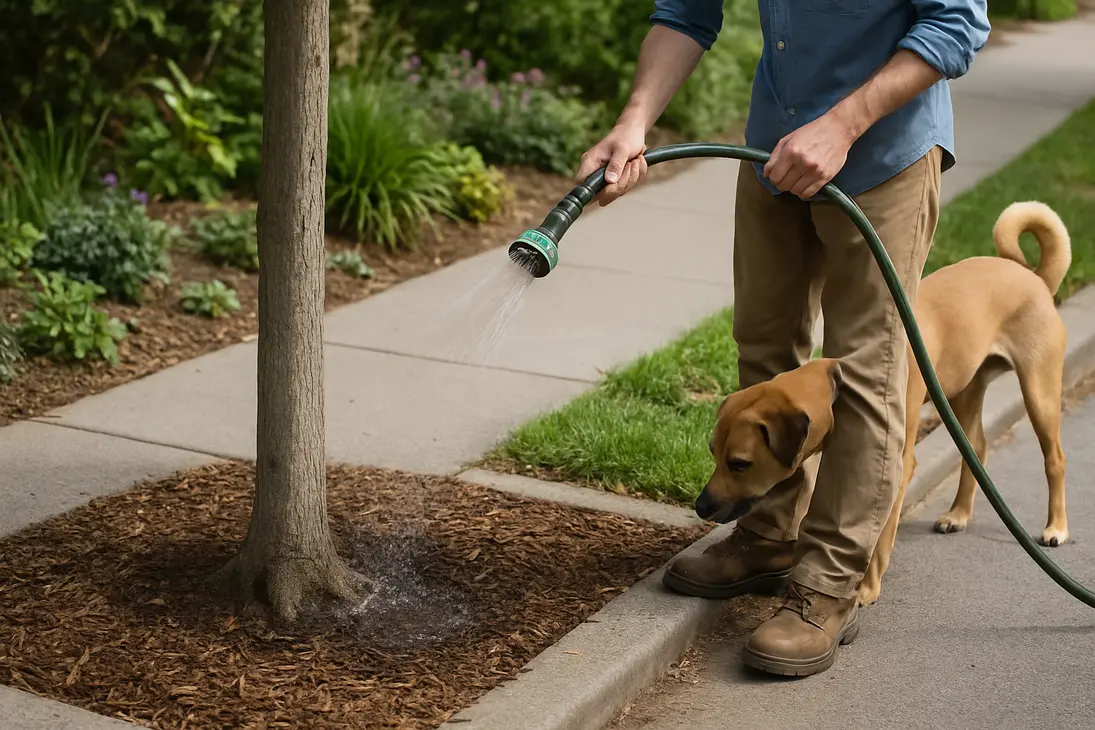
If you see a dog urinate at the base of a tree and are concerned, water the area as soon as practical. The goal is to dilute the urine and move it through a larger soil volume.
For trunk marking, gently rinse the lower bark with plain water. For soil or mulch, water enough to soak the upper soil rather than just wetting the surface. This matters most in dry weather.
Use plain water only. Avoid strong household cleaners, vinegar, bleach, ammonia, baking soda mixtures, or deodorizing chemicals around trees. These can harm roots, soil organisms, pets, and nearby plants.
If the tree is young, make watering part of normal care. A newly planted tree usually benefits more from deep, consistent watering than from quick daily sprinkles. Dog urine may be the obvious concern, but drought stress is often the bigger problem.
Use mulch and barriers without piling mulch against the trunk
Mulch helps protect a tree’s root zone by conserving moisture, moderating soil temperature, and reducing grass competition. It can also soften the surface impact of urine. But it must be applied correctly.
A good mulch ring is:
- Broad and even over the root zone.
- Kept a few inches away from the trunk.
- Not piled into a “mulch volcano.”
- Moderate in depth, not packed deeply.
- Replenished as it decomposes.
Do not mound mulch against bark to “protect” the trunk from urine. Wet mulch against bark can encourage decay, hold moisture at the trunk, hide pests, and bury the root flare. The root flare—the area where the trunk widens into main roots—should remain visible.
For high-traffic dog areas, a low barrier can help. Options include a small decorative fence around a young tree, stones placed outside the root flare, sturdy edging, or tough plants around the outer edge of the bed. The goal is to make the trunk less convenient while preserving air, water, and healthy root conditions.
Train dogs to use a designated spot
The best long-term fix is behavioral: give dogs a better place to go. This is especially useful in private yards, courtyards, shared gardens, and apartment landscapes where the same dogs visit daily.
A designated dog area can be simple. Choose a spot away from young trees and sensitive plantings. Use pea gravel, mulch, artificial turf designed for pets, or another washable surface. Add a vertical object, such as a post, if the dog likes to mark. Reward the dog for using that location.
For yards, keep water nearby and rinse the area regularly. For public-facing trees, a small sign or barrier may help, though prevention is easier than correction once a tree becomes a popular marking post.
If you walk your dog, steer them away from newly planted street trees, small shrubs, vegetable beds, and ornamental planters. Established trees may tolerate occasional marking, but young urban trees are often already stressed by limited soil, reflected heat, and compaction.
Choose tougher plants for dog-heavy areas
No plant is completely urine-proof, but some tolerate occasional exposure, foot traffic, drought, and imperfect soil better than delicate ornamentals.
For dog-heavy areas, choose plants with:
- Tough, leathery, or aromatic foliage.
- Drought tolerance once established.
- A spreading or clumping habit that can recover from edge damage.
- Low maintenance needs.
- Suitability for your climate and soil.
Avoid planting sensitive annuals, young edibles, or delicate groundcovers where dogs routinely mark. Even tough plants can suffer from daily concentrated urine without water.
Often, the best design is a buffer: keep valued plants set back from the path, use mulch or hardscape near the dog route, and place tougher plants at the edge.
What Not to Worry About Too Much
It is easy to overreact when you see a dog urinate on a tree you care about. Fortunately, several common worries are larger than the usual risk.
First, dog urine does not automatically kill trees. A healthy, established tree is not likely to die because one dog marked it. Trees regularly deal with bird droppings, decomposing organic matter, changing soil chemistry, and many minor environmental insults. Occasional dog urine is usually just one small stressor.
Second, urine is not purely poison. It contains nutrients plants can use, especially nitrogen. The problem is that it is delivered unpredictably, unevenly, and often too concentrated for the spot where it lands. Dose, dilution, and frequency determine the outcome.
Third, visible damage near a tree may not be tree damage. Brown grass at the base may be turf burn while the tree remains fine. A yellowing young tree may be suffering from drought, poor planting depth, girdling roots, compacted soil, or drainage problems, with dog urine only adding stress.
Fourth, special neutralizing products are rarely necessary. Plain water is usually the safest first response. Be cautious with products that claim to “neutralize” dog urine in soil; adding more chemicals to a stressed root zone can backfire if you do not know the real cause of decline.
A calm approach works best: rinse, water, observe, and reduce repeat exposure.
Conclusion
If a tree could answer directly, it would probably say: “I’d rather the dog chose somewhere else, but I’m not collapsing over one incident.”
That is the most accurate way to think about the tree response to dog urine. Occasional marking on a mature, healthy tree is usually manageable and often causes no visible harm. The concern rises when urine is concentrated in the same small area again and again, especially around young trees, shallow roots, compacted soil, drought-stressed sites, and sensitive companion plants.
Dog urine contains nitrogen and salts. In diluted, modest amounts, the nutrient side may be minor or even slightly fertilizing. In concentrated, repeated doses, salts and excess nitrogen can burn grass, stress fine roots, and worsen difficult growing conditions.
The best remedy is simple: water the area, protect the root zone with proper mulch, avoid harsh neutralizers, improve irrigation, and redirect dogs where possible. Think annoyance more than emergency—but pay attention if the same tree is being used as a daily marking post.
FAQ
Can dog urine kill a tree?
Yes, but it is uncommon for dog urine alone to kill a healthy, established tree. The greater risk is to young trees, small trees in confined planting spaces, drought-stressed trees, or trees repeatedly urinated on in the same spot.
Repeated exposure can stress fine roots, damage nearby grass or groundcovers, and contribute to decline when other problems are already present. If a tree is seriously declining, also check planting depth, watering, trunk wounds, compacted soil, drainage, pests, disease, and root damage.
Is dog urine ever beneficial to plants?
In small, diluted amounts, dog urine can supply some nitrogen, which plants use for growth. That is why grass may sometimes grow darker green around the edge of a urine spot.
But dog urine is not a reliable or recommended fertilizer. It is too concentrated, unevenly applied, and salty. Controlled fertilizer and compost, used appropriately, are safer ways to feed plants.
What can I pour on dog urine to neutralize it?
Use plain water. Water is the safest and most practical way to dilute dog urine in soil or mulch. If urine lands on the trunk, gently rinse the bark. If it lands on soil, soak the area enough to dilute the concentration around the roots.
Avoid vinegar, bleach, ammonia, strong detergents, baking soda mixtures, or deodorizing chemicals around trees. These can harm roots, alter soil conditions, or create safety concerns for pets and people.
Are some trees or plants more resistant to dog urine?
Yes. Tough, drought-tolerant, established plants with resilient root systems usually handle occasional exposure better than delicate plants. Mature trees also cope better than young trees because they have larger root systems and more stored energy.
However, no tree or plant is immune to repeated concentrated urine in the same spot. In dog-heavy areas, use tough plants, mulch, hardscape buffers, and barriers to protect young trees and sensitive plantings.
You Might Also Like