How Do Mitochondria and Chloroplasts Impact Life When They Fail?
Mitochondria and chloroplasts shape life by controlling major steps in energy flow. Chloroplasts capture sunlight and build energy-rich sugars. Mitochondria break down sugars and other fuels to make ATP, the immediate energy currency cells use for work.
When either organelle fails, the effects spread beyond one cell part. Energy conversion weakens, cells lose stability, plants grow poorly, and food webs may lose some of the primary production that supports animals, fungi, and microbes.
Mitochondria and Chloroplasts: The Cell’s Energy-Converting Organelles
Mitochondria and chloroplasts are often called “powerhouses,” but they do not create energy. They convert it.
Mitochondria convert chemical energy in food molecules into ATP through cellular respiration. Chloroplasts convert light energy into chemical energy by making sugars through photosynthesis. In plants, the two systems work together: chloroplasts make much of the fuel, and mitochondria release that fuel in a usable form.
| Feature | Mitochondria | Chloroplasts |
|---|---|---|
| Main role | Cellular respiration | Photosynthesis |
| Main input | Sugars, fats, and other fuels | Light |
| Main output | ATP for cell work | Sugars that store energy |
| Found in | Most eukaryotic cells | Plants, algae, and some protists |
| Failure causes | ATP shortage and stress | Reduced sugar production and weak growth |
What Mitochondria Do
Mitochondria are the main sites of aerobic cellular respiration in eukaryotic cells. They use oxygen to extract energy from fuel molecules, especially products of glucose breakdown. In the electron transport chain, electrons help build a proton gradient across the inner mitochondrial membrane. ATP synthase then uses that gradient to make ATP.
Cells spend ATP to move ions, build and repair molecules, divide, transport materials, and communicate. Mitochondria also help regulate calcium balance, influence cell death pathways, support heat production in some tissues, and participate in many metabolic reactions. That is why mitochondrial failure affects more than “energy” alone.
What Chloroplasts Do
Chloroplasts are the photosynthetic organelles of plants and algae. Chlorophyll and other pigments absorb light. The light reactions move electrons, split water, release oxygen, and produce ATP and NADPH inside the chloroplast. The Calvin cycle then uses ATP and NADPH to fix carbon dioxide into sugars.
Plants use those sugars for growth, maintenance, storage, cell wall construction, and transport to roots, fruits, seeds, and growing tips. In a garden, chloroplast health often shows in the leaves: pale, scorched, shaded, diseased, or nutrient-deficient leaves may have damaged or underperforming chloroplasts.
What They Have in Common
Mitochondria and chloroplasts have different jobs, but both are membrane-bound energy-converting organelles. Both use electron transport chains, proton gradients, and ATP synthase. Both contain their own DNA and ribosomes, divide within cells, and have evolutionary roots in bacteria.
They are not independent cells. Most proteins they need are encoded by nuclear DNA, made in the cytoplasm, and imported into the organelles. This is why they are often called semi-autonomous.
What Happens When Mitochondria Fail?
When mitochondria fail, cells cannot efficiently convert fuel into ATP. Pumps slow, chemical gradients weaken, reactive molecules may accumulate, and the cell can become injured or die.
Mitochondrial failure can be mild, temporary, partial, or severe. A small disruption may reduce performance and trigger stress responses. A major disruption can threaten cells, tissues, or whole organisms.
Loss of Usable Energy
Cells depend on ATP to maintain their internal environment. One of ATP’s most important jobs is powering ion pumps that keep sodium, potassium, calcium, and hydrogen ions in the right places.
When ATP production falls:
- Ion gradients become harder to maintain.
- Calcium may accumulate where it causes damage.
- Protein folding and repair become less reliable.
- Internal transport slows.
- Membranes become less stable.
- Reactive oxygen species may increase.
Mitochondrial failure is both an energy problem and a control problem. A cell with failing mitochondria loses the ATP and chemical stability needed to stay organized.
Damaged mitochondria can also trigger apoptosis, or programmed cell death. This can remove damaged cells cleanly, but if too many cells are affected, tissue function declines.
Effects on Cells, Tissues, and Organisms
At the cell level, mitochondrial failure can slow growth, reduce repair, disrupt signaling, and increase vulnerability to stress. Cells may rely more on less efficient pathways, but these usually cannot fully replace aerobic respiration.
At the tissue level, the impact depends on energy demand. In animals, mitochondrial problems often appear most strongly in muscles, the heart, nerves, and the brain because these tissues need constant ATP.
Plants also rely on mitochondria. Roots need ATP to absorb mineral nutrients and grow through soil. Seeds, flowers, and fruits need ATP for rapid biosynthesis. Leaves need mitochondria in the dark and during normal daytime metabolism.
In a garden plant, mitochondrial stress may appear as weak growth, poor rooting, reduced flowering, low stress tolerance, or tissue collapse after heat, drought, disease, or chemical injury. The visible symptom usually reflects several stresses, not mitochondria alone.
Why Mitochondrial Failure Is Especially Serious in Energy-Demanding Cells
Some cells have little margin for error. Nerve cells maintain electrical gradients. Muscle cells power contraction. Root hair cells actively transport nutrients. Guard cells around stomata use energy to regulate gas exchange and water loss.
These cells constantly spend ATP. If mitochondria cannot keep up, normal function begins to fail. They are also sensitive to oxidative stress because disrupted electron flow can increase reactive oxygen species. At controlled levels, these molecules help signaling; at high levels, they damage proteins, lipids, and DNA.
What Happens When Chloroplasts Fail?
When chloroplasts fail, photosynthesis falls. The plant fixes less carbon dioxide, makes fewer sugars, and has less chemical energy for growth, storage, defense, flowering, fruiting, and root development.
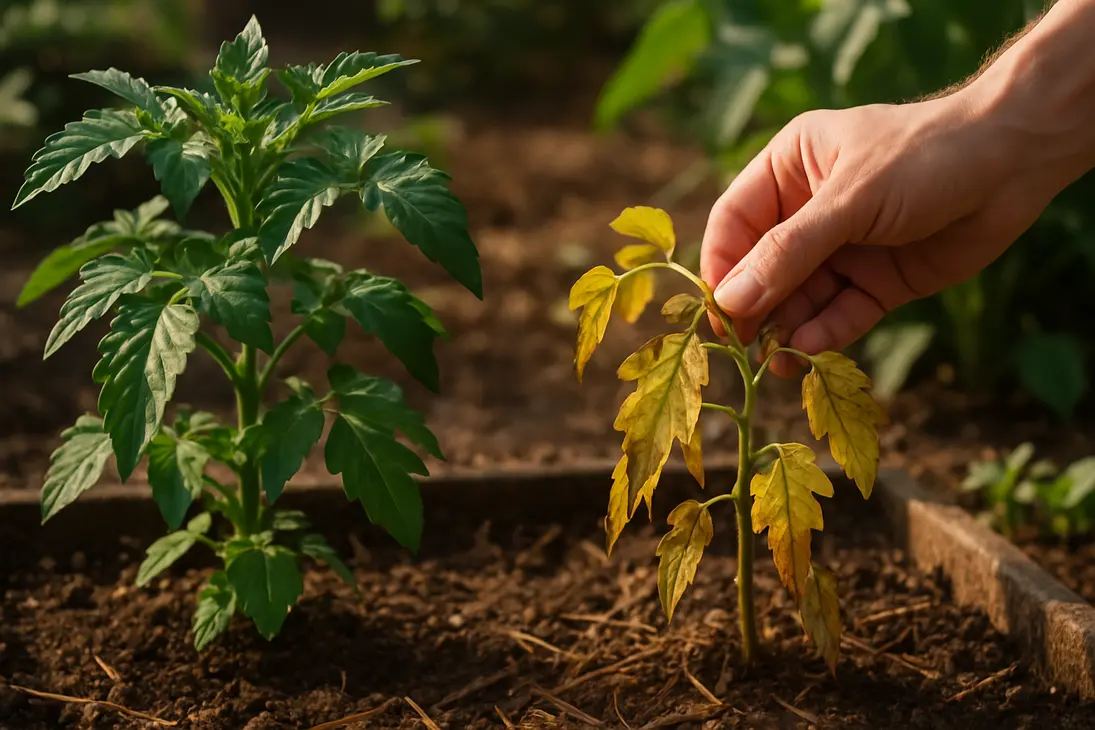
Chloroplast failure can result from genetic defects, disease, nutrient deficiencies, herbicide injury, heat, chilling, drought, excess light, or natural leaf aging. In gardens, it often appears as chlorosis, bleaching, mottling, stunting, early leaf drop, poor yields, or easily scorched leaves.
Reduced Photosynthesis
Photosynthesis depends on healthy chloroplast structure, working pigments, intact membranes, water, carbon dioxide, enzymes, and nutrients. Damage to any of these can reduce sugar production.
A chloroplast that cannot capture light properly or move electrons safely may produce less ATP and NADPH for carbon fixation. Damaged chlorophyll can make leaves pale green, yellow, or white. Under severe excess light or heat, photoinhibition can damage photosynthetic machinery faster than the plant can repair it.
The direct result is less sugar. Since sugars are both fuel and building material, the whole plant feels the shortage. A tomato plant with badly chlorotic leaves may set fewer fruit; shaded seedlings may stretch and stay weak; frost- or herbicide-damaged leaves may never regain full productivity.
Effects on Plant Growth and Development
Plants can reallocate resources, but they cannot escape basic energy accounting. If chloroplasts make fewer sugars, the plant has less carbon and energy for roots, shoots, flowers, fruits, seeds, storage tissues, and defenses.
Common effects include:
- Slower growth and smaller leaves.
- Weak stems or poor branching.
- Reduced root growth.
- Delayed flowering or fewer flowers.
- Smaller fruits, tubers, bulbs, or seeds.
- Lower tolerance of pests, disease, drought, heat, or cold.
- Earlier leaf aging and death.
Timing matters. Chloroplast failure in seedlings may stunt the whole plant. Failure during flowering may reduce fruit or seed set. Failure late in the season may reduce storage in bulbs, crowns, roots, or perennial tissues.
Not every yellow leaf means permanent chloroplast failure. Older leaves naturally break down chlorophyll. Nitrogen, magnesium, or iron problems can reduce chlorophyll formation. Waterlogged roots can also cause leaf yellowing indirectly. Leaf color is a clue, not a complete diagnosis.
Impact on Food Chains and Ecosystems
Chloroplast failure matters beyond individual plants because photosynthesis is the entry point for much of the energy in ecosystems. Plants, algae, and other photosynthetic organisms turn light and carbon dioxide into organic molecules. Herbivores eat them, predators eat herbivores, and decomposers recycle the remains.
If chloroplast function drops across many plants or algae, primary production falls. In a garden, that can mean fewer flowers for pollinators, less seed for birds, less root exudate for soil microbes, and lower yields. In larger ecosystems, widespread reductions in photosynthesis can affect carbon cycling, oxygen production, habitat, and food availability.
A few damaged leaves are usually a local setback. A disease, drought, heat wave, pollutant, or algal die-off that impairs photosynthesis over a large area can affect many connected organisms.
Why Plant Cells Need Both Chloroplasts and Mitochondria
A common misconception is that chloroplasts are the plant version of mitochondria, so plants do not need both. That is incorrect. Plant cells need chloroplasts to capture light and make sugars, and mitochondria to convert sugars into ATP for cell work.
Chloroplasts and mitochondria are partners, not replacements.
Chloroplasts Make Energy-Rich Sugars
Chloroplasts use sunlight to build carbohydrates from carbon dioxide and water. Those carbohydrates store energy in chemical bonds. The plant can use them immediately or store them as starch and other compounds.
During the day, chloroplasts produce ATP inside the chloroplast, but that ATP is mainly used locally to power sugar production. It is not the general ATP supply for the entire plant cell.
The key distinction is simple: chloroplasts make energy-rich food; mitochondria make broadly usable cellular ATP from food.
Mitochondria Turn Sugars Into ATP
Mitochondria release energy from sugars through respiration. This happens in leaves, stems, flowers, fruits, seeds, and roots. It happens during the day and at night, in green and non-green tissues.
Roots are the clearest example. Most roots do not photosynthesize. They depend on sugars transported from leaves, and root mitochondria use those sugars to make ATP for nutrient uptake, growth, and maintenance.
Developing fruits, seeds, bulbs, and tubers also depend heavily on respiration. Even if some tissues contain chloroplasts when young, much of their growth relies on imported sugars and mitochondrial ATP production.
How Organelle Failure in One System Affects the Other
Because chloroplasts and mitochondria are metabolically linked, failure in one system often affects the other.
If chloroplasts fail, sugar supply drops. Mitochondria may still work, but they have less fuel. The plant may consume stored starch, slow growth, or sacrifice older tissues to support new growth.
If mitochondria fail, the plant may still photosynthesize, but it cannot use the resulting sugars properly. ATP-dependent transport, nutrient uptake, repair, and biosynthesis suffer. Sugars may accumulate in some places while growth remains poor elsewhere.
Both organelles also produce stress signals, including reactive oxygen species, when damaged. Plants can use these signals to adjust metabolism and defense, but severe or prolonged stress overwhelms repair systems.
Why Their Evolutionary Origins Matter
The evolutionary history of mitochondria and chloroplasts explains why they share features and why their failure is so consequential. Both appear to have originated through endosymbiosis, in which ancient cells engulfed bacteria that were not digested. Over time, those bacteria became permanent internal partners.
Mitochondria are linked to ancient aerobic bacteria. Chloroplasts are linked to photosynthetic cyanobacteria. These partnerships gave eukaryotic cells powerful energy-converting systems and helped make complex multicellular life possible.
Evidence They Came From Bacteria
Several features point to bacterial ancestry. Mitochondria and chloroplasts have their own DNA, often described as circular in many organisms. They have their own ribosomes, which are more bacteria-like than the ribosomes in the surrounding cytoplasm. They divide by a process similar to bacterial fission and are surrounded by membranes consistent with an engulfing event.
Their biochemistry also fits this origin. Chloroplast photosynthesis resembles cyanobacterial photosynthesis, while mitochondrial respiration reflects bacterial-style electron transport adapted into eukaryotic cells.
They are related in evolutionary pattern, not in function. They are not the same organelle, but both descend from bacteria that became integrated into host cells.
Why They Still Depend on the Cell Nucleus
Despite having their own DNA, mitochondria and chloroplasts cannot live independently. Over time, many genes from the original bacterial partners were lost or transferred to the host cell nucleus. Today, most mitochondrial and chloroplast proteins are encoded by nuclear genes.
This means the nucleus, cytoplasm, mitochondria, and chloroplasts must coordinate closely. A failure may originate in organelle DNA, nuclear genes, imported proteins, membrane damage, or environmental stress. The organelle is not an isolated machine; it is part of a larger cellular system.
Conclusion
The mitochondria chloroplasts impact on life is best understood through energy flow. Chloroplasts capture light and turn it into sugars. Mitochondria convert sugars and other fuels into ATP that cells can spend immediately.
When mitochondria fail, cells lose usable ATP and become chemically unstable. High-demand tissues and processes are especially vulnerable. When chloroplasts fail, plants produce fewer sugars, grow poorly, and support less life above and below ground. At ecosystem scale, reduced photosynthesis weakens the base of food chains.
Plants need both organelles because making sugar is not the same as using it. Chloroplasts load energy into carbon compounds; mitochondria release that energy in a controlled, usable form.
FAQ
What is the main difference between mitochondria and chloroplasts?
Mitochondria use cellular respiration to convert fuel molecules into ATP. Chloroplasts use photosynthesis to convert light energy into sugars.
Why do plants need mitochondria if they already have chloroplasts?
Plants need mitochondria because chloroplast ATP is mainly used inside the chloroplast to build sugars. Mitochondria break down sugars to make ATP for the rest of the cell, including roots, flowers, fruits, seeds, and nighttime metabolism.
Are mitochondria and chloroplasts related?
Yes, in an evolutionary sense. Both likely originated from bacteria through endosymbiosis. Mitochondria are associated with ancient aerobic bacteria, while chloroplasts are associated with photosynthetic cyanobacteria.
What would happen to a plant if its chloroplasts stopped working?
Photosynthesis would fall or stop. The plant would make fewer sugars, growth would slow, and leaves might become pale, yellow, white, or damaged. If failure were widespread and long-lasting, the plant could use up stored energy and die.
You Might Also Like