Why Climbing Plants Need a Self-Watering Moss Pole
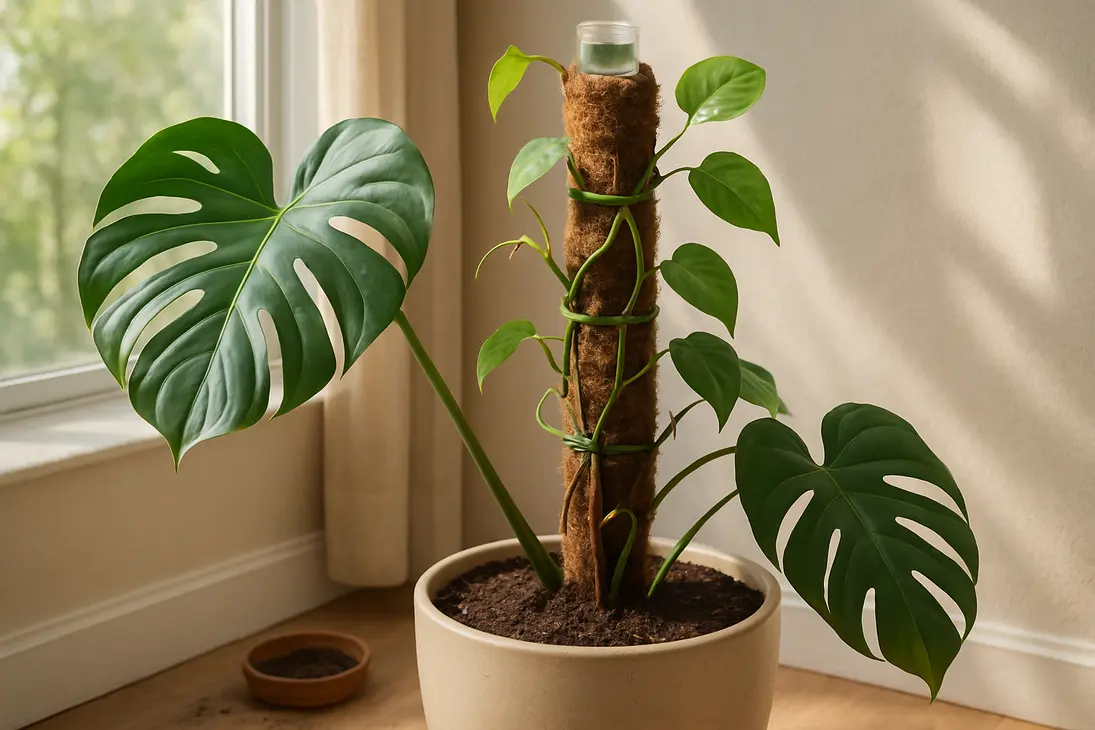
Indoor climbing plants do not climb simply because their vines are long. Many are adapted to grow upward on tree trunks, rocks, and other damp, textured surfaces. In the home, a wall, bamboo cane, or trellis may hold the plant upright, but it does not always provide what the plant is looking for: a surface where aerial roots can attach.
That is where a climbing plants moss pole becomes useful. A regular moss pole gives structure. A self-watering moss pole goes further by helping keep that structure moist, making it more inviting for aerial roots and easier to maintain.
Used well, it can help plants such as monstera, pothos, philodendron, and rhaphidophora grow in a more natural, vertical way. Used poorly, it becomes little more than a decorative stake. The difference is moisture, timing, plant choice, and how you train new growth.
What a Moss Pole Does for Climbing Plants
A moss pole gives climbing houseplants a vertical support that loosely mimics the tree trunks and damp surfaces they climb in nature. Instead of sprawling across a shelf or trailing from a basket, the plant can grow upward.
For many aroids, upward growth is not just cosmetic. When a climbing plant finds support, it may produce:
- Firmer, better-supported stems
- More active aerial roots
- Shorter gaps between leaves, in some cases
- Larger or more mature leaves over time
- More upright, space-efficient growth
A moss pole cannot compensate for poor light, weak roots, or inconsistent watering. But for the right plant, it supports a more suitable growth habit than letting long vines hang unsupported.
It is especially helpful for plants that change as they mature. Juvenile leaves on some climbers are small and simple, while mature leaves may become larger, split, fenestrated, or more textured. Support is one cue that can help these plants move toward adult growth, provided the rest of their care is strong.
How climbing plants use aerial roots
Aerial roots emerge above the soil, usually from nodes along the stem. On climbing houseplants, they mainly help with attachment and, to a lesser extent, moisture uptake.
In nature, a monstera or philodendron may send aerial roots into bark, moss, leaf litter, or crevices on a tree. Indoors, aerial roots often have nowhere useful to go. They may dry out, press against a wall, or dangle without attaching.
A moss pole gives them a textured surface to explore. When the moss is moist, roots are more likely to grow into it rather than sit on the outside. Dry moss may still provide structure, but it is much less effective as a rooting surface.
Moss pole vs. trellis, stake, or wall support
Different supports solve different problems. A moss pole is not always the right answer.
| Support type | Best for | Main limitation |
|---|---|---|
| Moss pole | Aroids and climbers with aerial roots | Needs regular moisture and correct training |
| Self-watering moss pole | Climbers that root into support; growers who struggle to keep moss damp | Still needs monitoring |
| Trellis | Decorative shaping, light support, twining plants | Usually does not encourage aerial roots to attach |
| Bamboo or wooden stake | Temporary support, single stems, young plants | Limited rooting surface |
| Wall clips or hooks | Displaying long vines across a wall | Roots may attach to paint or plaster |
| Coir pole | Affordable textured support | Often stays drier than sphagnum moss |
A trellis is useful if your goal is display. A stake is useful when a plant simply needs to stop leaning. A moss pole is different because it is meant to become part of the plant’s growth system. Ideally, the plant is not just tied to it; it roots into it.
The best results come when new growth is guided onto moist moss while aerial roots are fresh and active.
Why a Self-Watering Moss Pole Works Better Than a Dry Pole
A self-watering moss pole is designed to keep the moss or growing medium evenly moist for longer than a standard pole. Designs vary, but most use a reservoir, wick, tube, or enclosed column that slowly distributes water.
This matters because indoor moss poles dry out quickly. Warm rooms, fans, air conditioning, heating, bright windows, and low humidity can dry sphagnum moss faster than expected. Spraying the outside may wet the surface briefly, but often does not hydrate the inner moss deeply enough.
A self-watering design reduces that daily burden. It does not make the plant automatic or maintenance-free, but it makes consistent moisture more realistic.
Moist moss encourages root attachment
Aerial roots respond better to a surface that feels like a viable place to grow. Moist moss offers:
- Texture: roots can grip and branch into the fibers.
- Humidity near the stem: the area around the node is less dry.
- Contact: roots have something to press into.
- Stability: once rooted, the plant can hold itself more securely.
The node is the important area. A node is the point on the stem where leaves, aerial roots, and new growth can emerge. If the node sits close to damp moss, the aerial root has a better chance of entering the pole.
Moist does not mean soggy, stagnant, or dripping. A pole that stays constantly waterlogged can cause sour smells, algae, fungus gnats, or rot where stems are pressed tightly against wet material. Aim for evenly damp moss with some airflow.
A practical test is to touch the moss or the openings in the pole. It should feel cool and slightly damp, not crisp and dry, and not so wet that water runs down the stem or pools on the soil.
Self-watering does not replace regular plant care
A self-watering moss pole supports climbing, but it does not water the entire plant correctly by itself. Most houseplants still need their potting mix checked and watered according to root-zone conditions.
The plant has two moisture zones:
- The moss pole, where aerial roots may attach.
- The potting mix, where the main root system lives.
Keeping the pole damp does not guarantee the soil is moist enough. Watering the pot does not guarantee the pole is hydrated. You need to monitor both.
A self-watering pole also does not replace adequate light, suitable potting mix, fertilizing during active growth if appropriate, pest checks, pruning, training, or repotting. Think of it as a support-and-moisture tool, not a full care system.
Which Climbing Plants Benefit Most From a Moss Pole
The best candidates are plants that naturally climb with aerial roots and show stronger growth when supported. Many are aroids, including monstera, philodendron, pothos, rhaphidophora, and syngonium.
Not every trailing plant needs a moss pole. Some look best cascading from a basket. Others climb by twining, tendrils, or leaning rather than rooting into a damp surface. A moss pole can still be used for display, but it may not change the plant’s growth in a meaningful way.
Best candidates for a self-watering moss pole
A self-watering moss pole is most worthwhile for plants likely to root into the pole and benefit from consistent moisture.
Good candidates include:
- Monstera deliciosa: Often grows larger, heavier leaves with vertical support and good light.
- Monstera adansonii: Climbs readily and can produce larger leaves when grown upward.
- Pothos (Epipremnum aureum): Commonly trails indoors, but naturally climbs and can size up vertically.
- Philodendron hederaceum and similar vining philodendrons: Respond well when new growth is trained early.
- Philodendron micans, Brasil, and erubescens types: Benefit from gentle training and a moist rooting surface.
- Rhaphidophora tetrasperma: Usually grows more neatly with vertical support.
- Some syngoniums: Often become more vining with age and can be trained upward.
Plants that may not need a moss pole include:
- Compact, self-heading philodendrons
- Most succulents and cacti
- String-of plants
- Many hoyas, which often prefer trellises
- Plants grown specifically for trailing effect
- True twining vines that wrap around supports without needing moss
The question is not simply “Can this plant climb?” but “Will this plant attach to and benefit from a moist vertical surface?”
Signs it is time to add a moss pole
It is usually better to add a moss pole before the plant becomes a long, tangled vine. Young, active growth is easier to train, and new aerial roots are more likely to attach.
Signs your plant may be ready include:
- New vines are searching outward or upward.
- Aerial roots are forming at several nodes.
- The plant flops over even though it is healthy.
- Leaves are getting smaller as vines trail farther from the pot.
- You want larger, more mature foliage rather than long trailing vines.
- The plant is taking up too much horizontal space.
- A monstera stem is leaning heavily or rotating toward the light.
You can add a moss pole to a mature plant, but it requires more patience. Older stems are less flexible, and old aerial roots may not attach as readily as fresh ones. Often, the goal is to secure the existing plant safely while guiding new growth onto the pole.
How to Use a Self-Watering Moss Pole Correctly
The most important principle is this: a moss pole works best when the plant grows into it, not when old vines are merely tied onto it.
You can attach existing stems for support, but real progress comes from positioning nodes and new aerial roots close to moist moss. Over time, new growth follows the direction you train it to take.
Place and anchor the pole securely
Install the pole firmly enough that it does not wobble when the plant becomes heavier. A loose pole can damage roots, shift stems, and prevent aerial roots from staying in contact with the moss.
The best time to install a pole is usually during repotting, when you can position it without forcing it through a dense root ball. If adding one between repots, work slowly and avoid stabbing blindly into the pot.
Basic placement steps:
- Choose a pot with enough depth and weight. Tall poles can make lightweight pots top-heavy.
- Place the pole near the back or center of the plant. For monstera, position it behind the main stem so the plant can lean into it.
- Insert the base deeply enough to hold firm. Many poles need several inches buried or secured according to their design.
- Pack potting mix around the base. The pole should not rock when gently moved.
- Face nodes and aerial roots toward the pole where possible.
- Extend gradually. Do not start with an excessively tall, unstable structure unless the pot can support it.
For modular self-watering poles, make sure each section fits securely. If water is added through a central tube or reservoir, test it before tying in the plant so you know whether it leaks heavily into the pot.
Attach stems without damaging the plant
Use soft, flexible ties. Plant Velcro, soft twine, coated wire, nursery tape, or gentle clips can work if they do not pinch. Avoid thin wire, fishing line, tight zip ties, or anything that cuts into the stem as it thickens.
Good tying practice:
- Tie loosely enough to leave a little space.
- Support the stem, not the leaf stalk.
- Place nodes close to the moss when possible.
- Do not bend woody or older stems sharply.
- Recheck ties every few weeks during active growth.
- Remove or loosen ties once roots have attached firmly.
For long vines, resist wrapping everything tightly around the pole in one session. If a vine has been trailing for months, it may not root all along its length. Secure it gently for shape, then focus on the newest growth at the tip.
Keep the pole moist and check new growth regularly
A self-watering moss pole still needs attention. The reservoir must be refilled, the moss checked, and new stems guided while flexible.
How often you refill depends on pole size, room temperature, humidity, airflow, and plant growth. In a dry, heated room, a pole may need water more often. In a humid room with less airflow, it may stay damp longer.
A simple routine:
- Check the pole by touch once or twice a week.
- Refill the reservoir before the moss becomes completely dry.
- Watch for water pooling in the saucer or potting mix.
- Guide new growth toward the pole while stems are soft.
- Loosen ties as stems thicken.
- Rinse or refresh the pole if it develops unpleasant odors or heavy mineral buildup.
If you use tap water and notice crusty deposits, minerals may be accumulating. Occasional flushing with plain water can help, as long as the pot drains freely. Avoid leaving the plant sitting in runoff.
Be cautious about adding fertilizer directly to a self-watering pole unless you know how your setup behaves. Nutrients can build up in moss or reservoirs. For most growers, feeding through the potting mix during the normal growing season is simpler and easier to control.
Common Moss Pole Mistakes to Avoid
Many moss pole disappointments come from using the pole as a basic trellis. The plant may look vertical, but it never actually attaches. Avoid these common mistakes.
Letting the pole dry out completely
Dry moss does not encourage aerial roots as well as damp moss. A self-watering design helps, but only if you keep the reservoir filled and confirm that moisture is reaching the moss.
Adding the pole too late
You can add support to a mature plant, but younger vines are easier to train. If you wait until the plant is several feet long and tangled, you may need to prune, propagate, or accept a less tidy transition.
Tying only old vines to the pole
Old vines can be secured for appearance, but new growth matters most. Train the growing tips and fresh nodes toward the moss.
Choosing the wrong plant
A moss pole will not make every plant climb better. Some plants prefer to trail, twine around a trellis, or grow as compact clumps.
Tying stems too tightly
Stems expand as they grow. Tight ties can cut into tissue, restrict growth, or create wounds. Use soft ties and check them regularly.
Keeping the pole too wet
Moist is good; stagnant and soggy is not. If the moss smells sour, stays dripping wet, or attracts fungus gnats, reduce watering, improve airflow, and check that the pot is not waterlogged.
Expecting instant larger leaves
A moss pole is not a switch that immediately produces mature foliage. Larger leaves depend on support, light, root health, nutrition, plant age, and genetics.
Using a pole that is too short
If the plant reaches the top quickly, new growth may start trailing again. Choose a pole that can be extended or replaced without disturbing the plant too much.
Ignoring light direction
A plant will still grow toward light. If the pole is on one side but the window pulls growth another way, stems may twist away. Position the pole so the plant can grow upward while still facing its light source.
Conclusion
Climbing plants use moss poles best when the pole provides both structure and moisture. The support gives stems a place to grow upward, while damp moss encourages aerial roots to grip, attach, and develop. That is why a self-watering moss pole can be more effective than a dry pole, especially for indoor growers who struggle to keep moss consistently moist.
The best results come from matching the pole to the right plant, installing it securely, placing nodes close to the moss, and training new growth rather than only tying up old vines. A self-watering moss pole will not replace good light, proper watering, or regular care, but it can make vertical growth healthier, neater, and more natural for many climbing houseplants.
FAQ
Do all climbing plants need a moss pole?
No. Many climbing or trailing plants grow well without a moss pole. Some are happy in hanging baskets, some prefer trellises, and some do not produce aerial roots that meaningfully attach to moss.
Moss poles are most useful for climbing aroids such as monstera, pothos, philodendron, rhaphidophora, and some syngoniums. If your goal is larger, more mature upward growth, a moss pole may help. If your goal is a trailing display, you may not need one.
Is a self-watering moss pole better than a regular moss pole?
For many indoor growers, yes. It helps keep the moss consistently moist with less frequent manual watering, and moist moss is more likely to encourage aerial roots to attach than dry moss.
However, a self-watering moss pole is only better if used correctly. You still need to refill it, monitor moisture, prevent soggy conditions, and care for the plant’s main root system in the pot.
Can I add a moss pole to a mature climbing plant?
Yes, but it is usually harder than adding one when the plant is young. Mature stems may be stiff, tangled, or already growing in another direction. Install the pole carefully, secure existing stems gently, and focus on training new growth onto the pole.
If the plant is very long or bare, pruning and propagating may give a better result than trying to force every old vine onto the pole.
How moist should a self-watering moss pole stay?
The moss should stay lightly to evenly damp, not bone dry and not constantly dripping. When touched, it should feel cool and moist, but water should not run down the stem or pool in the pot.
If the pole dries out completely, aerial roots may stop exploring it. If it stays waterlogged, you may see odor, algae, fungus gnats, or stem issues. Adjust the reservoir level, watering frequency, and airflow until the pole stays consistently damp without becoming stagnant.
You Might Also Like