Celatom vs Datom: What’s the Difference for Plants?
If you are comparing celatom vs datom for plants, the key point is that these names are not always equivalent, and one may not be a clear product name at all.
Celatom is commonly used as a brand or product line name for materials made from diatomaceous earth. “Datom” is often a misspelling, shorthand, or confused version of diatom or diatomaceous earth. Because these terms can appear on products made for gardening, pest control, filtration, absorbents, or industrial use, you should not choose by name alone.
For plants, the safer choice is the product clearly labeled for garden, household pest, or plant-related use. Avoid vague, industrial, pool-filter, or filtration products unless the manufacturer specifically says they are appropriate for your intended plant use.
What Celatom and Datom Usually Refer To
Celatom and “datom” are sometimes discussed as if they are two separate soil amendments or pest control powders. In practice, the difference is usually the product label, not the name.
Celatom generally refers to a branded diatomaceous earth product. Depending on the exact version, it may be intended for filtration, absorbency, industrial processing, fillers, or other uses.
Datom is not commonly used as a precise gardening category. Many people use it when they mean diatom, diatomite, or diatomaceous earth. That matters because diatomaceous earth products vary by processing, particle size, additives, and intended use.
Before putting either around plants, check the label for:
- Full product name
- Intended use
- Grade or category
- Safety warnings
- Whether it is labeled for garden, plant, indoor pest, or outdoor pest use
- Whether it is filter-grade, pool-grade, calcined, or industrial
A powder that looks like diatomaceous earth is not automatically safe or useful in the garden.
Celatom at a Glance
Celatom is best understood as a product name associated with diatomaceous earth materials, not as a separate natural substance unrelated to diatoms.
Depending on the version, Celatom products may be used in filtration, fillers, absorbents, or commercial applications. Some may be finely milled powders, while others may be processed for non-gardening systems.
For a gardener, the question is not simply, “Is this Celatom?” It is:
Which Celatom product is it, and what is it labeled for?
If the label does not mention plants, gardens, household pest control, or safe use around growing areas, treat it cautiously and contact the manufacturer before using it.
Datom or Diatomaceous Earth at a Glance
“Datom” is usually not a formal garden product category. In most plant-care conversations, it likely means diatomaceous earth, often abbreviated as DE.
Diatomaceous earth is a powdery material made from fossilized remains of diatoms, a type of microscopic algae. Its silica-rich particles are abrasive and absorbent. In gardening, DE is most often used as a dry barrier or dust against some crawling insects.
You may also see claims that diatomaceous earth improves soil, adds minerals, dries damp surfaces, or discourages fungus gnats. Some uses can help in limited situations, but DE is not a cure-all. Its effectiveness depends on dryness, pest contact, insect type, and careful application.
Main Differences Between Celatom and Datom
The practical difference between Celatom and “datom” is usually not the raw origin but the specific product.
Both may refer to materials derived from diatomaceous earth. The real differences come from:
- Composition and source material
- Processing method
- Particle size
- Additives or blends
- Intended use
- Label directions
- Safety warnings
- Grade, such as food-grade, garden-grade, or filter-grade
| Feature | Celatom | “Datom” / Diatomaceous Earth |
|---|---|---|
| What the name usually means | A brand or product line associated with diatomaceous earth materials | Often a misspelling or shorthand for diatomaceous earth |
| Best way to identify it | Read the exact product label | Confirm the seller means diatomaceous earth and check the label |
| Possible uses | Filtration, absorbents, fillers, industrial uses, sometimes other uses depending on product | Pest control, garden use, household use, filtration, or industrial use depending on grade |
| Safe for plants? | Only if the exact product is appropriate for plant/garden use | Only if the exact DE product is appropriate for plant/garden use |
| Main risk | Assuming all Celatom products are garden-safe | Assuming any “datom” or DE powder is the right grade |
Ingredient and Source Differences
Celatom products and diatomaceous earth products often share a similar geological origin: deposits formed from fossilized diatoms. These deposits contain silica-based skeletal remains plus varying natural impurities.
That does not mean every product behaves the same.
A DE product intended for insect control is usually selected and processed differently from one intended to filter liquids. A filtration product may be heat-treated or processed to improve flow and filtering performance. A garden or household pest product should provide directions for use around plants, living spaces, or pest-prone areas.
Natural source variation can also affect mineral content, color, particle structure, and purity. These differences matter most for indoor use, edible crops, repeated applications, or mixing into soil.
Food Grade, Garden Grade, and Filter Grade Labels
The label is more important than the casual name.
Food-grade diatomaceous earth is often discussed online because it is generally understood to be less processed than pool-filter DE. However, “food grade” does not automatically mean “best for plants,” and it does not remove the need for careful dust handling.
Garden-grade or pest-control diatomaceous earth is usually the better fit for plant-related pest use because the label should explain where and how to apply it.
Filter-grade or pool-grade diatomaceous earth should not be used on plants. Pool-grade DE is commonly processed for filtration performance and may contain forms of silica that create greater inhalation concerns. It is meant for filter systems, not leaves, potting mix, vegetable beds, or houseplants.
If you remember one rule, make it this:
Do not use pool-filter or industrial diatomaceous earth as a garden pest dust.
Texture, Purity, and Additives
Texture affects usefulness and risk. A fine powder spreads easily and contacts insects well, but it is more likely to become airborne. Coarser material may be less dusty but may not work as well as an insect barrier.
Purity also matters. Some products are nearly pure diatomaceous earth; others may include clays, anti-caking agents, absorbents, or other materials. Additives are not automatically bad, but they must be appropriate for plant use.
For plants, avoid products that are:
- Labeled only for industrial use
- Sold for pool or beverage filtration
- Mixed with unknown additives
- Fragranced or treated
- Sold without clear ingredient information
- Marketed with vague claims but no practical directions
This is especially important for edible crops and indoor houseplants.
How They Are Used Around Plants
Diatomaceous earth products are used around plants mostly for pest management and, less commonly, as a soil ingredient. Whether the bag says Celatom, DE, diatomaceous earth, or something similar, plant use should follow the product label.
The common mistake is expecting it to solve every pest or soil problem. It is more limited than that.
For Crawling Insects and Garden Pests
Diatomaceous earth works physically rather than like a conventional chemical insecticide. Dry particles can damage the waxy outer coating of some crawling insects and contribute to moisture loss. The insect generally needs to crawl through or contact the dry dust.
It is most often used against pests such as:
- Ants moving across dry surfaces
- Some beetles and crawling larvae
- Earwigs in dry hiding areas
- Cockroaches in non-garden household situations
- Some crawling pests around greenhouse benches or pots
Fungus gnats are a common reason houseplant owners use DE. A thin dry layer on the soil surface may discourage adults and reduce contact with the moist mix beneath. But fungus gnat control usually also requires fixing the main cause: consistently wet potting mix. If the surface stays damp, DE will not remain effective.
Diatomaceous earth is less useful for pests that do not reliably crawl through dry powder, such as aphids on tender growth, spider mites under leaves, whiteflies, scale insects, slugs, and snails. It can also affect non-target insects that crawl through it. Avoid dusting flowers where pollinators visit, and apply only where needed.
Around Potted Plants and Soil Surfaces
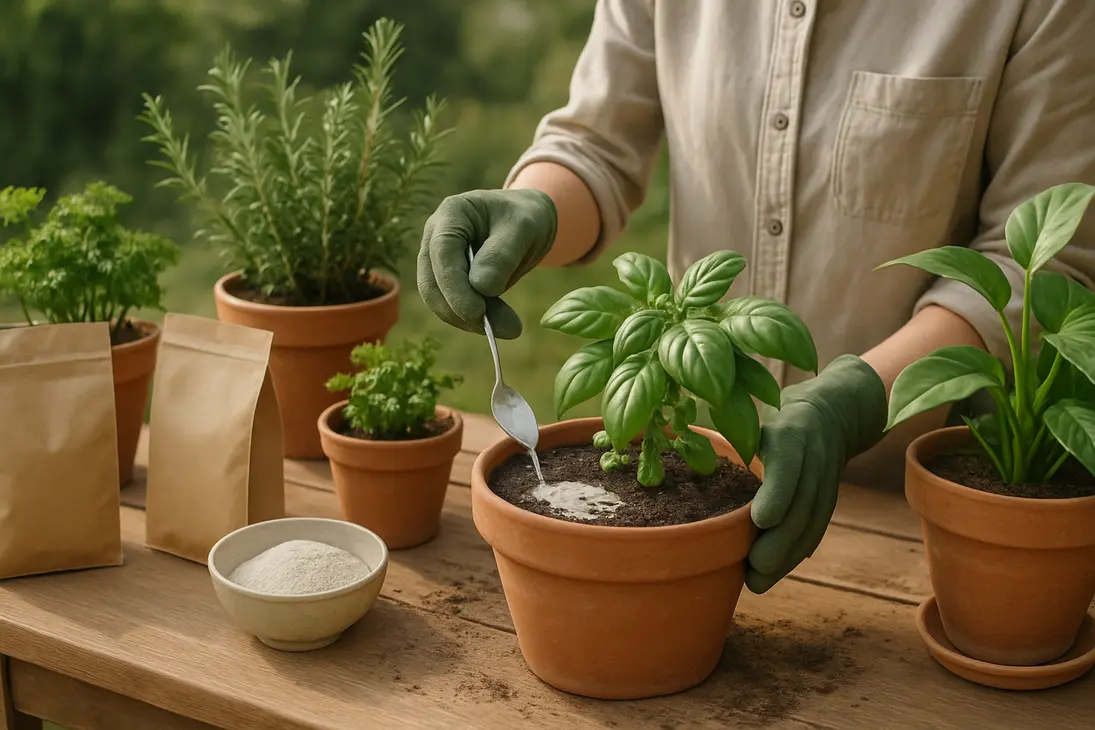
For houseplants and container plants, DE is often applied as a thin layer on the soil surface or around the outside of pots.
Useful situations include:
- A dry barrier around pots on a bench
- A light surface layer for fungus gnat management
- Treatment of cracks, tray edges, or dry hiding spots
- Short-term use after isolating an infested plant
Use restraint. A heavy crust of powder can interfere with watering, make soil moisture harder to judge, and create dust whenever the plant is moved.
For indoor use, apply with a small spoon, bulb duster, or gloved fingers rather than dumping from the bag. Keep it away from fans, vents, air purifiers, pet bedding, children’s areas, and your face.
A practical indoor approach is:
- Let the top layer of potting mix dry as much as the plant safely allows.
- Remove fallen leaves and surface debris.
- Apply a very thin layer only to the soil surface or pest travel route.
- Water carefully to avoid splashing or soaking the powder.
- Reassess after several days instead of automatically adding more.
In Soil Mixes: When It Helps and When It Doesn’t
Some gardeners mix diatomaceous earth into potting soil because it is porous and absorbent. In certain granular forms, diatomaceous material can help with moisture regulation or structure. However, fine powder sold for pest dusting is not the same as a coarse mineral amendment.
Fine DE powder mixed heavily into potting soil may:
- Hold water rather than improve drainage
- Compact with peat- or coir-heavy mixes
- Become ineffective for insect control once wet
- Make the mix dusty when dry
- Add little benefit compared with perlite, pumice, bark, or grit
If your goal is better drainage, choose an amendment designed for that purpose, such as pumice, perlite, coarse bark, horticultural grit, or appropriate coarse sand. If your goal is fewer fungus gnats, watering habits and airflow are usually more important than mixing DE into the soil.
Safety and Common Mistakes to Avoid
The main safety issue with diatomaceous earth products is dust inhalation. Even when a product is labeled for garden or household use, avoid breathing the powder.
Another major mistake is using the wrong grade. Pool-filter DE is not a cheaper substitute for garden DE.
With celatom vs datom, label confusion is the real problem. Read the intended use before applying anything around plants.
Avoid Breathing the Dust
Diatomaceous earth is dusty. Fine particles can irritate the nose, throat, lungs, eyes, and skin.
Use basic precautions:
- Wear a dust mask or respirator when applying powder.
- Wear eye protection if dust may blow back.
- Apply on a calm day outdoors.
- Avoid fans or vents indoors.
- Keep pets and children away during application.
- Do not shake the bag over plants.
- Wash hands after handling.
- Store the product sealed and dry.
You want the powder on a targeted dry surface, not floating through the air.
Do Not Use Pool-Grade Diatomaceous Earth on Plants
Pool-grade diatomaceous earth is designed for filtration equipment. It may be heat-treated or processed differently from garden or food-grade products, making it unsuitable for dusting leaves, applying to soil surfaces, or mixing into potting media.
Do not use pool-grade DE on vegetable leaves, herbs, houseplant soil, seed-starting mix, compost bins, pet areas, or any plant surface. If the label says pool filter, filter aid, calcined, industrial, or filtration use only, do not repurpose it for plants.
Reapply Carefully After Rain or Watering
Diatomaceous earth loses much of its insect-control value when wet. Rain, overhead watering, misting, or high humidity can reduce its effectiveness.
After watering or rain:
- Wait until the surface dries.
- Check whether the pest is still active.
- Reapply only where needed.
- Use a thin layer rather than building up residue.
- Avoid repeated dusting on blooms or edible harvest parts.
Outdoors, DE works best in dry weather and protected locations such as under benches, around pot feet, beneath dry overhangs, and along pest travel paths.
Avoid Treating Every Plant Problem the Same Way
Diatomaceous earth is not a universal plant treatment. It does not correct nutrient deficiencies, cure fungal diseases, repair root rot, or stop every insect.
Before applying any powder, identify the problem:
- Are leaves yellow from overwatering, pests, low light, or nutrients?
- Are flying insects fungus gnats, whiteflies, or something else?
- Is the pest crawling through soil or feeding under leaves?
- Will rain or watering wash the product away?
- Is the plant blooming and attracting pollinators?
- Is the product label appropriate for the site?
For example, if fungus gnats are thriving because potting mix stays wet for two weeks, DE alone will not solve the problem. You may need better watering habits, more light, improved drainage, fresh mix, sticky traps, or another targeted control.
Which One Should You Choose for Plants?
When deciding between Celatom and “datom,” do not choose based on the shorter or more familiar name. Choose based on the label.
For plants, the best choice is a product that is:
- Clearly identified as diatomaceous earth if that is what you want
- Labeled for garden, plant, household pest, or outdoor pest use
- Not pool-grade or filter-grade
- Free from unclear additives
- Suitable for the specific place you plan to use it
- Packaged with application directions and safety warnings
If “datom” appears on a listing and the seller does not clearly explain what it is, avoid it. It may be a typo, translation issue, vague product listing, or something different from garden-safe diatomaceous earth.
If Celatom appears on the label, confirm the exact product type. Some Celatom products may be diatomaceous earth-based, but that does not automatically mean they belong on tomato plants, houseplants, seed trays, or raised beds.
| If the product says… | Plant-use recommendation |
|---|---|
| Garden diatomaceous earth or pest-control DE with plant directions | Usually the most appropriate option, used according to label |
| Food-grade diatomaceous earth | May be usable in some garden contexts, but handle dust carefully and confirm suitability |
| Celatom with garden or pest-control directions | Follow the exact label if plant use is included |
| Celatom for filtration or industrial use | Do not use on plants unless the manufacturer specifically allows it |
| Pool-grade or filter-grade DE | Do not use on plants |
| “Datom” with no clear ingredient or use information | Avoid for plant use |
The name is secondary. The intended use is primary.
Conclusion
Celatom and “datom” are not always direct equivalents. Celatom is commonly a branded product name associated with diatomaceous earth materials, while “datom” is often a misspelling or shorthand for diatomaceous earth. For gardeners, that matters because DE products are sold in several grades and forms, and not all belong near plants.
If your goal is pest control around plants, choose a product clearly labeled for garden or plant-safe pest use. Keep it dry, apply it lightly, avoid breathing the dust, and do not expect it to fix every plant problem. Never use pool-grade or industrial filtration products as substitutes.
For plants, the safest answer to celatom vs datom is not “one is always better.” It is: use only the product whose label clearly matches your gardening purpose.
FAQ
Is Celatom the same as diatomaceous earth?
Celatom is commonly associated with diatomaceous earth-based products, but it is best treated as a product or brand name rather than a universal synonym. Some Celatom products may be intended for filtration or industrial uses instead of gardening. Always check the exact label before using it around plants.
Can I use Datom or diatomaceous earth directly on plant leaves?
Some garden-labeled diatomaceous earth products can be used on or around plants if the label allows it, but leaf dusting should be careful and light. Avoid flowers visited by pollinators, windy conditions, and heavy coating. For pests like aphids or mites, DE may not be the best option because contact is often inconsistent.
Is Celatom safe for indoor houseplants?
Only if the specific Celatom product is appropriate for that use. Many indoor gardeners use diatomaceous earth on dry soil surfaces for fungus gnats, but dust control is important. Do not use filtration, pool-grade, or industrial Celatom products on houseplants. If the label does not clearly support indoor plant or pest use, choose a properly labeled garden or household DE product instead.
Why is diatomaceous earth not working after watering or rain?
Diatomaceous earth works best when dry. Watering, rain, misting, or damp soil can reduce its effectiveness because the particles no longer act the same way against crawling insects. Let the area dry before reapplying, and use only a thin layer where pests travel. If the underlying issue is wet potting mix, poor drainage, or wrong pest identification, DE alone may not solve the problem.
You Might Also Like