NPK 18-18-18 vs 20-20-20 Fertilizer: What’s the Difference for Trees?
NPK 18-18-18 and 20-20-20 fertilizers are both “balanced” fertilizers because they supply nitrogen, phosphorus, and potassium in equal proportions. For trees, the main difference is concentration: 20-20-20 contains slightly more nutrients per pound, scoop, or gallon of mixed solution than 18-18-18.
That difference is small, but it matters when fertilizing young trees, container trees, stressed trees, or soils that already have adequate fertility. Stronger fertilizer is not automatically better. The best choice depends on soil conditions, product form, tree age, and application rate.
What NPK Numbers Mean in Modified Fertilizers
NPK numbers describe the fertilizer analysis. On most labels, the three numbers represent:
- N: nitrogen
- P: available phosphate, commonly used as the phosphorus value
- K: soluble potash, commonly used as the potassium value
The numbers are percentages by weight. A 20-20-20 fertilizer contains 20% nitrogen, 20% phosphate, and 20% potash. An 18-18-18 contains 18% of each.
Because the numbers are equal, both products have a 1:1:1 nutrient ratio. The 20-20-20 is simply more concentrated.
| Fertilizer | Nutrient ratio | Nutrient concentration | Practical meaning |
|---|---|---|---|
| 18-18-18 | 1:1:1 | 18% each N, P, K | Balanced, slightly less concentrated |
| 20-20-20 | 1:1:1 | 20% each N, P, K | Balanced, slightly more concentrated |
A “balanced” fertilizer does not mean a tree needs all three nutrients equally. It only means the product contains them in equal proportions.
Nitrogen, phosphorus, and potassium roles in trees
Trees use each primary nutrient differently.
Nitrogen supports leaf growth, shoot growth, chlorophyll production, and overall vigor. Too much nitrogen can push soft, fast growth that is more vulnerable to drought, cold, pests, or breakage.
Phosphorus supports root development, energy transfer, flowering, and fruiting. Many landscape soils already contain enough phosphorus, and excess phosphorus can contribute to nutrient imbalance.
Potassium helps with water regulation, stress tolerance, disease resistance, winter hardiness, and fruit quality.
Yellowing leaves, weak growth, and sparse foliage are clues, not diagnoses. The cause may be nutrient deficiency, but it may also be poor drainage, compacted soil, overwatering, planting too deeply, root damage, pests, disease, or pH problems.
Why “balanced” does not always mean “best”
Balanced fertilizer is convenient, but trees often do not need equal amounts of nitrogen, phosphorus, and potassium.
In many landscapes, nitrogen is the nutrient most likely to be needed for leafy growth, while phosphorus and potassium may already be adequate. Applying 18-18-18 or 20-20-20 in that situation adds all three nutrients whether the tree needs them or not.
Balanced NPK can be appropriate when:
- A soil test shows low levels of multiple nutrients.
- A tree is growing in a container or raised bed.
- A fruit tree has documented nutrient demand.
- You are using a carefully diluted water-soluble fertilizer as part of a managed routine.
It is less appropriate for mature, healthy trees growing normally in soil with adequate fertility.
What “modified fertilizer” may refer to on a label
“Modified fertilizer” is not always a standardized label term. Depending on the product, it may mean the fertilizer has been blended, coated, made water-soluble, fortified with micronutrients, adjusted for pH, or combined with organic materials.
Do not rely on the word “modified” alone. Read the full label for NPK analysis, release type, application method, recommended plants, frequency, and cautions.
18-18-18 vs 20-20-20: The Practical Difference
The practical difference between 18-18-18 and 20-20-20 is dosage. 20-20-20 is about 11% more concentrated than 18-18-18 when comparing nutrients supplied per equal amount of product.
For example:
- 1 pound of 18-18-18 contains 0.18 pound each of nitrogen, phosphate, and potash.
- 1 pound of 20-20-20 contains 0.20 pound each.
That extra 0.02 pound per nutrient per pound of fertilizer can matter with heavy rates, repeated applications, or use near sensitive roots.
Nutrient concentration and application rate
If your goal is to supply the same nutrient amount, use slightly less 20-20-20 than 18-18-18.
| If a rate is based on… | Equivalent adjustment |
|---|---|
| 18-18-18 and you switch to 20-20-20 | Use about 10% less product |
| 20-20-20 and you switch to 18-18-18 | Use about 11% more product |
Still, the safest rule is: follow the label for the specific product you bought. Fertilizers differ in salt index, solubility, release rate, micronutrients, and intended use.
This matters with trees because roots spread widely and unevenly. A concentrated band, pile, or strong liquid solution can injure roots even if the total amount seems reasonable.
Water-soluble vs granular forms
Many 20-20-20 fertilizers are sold as water-soluble powders, while many 18-18-18 products are sold as granular blends, though this is not universal. Product form matters as much as the NPK number.
Water-soluble fertilizers act quickly because nutrients are available as soon as they dissolve and move into the root zone. They can be useful for container trees, nursery stock, or quick correction, but they are easier to overuse.
Granular fertilizers release nutrients more gradually, depending on the formulation. Some dissolve quickly after rain or irrigation; others are coated for slow release. They are often easier to spread over a broad root zone but can still burn roots if dumped in clumps or placed against the trunk.
For in-ground trees, slow and even feeding is usually safer than frequent strong feeding.
When the difference matters—and when it does not
The difference matters most when fertilizing young trees, container trees, dry soil, stressed trees, or when applying water-soluble fertilizer repeatedly. It also matters when you are trying to match a soil-test recommendation precisely.
The difference matters less when you apply conservative label rates, use a slow-release product evenly, fertilize an established tree in a large soil volume, or adjust the product amount for concentration.
Neither formula is automatically better. 20-20-20 is stronger, but stronger is not always an advantage.
Which Fertilizer Is Better for Trees?
The better fertilizer is the one that matches the tree’s actual needs. Sometimes that may be 18-18-18. Sometimes it may be 20-20-20. Sometimes it may be a fertilizer with less phosphorus, a slow-release nitrogen product, compost, mulch, or no fertilizer.
Before choosing between balanced modified fertilizers NPK formulas, consider:
- Tree age and species
- Soil test results
- Soil pH
- Leaf color and annual shoot growth
- Mulch and organic matter
- Irrigation practices
- Whether the tree is fruiting, ornamental, newly planted, or stressed
Young trees vs established trees
Young trees need nutrients for root and canopy growth, but they are also easier to damage.
For newly planted trees, avoid placing fertilizer directly in the planting hole unless the label specifically allows it. Concentrated fertilizer near tender roots can cause injury. Proper planting depth, watering, and mulching are usually more important in the first season.
A young tree may benefit from light feeding after active growth begins, especially in poor soil. If using 18-18-18 or 20-20-20, use a conservative rate and keep fertilizer away from the trunk.
Established trees are different. A mature shade tree growing normally may not need routine fertilizer, especially if it is in a lawn or garden area that already receives nutrients.
Fruit trees, ornamental trees, and stressed trees
Fruit trees often have higher nutrient demand because they support flowering and fruit production. Still, too much balanced fertilizer can be counterproductive. Excess nitrogen may promote leafy growth at the expense of fruiting, and unnecessary phosphorus or potassium can build up.
Ornamental trees are usually fertilized for healthy growth, foliage color, and resilience. A balanced fertilizer may help if the soil is genuinely low in nutrients, but overfeeding can create long, weak shoots.
Stressed trees need caution. Fertilizer is not medicine. A tree suffering from drought, waterlogged soil, compaction, trunk injury, root damage, pests, or disease may be unable to use added nutrients. Correct water, mulch, soil, and planting problems before fertilizing.
Why soil testing matters before adding phosphorus or potassium
Soil testing is especially useful before using balanced fertilizers because every application adds all three major nutrients.
If a soil test shows low nitrogen but adequate phosphorus and potassium, 18-18-18 or 20-20-20 may not be the best fit. A nitrogen-focused fertilizer may be more appropriate.
If phosphorus or potassium is already high, repeated balanced fertilizer can make the imbalance worse. Soil pH also affects nutrient availability; nutrients may be present but unavailable because pH is too high or too low.
A soil test does not solve every tree problem, but it is safer than guessing.
How to Apply Balanced NPK Fertilizer Safely Around Trees
Application matters more than choosing between 18-18-18 and 20-20-20. A useful fertilizer can still harm a tree if applied in the wrong place, at the wrong rate, or too often.
Start with the product label. Use the rate for trees, shrubs, or landscape plants, not the rate for vegetables, turf, or greenhouse crops unless the label says it applies. If the label gives a range, start low.
Do not fertilize very dry soil. Water first if needed, apply fertilizer evenly, then water again to move nutrients into the root zone.
Where to place fertilizer around a tree
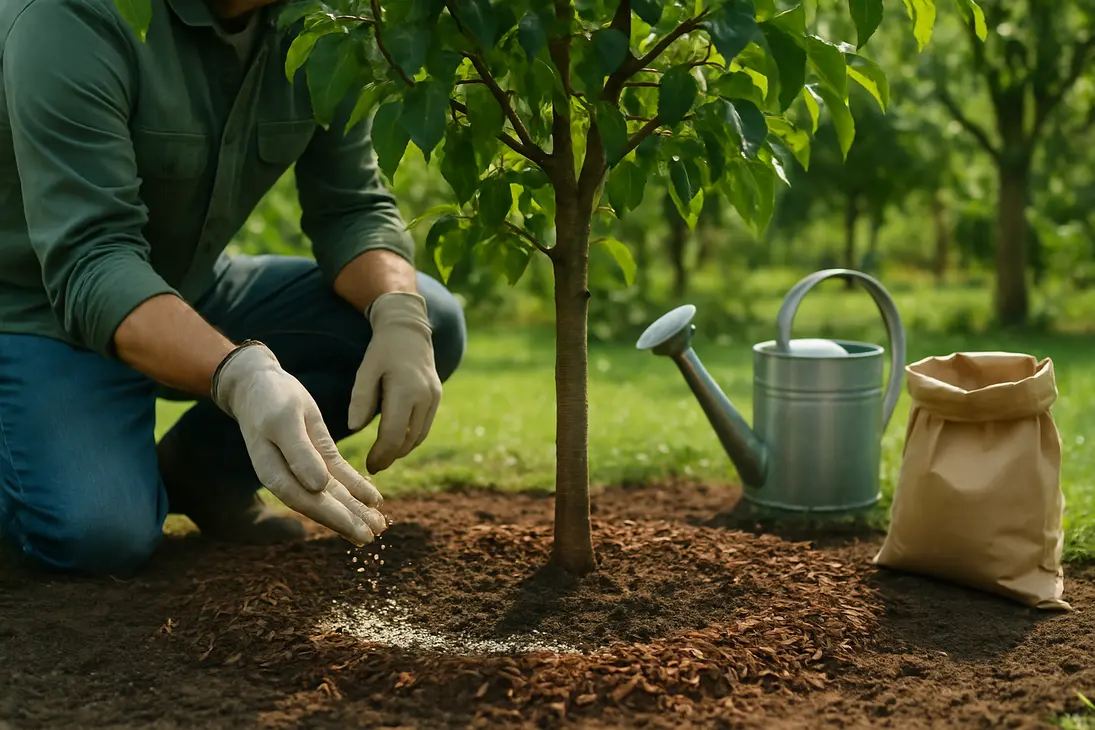
Tree roots are not concentrated at the trunk. Most absorbing roots are in the upper soil and spread outward, often beyond the drip line.
For in-ground trees:
- Keep fertilizer away from the trunk.
- Apply it evenly over the root zone.
- Focus under the outer canopy and slightly beyond the drip line.
- Avoid piles, rings, or concentrated bands.
- Water it in after application.
For container trees, use only products labeled for container use, dilute carefully, and make sure water drains freely.
How often to fertilize
Frequency depends on product form, tree type, soil, and growing conditions.
A slow-release granular fertilizer may be applied once during the growing season if needed. A water-soluble fertilizer may be applied more often, but only at label dilution and only when the tree is actively growing.
Avoid fertilizing late in the season if it may push tender growth before cold weather. Also avoid fertilizing during drought or heat stress unless the tree is being watered properly and the label supports that use.
Fertilize only when there is a clear reason, such as a soil-test deficiency, weak growth, pale leaves after other causes are considered, poor fruiting linked to nutrition, or container growth in a limited medium.
Signs the tree may not need fertilizer
A tree may not need fertilizer if it has normal leaf color, good annual shoot growth, full canopy density, normal leaf size, healthy buds, and no soil test indication of deficiency.
If a tree looks poor but the soil is compacted, soggy, dry, or dominated by competing turf, improving the root environment is usually more helpful than adding fertilizer.
Risks of Over-Fertilizing Trees
Over-fertilizing is a common mistake. Gardeners often apply more for a faster response or repeat water-soluble feedings too closely. The result can be browning leaves, root injury, stunted growth, or decline.
Balanced fertilizers like 18-18-18 and 20-20-20 contain substantial soluble nutrients. Used correctly, they can help. Used excessively, they can raise salt levels around roots, disrupt water uptake, and cause nutrient imbalance.
Symptoms of fertilizer burn
Possible symptoms of fertilizer burn or overapplication include:
| Symptom | What it may look like |
|---|---|
| Leaf edge browning | Brown, crispy margins or tips |
| Wilting despite moist soil | Roots cannot take up water normally |
| Yellowing leaves | Nutrient imbalance or root stress |
| Sudden leaf drop | Stress response after overfeeding |
| Stunted growth | Root injury or salt stress |
| White crust on soil surface | Salt buildup, especially in containers |
These symptoms are not unique to fertilizer burn. Drought, herbicide exposure, root rot, winter injury, and pests can look similar. Timing matters; symptoms soon after a strong fertilizer application make overfertilization more likely.
What to do if too much fertilizer was applied
If too much granular fertilizer was applied:
- Remove visible granules if possible.
- Do not add more fertilizer or amendments to “balance it out.”
- Water deeply if the soil drains well.
- Avoid waterlogging heavy clay or saturated soil.
- Mulch properly, keeping mulch off the trunk.
- Wait and observe before pruning damaged growth unless it is clearly dead.
For containers, remove visible fertilizer, flush the pot with clean water so salts drain out, make sure drainage holes are open, and stop feeding until healthy growth resumes.
If the tree is valuable, mature, or declining rapidly, consult a certified arborist or local extension service.
Why more fertilizer can make problems worse
When a tree struggles, feeding it again can make things worse if the real issue is root stress, drought, excess water, compaction, disease, or planting depth.
Fertilizer salts affect how water moves into roots. High concentrations can make it harder for roots to absorb water, even when soil feels moist. Excess nutrients can also push growth the roots cannot support.
Fertilizer can also distract from the real problem. Poor fruiting may involve pruning, pollination, sunlight, or chilling. Sparse foliage may come from root damage. Yellowing after planting may be caused by planting too deep. In these cases, NPK fertilizer is not the main solution.
Organic vs Chemical Fertilizers for Tree Nutrition
Organic and synthetic fertilizers can both be useful. Organic amendments generally improve soil conditions over time, while synthetic NPK fertilizers provide faster, more measurable nutrient delivery.
Trees may benefit from either approach, but not always at the same time or in large amounts.
When organic fertilizer is helpful
Organic materials such as compost, well-rotted manure, leaf mold, wood chips, and plant-based amendments can improve soil structure, moisture retention, microbial activity, and surface organic matter.
For landscape trees, one of the best organic practices is proper mulching with wood chips or shredded bark. Mulch reduces grass competition, moderates soil temperature, conserves moisture, and slowly adds organic matter.
Organic fertilizers are helpful when soil is low in organic matter, the site is harsh or compacted, you want gradual nutrient release, or you are improving soil health over time.
Organic does not mean risk-free. Manure, compost, and organic fertilizer blends still contain nutrients and can add excess phosphorus, potassium, or salts if overused.
When a synthetic NPK fertilizer is more precise
A synthetic 18-18-18 or 20-20-20 fertilizer is more precise when you need to know exactly what nutrients you are applying. This can help with container trees, nursery production, or a soil-test-confirmed deficiency.
Water-soluble synthetic fertilizers are predictable because you can dilute them to a known strength. The trade-off is that mistakes happen quickly. A solution mixed too strong or applied too often can damage roots.
Synthetic fertilizer is useful when a soil test supports the nutrient ratio, the tree is in a container or artificial medium, you need nutrients available quickly, and you can follow label rates accurately.
Why mixing fertilizers can create nutrient excess
Combining organic and synthetic fertilizers can work in a planned program, but casual mixing often creates excess.
For example, composted manure, balanced granular fertilizer, and water-soluble 20-20-20 in the same season may add far more phosphorus and potassium than the tree needs.
Avoid stacking products unless you know what each contributes, including compost, manure, fertilizer spikes, lawn fertilizer, fruit tree fertilizer, micronutrient blends, and water-soluble NPK products.
The safest approach is to choose one main fertilization strategy, apply it conservatively, and adjust based on tree response and soil testing.
Conclusion
NPK 18-18-18 and 20-20-20 fertilizers are both balanced fertilizers with a 1:1:1 nutrient ratio. The difference is concentration: 20-20-20 is slightly stronger, supplying more nitrogen, phosphorus, and potassium per amount of product.
For trees, that difference mainly affects application rate, dilution, and overfertilizing risk. It does not mean 20-20-20 is automatically better, and it does not mean 18-18-18 is safe if applied too heavily.
Use balanced modified fertilizers NPK products only when they match the tree’s needs. Read the label, consider a soil test, apply fertilizer across the root zone rather than against the trunk, water it in, and avoid repeated feeding without a clear reason. Healthy tree growth depends on soil, water, planting, mulch, and careful nutrition—not stronger fertilizer alone.
FAQ
Is 20-20-20 stronger than 18-18-18 fertilizer?
Yes. 20-20-20 contains 20% each of nitrogen, phosphate, and potash, while 18-18-18 contains 18% each. The ratio is the same, but 20-20-20 is more concentrated. To supply the same nutrient amount, use slightly less 20-20-20.
Can I use 18-18-18 fertilizer on trees?
Yes, if the tree and soil need a balanced fertilizer. Apply it according to the label, keep it away from the trunk, spread it over the root zone, and water it in. Do not use it simply because a tree looks stressed; many tree problems are caused by water, planting depth, compaction, pests, disease, or root damage.
Is balanced NPK fertilizer good for all trees?
No. Balanced fertilizer is not automatically good for all trees. Some trees need more nitrogen but not more phosphorus or potassium. Others may not need fertilizer at all. Mature, healthy trees in fertile soil often require little or no supplemental feeding.
What happens if I apply too much NPK fertilizer to a tree?
Too much NPK fertilizer can cause root burn, leaf edge browning, wilting, yellowing, stunted growth, leaf drop, and salt buildup. Remove excess granules if possible and water deeply if the soil drains well. For containers, flush the pot with clean water and let it drain. Do not fertilize again until the tree clearly recovers.
You Might Also Like