Observing Stomata in Leaves: Where to Find Them and What You’ll See
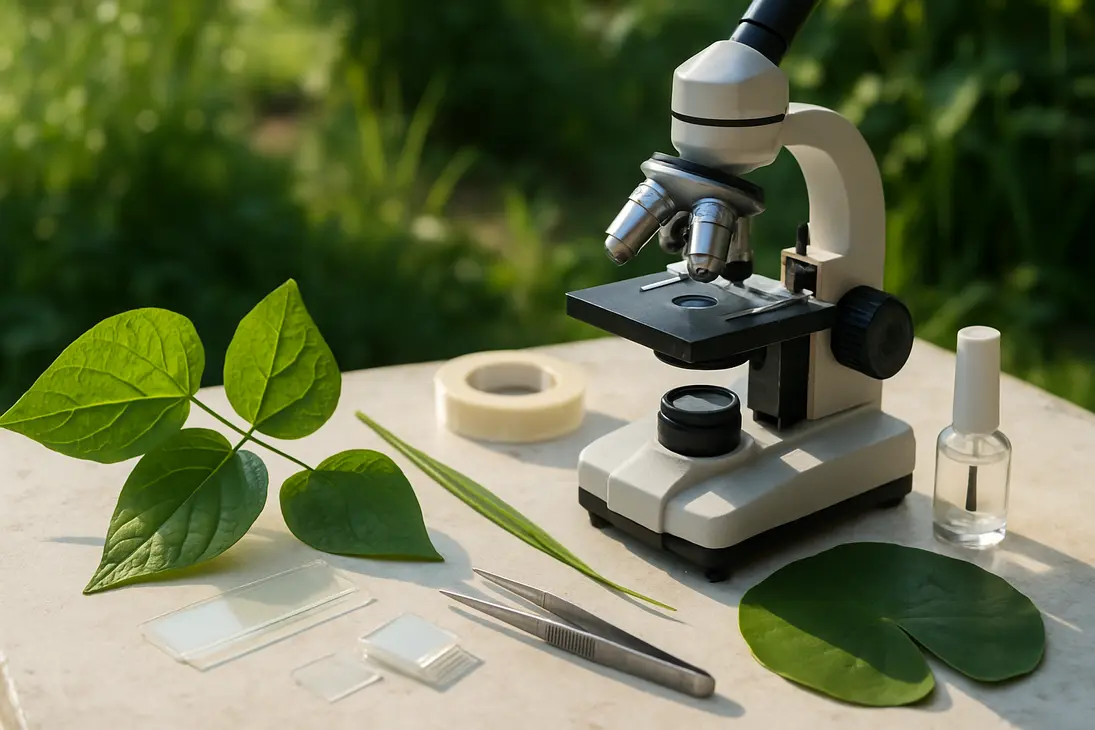
Observing stomata in leaves is a simple way to see how plants balance gas exchange with water conservation. With a compound microscope and either a thin leaf peel or a clear nail-polish impression, you can view the tiny pores that help leaves take in carbon dioxide, release gases, cool themselves, and regulate water loss.
Stomata are not randomly placed. Their number, position, and shape reflect how a plant lives: in sun or shade, on land or water, or in dry or moist conditions.
What Stomata Are and Why They Matter
Stomata are microscopic pores in the epidermis, the outer surface layer of leaves and some young stems. The singular form is stoma.
Each stoma is a controllable opening. When open, carbon dioxide enters for photosynthesis, while oxygen and water vapor can leave. When conditions are hot, dry, or stressful, many plants partly close their stomata to reduce water loss.
This trade-off is central to plant survival: leaves need carbon dioxide to make sugars, but every open pore also allows water vapor to escape.
Stomata, guard cells, and the stomatal pore
A typical stoma includes:
- The stomatal pore — the opening where gases pass through.
- Guard cells — two specialized cells that surround and control the pore.
- Neighboring epidermal cells — the surrounding surface cells.
Guard cells are usually the easiest part to recognize. In many dicot leaves, such as bean, geranium, or tradescantia, they look like two curved kidney-shaped cells facing each other. The gap between them is the pore.
When guard cells become turgid, or swollen with water, they bend and open the pore. When they lose turgor, the pore narrows or closes. Light, carbon dioxide level, humidity, temperature, water availability, and internal plant signals all affect this movement.
In grasses and many other monocots, guard cells are often dumbbell-shaped rather than kidney-shaped.
How stomata support photosynthesis, respiration, and transpiration
Stomata are often linked with photosynthesis, but they support several processes.
During photosynthesis, carbon dioxide enters through stomata and is used by leaf cells to make sugars. Oxygen, a byproduct, can leave through the same pores.
During respiration, plant cells use oxygen to release energy from sugars. Leaves also exchange respiratory gases through stomata.
During transpiration, water evaporates from moist internal leaf surfaces and exits as water vapor. This helps pull water and dissolved minerals upward from the roots and can cool the leaf. Too much transpiration can dehydrate the plant, so stomatal control is essential.
Where to Look for Stomata on a Leaf
The first practical question is: which side of the leaf should you sample?
For many common garden and classroom plants, start with the lower leaf surface, also called the underside or abaxial surface. This rule is useful but not universal. Some leaves have stomata on both surfaces, floating aquatic leaves often have them mainly on the upper surface, and many submerged aquatic leaves have few or no functional stomata.
Why many leaves have more stomata on the lower surface
Many broad-leaved terrestrial plants have more stomata on the underside because that position helps reduce water loss.
The upper leaf surface usually receives more direct sunlight, heat, and moving air. If most stomata were there, water vapor could escape quickly, especially in dry or windy weather. The lower surface is often cooler, more shaded, and less exposed, so gas exchange can occur with less water loss.
Leaves such as bean, hibiscus, geranium, rose, and many houseplants often show stomata most clearly on the lower epidermis.
Leaves with stomata on both sides are called amphistomatous. Leaves with stomata mainly or only on the lower surface are called hypostomatous.
Differences between dicot and monocot leaves
Dicots and monocots often differ in stomatal arrangement.
Dicot leaves usually have branching veins and irregular epidermal cell patterns. Their stomata are often scattered, especially on the lower surface, and the guard cells are commonly kidney-shaped.
Monocot leaves, such as grasses, maize, lilies, and irises, often have parallel veins. Their stomata may be arranged in rows along the length of the leaf. In grasses, the guard cells are frequently dumbbell-shaped, often with subsidiary cells beside them.
| Leaf type | Common stomatal pattern | What you may see |
|---|---|---|
| Dicot leaf, such as bean or geranium | Often more on lower surface | Kidney-shaped guard cells |
| Monocot leaf, such as grass or maize | Often in rows | Dumbbell-shaped guard cells |
| Floating aquatic leaf, such as water lily | Mostly on upper surface | Stomata on the air-exposed side |
| Submerged aquatic leaf | Few or no functional stomata | Stomata may be absent or hard to find |
Why floating aquatic leaves may have stomata on the upper surface
Floating leaves, such as those of water lily or lotus, are an important exception. Their lower surface rests against water, so stomata there would not be useful for direct air exchange. The upper surface is exposed to air, so it is the better place for stomata.
If you peel the underside of a floating aquatic leaf and see few or no stomata, the preparation may not have failed. You may simply be looking at the wrong side. Fully submerged leaves are different again: many exchange gases across the leaf surface and may have reduced, absent, or non-functional stomata.
How to Observe Stomata in Leaves
You do not need advanced equipment, but preparation matters. The two most useful classroom methods are the leaf peel method and the clear nail-polish impression method.
A compound light microscope is best. A hand lens is usually not enough. A phone microscope may work if it provides sufficient magnification and clarity.
Materials needed
For a simple observation, gather:
- Fresh leaves from one or more plants
- Compound microscope
- Slides and coverslips
- Water and dropper
- Tweezers or forceps
- Clear tape
- Clear nail polish
- Paper towel
- Optional stain, if allowed
Good beginner leaves include tradescantia, geranium, bean, hibiscus, lily, grass, spinach, pothos, and coleus. Avoid very thick, waxy, hairy, or leathery leaves for a first attempt because they are harder to peel or imprint clearly.
Leaf peel method
The leaf peel method gives a direct view of the epidermis. It works best on leaves with a peelable lower surface.
- Choose a fresh, healthy leaf.
- Turn it over and gently tear or bend it so a thin transparent layer begins to separate.
- Use tweezers to pull off a small piece of epidermis.
- Place the peel flat on a slide.
- Add one drop of water.
- Lower a coverslip carefully.
- Start at low power, then increase magnification.
Aim for a thin, nearly clear film, not a thick green chunk. If the sample is too dark or full of green tissue, try again with a thinner peel.
Clear nail-polish impression method
The nail-polish method is often easier than peeling and works well for comparing upper and lower surfaces.
- Paint a thin patch of clear nail polish on the leaf surface.
- Let it dry completely.
- Press clear tape over the dried polish.
- Peel the tape away carefully.
- Stick the tape, polish side down, onto a slide.
- Observe under the microscope.
Use a thin coat. Thick polish can dry unevenly and obscure details. Hairy or dusty leaves may produce messy impressions.
What stomata look like under the microscope
At low power, stomata may appear as tiny dots, slits, or ovals among epidermal cells. At higher magnification, look for:
- A pair of guard cells
- A central pore or slit
- Repeated similar structures across the surface
- Differences between upper and lower surfaces
At about 100× total magnification, you may locate the epidermal pattern. At 400× total magnification, stomata are usually much easier to identify. If your microscope has 10× eyepieces and a 40× objective, that gives 400× total magnification.
Stomata are not always open. A closed stoma may look like two guard cells pressed together with only a faint line between them.
Comparing Stomata in Different Plant Types
Once you can find stomata, comparing leaves becomes more useful than viewing one sample. Differences often reflect habitat, leaf structure, and water strategy.
Terrestrial plants
Most garden plants, shrubs, trees, vegetables, and houseplants are terrestrial. In many, stomata are more numerous on the lower surface.
Useful comparisons include:
- Lower surface vs. upper surface of the same leaf
- Bean or geranium vs. grass
- Sun-exposed leaf vs. shaded leaf from the same plant
- Young mature leaf vs. older leaf
You may notice differences in stomatal density, but avoid broad conclusions from one microscope field. Density can vary with species, light exposure, water availability, and leaf age.
Aquatic and submerged plants
Aquatic plants show clear stomatal adaptations.
Floating leaves, such as water lily leaves, often have stomata on the upper surface because that side contacts air. Their lower surface contacts water, so stomata there are less useful.
Submerged leaves may have few or no functional stomata. Because they are surrounded by water, they can exchange dissolved gases through their surfaces, and the usual need to control water loss is reduced. If you cannot find stomata on a fully submerged leaf, that absence may be biologically meaningful.
Some plants produce different leaf types. One plant may have stomata on aerial or floating leaves but few on submerged leaves.
Xerophytes, cacti, and sunken stomata
Xerophytes are plants adapted to dry environments. Cacti, many succulents, oleander, pine, and some desert shrubs may reduce water loss with thick waxy cuticles, hairs, pits or grooves, fewer visible stomata, or stomata that open mainly at night in CAM plants, including many cacti.
Sunken stomata sit below the main leaf surface in small depressions. This creates a more humid pocket near the pore and slows water vapor loss. They can be hard to see with a simple surface view unless you have a good impression or thin section.
Cacti are unusual because their leaves are reduced to spines, and photosynthesis occurs mainly in green stems. For many cacti, a stem surface impression is more relevant than looking at the spines.
Common Problems and Misconceptions When Observing Stomata
Beginners often miss stomata at first. Common causes include sampling the wrong surface, using tissue that is too thick, starting at too high a magnification, or expecting all leaves to look alike.
Why you may not see stomata at first
If stomata are hard to find, check these issues:
| Problem | Likely cause | What to try |
|---|---|---|
| Image is dark | Peel is too thick or folded | Use a thinner peel or impression |
| Green cells dominate | Inner tissue came away with epidermis | Try a thinner epidermal peel |
| Surface looks blank | Wrong side or low density | Test both leaf surfaces |
| Details are blurry | Too much water or air bubbles | Use less water and lower coverslip slowly |
| Stomata look like lines | Pores may be closed or magnification is low | Move to 400× and find paired guard cells |
| Impression is messy | Polish too thick, wet, or leaf is hairy | Use a thin coat and let it dry |
Start at low power to find the sample and focus, then increase magnification. If you begin at high power, it is easy to focus on dust, bubbles, or the wrong layer.
Not all leaves have stomata in the same place
A common misunderstanding is that stomata are always on the underside of leaves. Many terrestrial broad leaves do have more there, but the pattern depends on plant type and habitat.
Grasses and other monocots may have stomata on both surfaces. Floating aquatic leaves may have them mainly on the upper surface. Submerged leaves may lack functional stomata. Xerophytes may hide stomata in grooves or pits.
The best approach is comparative: test both sides when possible and record which surface shows more visible stomata.
Stomata are not only important for photosynthesis
Stomata do allow carbon dioxide to enter for photosynthesis, but that is not their only role. They also regulate water vapor loss through transpiration, oxygen movement, leaf cooling, water and mineral movement, and responses to drought and heat stress.
This is why plants may close stomata during dry conditions even though closing them limits carbon dioxide intake. The plant trades some photosynthetic activity for water conservation.
What happens if leaves lack functional stomata?
If a typical land plant lacked functional stomata, it would struggle to exchange gases and regulate water movement. Photosynthesis would be limited because carbon dioxide could not enter efficiently, and transpiration-driven cooling and water movement would be disrupted.
However, some submerged aquatic leaves exchange gases directly with surrounding water and do not rely on stomata in the same way. A more accurate statement is: most aerial leaves of vascular plants rely on functional stomata for normal gas exchange and water regulation.
Conclusion
Observing stomata in leaves turns an invisible plant process into something you can see directly. For most common land plants, begin with the lower leaf surface and use either a thin epidermal peel or a clear nail-polish impression. Then compare different plants and habitats. A bean leaf, grass blade, floating aquatic leaf, and xerophyte can all show different versions of the same basic problem: exchanging gases while avoiding excessive water loss.
FAQ
Which side of the leaf is best for observing stomata?
For many common terrestrial broad-leaved plants, the lower surface is best because it usually has more stomata. Floating aquatic leaves often have stomata on the upper surface, and grasses may have stomata on both sides.
Why are stomata usually found on the underside of leaves?
The underside is usually cooler, more shaded, and less exposed to direct wind and sunlight. Having more stomata there allows gas exchange while reducing excessive water loss.
What magnification is needed to see stomata?
You can often locate stomata at about 100× total magnification, but they are usually clearer at 400×. Good sample preparation is just as important as magnification.
Do all plants have stomata in their leaves?
No. Most aerial leaves of vascular plants have stomata, but their number and position vary. Floating aquatic leaves may have stomata mainly on the upper surface, while many fully submerged aquatic leaves have few or no functional stomata. In cacti, stomata are often more relevant on the photosynthetic stem than on reduced leaves.
You Might Also Like