Mango Plant Characteristics: Root and Leaf Types Explained
What Kind of Plant Is a Mango?
A mango is a tropical evergreen fruit tree known botanically as Mangifera indica. It belongs to the cashew family, Anacardiaceae, along with cashew and pistachio. In gardening terms, mango is a long-lived, woody, broadleaf evergreen that grows best in warm climates with little to no frost.
A healthy mango usually forms a single trunk, spreading branches, and a rounded or dome-shaped canopy. Grafted garden trees are often kept about 10 to 20 feet tall with pruning, while unpruned trees in favorable tropical climates may reach 30 to 60 feet or more.
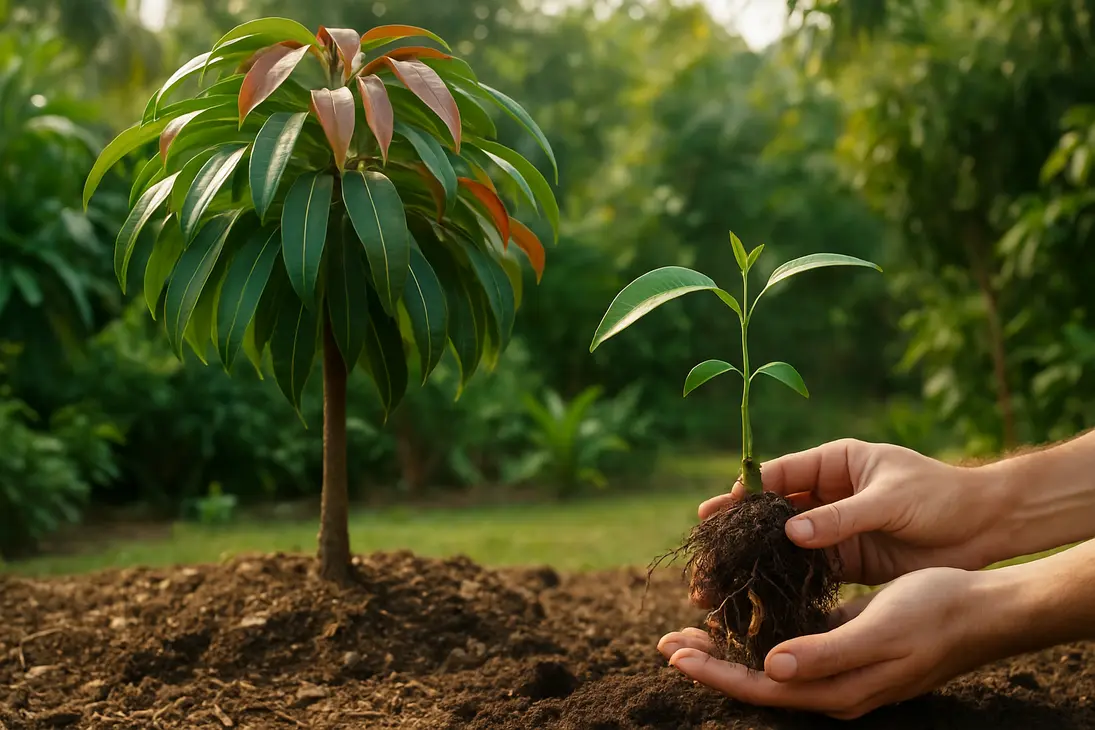
Mango trees keep foliage year-round, although older leaves naturally yellow and drop as new growth replaces them. Growth often occurs in flushes: a branch rests, then suddenly produces tender new leaves. These young leaves commonly emerge reddish, bronze, copper, or purple before turning green.
Understanding mango roots and leaves explains several care needs: mangoes tolerate dry periods better than many shallow-rooted fruit trees, dislike waterlogged soil, and often produce colorful new leaves that are completely normal.
Mango Root System Characteristics
Mango has a strong root system made up of a taproot, spreading lateral roots, and fine feeder roots. The taproot and deeper roots anchor the tree and help reach moisture lower in the soil. Lateral roots spread outward for stability. Feeder roots absorb most water and nutrients.
This system helps established mango trees handle seasonal drought. However, young trees, container plants, flowering trees, and fruiting trees still need dependable moisture. Mango roots also need oxygen, so poor drainage and soggy soil can cause serious decline.
Taproot System
Mango trees begin life with a taproot. When a seed germinates, the first major root grows downward before much shoot growth appears. This gives the seedling anchorage and access to deeper moisture.
Seed-grown mangoes can develop a strong taproot if grown undisturbed in deep soil. Because of this, seedlings may resent rough transplanting once the root is long. If the taproot breaks, the tree may survive, but growth can pause while replacement roots form.
Grafted nursery mangoes may have a less obvious taproot because container growth shapes their roots. Trees left too long in pots can develop circling roots, which may restrict later growth. Plant young mangoes in a permanent location when possible, handle roots gently, and avoid keeping vigorous seedlings in small containers too long.
Lateral Roots
Lateral roots grow outward from the main root system. They stabilize the tree and allow it to explore a wider volume of soil. In mature mangoes, these roots may extend as wide as the canopy and sometimes beyond it, especially in loose, well-drained soil.
Because many nutrients are in the upper soil layers, watering and feeding only beside the trunk is not ideal. Water should soak a broad area under the canopy, especially near the drip line, which is the area below the outer edge of the branches.
Lateral roots also explain why mango trees need space. Planting too close to walls, paving, buildings, or competing trees can limit growth and make pruning, harvesting, and pest monitoring harder. Mango roots are not usually considered highly aggressive structural roots, but a full-sized mango is still a large tree.
Feeder Roots
Feeder roots are the fine roots that absorb most water and nutrients. They are commonly found in the upper, oxygen-rich soil layers where moisture, organic matter, and nutrients are most available.
These roots are easily damaged by deep digging, soil compaction, prolonged drought, waterlogging, and heavy cultivation. When feeder roots suffer, symptoms often show first in the leaves: wilting, yellowing, dull color, leaf drop, or weak new growth.
Mulch helps protect feeder roots by moderating soil temperature, conserving moisture, and gradually adding organic matter. Keep mulch a few inches away from the trunk and spread it outward over the root zone rather than piling it against the bark.
Feeder roots also need air. Mangoes prefer well-drained soil because roots require both moisture and oxygen. In heavy clay or low areas, raised planting mounds or improved drainage may be necessary.
Root Depth and Spread
Mango roots can grow deeply where soil is loose and moisture is available at depth. These deeper roots improve anchorage and drought tolerance. At the same time, many active feeder roots stay relatively shallow because the upper soil contains more oxygen and nutrients.
For everyday care, root spread often matters more than root depth. A mature mango’s roots may extend across the canopy area and farther, so irrigation should wet a wide zone, not just a small circle around the trunk.
| Root feature | Main role | Practical point |
|---|---|---|
| Taproot | Anchorage and deeper moisture access | Avoid disturbing young seedlings |
| Lateral roots | Stability and soil exploration | Give trees horizontal space |
| Feeder roots | Water and nutrient absorption | Mulch and avoid compaction |
| Deep roots | Drought survival | Established trees handle dry spells better |
| Shallow active roots | Rapid uptake | Water broadly under the canopy |
Young mango trees need more frequent watering because their roots are still limited. Mature trees are more drought tolerant, but severe dryness can still reduce growth, flowering, fruit size, and fruit quality.
Mango Leaf Characteristics
Mango leaves are simple, evergreen, leathery, and usually long and narrow with a pointed tip. Their color changes noticeably as they mature, making them one of the easiest mango plant characteristics to recognize.
A healthy mango canopy often contains mature green leaves and, during growth flushes, young leaves in shades of copper, red, bronze, or purple. Leaf condition can also reveal stress, nutrient imbalance, pest damage, disease, or root problems.
Simple Evergreen Leaves
Mango leaves are simple, not compound. Each leaf is a single, undivided blade attached to the stem by a petiole. Mango leaves do not have separate leaflets.
Because mango is evergreen, it keeps foliage throughout the year in suitable climates. However, individual leaves do not last forever. Older leaves naturally age, yellow, and drop as the tree replaces them.
Leaves produce sugars through photosynthesis, supporting roots, flowers, fruit, and new shoots. A dense, healthy canopy helps the tree carry fruit, but an overly crowded canopy can reduce airflow and light penetration. Light pruning after harvest is often used to keep the tree open and manageable.
Leaf Shape, Size, and Texture
Mango leaves are usually lance-shaped to oblong-lanceolate: long, narrow, and tapered, often with a pointed tip. The central vein is prominent, with smaller veins running outward.
Leaf size varies by variety, age, and growing conditions. Many mango leaves are about 6 to 16 inches long, though vigorous shoots may produce larger leaves and stressed or container-grown trees may produce smaller ones.
Mature leaves are firm and leathery, which helps reduce water loss. The upper surface is often glossy or semi-glossy, while the underside is lighter and less shiny. Healthy mature leaves are usually deep green. Pale or yellowing leaves may suggest nutrient deficiency, poor root function, water stress, unsuitable soil pH, or waterlogged soil.
Young Leaf Color vs. Mature Leaf Color
Young mango leaves often emerge red, copper, bronze, wine-colored, or purplish brown. As they expand and harden, they turn light green and then deep green.
This is normal mango growth. Beginners sometimes mistake colorful new flushes for disease, but color alone is not a problem.
Look at progression and texture. Normal young leaves are soft and colorful, then become firmer and greener. Trouble is more likely if leaves become blackened, crispy, badly distorted, spotted, or fail to mature. Growth flushes may also be uneven, with one branch producing red new leaves while another remains still.
Leaf Arrangement on Branches
Mango leaves are commonly arranged alternately along shoots, though they often look clustered near branch tips because growth occurs in flushes. This creates a leafy, tufted appearance at the ends of branches.
New leaves usually emerge from terminal buds. Flower panicles also form from terminal buds, so pruning at the wrong time can remove potential bloom sites. The combination of clustered tip growth, long leathery leaves, and coppery new flushes is a useful way to identify mango.
A healthy canopy should have enough leaves to capture sunlight without becoming so dense that the interior stays dark and humid. Repeated hard pruning may produce many leafy upright shoots, but that does not always improve fruiting.
How Roots and Leaves Support Mango Plant Growth
Roots and leaves depend on each other. Roots supply water and minerals; leaves produce carbohydrates through photosynthesis. If roots are damaged, leaves soon show stress. If the canopy is heavily damaged or overpruned, the tree has less energy for roots, flowers, and fruit.
This balance matters especially where mangoes are grown outside ideal tropical conditions. Cool weather, compacted soil, containers, irregular watering, poor drainage, and excessive pruning can all disrupt growth.
Water and Nutrient Uptake
Mango trees need deep watering followed by good drainage. The goal is to moisten the root zone, then let excess water drain so air returns to the soil. Constantly wet soil is risky because mango roots need oxygen. Repeated shallow watering can also leave roots unprepared for hot, dry weather.
Young trees need closer attention because their roots have not spread far. They may wilt quickly in heat, sandy soil, or containers. Established in-ground mangoes are more forgiving but still benefit from irrigation during dry periods, flowering, and fruit sizing.
Nutrients enter mainly through feeder roots. If leaf color is poor or growth is weak, check soil moisture and drainage before adding fertilizer. Overfertilizing a stressed mango can worsen root problems, especially in containers.
Common signs that roots may not be supporting the canopy include wilting in mild conditions, widespread yellowing, leaf drop with wet soil, weak growth after planting, tip dieback, or sour-smelling saturated soil. When root trouble is suspected, first check drainage, watering frequency, planting depth, mulch placement, and container size.
Photosynthesis and Canopy Growth
Mango leaves capture sunlight and turn it into energy for shoots, roots, flowers, and fruit. Healthy leaves help the tree bloom and carry a crop.
More leaves are not always better. In a crowded canopy, outer leaves may look healthy while inner branches become shaded and unproductive. Selective pruning can improve light and airflow.
Timing matters. Heavy pruning before flowering can reduce bloom because mango flowers often form at shoot tips. In many home gardens, pruning is best done after harvest or after the main risk of cold damage has passed, depending on climate. The goal is to maintain structure, not force constant leafy growth.
Excess nitrogen, warm wet conditions, or hard pruning can push vegetative growth at the expense of bloom. Mango care often requires restraint: enough water and nutrition to keep the tree healthy, but not so much stimulation that it grows mostly leaves.
Signs of Root or Leaf Problems
Leaves often provide the first visible warning of root or canopy stress. Symptoms can have several causes, so look for patterns rather than diagnosing from one leaf.
| Symptom | Possible cause | Check first |
|---|---|---|
| Coppery or reddish new leaves | Normal young growth | Do they turn green? |
| Yellow older leaves | Aging, nutrient issue, water stress | Pattern and soil moisture |
| Wilting | Drought, root damage, heat, waterlogging | Moisture below the surface |
| Brown tips or edges | Salt, drought, fertilizer burn, wind | Water quality and fertilizer |
| Black spots or blotches | Fungal issue or weather injury | Humidity and airflow |
| Distorted new growth | Insects, disease, herbicide drift | Pests and nearby spraying |
| Sudden leaf drop | Transplant shock, cold, drought, root stress | Recent changes |
A few blemished leaves are normal on outdoor trees. More serious problems usually affect many leaves, a whole branch, or the entire canopy.
Growing Mango From Seed: What to Expect
You can plant a mango seed from a fruit if it is fresh and viable. Germination often begins with root growth before much appears above the soil. The young taproot develops first, then a shoot emerges and produces soft young leaves that may be reddish, bronze, or copper before turning green.
Keep expectations realistic:
- A seed-grown mango may not produce fruit identical to the parent fruit.
- Some mango seeds are polyembryonic, while others are monoembryonic and more genetically variable.
- Seed-grown trees usually take longer to fruit than grafted trees.
- Seedlings may become large and vigorous.
- Fruit quality, disease resistance, and tree size are less predictable from seed.
If you want a mango plant for interest, planting a seed is worthwhile. If you want reliable fruit from a known variety, choose a grafted tree. Grafted mangoes are selected for fruit quality and often bear earlier.
When starting from seed, use a deep container if you are not planting directly in the ground. The early root grows quickly, and a shallow pot can distort it. Keep the mix moist but not soggy, provide warmth, and move the seedling gradually into stronger light once it is actively growing.
Conclusion
The main mango plant characteristics are its evergreen tree habit, deep anchoring roots, spreading lateral roots, fine feeder roots, and simple leathery leaves.
The taproot and deeper roots help the tree anchor and tolerate dry periods once established. Lateral and feeder roots spread through the upper soil to collect water and nutrients, making drainage, mulch, and broad watering important. Above ground, mango leaves are simple, evergreen, long, narrow, and leathery, with young leaves often emerging red, bronze, or copper before turning green.
Healthy mango growth depends on balance. Roots need oxygen, moisture, and room. Leaves need sunlight, airflow, and protection from repeated stress. When both systems work well, the tree can produce strong growth flushes, flowers, and fruit.
FAQ
What type of root system does a mango plant have?
A mango has a taproot-based root system with spreading lateral roots and many fine feeder roots. The taproot helps with anchorage and deeper water access, lateral roots stabilize the tree, and feeder roots absorb most water and nutrients.
Are mango leaves simple or compound?
Mango leaves are simple. Each leaf is a single, undivided blade attached to the stem. They are not compound leaves and do not have separate leaflets.
Why are young mango leaves reddish or copper-colored?
Young mango leaves naturally emerge reddish, copper, bronze, or purplish because of pigments present during early development. As they expand and harden, they usually turn green. This is normal unless the leaves are also distorted, blackened, crispy, or failing to mature.
Can you plant a mango seed from a fruit?
Yes. A fresh, viable mango seed can germinate and grow into a seedling. However, the fruit may not match the parent mango, and seed-grown trees usually take longer to fruit than grafted trees. For predictable fruit quality, a grafted mango is usually better.
You Might Also Like