How to Identify Bonsai Types
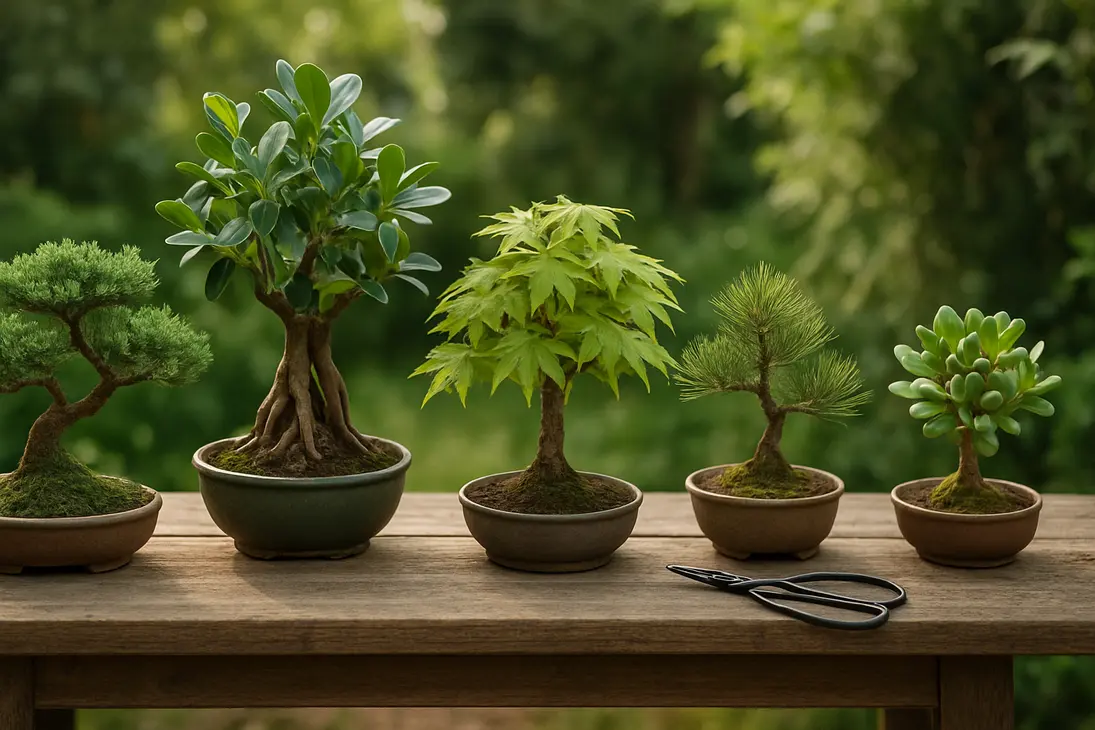
Identifying bonsai types is easier when you know what “type” means. People may be asking about the plant species, whether it belongs indoors or outdoors, or its artistic style, such as cascade or informal upright.
Use this order: identify the species first, describe the style second, then match care to the tree’s needs. A juniper cascade and a ficus cascade may share a shape, but they need very different light, temperature, and watering.
Start With the Difference Between Bonsai Type, Species, and Style
A bonsai can be called a “juniper bonsai,” an “informal upright bonsai,” or an “outdoor bonsai.” All can be correct, but they describe different things.
Bonsai Is a Technique, Not a Species
Bonsai is not a single plant species. It is the practice of growing and training a woody plant in a container to suggest an older tree in nature. Maples, elms, junipers, pines, ficus, azaleas, and jades can all be used for bonsai.
This is why “bonsai seeds” is often misleading. There are maple seeds, pine seeds, and elm seeds, but no special seed that automatically becomes bonsai. Bonsai is created through pruning, root work, wiring, container culture, and time.
Why Correct Identification Matters for Care
Species identification matters because bonsai care is still plant care. The shallow pot affects watering and roots, but it does not change the tree’s natural requirements.
For example:
- Juniper usually needs outdoor sun and seasonal changes.
- Ficus tolerates indoor conditions better than many bonsai species.
- Japanese maple needs outdoor dormancy and protection from harsh heat in many climates.
- Jade stores water and can rot if watered like a thirsty elm.
Many beginners lose trees because an outdoor conifer is kept indoors, or a succulent bonsai is watered like a tropical tree.
Common Ways Bonsai Are Categorized
Use these categories separately:
| Category | What it tells you | Example |
|---|---|---|
| Species | The actual plant | Ficus, juniper, Chinese elm |
| Style | The visual form | Formal upright, cascade, broom |
| Growing location | Indoor or outdoor suitability | Ficus indoors; pine outdoors |
| Development stage | Maturity level | Seedling, pre-bonsai, refined bonsai |
| Leaf type | Identification clue | Broadleaf, needle, scale, succulent |
A useful label might be: “Chinese elm bonsai in an informal upright style.” That is more helpful than simply saying “bonsai tree.”
Identify the Tree Species First
Species is the foundation. Style can change, but a ficus will not become a juniper because it is wired into a similar shape. Look closely at the plant, not just the pot or label.
Check the Leaves or Needles
Foliage is usually the fastest clue. Notice whether the tree has broad leaves, lobed leaves, needles, scale-like foliage, or fleshy succulent leaves.
Ask:
- Are the leaves broad and flat?
- Are they tiny, oval, and serrated?
- Are they lobed like maple leaves?
- Are they thick and fleshy?
- Are they needles in bundles?
- Are they scale-like sprays?
Leaf arrangement also helps. Some trees have opposite leaves, while others have alternate leaves. New growth can differ from mature growth; junipers, for example, may show sharp juvenile needles and softer scale foliage on the same plant.
Look at Bark, Trunk, and Branching Pattern
Bark and branching add important clues:
- Ficus often has smooth gray bark and may develop aerial roots.
- Chinese elm may form mottled, flaking bark with age.
- Pines develop rugged, plated bark.
- Junipers often have fibrous bark and twisting deadwood.
- Jade has smooth, fleshy stems when young.
Branching also matters. Elms often produce fine twigging. Maples have graceful branching and strong winter silhouettes. Pines make candles of new growth and needles in clusters or bundles.
Notice Flowers, Fruit, or Cones
Flowers, fruit, and cones can confirm an identification:
- Azalea: showy spring flowers.
- Serissa: small white or pale pink star-shaped flowers.
- Ficus: occasional small fig-like fruits.
- Juniper: berry-like cones.
- Pine: cones and spring candles.
Do not rely on flowers alone. Many flowering bonsai are sold in bloom, then look different for most of the year.
Consider Seasonal Behavior
Seasonal behavior is a strong clue. Deciduous trees, such as many maples and elms, drop leaves during dormancy. If the twigs remain flexible and alive, a bare winter tree may not be dead.
Evergreens such as junipers and pines keep foliage year-round but still slow in winter and push growth in spring. Tropical species such as ficus do not need cold dormancy and may grow indoors if warm and bright enough. Succulent bonsai such as jade react strongly to watering, light, and cold.
Use Climate and Growing Location as Clues
Growing location helps but should not be your only evidence. A tree thriving outdoors through cold winters is unlikely to be ficus. A glossy-leaved plant sold with houseplants may be ficus, jade, or another tropical/subtropical species. A small conifer sold as an “indoor bonsai” may still need outdoor conditions.
Retail labels are often vague. If a tag only says “bonsai” or “indoor bonsai,” use foliage, bark, and growth habit to narrow the species.
Common Bonsai Types and How to Recognize Them
These are common beginner bonsai types and quick ways to recognize them.
Ficus Bonsai
Ficus is one of the most common indoor bonsai choices. It usually has glossy oval leaves, smooth gray to tan bark, and sometimes exposed or swollen roots.
Common signs:
- Glossy green leaves
- Smooth bark
- Milky sap when cut
- Better indoor tolerance than many bonsai
- Possible aerial roots in humidity
Ficus still needs bright light. Leaf drop often follows sudden moves, cold drafts, or watering problems.
Juniper Bonsai
Junipers are classic bonsai but are often wrongly kept indoors. Most should live outside.
Common signs:
- Scale-like foliage or sharp juvenile needles
- Fibrous reddish-brown bark with age
- Conifer appearance
- Possible blue-green berry-like cones
- Strong need for sun and airflow
A juniper can stay green for a while after decline begins, so check branch flexibility and root moisture if health is uncertain.
Chinese Elm Bonsai
Chinese elm is popular because it is relatively forgiving and has naturally small leaves.
Common signs:
- Small oval serrated leaves
- Fine twiggy branching
- Mottled or flaky bark with age
- Semi-deciduous behavior in some conditions
- Often informal upright or broom style
Chinese elm can grow outdoors in many regions and may tolerate very bright indoor conditions if acclimated.
Japanese Maple Bonsai
Japanese maple bonsai are outdoor trees valued for delicate leaves and seasonal color.
Common signs:
- Palmate, lobed leaves
- Opposite leaf arrangement
- Fine branching
- Soft spring growth
- Autumn color depending on variety
They need winter dormancy and may suffer in hot sun, drying wind, or reflected heat.
Jade Bonsai
Jade bonsai usually means common jade or dwarf jade. These are succulents trained as bonsai.
Common signs:
- Thick fleshy leaves
- Smooth succulent stems
- Oval, round, or compact leaves
- Brittle branches compared with woody trees
- Need for fast drainage
Jade stores water, so let it dry more between waterings than many leafy bonsai. Strong light keeps growth compact.
Pine Bonsai
Pines are traditional outdoor bonsai and often require more specific care.
Common signs:
- Needles instead of broad leaves
- Needles in bundles, depending on species
- Spring candles
- Rugged bark with age
- Cones on mature trees
“Pine” is only a broad identification. Black pine, white pine, Scots pine, and mugo pine have different habits and care needs.
Azalea Bonsai
Azalea bonsai are known for flowers, especially satsuki azaleas.
Common signs:
- Small evergreen or semi-evergreen leaves
- Showy spring or early summer flowers
- Dense fine branching
- Smooth gray-brown bark
- Rounded or spreading shape
Azaleas prefer acidic conditions and should not dry severely. Pruning after flowering helps set up future blooms.
Serissa Bonsai
Serissa is often sold as an indoor bonsai, but it can be sensitive.
Common signs:
- Tiny narrow leaves
- Fine twiggy growth
- Small white or pale pink star-like flowers
- Pale or rough older bark
- Leaf drop when stressed
If your tree is serissa, keep conditions stable and avoid constant moving, pruning, or repotting.
Identify Bonsai by Style and Shape
After identifying the species, describe the style. Style explains the design, not the plant’s care needs.
Formal Upright
Formal upright bonsai have a straight vertical trunk that tapers from a wider base to a narrower top.
Look for:
- Straight trunk
- Clear taper
- Apex above the base
- Balanced, calm shape
This style suits naturally upright species such as some pines, junipers, and elms.
Informal Upright
Informal upright is very common. The trunk rises upward but curves along the way.
Look for:
- Curved trunk
- Apex roughly above the root base
- Branches on the outside of curves
- Natural movement
It works well with imperfect nursery material and many beginner bonsai.
Slanting
In slanting style, the trunk emerges at an angle, suggesting wind, slope, snow, or a search for light.
Look for:
- Strong lean
- Roots or branches balancing the angle
- A stable feeling despite the slant
A good slanting bonsai should not look like it is simply falling over.
Cascade and Semi-Cascade
Cascade bonsai suggest trees growing from cliffs or steep banks. In a full cascade, the main line drops below the bottom of the pot. In a semi-cascade, it falls below the rim but usually not below the base.
Look for:
- Downward trunk movement
- Deep pot
- Foliage below the rim
- Strong visual flow
Junipers are common in cascade styles, though other species can be trained this way.
Broom
Broom style has a straight trunk that divides into many branches forming a rounded crown.
Look for:
- Straight trunk
- Branching starting at a similar height
- Fine twig network
- Rounded canopy
Chinese elm and other deciduous trees are common broom candidates.
Windswept
Windswept bonsai look as if steady wind has pushed the trunk, branches, and foliage in one direction.
Look for:
- Trunk and branches leaning the same way
- Foliage arranged with the movement
- A believable weather-shaped story
This style can look artificial if exaggerated.
Forest or Group Planting
Forest bonsai use multiple trees in one container to suggest a grove.
Look for:
- Several trunks, usually one species
- Uneven spacing
- Taller trees placed for depth
- A shared landscape composition
Odd numbers are common in small groups, but natural rhythm matters more than counting.
Avoid Common Identification Mistakes
Most beginner errors come from assumptions. Identify the tree before deciding how to care for it.
Don’t Assume All Bonsai Are Indoor Trees
Many bonsai are temperate outdoor trees. Pines, junipers, maples, many elms, and many azaleas generally need outdoor light, airflow, and seasonal change.
Indoor growing is mainly for tropical and subtropical species, and even those need bright light. A bonsai far from a window may slowly weaken.
Don’t Rely Only on the Pot or Size
A shallow ceramic pot does not identify the plant. The same pot could hold ficus, juniper, elm, or something else. Likewise, a nursery plant may be good pre-bonsai material even before styling.
Bonsai are not usually genetically miniature. They stay small through pruning, root management, and container culture.
Don’t Confuse a Young Starter Plant With a Finished Bonsai
Many beginner trees are starter bonsai or pre-bonsai. They may have thin trunks, simple branching, or little taper. That does not mean they are the wrong type; it means they are early in development.
A refined bonsai usually has trunk taper, good branch placement, fine ramification, a convincing root base, and a suitable pot. A starter may have only some of these features.
Don’t Use One Care Routine for Every Bonsai Type
There is no universal bonsai watering schedule. A jade in a sunny window, a juniper outdoors, and a maple in wind will dry at different rates.
Check the soil and learn the species’ preferences. Some trees need even moisture, some should dry slightly, some require winter dormancy, and tropical trees need protection from cold.
Conclusion
The best way to identify bonsai types is to work in order. First identify the species using foliage, bark, flowers, fruit, cones, seasonal behavior, and growing conditions. Then describe the style, such as informal upright, cascade, broom, or forest. Finally, adjust care to the actual tree.
If unsure, take clear photos of the foliage, trunk, soil surface, and whole tree, then compare them with reliable examples. Correct identification tells you whether the tree belongs indoors or outdoors, how much light it needs, and what seasonal care to expect.
FAQ
What is the easiest way to identify a bonsai tree?
Start with the foliage. Check whether it has broad leaves, lobed leaves, needles, scale-like foliage, or fleshy succulent leaves. Then use bark, branching, flowers, cones, and seasonal behavior to narrow the species.
Are indoor bonsai and outdoor bonsai different types?
Indoor and outdoor describe growing suitability, not artistic style. Indoor bonsai are usually tropical or subtropical species such as ficus or jade. Outdoor bonsai include many junipers, pines, maples, elms, and azaleas.
Can any tree be turned into a bonsai?
Many woody trees and shrubs can be trained as bonsai, but some are more suitable than others. Good candidates tolerate pruning, grow well in containers, develop attractive trunks, and have leaves or needles that look proportional.
Why does identifying my bonsai species matter?
Species determines care. It affects light, watering, pruning, repotting, cold tolerance, dormancy, and indoor or outdoor placement. Style tells you the shape; species tells you how to keep the tree alive.
You Might Also Like