Is Growing a Money Plant in Plain Water Hydroponics?
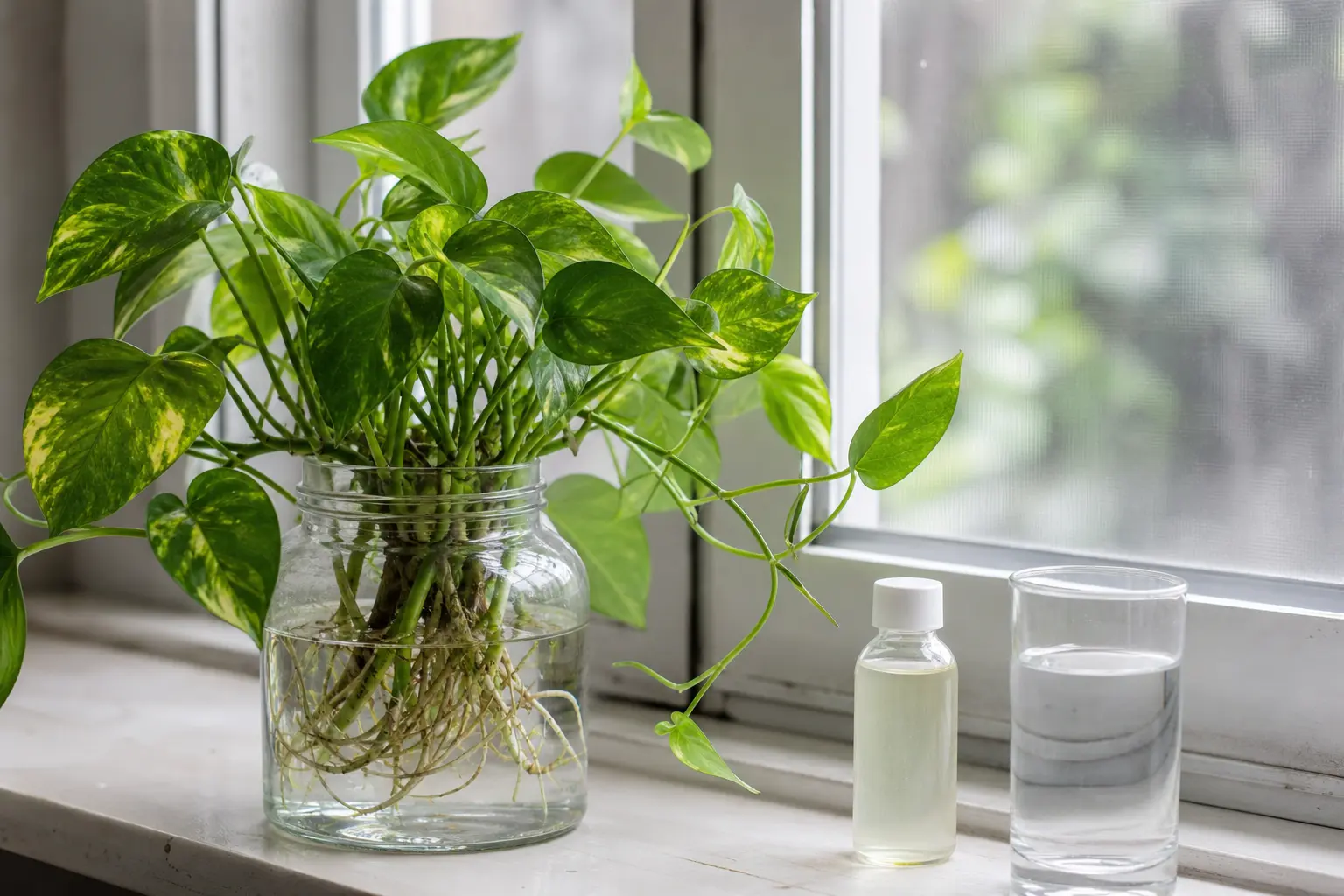
Growing a money plant in a jar of water is often called hydroponics, but the answer depends on how strictly the term is used.
For this article, “money plant” means pothos (Epipremnum aureum), the common trailing houseplant also sold as devil’s ivy. In some regions, money plant can also mean jade plant or money tree, which have different needs and are not usually grown long-term in water.
A pothos cutting can root, survive, and even produce new leaves in plain water. However, plain water alone does not provide the balanced nutrition needed for strong, sustained growth over many months or years. It is better described as water propagation or simple water culture. Once you provide a suitable nutrient solution and manage the water conditions, it becomes a more complete form of money plant hydroponics.
What Counts as Hydroponics?
Hydroponics is growing plants without soil while supplying water, oxygen, and mineral nutrients directly to the roots. Instead of drawing nutrients from compost, potting mix, or garden soil, the plant receives them in a dissolved nutrient solution.
There are many hydroponic systems. Some use a reservoir of nutrient-rich water, while others use an inert support material such as clay pebbles, perlite, coco coir, or rock wool. The roots may sit partly in water, be misted, or receive a regular flow of solution.
The important distinction is nutrition:
- Water propagation: A cutting is placed in plain water so it can form roots. It relies largely on energy and nutrients stored in its stem and leaves.
- Plain-water growing: An established plant is kept in water without fertilizer. It may survive for a while and sometimes grow slowly, but nutrients eventually become limiting.
- Hydroponic growing: Roots grow without soil and receive a complete, appropriately diluted nutrient solution over the long term.
In everyday conversation, a pothos in a vase may be called hydroponic because it is growing without soil. Technically, though, a plant in plain water is not receiving the full nutrient management normally associated with hydroponics.
Can a Money Plant Grow in Plain Water Without Added Nutrients?
Yes. A money plant can grow in plain water for a considerable period, particularly when it begins as a healthy cutting with several leaves. Pothos is forgiving, adapts readily to water, and forms roots easily from stem nodes.
That does not mean water contains everything the plant needs. New roots and leaves require carbohydrates, mineral nutrients, oxygen, and light. The cutting brings some of these resources with it. Tap water may also contain small amounts of dissolved minerals, although the amount and composition vary widely by location.
A plant can therefore appear healthy in a glass of water for weeks or months. It may even produce a long vine. But vigorous growth does not prove that plain water is nutritionally complete. The plant may be using reserves accumulated while it was growing in soil, or it may simply be growing slowly enough that deficiencies have not yet become obvious.
Where the Plant Gets Nutrients in Water
A pothos cutting in water has several initial sources of support:
- Stored reserves in the cutting. Mature stems and leaves contain carbohydrates and nutrients that help power root formation and early leaf growth.
- Photosynthesis. Leaves make sugars from light, water, and carbon dioxide. These sugars fuel growth, but they do not replace minerals such as nitrogen, potassium, calcium, magnesium, and trace elements.
- Dissolved minerals in the water. Tap water is not chemically empty. Depending on its source, it can contain calcium, magnesium, and other minerals. These are usually not present in a balanced form or concentration for long-term plant nutrition.
- Tiny amounts of residue. Dust, old potting mix caught in roots, or organic debris may add trace nutrients. This is unreliable and can also foul the water.
If you place a healthy pothos cutting in clean water, it can use these resources to make water-adapted roots. This is why propagation works so well. The cutting does not need fertilizer immediately to begin rooting.
A cutting with no leaves, a weak stem, or a damaged node has far fewer reserves. It may root poorly even if the water is clean. For propagation, choose a firm cutting with at least one node and preferably one or more healthy leaves.
Why Growth May Slow Down Over Time
After the initial rooting stage, the plant’s stored nutrients become less important. As it produces more leaves, stems, and roots, it needs a continuing supply of mineral nutrients.
In plain water, a money plant may show signs that its resources are becoming limited:
- New leaves are smaller than older ones.
- Vine growth becomes sparse or stops.
- Leaves look pale rather than evenly green.
- Older leaves yellow and drop.
- Roots remain alive but stop branching strongly.
- The plant produces long stretches of stem with few new leaves.
Not every yellow leaf means nutrient deficiency. Older leaves naturally age, and yellowing can also result from poor light, cold conditions, stagnant water, or decaying roots. Still, a plant that has lived in plain water for a long time and gradually loses vigor often benefits from either a proper hydroponic nutrient routine or a move back into potting mix.
Water Propagation vs. Long-Term Hydroponic Growing
Water propagation and hydroponic growing overlap, but they have different goals.
Water propagation is temporary. Its purpose is to encourage a cutting to form roots before it is planted in soil, moved to a hydroponic system, or kept decoratively in water for a limited time.
Long-term hydroponic growing is a cultivation method. The aim is to keep the plant healthy and growing indefinitely without soil. That requires more than filling a vase. You need to provide nutrients, prevent water from becoming stagnant, monitor root condition, and give the plant enough light to support continued growth.
| Situation | Plain water suitable? | Nutrients needed? |
|---|---|---|
| Rooting a fresh pothos cutting | Yes | Usually not at first |
| Displaying a cutting for a short period | Yes | Usually unnecessary |
| Keeping a mature plant in water for months | Possible, but growth may decline | Often helpful |
| Growing a large, vigorous pothos without soil long-term | Not ideal alone | Yes, use a complete hydroponic nutrient solution |
When Plain Water Is Enough
Plain water is usually enough when you are propagating pothos or keeping a small cutting as a simple decorative plant.
Use plain water if:
- The cutting is still forming its first roots.
- You plan to pot it into soil soon.
- You are happy with slow growth rather than trying to grow a large plant.
- You can refresh the water regularly.
- The cutting has healthy leaves and is placed in suitable indirect light.
There is little benefit in fertilizing before a new cutting has roots. Fertilizer salts can be stressful to an unrooted cutting, especially if added too strongly. Let the node root first, then decide whether the plant will move to soil or remain in water.
When to Add Hydroponic Nutrients
Add nutrients when your goal is sustained, soil-free growth rather than short-term rooting.
Choose a fertilizer specifically intended for hydroponic use, as it is designed to dissolve in water and provide a broader range of essential nutrients. Follow the product directions carefully and avoid assuming that more fertilizer will produce faster growth. In a small jar, excess fertilizer can build up quickly and damage roots.
Nutrients are most useful when:
- The plant has a developed root system.
- It has been growing in water for several months.
- New leaves are increasingly small or pale.
- You want it to continue growing as a permanent water-grown houseplant.
- You are using an inert medium, such as clay pebbles, that provides support but little or no nutrition.
A nutrient solution is not a substitute for clean water and good light. A poorly lit pothos will not use fertilizer efficiently, and a dirty container can still lead to unhealthy roots.
How to Keep a Money Plant Healthy in Water
A money plant in water is simple to maintain, but it is not maintenance-free. The water is both its growing medium and its root environment. If it becomes stale, cloudy, overly fertilized, or depleted of oxygen, the roots are affected quickly.
Start with a clean container. A narrow-necked bottle can look attractive, but it may be difficult to remove roots and scrub away algae or residue. A wider container is usually easier to maintain.
Keep only the nodes and roots underwater. Leaves and leaf stalks left below the waterline tend to decay, which can make the water foul and encourage root problems.
Change the Water Regularly
Refresh plain water about every one to two weeks, or sooner if it looks cloudy, smells unpleasant, or has visible debris. During each change:
- Lift the plant out gently and inspect the roots.
- Rinse the container with clean water.
- Remove loose, slimy, blackened, or obviously decaying root sections with clean scissors.
- Refill with fresh room-temperature water.
- Return the plant with the roots and lower nodes submerged, but keep leaves above the water.
If you are using hydroponic nutrients, refresh the solution according to the fertilizer instructions rather than endlessly topping up the same water. Topping up replaces lost water but does not restore the balance of nutrients. It can also concentrate dissolved salts over time.
Clear glass makes it easy to watch the roots, but it also lets light reach the water and can encourage algae. Algae is not always immediately harmful, but it makes maintenance harder and can make the container look untidy. Keeping the jar out of direct sun, cleaning it regularly, or placing it inside an opaque outer pot can help.
Provide Bright, Indirect Light
Pothos tolerates low light, but it grows best in bright, indirect light. Place it near a bright window where harsh midday sun does not shine directly through the glass onto the leaves or water.
Too little light can cause slow growth, long bare stems, and smaller leaves. Strong direct sun can scorch foliage and heat the water in a clear container. Warm, sunlit water also becomes stagnant more quickly.
Rotate the container occasionally if one side receives more light. This helps the vine grow more evenly rather than stretching in one direction.
A money plant grown in water may grow more slowly than one in a well-managed potting mix, especially if it receives no nutrients. That is not necessarily a problem. Slow, steady growth with firm green leaves is generally more desirable than rapid growth supported by excessive fertilizer.
Watch for Yellow Leaves and Root Rot
Check leaves and roots whenever you change the water. Healthy water-grown pothos roots are often pale cream, tan, or light brown. Their color alone is not a reliable sign of trouble; water roots can naturally look darker than soil roots. More important signs are texture and smell.
Healthy roots are usually firm. Unhealthy roots may become soft, dark, slimy, mushy, or foul-smelling.
Yellow leaves can have several causes:
| Symptom | Likely issue | Practical response |
|---|---|---|
| One older leaf turns yellow | Normal aging or adjustment | Remove it and monitor the rest of the plant |
| Several leaves yellow after water becomes cloudy | Stagnant water or root stress | Change water, clean the container, inspect roots |
| Pale new leaves and weak growth | Low nutrients or insufficient light | Improve light; consider hydroponic nutrients for established plants |
| Brown, crisp patches | Direct sun, dry indoor air, or water-quality stress | Move out of harsh sun and refresh water |
| Soft dark roots with an unpleasant smell | Root decay | Trim damaged roots, clean container, use fresh water |
Do not respond to every yellow leaf by adding fertilizer. If the roots are decaying, fertilizer will not solve the underlying problem and may worsen water quality. First restore clean conditions, provide suitable light, and confirm that the plant is not sitting in overly warm or stagnant water.
Conclusion
A money plant can survive, root, and produce new growth in plain water. For a cutting or a small decorative plant, this simple method works well and is often all that is needed in the short term.
However, plain water is not a complete nutrient source. A pothos kept in water long-term eventually needs balanced nutrition, clean water, adequate light, and regular root checks if you want sustained growth. Calling it hydroponics is reasonable in a broad soilless-growing sense, but true long-term money plant hydroponics involves more than a jar of water: it includes a suitable nutrient solution and ongoing water management.
FAQ
Is money plant in water considered hydroponics?
It can be described as hydroponics in a broad sense because the plant is growing without soil. More precisely, a pothos cutting in plain water is water propagation or water culture. Long-term hydroponics normally means the roots receive a balanced nutrient solution rather than plain water alone.
How long can a money plant live in plain water?
A healthy pothos can live in plain water for months and sometimes much longer, especially when the water is changed regularly and the plant receives good indirect light. Its growth may slow over time if no nutrients are supplied. The exact period varies with the size and health of the plant, light levels, water quality, and how often the container is cleaned.
Do money plants need fertilizer when grown in water?
Fresh cuttings generally do not need fertilizer while they are forming roots. For a plant that will remain in water long-term, a properly diluted hydroponic nutrient solution is useful for continued healthy growth. Avoid overfertilizing, and use a product intended for water-grown plants according to its label.
Can I move a money plant from water to soil?
Yes. Move it when it has several healthy roots, preferably before it becomes severely nutrient-deprived in water. Plant it in a small pot with drainage and a light, well-draining houseplant mix. Keep the soil lightly moist for the first few weeks while the plant adapts from water roots to soil roots. Some temporary leaf yellowing or slowed growth is normal during the transition.
You Might Also Like