Fast-Growing Bamboo for Shade Around a Trailer Home
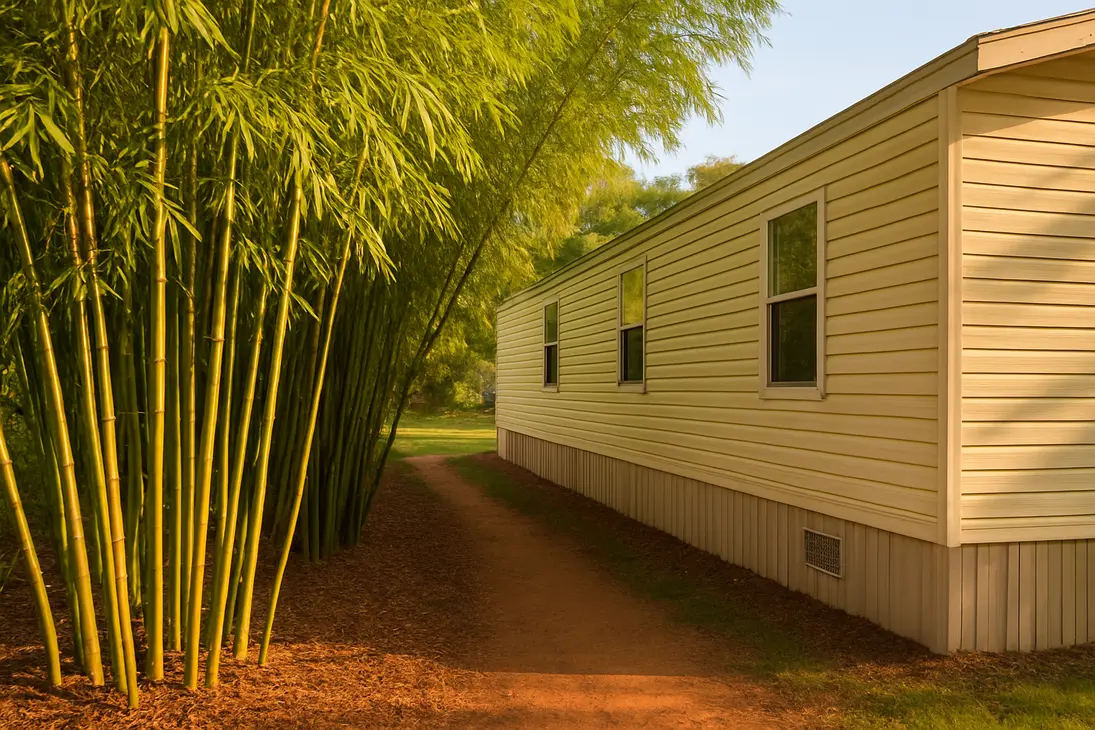
Bamboo can add fast shade and privacy around a trailer home, especially where trees would take years to help. The best choice depends on climate, space, drainage, mature size, and how much maintenance you can handle.
For most trailer-home sites, the safest option is a manageable clumping bamboo planted far enough from the home that mature canes do not touch skirting, siding, vents, plumbing, septic areas, or the roofline. Running bamboo can grow faster and taller, but it requires serious containment and is often a poor fit near homes.
Can Bamboo Provide Fast Shade for a Trailer Home?
Yes, bamboo can provide fast shade, but it works best as a living side screen, not as a broad shade tree.
Bamboo is especially useful on the west or southwest side of a trailer, where it can block low afternoon sun from walls and windows. It can reduce glare, add privacy, soften wind, and make hot weather more comfortable.
What bamboo usually does not provide is full overhead roof shade. Most types grow as upright canes with leafy tops rather than wide canopies. Very tall bamboo may cast some roof shade, but planting it close enough to cover the roof can cause problems with gutters, power lines, rubbing canes, and maintenance access.
Use bamboo to:
- Block afternoon sun from siding and windows
- Create privacy around a porch, deck, patio, or entry
- Screen roads, neighbors, sheds, or utilities
- Reduce wind exposure
- Add fast greenery where trees would take years
The trade-off is control. Bamboo grows quickly because it is vigorous, so species choice and spacing matter.
Best Fast-Growing Bamboo Types for Shade
The best bamboo for shade around a trailer is one that reaches useful height quickly without becoming unmanageable. In warm climates, clumping bamboos are usually best. In colder climates, many hardy choices are running types, which need containment.
Before buying, confirm winter lows, mature size, overhead clearance, and local rules. Some areas restrict running bamboo.
| Bamboo type | Best use | Shade value | Main caution |
|---|---|---|---|
| Clumping bamboo | Screens near homes | Dense side shade and privacy | Some types are not cold-hardy |
| Running bamboo | Tall screens in colder areas | Fast height and coverage | Spreads aggressively |
| Dwarf bamboo | Groundcover | Limited | Not useful for wall shade |
| Timber bamboo | Large properties | High screen | Often too large near trailers |
Clumping Bamboo Options
Clumping bamboo is usually the better choice near a trailer because it expands gradually from the original clump instead of sending long underground runners across the yard. It is not maintenance-free, but it is much easier to manage than running bamboo.
Bambusa multiplex
Bambusa multiplex is commonly used for hedges and privacy screens in warm climates. It forms a dense clump, responds well to thinning, and can create a leafy wall of filtered shade along the sunny side of a trailer.
Bambusa textilis
Bambusa textilis, often called weaver’s bamboo, has upright canes and an elegant shape. Its vertical habit can be helpful near a home because the canes are easier to keep away from siding and roof edges. It still needs room as it matures.
Cold-hardy clumping bamboos
In colder areas, consider cold-hardy clumping bamboos such as some Fargesia species. These may tolerate winter better than tropical Bambusa types, but many prefer cooler conditions and may struggle with reflected heat, intense sun, or hot southern summers.
In general, Bambusa types are often more useful in warm regions, while Fargesia may be safer than running bamboo in cool regions.
Running Bamboo Options
Running bamboo includes many Phyllostachys species, known for speed, height, and cold tolerance. These can make excellent screens, but they are risky near trailer homes unless properly contained.
Common screening runners include yellow groove bamboo, black bamboo, and other tall Phyllostachys types. They spread by underground rhizomes, and shoots may appear in lawns, beds, under fences, or near structures.
Consider running bamboo only if:
- You have room for a dedicated bamboo bed
- Local rules allow it
- You install a proper rhizome barrier before planting
- You can inspect and maintain the barrier
- You are not planting near septic, drainage lines, or vulnerable hardscape
Around a trailer, uncontrolled running bamboo can interfere with skirting, plumbing access, tie-downs, pest inspections, and repairs.
What to Avoid Near a Trailer
Avoid planting aggressive running bamboo directly in the ground near a trailer without a barrier. It may seem manageable at first, then spread quickly once the rhizome system is established.
Also avoid species that are too large for the site. Very tall bamboo may look appealing, but near a trailer it can create problems with roof contact, gutters, leaf litter, power lines, and difficult pruning. Canes moving in wind can rub siding or roof edges if planted too close.
Do not plant bamboo close to:
- Trailer skirting
- Plumbing lines
- Septic tanks or drain fields
- Pads, piers, or tie-downs
- HVAC units
- Electrical service areas
- Crawlspace access panels
- Water shutoff points
- Roof overhangs or gutters
Even clumping bamboo should not be tucked tight against the home. Leave room to walk between the bamboo and trailer for repairs, inspection, pest control, and pruning.
Growing Bamboo in Red Clay Soil
Bamboo can grow in red clay soil if drainage is good enough. Clay often holds nutrients, but it can also stay wet, compact, and low in oxygen. Bamboo generally dislikes long periods in waterlogged soil.
The goal is not to replace all the clay. Improve a wide planting zone so roots can grow into soil that is moist, fertile, and aerated.
Practical steps for red clay:
-
Check drainage before planting.
Avoid areas where water stands for a day or more after heavy rain. Choose a better spot or build a raised mound. -
Plant slightly high.
Set the root ball level with or slightly above the surrounding grade. Do not bury the crown deep in sticky clay. -
Improve a wide area.
A narrow hole in clay can create a “bathtub” that traps water. Loosen a broad area and blend compost into the native soil. -
Use compost, not just sand.
Compost improves structure and biological activity. Sand alone can make clay worse if used incorrectly. -
Mulch generously.
Wood chips, shredded bark, leaves, or bamboo leaves help keep clay from baking hard, cracking, and drying too quickly. Keep mulch slightly away from the canes. -
Avoid compaction.
Do not plant where vehicles park, foot traffic is heavy, or roof runoff constantly pounds the soil.
Raised planting mounds work well in red clay. Build a broad, gentle mound with native soil blended with compost, then mulch it. The slight elevation improves drainage while still allowing roots to spread outward.
Where and How to Plant Bamboo for Shade
For cooling a trailer, placement matters as much as species. The hottest wall is usually the west or southwest side because it receives intense afternoon sun. In some locations, the south side may also need shade, especially if windows are exposed.
Walk around the trailer in late afternoon and note where sun hits the siding and windows. That is where bamboo will usually provide the most cooling. A screen on the wrong side may add privacy but little temperature benefit.
Good placement principles:
- Plant on the side that receives the hottest afternoon sun
- Keep mature canes away from siding and roof edges
- Leave a clear walking path between bamboo and trailer
- Avoid blocking crawlspace doors, vents, utilities, and cleanouts
- Consider winter sun if you rely on passive warmth
- Account for wind, since tall canes can lean or sway
A bamboo screen does not need to be right against the wall. Planting several feet away usually improves airflow and access while still allowing shade to reach the trailer if the bamboo is tall enough.
If space is tight, choose a narrower, upright clumping bamboo. If you have more room, a staggered row can create denser shade without crowding each plant.
Spacing for a Shade Screen
Spacing depends on bamboo type, nursery plant size, and how quickly you want coverage.
For clumping bamboo, wider spacing costs less and gives each clump room, but the screen fills in more slowly. Closer spacing gives faster privacy but may require more thinning later.
| Planting goal | Clumping bamboo spacing | Result |
|---|---|---|
| Faster privacy screen | About 4–6 feet apart | Quicker fill, more thinning later |
| Balanced screen | About 6–8 feet apart | Good long-term spacing for many clumpers |
| Specimen clumps | 8 feet or more apart | Individual clumps stay distinct |
For running bamboo, spacing matters less than the contained bed. A few plants can eventually fill the allowed area if rhizomes are managed. Design the bed and install the barrier before planting.
Do not space bamboo based only on the small nursery pot. Ask how wide the mature clump or grove can become in your region.
Root Barriers and Containment
Root barriers are essential for running bamboo near a home. They may also help with clumping bamboo where space is very tight.
A bamboo rhizome barrier is usually a heavy plastic barrier installed vertically around the planting area. Many are installed roughly 24 to 36 inches deep, with the top edge left slightly above soil level so rhizomes cannot cross unnoticed. Exact depth and material should match the bamboo, soil, and local guidance.
A barrier is not a set-it-and-forget-it solution. Inspect it at least once or twice a year for:
- Shoots outside the bed
- Rhizomes crossing over the barrier lip
- Soil or mulch piled too high against the barrier
- Cracks, gaps, or lifted seams
- Rhizomes moving under edging, fences, or hardscape
For small trailer-home lots, large above-ground planters or contained beds may be safer than in-ground running bamboo. Even then, drainage and soil contact matter. A bottomless planter can still allow escape.
Clumping bamboo usually does not need the same barrier, but it may need thinning, root pruning, or clump reduction as it expands.
Care for Fast Growth
Fast bamboo growth depends on water, warmth, soil, and nutrients. A new planting still needs time to establish before producing tall, thick canes.
During the first growing season, water deeply and consistently. Keep soil evenly moist but not waterlogged. In red clay, check moisture before watering instead of following a fixed schedule; clay may look dry on top while staying wet below.
Mulch is one of the best supports for bamboo in clay. It cools the root zone, reduces evaporation, and improves soil as it breaks down. Bamboo leaves can be left under the plants as natural mulch unless they interfere with skirting or drainage.
Bamboo often responds well to nitrogen because it is a leafy grass. Use a balanced lawn-type or bamboo-appropriate fertilizer according to the label, or rely on compost and organic mulch for slower feeding. Avoid overfertilizing newly planted bamboo in poorly drained soil.
Thin canes to keep the screen useful and safe. Each year, remove dead, weak, crowded, or badly leaning canes at ground level. This improves airflow and reduces the chance of canes rubbing the trailer. Selective thinning usually looks better than shearing bamboo like a formal hedge.
Expect a gradual increase in size:
- Year 1: Roots establish; top growth may be modest
- Year 2: More canes appear and the screen fills in
- Year 3 and beyond: New canes often become taller and thicker
Each bamboo cane reaches its full height in one season. The plant seems to get taller over time because newer canes emerge larger as the root system matures.
For a trailer, prune with access in mind. Keep canes away from siding, vents, and roof edges. Remove shoots where you need to walk, inspect, or repair.
Conclusion
Fast-growing bamboo can be a good shade solution for a trailer home when used as a living screen rather than a canopy tree. It is especially useful on the west or southwest side, where it can block hot afternoon sun, add privacy, and reduce wind.
For most homeowners, clumping bamboo such as Bambusa multiplex or Bambusa textilis is the most manageable choice in warm climates. In cooler areas, cold-hardy clumping types may work, though they may not tolerate intense heat. Running bamboo can grow quickly, but near a trailer it should only be used with serious containment and regular inspection.
Red clay soil is not a dealbreaker. Improve drainage, plant slightly high, use compost wisely, and mulch the root zone. Most importantly, plant far enough from the trailer that bamboo can mature without interfering with skirting, plumbing, septic areas, rooflines, or repair access.
The best bamboo is the one you can live with five or ten years from now—not just the one that grows fastest this season.
FAQ
What is the fastest bamboo for shade?
Many running bamboos, especially some Phyllostachys species, are among the fastest for height and screening. However, they can spread aggressively and are risky near trailer homes without containment.
For a safer screen in warm climates, clumping bamboos such as Bambusa multiplex or Bambusa textilis are often better choices. They may be slower than runners but are much easier to manage near a home.
Will bamboo grow well in red clay soil?
Bamboo can grow in red clay if the site drains reasonably well. Clay holds nutrients, but it can become compacted and waterlogged.
Improve the planting area with compost, plant slightly high or on a raised mound, and mulch the soil surface. Avoid low spots where water stands after rain.
How far should bamboo be planted from a trailer home?
Plant bamboo far enough away to allow for its mature width plus a clear access path around the trailer. For many clumping bamboos, that means several feet away at minimum, and more for larger species.
Do not plant bamboo tight against skirting, plumbing, crawlspace access, vents, septic lines, or roof overhangs. You should be able to walk between the bamboo and trailer.
Is clumping bamboo better than running bamboo for shade?
Clumping bamboo is usually better near a trailer because it stays in a more predictable clump and is easier to maintain. It can still grow large, but it does not typically send long runners across the yard.
Running bamboo can provide faster and taller screening in some climates, but it requires a strong barrier, regular inspection, and ongoing control. On small lots or near homes, uncontrolled running bamboo is usually not worth the risk.
You Might Also Like