How to Amend Soil With Boron for Better Broccoli Growth
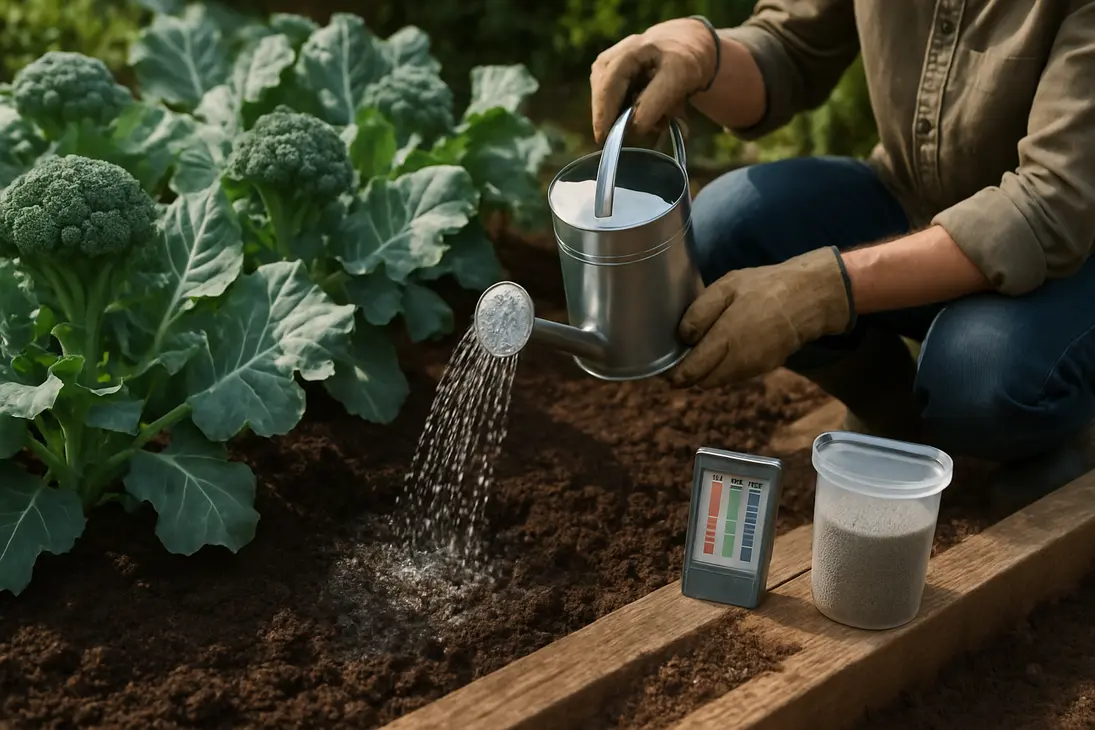
Broccoli needs boron, but only in trace amounts. A shortage can cause weak stems, distorted growing tips, poor head formation, and hollow or corky tissue. Too much boron can injure plants and may persist in soil.
The safest approach is to test first. Consider soil texture, pH, organic matter, and watering, then apply boron only if a soil test or local extension recommendation calls for it.
Why Boron Matters for Broccoli
Boron is a micronutrient, meaning broccoli needs far less of it than nitrogen, phosphorus, potassium, calcium, or magnesium. Still, it is essential. Boron helps plants build cell walls, move sugars, maintain growing points, and develop normal roots, stems, flowers, and heads.
In broccoli, those roles affect the thick central stem, large leaves, root system, and compact edible head. If boron is short during rapid growth, plants may stay green but fail to form strong stems or high-quality heads.
Boron’s role in brassica crops
Brassicas, including broccoli, cauliflower, cabbage, Brussels sprouts, kale, and turnips, are often sensitive to boron deficiency. Boron supports:
- Cell wall strength in stems and young tissues.
- Growing point health at crowns and root tips.
- Sugar transport to developing heads.
- Flower and bud development, which affects head quality.
- Root growth, which improves water and nutrient uptake.
Because boron does not move freely from older tissue to new growth in many plants, young leaves and developing heads can suffer even when older leaves look normal.
Why broccoli can be sensitive to low boron
Broccoli grows quickly and produces a large leafy plant before forming a head. That fast growth requires steady water and nutrient uptake.
If boron supply is interrupted while stems and heads are forming, symptoms may appear as hollow stems, internal browning, poor head quality, or distorted new growth. Risk rises when sandy soil, dry soil, high pH after liming, low organic matter, or uneven irrigation overlap. In those cases, boron may be present but not available enough during peak demand.
Signs Your Broccoli Soil May Be Low in Boron
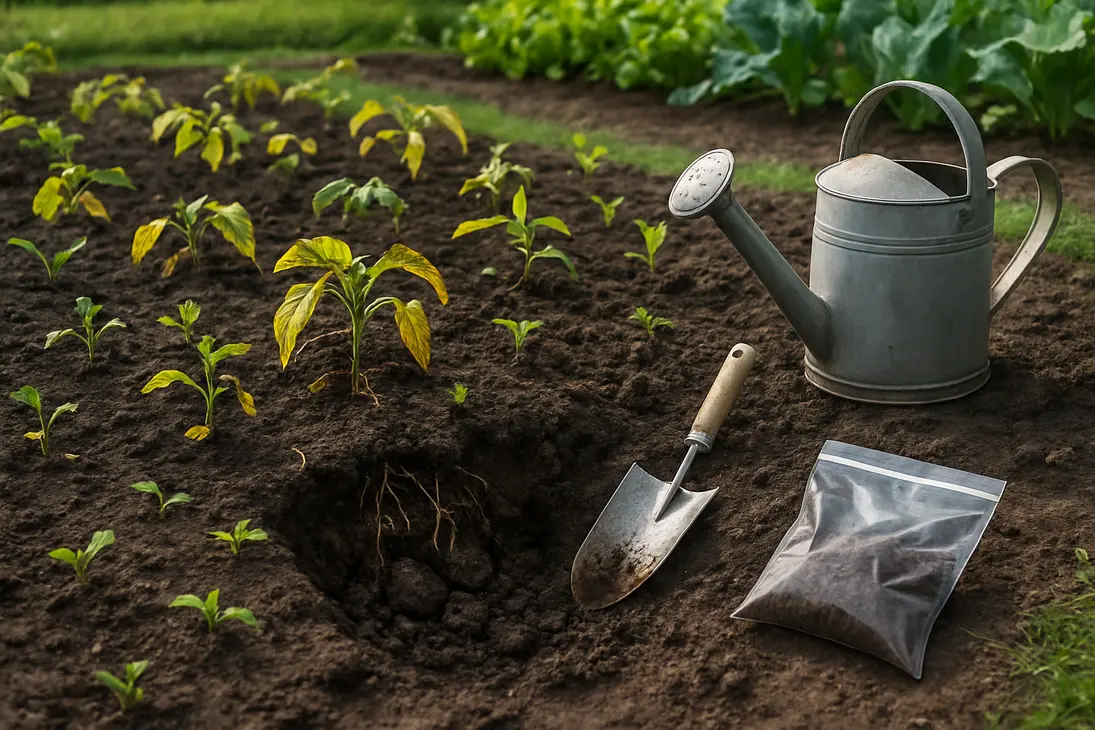
Boron deficiency can be hard to spot early. Plants may look mostly green but still develop poor stems or heads. By the time internal symptoms are visible, the crop may not fully recover.
Typical boron deficiency symptoms in broccoli
Possible signs include:
| Plant part | Possible symptoms |
|---|---|
| Growing point | Distorted, brittle, or dying new growth |
| Leaves | Thickened, curled, puckered, or misshapen young leaves |
| Stem | Hollow, cracked, corky, or internally browned tissue |
| Head | Loose, uneven, browned, or poorly formed heads |
| Roots | Reduced growth and weaker drought tolerance |
| Overall plant | Stunting, poor vigor, or uneven growth |
One classic symptom is hollow stem, where the stem splits internally and may later discolor. Boron deficiency can contribute to hollow stem, but rapid growth, spacing, nitrogen level, cultivar, and water availability can also play a role.
Because some symptoms remain hidden until harvest, soil testing before planting is more useful than trying to diagnose the issue after damage appears.
Soil conditions linked to boron deficiency
Boron deficiency is more likely in:
- Sandy soils, where boron leaches easily.
- Low-organic-matter soils, which hold less moisture and fewer nutrients.
- Dry soil, because boron moves to roots mainly with soil water.
- High-pH soil, especially after heavy liming.
- Cool or stressed root zones, which slow uptake.
- Heavy rainfall or over-irrigation, especially in light soils.
- Fast crop growth, when nutrient demand rises quickly.
If only a few plants show symptoms, check irrigation coverage, compaction, soil texture, and organic matter before treating the whole bed.
Why symptoms can be confused with other nutrient or watering problems
Boron deficiency can resemble calcium problems, inconsistent watering, root damage, herbicide drift, disease, heat stress, and general fertility shortages.
Dry soil can limit nutrient uptake, excess nitrogen can encourage rapid growth and hollow stems, and compaction can restrict roots. If you add boron when the real issue is watering, nitrogen, or root stress, you may not solve the problem—and you may create toxicity.
Test the Soil Before Adding Boron
Boron is not a “just in case” amendment. The margin between enough and too much is narrow. Before adding any boron product to a broccoli bed, use a soil test that includes micronutrients or ask your local extension service what is appropriate.
What a soil test can tell you
A useful soil test can show:
- Whether boron is low, adequate, or high.
- Soil pH.
- Organic matter level.
- Major nutrient levels.
- Whether lime is needed.
- Whether a boron amendment is justified.
Not every basic home test includes boron. If broccoli repeatedly develops hollow stems, distorted new growth, or poor head quality, choose a lab test that reports boron or ask your extension office which test package to use.
The recommendation matters as much as the number because boron behavior varies with soil texture, rainfall, irrigation, pH, and regional conditions.
Soil pH, organic matter, and moisture considerations
Boron availability depends heavily on soil conditions.
Soil pH: Broccoli generally grows best in slightly acidic to near-neutral soil. Liming may be needed if pH is too low, but overliming can reduce boron availability. If problems appear after a large lime application, test before adding more amendments.
Organic matter: Compost, leaf mold, cover crop residues, and well-rotted manure improve soil structure, water retention, and nutrient buffering. However, compost is not a precise boron correction because its boron content varies.
Moisture: Boron reaches roots largely through soil water. Dry soil can create a temporary deficiency even when soil boron is adequate. Excessive watering on sandy soil can leach boron away. Consistent moisture is often as important as the amendment itself.
When to retest after amending
If a test recommends boron and you apply it before planting, retest before the next heavy brassica crop or the following growing season. Do not add boron every time you plant broccoli unless testing or local guidance says it is needed.
Retesting is especially important in sandy soil, raised beds, heavily irrigated beds, recently limed soil, or areas where brassicas are grown often. Keep a record of the product, amount, bed size, and date so you do not accidentally repeat a micronutrient application too soon.
How to Amend Soil With Boron Safely for Broccoli
Once a soil test confirms a shortage, the goal is to apply a very small amount evenly. Uneven application is risky: one spot may become toxic while another remains deficient.
Common boron sources for garden soil
Several products can supply boron:
| Source | Use | Main caution |
|---|---|---|
| Agricultural boron products | Applied by label or soil-test rate | Often concentrated |
| Borated fertilizer blends | Fertilizer with added boron | Must match overall soil needs |
| Soluble boron products | Mixed with water | Easy to overmix |
| Borax | Sometimes used by gardeners | High risk of measurement errors |
| Compost | Long-term soil improvement | Not a precise correction |
| Foliar boron sprays | Short-term in-season correction | Must follow label |
Borax needs special caution. It can supply boron, but garden amounts may be tiny, and casual measuring can easily lead to excess. Use it only if a soil test or extension recommendation gives a specific rate for your bed size.
How to apply boron evenly
Do not toss dry boron powder by hand over a bed. Safer application principles include:
- Measure the bed area accurately.
- Use the recommended product when possible.
- Measure carefully, preferably by weight if directed.
- Dilute in water for more even distribution.
- Apply across the whole target area, not in clumps.
- Mix lightly into the topsoil if directed.
- Water normally afterward, keeping soil moist but not saturated.
If the recommended amount is too small to measure confidently, ask the soil lab, extension office, or a reputable garden center for help. A premixed fertilizer with boron may be safer than a concentrated source, but only if it also fits the rest of your soil test.
Why compost and organic matter help but may not fully correct deficiency
Compost improves structure, moisture retention, biological activity, and nutrient buffering. Those benefits help roots explore the soil and reduce moisture swings that can worsen boron stress.
But compost is not a precise boron amendment. Its boron content depends on the materials used. If a soil test shows only a marginal issue, improving organic matter and irrigation may help over time. If deficiency is clear and symptoms repeat, compost alone may not correct it fast enough.
Use compost as the foundation of soil health, then add a small, tested boron amendment only when needed.
Following label rates and local recommendations
Always follow the product label and soil-test recommendation. Boron rates are small because plants need little.
Avoid these mistakes:
- Applying boron every year without retesting.
- Adding boron because broccoli “likes boron.”
- Using a general online rate instead of a soil-test rate.
- Treating only the planting hole.
- Combining several boron-containing products.
- Guessing with Borax or other concentrated materials.
If your soil test does not recommend boron, do not add it. Focus on pH, compost, balanced fertility, irrigation, and crop timing.
Avoiding Boron Toxicity and Supporting Balanced Broccoli Growth
Boron works best as part of an overall fertility plan. It will not fix compacted soil, drought stress, low nitrogen, excess salts, poor drainage, or incorrect pH.
Symptoms of too much boron
Boron toxicity often appears first on older leaves, where excess boron can accumulate at tips and edges. Symptoms may include:
- Yellow or brown leaf margins.
- Scorched leaf edges.
- Dead spots on older leaves.
- Stunting.
- Poor root development.
- Reduced head quality.
- Severe decline or death.
Toxicity can resemble drought burn, salt injury, fertilizer burn, or disease. If symptoms appear after applying boron, stop adding it and avoid micronutrient blends until you test the soil.
Excess boron is not always easy to fix quickly. In well-drained soils, it may gradually leach with rainfall or irrigation, but prevention is much easier than correction.
Nutrients and conditions that interact with boron uptake
Broccoli depends on nutrient balance. Boron problems may be worse when other conditions drive fast growth or restrict roots.
Key interactions include:
- Nitrogen: Excess can push lush growth and increase hollow-stem risk; too little reduces size.
- Calcium: Both calcium and boron support cell walls; drought or root stress can limit calcium uptake.
- Potassium: Supports water regulation and vigor.
- Phosphorus: Low levels can reduce root growth.
- Soil salts: Overfertilizing can damage roots and interfere with water uptake.
- pH: High or low pH can create nutrient imbalances.
A full soil-test recommendation is more useful than treating boron as a single fix.
Watering practices that affect boron availability
Consistent watering is one of the best ways to prevent boron-related problems. Aim for steady moisture in the root zone, especially as heads begin forming.
Helpful practices include:
- Water deeply enough to reach active roots.
- Avoid frequent shallow watering.
- Mulch with straw, shredded leaves, or compost.
- Check soil moisture by feel.
- Use drip irrigation or soaker hoses when possible.
- Do not let raised beds dry out completely.
If boron is marginal, drought stress can turn a hidden shortage into visible damage.
Crop rotation and long-term soil management
Rotating crops helps manage pests, diseases, and nutrient demand. Broccoli and other brassicas are heavy feeders, so repeated planting in the same bed can expose fertility and soil-structure problems.
A long-term plan should include:
- Rotating broccoli with non-brassica crops when possible.
- Adding compost regularly but not excessively.
- Testing soil every few years, or more often if problems repeat.
- Liming only according to test results.
- Avoiding unnecessary micronutrient products.
- Using cover crops where practical.
- Keeping fertilizer and boron records.
Raised beds also need testing. Imported mixes can start low in some minerals or accumulate nutrients and salts over time.
Conclusion
Boron supports strong stems, healthy growing points, root development, flowering, and broccoli head formation. A shortage can contribute to hollow stems, distorted young growth, internal browning, and poor-quality heads.
But broccoli needs only a tiny amount, and too much boron can injure or kill plants. Before amending soil with boron, get a soil test that includes micronutrients or follow local extension guidance. If boron is needed, apply it lightly, evenly, and exactly as directed.
For best results, manage boron as part of the bigger picture: proper pH, steady moisture, organic matter, balanced fertility, and sensible crop rotation.
FAQ
Does broccoli need more boron than other vegetables?
Broccoli is more sensitive to low boron than many common vegetables. Brassicas such as broccoli, cauliflower, cabbage, and turnips often show problems in stems and growing points when boron is marginal.
That does not mean broccoli needs a large amount. Test and correct a confirmed shortage carefully; do not add boron automatically.
Can I use Borax to add boron to broccoli soil?
Borax can supply boron, but it is easy to overapply. The amount needed may be very small. Use it only when a soil test or extension recommendation specifically calls for boron and gives a rate you can measure accurately.
A labeled agricultural boron product or fertilizer blend with boron may be safer if it matches the soil-test recommendation.
How do I know if my broccoli has boron deficiency or another problem?
Look for distorted new growth, hollow stems, cracked or corky tissue, internal browning, poor root growth, and uneven heads. Also consider dry soil, high pH, sandy soil, low organic matter, overliming, or heavy rainfall.
Symptoms alone are not enough. Water stress, calcium issues, excess nitrogen, disease, compaction, and heat can look similar. A soil test is the most reliable guide.
Can too much boron kill broccoli plants?
Yes. Too much boron can injure or kill broccoli. Toxicity often appears as yellowing or browning along leaf tips and edges, scorched older leaves, stunting, and poor growth.
Never apply boron “just in case.” Test first, follow the recommendation exactly, and keep records so you do not reapply too soon.
You Might Also Like