Native Plants That Help Reduce Invasives in the Backyard
Native plants can be one of the best long-term tools for reducing invasive plants in a backyard—but only when used realistically. The goal is not to scatter native seed over bindweed, honeysuckle, privet, English ivy, invasive grasses, or other entrenched plants and hope they disappear.
The practical use of native plants to reduce invasives is as replacement vegetation. After you remove, weaken, or repeatedly cut back the invasive plant, natives occupy the space so the invader has fewer openings to return. Think of them as living mulch, root competition, shade, erosion control, and ecological repair.
Start With the Right Expectation: Native Plants Suppress, They Don’t Magically Erase Invasives
A dense native planting can make a yard far less welcoming to invasive seedlings. It covers bare soil, intercepts light, slows erosion, and competes for water and nutrients. But established invasive plants usually need direct control first.
That may mean hand-pulling, digging, smothering, repeated cutting, mowing at the right time, careful herbicide use where appropriate, or a combination of methods. Native plants help most after the invasive plant has been reduced enough for new plants to establish.
Why invasives usually win in disturbed backyard spaces
Backyards often create the conditions invasive plants prefer: exposed soil, edge habitat, runoff, compacted ground, excess nutrients, and gaps between ornamental plants. Common trouble spots include bare mulch beds, neglected fence lines, construction-disturbed soil, wet ditches, thin lawn edges, woodland borders with heavy deer pressure, invasive hedges, and dumped yard waste containing roots, berries, or seed heads.
Native planting is not just about adding flowers. It is about rebuilding plant cover so the yard has fewer empty opportunities for aggressive plants.
When native planting works best as follow-up control
Native planting works best when you replant quickly after invasive removal. If you clear a patch and leave it open for months, the seed bank often responds immediately.
Use native plants as follow-up control when you have removed invasive shrubs, dug out a groundcover, converted a weedy slope or ditch, cut back invasive vines, or replaced an invasive ornamental with a plant that fills the same landscape role.
Match the replacement to the job. A delicate woodland flower will not hold a sunny, weedy slope, and a tall meadow plant will not fix a shady ivy bed. The best native choices are locally adapted, vigorous enough for the site, and planted densely enough to close gaps.
Choose Native Plants by the Job They Need to Do
There is no single best native plant for reducing invasives. Choose species native to your region and suited to your soil, light, moisture, and space.
A useful way to choose is by function: cover soil, compete underground, shade seedlings, stabilize wet edges, or replace a hedge.
Dense groundcovers to cover bare soil
Bare soil is an invitation. Dense native groundcovers are especially useful after removing invasive mats such as English ivy, wintercreeper, periwinkle, goutweed, or creeping Jenny.
Good options, depending on region, include:
- Native violets for part shade and lawn-edge transitions
- Wild strawberry for sun to part shade
- Pennsylvania sedge and other native sedges for dry shade or woodland edges
- Foamflower for moist shade
- Green-and-gold for part shade to bright woodland edges
- Low native grasses for sunny, dry sites
Groundcovers work best when planted close together rather than dotted through mulch. In small beds, closely spaced plugs or small pots often close faster than a few larger plants placed far apart.
Fast-establishing perennials for sunny beds and meadow edges
Sunny disturbed ground is often taken over by invasive grasses, thistles, knapweeds, mugwort, garlic mustard along edges, or self-seeding ornamentals. Native perennials help when they establish quickly and form a thick canopy.
Useful groups include:
- Native asters
- Goldenrods
- Bee balm
- Mountain mint
- Black-eyed Susan
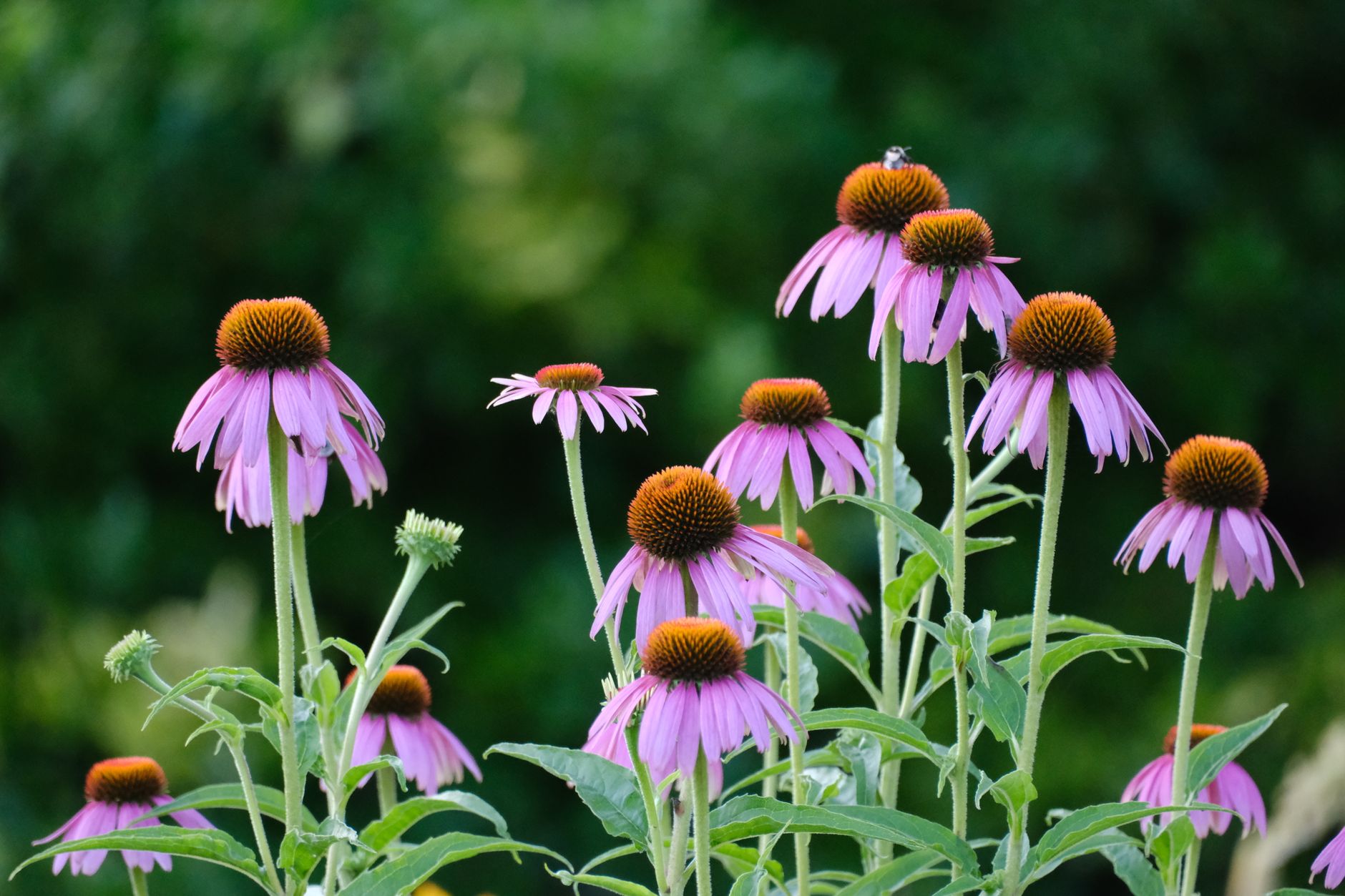
- Coneflowers
- Coreopsis
- Native sunflowers
- Ironweed
- Blazing star, where suited
Choose locally native, vigorous species for the first wave of restoration. More delicate species can be added later once the bed is stable. Goldenrods and asters are useful in many regions, but species selection matters because some spread strongly by rhizomes.
Native grasses and sedges for root competition
Many invasive plants exploit open soil below the surface as much as above it. Native grasses and sedges create dense root systems that make it harder for weed seedlings to establish.
For sunny sites, consider regionally appropriate grasses such as:
- Little bluestem
- Switchgrass
- Prairie dropseed
- Sideoats grama
- Indiangrass, where there is enough space
For shade or part shade, native sedges often do the work that turfgrass cannot. Examples include:
- Pennsylvania sedge
- Appalachian sedge
- Plantain-leaved sedge
- Fox sedge for wetter ground
- Other local Carex species suited to your site
Use grasses and sedges as a repeated base layer between flowering perennials, not just as scattered accents. This gives the bed structure and reduces bare spaces.
Shrubs and small trees to shade out invasive seedlings
Many invasive shrubs succeed because they form a dense midstory: bush honeysuckle, privet, burning bush, barberry, autumn olive, multiflora rose, and similar plants. When they are removed, sudden light can trigger a flush of seedlings. Replanting with native shrubs and small trees helps rebuild shade and structure.
Possible replacements include:
- Serviceberry
- Elderberry
- Spicebush
- Native viburnums
- Native dogwoods
- Willows
- Ninebark
- Chokeberry
- Buttonbush in moist soils
- Regionally native hollies, wax myrtles, ceanothus, manzanitas, or other local shrubs
Match mature size to the space. If replacing an invasive hedge, plant a mixed native hedge rather than a single-species wall. A layered mix is more resilient.
Moisture-loving natives for ditches, rain gardens, and wet edges
Wet disturbed soil is prime territory for invasives because water moves seed and soil is often disturbed. Ditches, pond edges, rain garden outlets, and downspout areas need plants that can handle moisture and competition.
Moisture-loving natives may include:
- Swamp milkweed
- Blue flag iris
- Joe-pye weed
- Cardinal flower
- Soft rush and other rushes
- Fox sedge and other wetland sedges
- Buttonbush
- Willows
- Pickerelweed, where native and appropriate
- Marsh marigold in suitable cool, wet regions
Wet sites require caution. Some plants spread rapidly in consistently moist ground. Also check local rules before planting near waterways, stormwater systems, or regulated wetlands.
Match Native Replacements to Common Backyard Invasives
The easiest way to choose native replacements is to look at the invasive plant’s habit. Was it acting as a groundcover, hedge, vine, grass, or ornamental flower? Replace the function, not just the plant.
| Invasive habit | What it was doing | Native replacement strategy |
|---|---|---|
| Groundcover mat | Covering soil and hiding bare areas | Dense native groundcovers, sedges, or low grasses |
| Shrub or hedge | Screening and structure | Mixed native shrubs with staggered heights |
| Vine | Covering fence, arbor, tree, or slope | Remove thoroughly first; use native vines only where monitoring is realistic |
| Ornamental grass or meadow weed | Filling sunny space | Native grass matrix with vigorous wildflowers |
| Self-seeding ornamental | Providing flowers but spreading freely | Locally native perennials with manageable reseeding |
For invasive groundcovers
Invasive groundcovers often return from small root or stem fragments. After removing as much as possible, replant quickly with native plants that can form a continuous layer.
For shade, consider native sedges, violets, foamflower, wild ginger where native, green-and-gold, woodland phlox, or other regional woodland groundcovers. For sun, consider wild strawberry, low native grasses, self-heal where native, or a short meadow mix of grasses and perennials.
Avoid replacing one aggressive mat with another plant you cannot manage. Even native plants can spread beyond the intended area in a garden setting.
For invasive shrubs and hedges
When removing invasive shrubs, expect a major change in light. The soil beneath may contain years of seed, and birds may continue bringing berries from nearby properties. Native shrubs help only if planted thickly enough to create shade and competition.
For screening, use a mixed row. In an eastern North American yard with suitable conditions, that might include serviceberry for height, spicebush for understory structure, viburnum for density, and sedges or woodland perennials underneath. In wetter sites, buttonbush, elderberry, and willow may fit better. In dry western gardens, choose regionally native shrubs adapted to drought and local soils.
For invasive vines
Invasive vines require patience. Many climb trees and fences, root along stems, or resprout after cutting. Before replanting, remove vines from structures, cut climbing stems, dig or treat roots where needed, and keep checking for regrowth.
Native vines can be useful on a fence, arbor, or trellis where you can monitor growth. Regionally native vines such as native honeysuckle, clematis, passionflower, coral honeysuckle, or Virginia creeper may be appropriate. On woodland edges where vines have smothered trees, shrubs, sedges, and perennials may be safer than another climber.
Do not plant any vine and walk away. Even native vines can overwhelm small shrubs or young trees if placed poorly.
For invasive ornamental grasses or meadow weeds
Some ornamental grasses seed into natural areas or form persistent clumps that crowd out other plants. Weedy meadow edges can also be dominated by aggressive non-native grasses or broadleaf weeds.
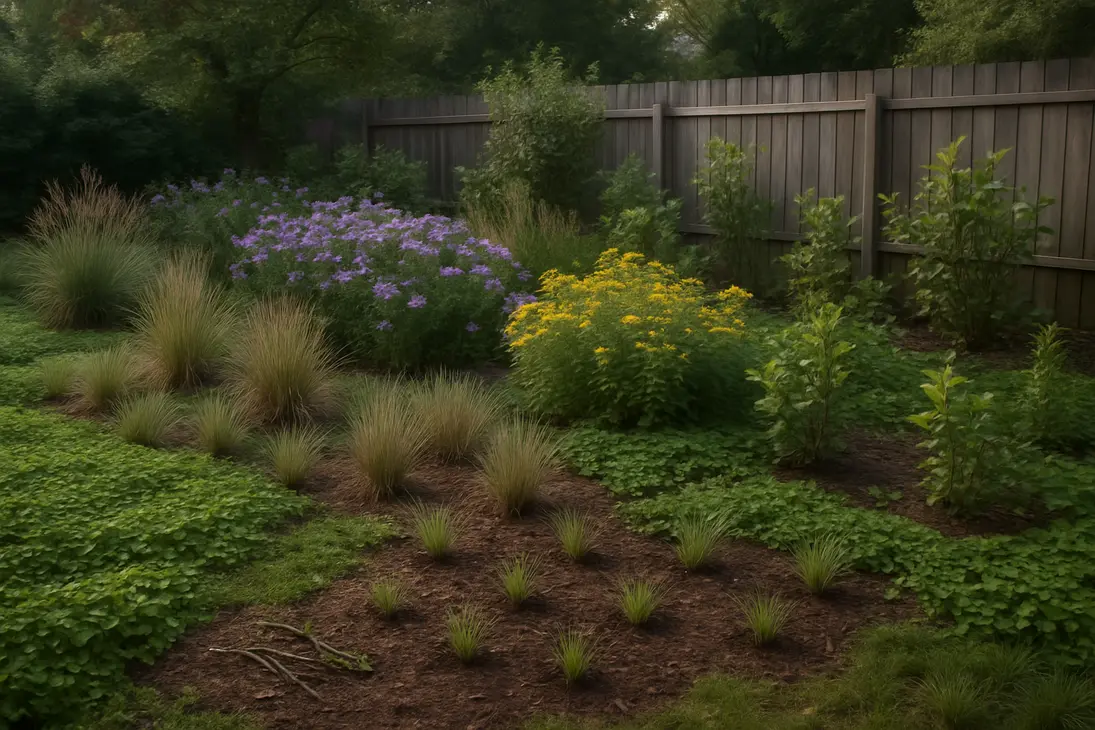
A strong native replacement usually includes both grasses and flowers. Grasses provide year-round structure and root competition; perennials add seasonal canopy, flowers, and diversity. The first two years are the most vulnerable, so keep annual weeds from shading young natives and do not assume a meadow planting is maintenance-free.
How to Plant So Natives Can Actually Hold the Space
The planting method matters as much as the plant list. A few native plants scattered into a weedy bed will usually struggle. Dense, layered, well-timed planting gives them a real chance.
Remove or weaken the invasive first
Start by identifying the invasive plant and learning how it spreads: seed, rhizomes, stolons, bulbs, berries, or stem fragments. Removal should target that weakness.
Practical steps include:
- Remove seed heads or berries before disturbing the plant, if possible.
- Dig roots thoroughly for plants that resprout from crowns or fragments.
- Dispose of reproductive material carefully where local guidance recommends it.
- Avoid unnecessary tilling, which can expose weed seed or chop roots into new pieces.
- Repeat control before planting if the invasive is resprouting heavily.
For difficult invasive plants, one removal session is rarely enough. It is often better to weaken the patch over a season and replant in stages than to clear dramatically and lose the space again.
Plant densely and in layers
Natural plant communities rarely look like isolated plants surrounded by bare mulch. To reduce reinvasion, aim for overlapping layers:
- Ground layer: sedges, groundcovers, low grasses
- Seasonal flower layer: perennials that fill spring, summer, and fall
- Structural layer: grasses, shrubs, or small trees
- Shade layer: taller shrubs or understory trees where appropriate
Use temporary mulch while plants establish, but do not rely on mulch forever as the main weed control. Shredded leaves, clean straw, arborist chips, or other suitable mulches can protect soil and reduce weed germination. Keep mulch away from plant crowns and trunks.
Water new plantings during establishment, especially plugs and small pots. Native does not mean drought-proof immediately.
Keep checking for seedlings for several seasons
Invasive control is a multi-year process. Seeds may remain in the soil, roots may resprout, and birds or wind may bring in new seed. Pulling a few seedlings from a dense native bed is much easier than reclaiming a fully invaded patch.
For the first few years, walk the area regularly, pull seedlings when soil is moist, cut or dig resprouts before they rebuild energy, add native plugs where gaps remain, replace failed plants quickly, and watch property lines, fence bases, and shrub edges.
A dense native planting becomes more effective over time, but only if gaps are corrected before invasives use them.
Where to Find Truly Local Native Plants
Many gardeners want to plant natives but find that local garden centers stock few true natives, and labels are not always clear. “Wildflower mix” can mean almost anything, including non-native species or plants inappropriate for your region.
Local ecotypes matter because nearby genetic sources are often better matched to local climate, bloom timing, soils, and wildlife relationships. You do not need to be perfect, especially in a small urban yard, but locally native, nursery-propagated plants are usually the best goal.
Good places to look include native plant nurseries, conservation district plant sales, native plant society sales, botanical garden and arboretum sales, watershed groups, extension program plant lists, responsible seed swaps with clear species identification, and specialty growers that list botanical names and seed origin.
When shopping, ask whether the plant is native to your region, whether it is a straight species or cultivar, whether it was nursery-propagated rather than wild-dug, what conditions it needs, how large it will get, and whether it spreads by seed or rhizomes.
Be cautious with vague labels such as “pollinator blend,” “meadow mix,” or “native-inspired.” A good supplier should provide botanical names, since common names vary too much to rely on alone.
Conclusion
Native plants can reduce invasives in the backyard by filling the ecological jobs invasive plants exploit: covering soil, competing with roots, shading seedlings, stabilizing wet or disturbed areas, and closing gaps after removal. They are not a one-step cure for an established infestation.
The best sequence is simple: identify the invasive, remove or weaken it, replant quickly with locally native species suited to the site, plant densely in layers, and monitor for several seasons. A living cover of native groundcovers, perennials, grasses, sedges, shrubs, and small trees will not make your yard immune to invasive plants, but it can make reinvasion much harder.
FAQ
Will native plants outcompete invasive plants on their own?
Usually, no. Established invasive plants often have too much root mass, seed production, or growth speed for young native plants to overcome. Native plants work best after you remove or repeatedly weaken the invasive first.
What is the best native plant for stopping invasives?
There is no single best plant. The best choice depends on your region and site conditions. For bare shady soil, native sedges or woodland groundcovers may be best. For sunny disturbed ground, native grasses with vigorous perennials may work better. After invasive shrub removal, native shrubs and understory trees are usually more useful than flowers alone.
Are all non-native plants invasive?
No. Many non-native plants stay where they are planted and do not spread into natural areas. An invasive plant spreads aggressively and causes ecological, economic, or management harm outside cultivation. Still, check local invasive plant lists before planting.
How long does it take for native plantings to reduce invasive weeds?
Expect several seasons. Some plugs and perennials fill in within one to two years, while shrubs, sedges, and meadow-style plantings may take three years or more to function as dense competition. The first year is usually establishment; later years are about filling gaps, maintenance, and monitoring.
You Might Also Like