Can You Grow Roses from Cuttings Without Rooting Hormone?
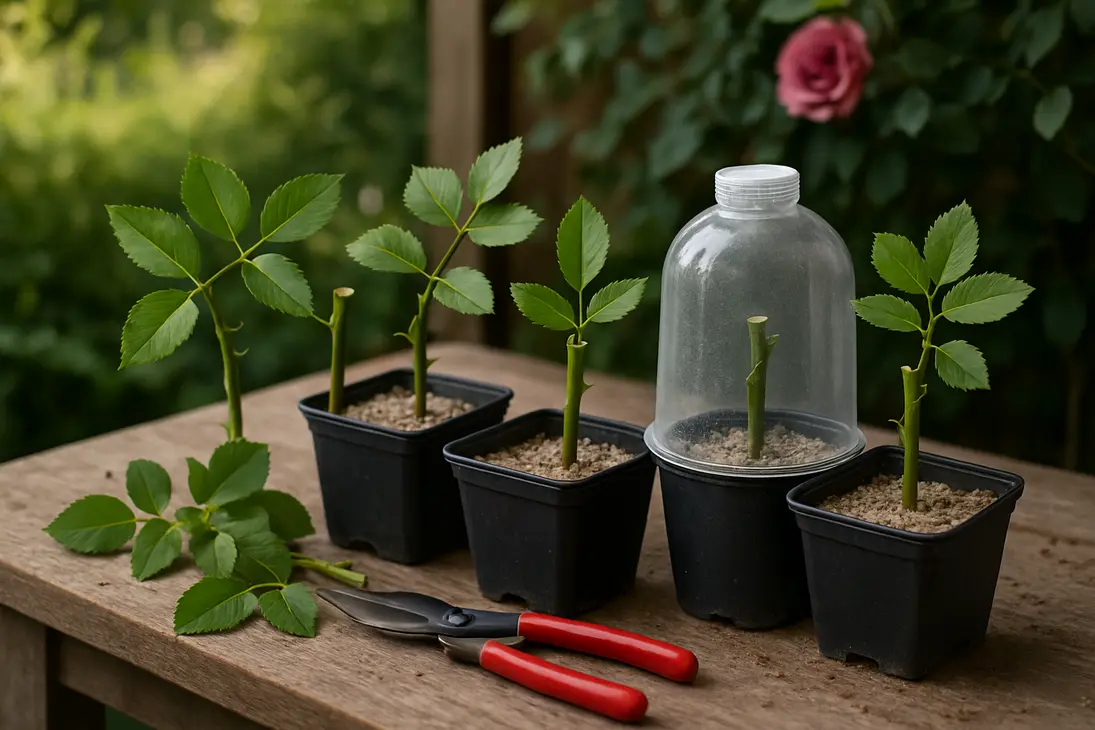
Yes. Roses can root from cuttings without rooting hormone if you use healthy stems, clean cuts, a free-draining medium, and steady humidity.
Rooting hormone can improve the odds, especially with slower varieties, but it cannot rescue weak cuttings in soggy soil. Without hormone, the goal is to keep the stem alive long enough to form roots: moist but not wet, humid but not moldy, bright but not hot.
Success varies by rose, season, and cutting quality. Take several cuttings and expect some losses.
Yes—But Start With the Right Rose Cutting
A rose cutting lives on stored energy until roots form, so stem quality matters. The best cuttings are young, healthy, semi-mature stems: firm, green to lightly brown, and about pencil-thick.
Avoid stems from roses that are wilting, diseased, drought-stressed, recently sprayed with harsh chemicals, or producing weak, floppy growth.
Best time to take rose cuttings
Late spring through early summer is usually easiest. New growth has begun to firm up but is not old and woody. A good cue is just after a flower fades; the stem below the spent bloom is often mature enough.
You can also try late summer cuttings in mild climates, autumn hardwood cuttings, or indoor winter cuttings with warmth and light. For beginners, late spring or early summer is the best starting point.
Choosing healthy stems from the parent rose
Choose stems from a vigorous rose with normal flowering and no obvious disease. A useful cutting has several leaf nodes, because roots often form near buried nodes.
Look for stems that are:
- 6 to 8 inches long
- Firm but not brittle
- Free of black spots, cankers, mildew, or soft areas
- Not carrying an open flower
- Not extremely thin or weak
Avoid very soft shoots that bend like grass; they wilt and rot easily. Avoid old gray canes unless you are intentionally trying hardwood propagation.
Some modern roses are patented or protected by plant breeders’ rights, so propagation without permission may not be legal in your area.
Can bouquet roses be used as cuttings?
Sometimes, but bouquet roses are harder. Florist stems may be harvested, stored, shipped, and treated before you receive them, leaving them dehydrated or exhausted.
If a bouquet rose roots, it grows on its own roots rather than nursery rootstock. That can affect vigor, disease resistance, or cold tolerance. Use only the freshest stems and avoid blackened, slimy, or collapsing ones.
How to transport rose cuttings before planting
Fresh cuttings dry out quickly. If you cannot plant them right away, keep them cool, shaded, and slightly moist.
Wrap the cut ends in damp paper towel, place the cuttings in a plastic bag, keep them out of sun, and plant them as soon as possible. For overnight storage, refrigerate them away from fruit, but do not freeze them or leave sealed wet cuttings in a hot car.
How to Prepare Rose Cuttings for Rooting
Preparation reduces water loss while keeping the stem clean and alive. Use clean, sharp pruners or a knife; dull tools crush stems, and dirty tools spread disease.
Where to make the cut
Take a 6- to 8-inch cutting with at least three or four nodes. Make the lower cut just below a node, where rooting is most likely. Trim the top just above a leaf node.
Remove any flower bud or spent bloom so the cutting does not waste energy flowering. Some gardeners lightly scrape a thin strip of bark from the lower inch to expose rooting tissue, but deep wounds invite rot.
Removing lower leaves, buds, and thorns
Remove leaves from the lower half of the cutting. Any foliage buried in the medium will rot.
Remove:
- Lower leaves
- Flower buds
- Spent blooms
- Hips
- Damaged or diseased foliage
You may remove thorns from the buried portion for easier handling, but avoid tearing bark. Leave one or two healthy leaflets near the top.
Trimming foliage to reduce water loss
If the remaining leaves are large, trim them by half with clean scissors. This reduces water loss while the cutting has no roots.
A prepared cutting should have a clean lower stem, a few nodes to bury, and only modest foliage at the top.
Optional natural alternatives to rooting hormone
Honey, cinnamon, aloe vera, and willow water are often suggested as natural rooting aids, but none is a dependable replacement for commercial rooting hormone.
| Option | Limitation |
|---|---|
| Honey | May discourage some microbes, but is not a proven rooting stimulant |
| Cinnamon | May dry the cut surface; does not create roots |
| Aloe vera | Inconsistent in wet media |
| Willow water | Strength varies widely |
If you use any, apply lightly. Do not coat stems in thick paste or soak them for days. Clean cuts, drainage, airy medium, and humidity matter more.
Rooting Rose Cuttings Without Hormone
The simplest method is to place prepared cuttings in a free-draining medium, cover them for humidity, and keep them in bright shade until roots form.
Best rooting medium: soil, perlite, or mixed media
The medium should hold moisture while allowing air around the stem. Dense garden soil is usually poor in pots because it compacts, stays wet, and encourages rot.
Good options include:
| Medium | Notes |
|---|---|
| Perlite | Excellent drainage; monitor moisture |
| Perlite + peat/coir | Good beginner balance |
| Seed-starting mix + perlite | Reliable if not too dense |
| Sharp sand + compost/coir | Works if clean and free-draining |
| Potting soil alone | Possible but often too wet |
A practical mix is half perlite and half seed-starting mix or coir. Moisten it first; it should feel like a wrung-out sponge, not dripping. Use pots with drainage holes.
Planting the cutting correctly
Make a hole with a pencil, chopstick, or dibber so the stem is not scraped during planting. Insert the cutting with one or two nodes below the surface, usually 2 to 3 inches deep.
Firm the medium gently so the cutting stands upright, but do not pack it hard. Keep top leaves above the medium. Water lightly, then let excess water drain before covering.
Using a plastic bottle or cover for humidity
A clear plastic bottle makes a simple mini-greenhouse. Cut off the bottom and place it over the cutting, leaving the cap off or loose for air exchange. A clear plastic bag supported by sticks also works.
The cover prevents wilting, but too much trapped moisture causes mold and rot. Vent more if condensation stays heavy all day or leaves look fuzzy.
Good habits:
- Use a clear cover.
- Keep plastic off the leaves.
- Vent when condensation is excessive.
- Remove fallen leaves.
- Keep the mix damp, not saturated.
Where to keep the cuttings while they root
Keep rose cuttings in bright, indirect light. Strong sun under plastic can overheat them quickly.
Good locations include a bright porch out of afternoon sun, a shaded greenhouse bench, a filtered windowsill, or a sheltered outdoor spot in open shade.
Warmth helps, but heat is dangerous. If the pot feels hot, move it. Avoid wind, which dries leaves and makes humidity harder to control.
How long rose cuttings take to root
Rose cuttings often take four to eight weeks to root, and some take longer. Hardwood cuttings may take months.
Do not keep pulling them up. Instead, look for several signs together:
- The stem stays green and firm.
- New growth appears and continues.
- There is slight resistance to a very gentle tug.
- Roots show through drainage holes or clear containers.
New leaves alone do not prove rooting. A cutting can grow from stored energy before it has roots.
Caring for New Rose Cuttings After Rooting
A newly rooted cutting is still fragile. Young roots are sparse and easily damaged, dried out, or rotted, so adjust care gradually.
Watering without causing rot
Water when the top of the medium begins to feel slightly dry, not on a strict daily schedule. Small pots dry at different speeds depending on weather, medium, and cover.
Water gently at the base and never leave the pot standing in water. Constant saturation is one of the fastest ways to lose a cutting.
If the mix smells sour, looks slimy, or grows fuzzy mold, it is too wet or poorly ventilated. Increase airflow and let the surface dry slightly.
When to remove the humidity cover
Do not remove the cover suddenly unless the cutting is well rooted and weather is mild. Dry air can wilt tender growth.
Harden it off gradually:
- Vent the cover for a few hours a day.
- Leave it vented most of the day.
- Remove it during mild daylight hours.
- Replace it if the cutting wilts.
- Remove it completely once the plant stays firm.
If it wilts badly, go back a step.
When and how to pot up rooted cuttings
Pot up when the cutting has a small root system, not just one tiny root. Roots showing from drainage holes, steady new growth, and gentle resistance are good signs.
Move it into a pot only slightly larger than the root ball. A large pot holds too much wet soil around a tiny root system and can cause rot.
Use a quality potting mix with drainage. Lift the cutting with as much surrounding medium as possible and avoid shaking roots clean. After potting, water gently and keep it in bright shade for a few days.
Early feeding and pruning for young roses
Do not fertilize unrooted cuttings. Fertilizer will not make roots appear faster and can stress tender tissue.
Once the cutting is rooted and growing, feed lightly with a mild balanced fertilizer unless the potting mix already contains fertilizer.
Prune minimally. Remove weak growth only after the plant is active, and pinch off early buds so energy goes into roots and structure.
Common Problems When Growing Roses From Cuttings
Most failures come from poor stem choice, rot, drying, heat, or impatience.
Cuttings rotting before they root
Rot usually means the medium stayed too wet, lacked air, or the stem was weak. The lower end may turn black, soft, or slimy.
Common causes include:
- Garden soil in a pot
- No drainage holes
- Overwatering under a cover
- Diseased stems
- Buried leaves
- Too much heat inside plastic
Prevent rot with a clean, free-draining mix, removed lower foliage, and good ventilation. If one cutting rots in a shared pot, remove it quickly.
Leaves or shoots growing but no roots
A cutting can push leaves using stored energy before roots form. This looks promising, but it is not proof of success.
Keep conditions steady: bright indirect light, even moisture, gentle warmth, humidity with ventilation, and no fertilizer. If new shoots suddenly wilt, the cutting may have exhausted its stored energy before rooting.
Cuttings drying out or wilting
Wilting means the cutting is losing more water than it can take up. Common causes include too much leaf area, direct sun, wind, no humidity cover, dry medium, or removing the cover too quickly.
Trim large leaves, restore humidity, and move the pot to bright shade. If the stem is still green and firm, it may recover. If it is wrinkled and brown, it probably will not.
Why some rose cuttings fail even when done correctly
Some roses simply do not root easily. Others root but grow weakly afterward. Variety, weather, season, stem maturity, and hidden disease all affect results.
Take multiple cuttings. If you want one plant, start with five or six. That is normal propagation practice.
A cutting-grown rose may not behave exactly like the original grafted plant. It may be smaller, slower, or less cold-hardy, depending on the variety and climate.
Conclusion
You can grow roses from cuttings without rooting hormone. Hormone may help, but healthy stems, good timing, clean preparation, an airy medium, humidity control, and patient aftercare matter more.
For best results, take several semi-mature cuttings from a vigorous rose, remove excess foliage, plant them in a damp free-draining mix, and cover them lightly for humidity. Keep them warm, bright, and out of harsh sun.
Some cuttings will fail. But when one stays green, resists a gentle tug, and grows on its own roots, it is a satisfying way to make a new rose.
FAQ
Can rose cuttings root in plain water?
Yes, but it is not the most reliable method. Water roots are delicate and may struggle when moved into soil. Stems can also grow leaves in water without forming roots.
If you try it, change the water often, keep the jar in bright indirect light, and pot the cutting once roots are small but visible.
How can I make rose cuttings root faster without hormone?
Use fresh semi-mature cuttings, remove flowers and excess leaves, plant in an airy medium, keep humidity high, and provide bright indirect light with gentle warmth.
Do not fertilize unrooted cuttings or keep them soggy. Faster rooting usually comes from reducing stress, not adding extra ingredients.
Why is my rose cutting growing leaves but no roots?
It is using stored energy to push leaves before roots form. This does not mean failure, but it also does not prove rooting.
Keep it humid, bright, and evenly moist. Avoid feeding or strong sun, and check for roots only gently after several weeks.
Do all rose varieties grow well from cuttings?
No. Some roses root easily and grow strongly on their own roots, while others are slow or inconsistent. Many old garden roses, shrub roses, and some climbing roses root well. Some hybrid teas and florist roses can be harder.
Rooting hormone may help difficult varieties, but it does not guarantee success. Taking several cuttings gives you the best chance.
You Might Also Like